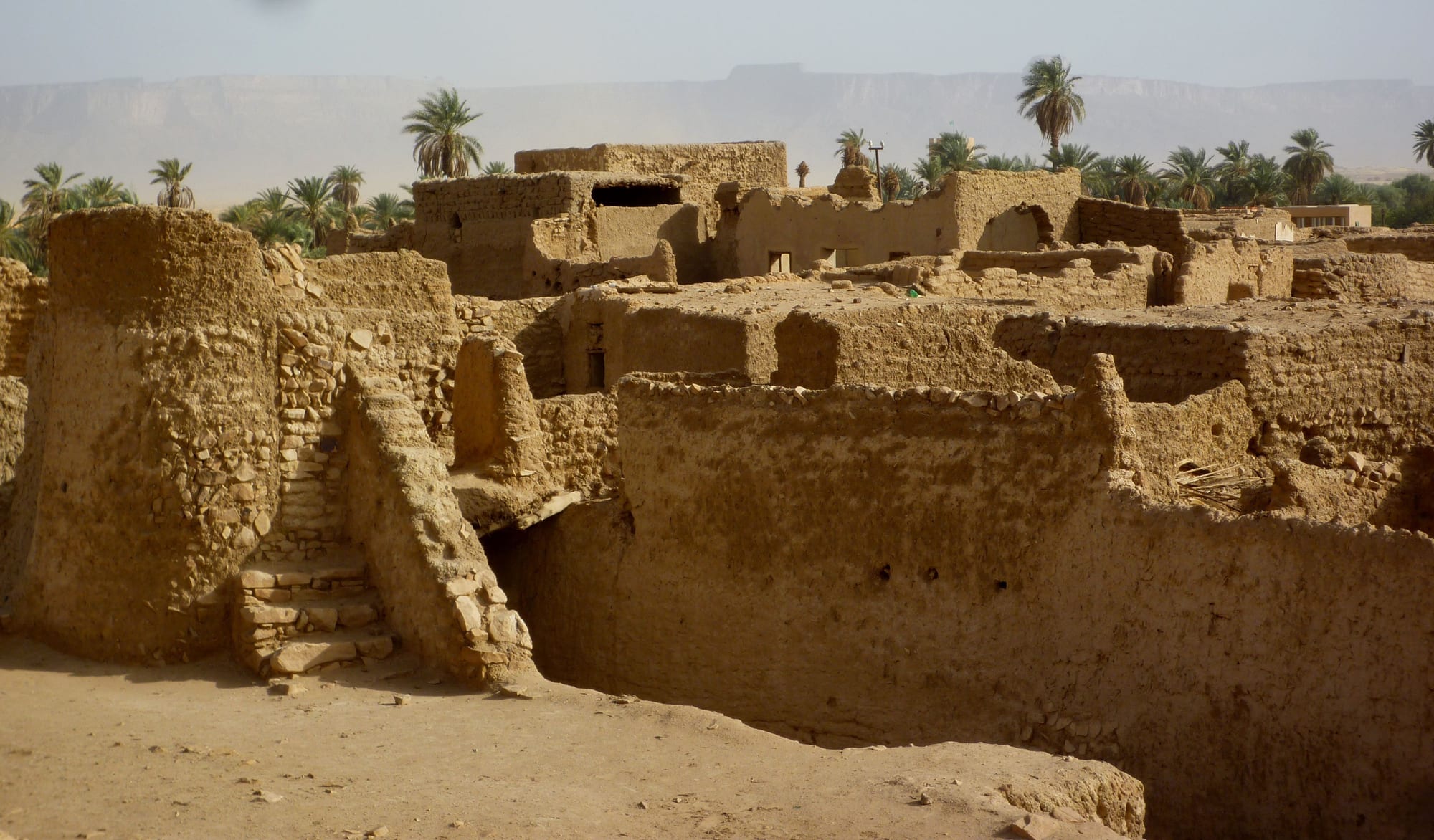
Roofless mud-brick houses and walls of an old desert quarter, with date palms and a flat-topped escarpment behind

The Fezzan, Libya

Ghat

The mud-brick old town of Ghat, with palm gardens and the desert escarpment behind it. (Franzfoto / Wikimedia Commons · CC BY-SA 3.0)

An oasis town in Libya's far south-west, close to the Algerian border and below the sandstone Tadrart Acacus mountains, whose prehistoric rock art is a UNESCO World Heritage Site. Long a Tuareg centre and a halt on the trans-Saharan caravan routes, it keeps a mud-brick old town beneath an Italian-built hilltop fort. This page is written to explain the city, not to encourage travel.

Neighbourhoods

  • The old town
    • Historic district
    • Walks and viewpoints

    A dense quarter of mud-brick houses, covered lanes and small courtyards built tightly together for shade, standing partly ruined below the fort. It was the heart of the caravan town, and its walls, doorways and roof terraces still show how a Saharan settlement was built before concrete.

    Open in Maps
  • The modern town
    • First-time visitors
    • Everyday services

    Low concrete houses, shops, a market, mosques and government offices spread along the roads below the old quarter, with satellite dishes on almost every roof. This is where the town lives and works today, and where transport for the desert routes is arranged.

    Open in Maps
  • The palm gardens
    • Quiet and residential
    • Countryside

    Irrigated gardens of date palms and vegetable plots fringe the settlement, watered from the oasis and worked by families who own scattered plots. Beyond them the ground turns quickly to sand, gravel and the ridges of the Acacus.

    Open in Maps

Things to do

In the town

  • The old town of Ghatneighborhood

    The mud-brick medina of narrow covered lanes and courtyard houses that formed the caravan settlement, much of it now abandoned but still standing.

    Open in Maps
  • The Italian fortlandmark

    The fort built by the Italian army on Koukemen hill above the town, used as a garrison post in the colonial period and the best vantage point over the oasis.

    Open in Maps

Desert and mountains

  • Tadrart Acacuslandmark

    A range of sandstone mountains beginning about 20 km east of the town and running north from the Algerian border, with arches, gorges and dunes, inscribed as a UNESCO World Heritage Site in 1985 for prehistoric paintings and engravings dating from about 12,000 BC to AD 100.

    Open in Maps

Getting around the region

  • Ghat Airporttransit hub

    The town's airport, about 20 km north, with intermittent domestic flights, which long served desert expeditions as well as residents.

    Open in Maps

Seasonal events

  • Ghat FestivalDecember

    An annual Tuareg cultural festival, one of Libya's most prominent, with music, dancing and craft displays; it drew outside visitors to the town before 2011.

Eat and drink

Long-standing places and food districts in Ghat. Hours, ratings and directions come from your maps app, always current.

Ghat kitchens and markets

  • The town marketmarket

    Dates from the oasis gardens, flour, vegetables, tea and sugar, and goods brought in across the desert or from over the Algerian border.

    Open in Maps
  • Local grills and bread ovensneighborhood

    Simple places serving grilled meat, rice, soup and flat bread; there is nothing like a restaurant scene, and most eating is done in homes.

    Open in Maps

Experience Ghat

History

Ghat stands where an oasis meets the caravan routes, and it has been a trading place for a very long time: the rock art of the mountains behind it records hunters, cattle herders, chariots and then camels, marking the Sahara's change from grassland to desert over thousands of years. Garamantian influence reached here from the north-east, and the town later became a link in the chain of desert settlements between the Niger bend, Ghadames and the Mediterranean.

By the 19th century Ghat was a Tuareg-run market town where caravans carrying slaves, gold, ivory, salt and cloth halted, under the authority of Tuareg confederations rather than any distant state, though Ottoman rulers of North Africa had claimed the region since the 17th century. European travellers passed through and described it, among them James Richardson, whose journeys of 1845–1846 left one of the fullest accounts of the town and its trade.

Italy took the Fezzan after 1912 but held the far south only intermittently; the fort on Koukemen hill above the old town dates from the colonial garrison, and French forces from Chad and Algeria were also present in the region during and after the Second World War, before it became part of independent Libya in 1951. In the late 20th century the Acacus rock art brought organised desert tourism, and Ghat became its base; that ended with the war of 2011, since when the town has lived with insecurity, border tension and isolation. Heavy rain flooded the town in June 2019.

Culture & Customs

Ghat is one of the centres of Tuareg life in Libya, and Tamasheq is spoken alongside Arabic. Tuareg society here belongs to a culture that spreads across southern Algeria, Niger and Mali, with its own script, Tifinagh, used for inscriptions and ornament, and with the men's veil, the tagelmust, worn indigo or white. Silversmithing, leatherwork and the making of saddles and camel gear are traditional crafts, and poetry and music — above all songs accompanied by the one-stringed imzad fiddle, played by women — carry much of the culture.

Kinship crosses the borders as naturally as the old trade routes did, and families in Ghat have relatives in Djanet in Algeria and further south. That has made the town a meeting place, and also exposed it to the politics of the frontier: border closures, smuggling and disputes over citizenship and control have all affected life here since 2011.

Hospitality is the desert rule: tea in three rounds, dates and a shared dish for a guest. Weddings and religious festivals bring camel racing, drumming and dancing, and the town's December festival gathers Tuareg communities and, before the war, outside visitors as well. Islam here has long had a Sufi colouring, and respect for elders and for the mountains' painted shelters is expected of anyone visiting them.

Daily Life

Ghat is a small town and the capital of its district, a thinly populated administrative area that reaches to the Algerian border. Most households depend on public salaries — administration, schools, the hospital, the police — along with date gardens, small trade and transport. The desert tourism that once employed guides, drivers and cooks has gone.

Distance defines daily life. Sabha, the nearest city of any size, is a long drive across the desert, and shortages of fuel, cash, medicines and spare parts are routine; power cuts are frequent and mobile and internet coverage patchy. Goods arrive by lorry from the north or informally across the border, and prices reflect the journey.

The old mud-brick town is largely empty, its families long since moved into concrete houses nearby, and its buildings decay quickly once roofs go. Summer days are organised around the heat, with business done early and late and the middle of the day spent indoors; in winter the evenings are cold enough for fires. The town's position on a frontier used by smugglers and armed groups keeps security uncertain, and residents describe the south as neglected by the governments in the north.

Food

Food in Ghat is Saharan and plain, built around bread, dates, milk and meat. Taguella, the Tuareg flat bread, is cooked in the hot sand under embers, then broken into pieces and served with a sauce of meat, onion and spices — the dish most closely associated with the town's culture. Bazin, a stiff barley dough eaten from a shared dish with a lamb or vegetable sauce, and couscous steamed with meat and vegetables are common across Libya and eaten here too.

Dates are the harvest that matters. The gardens produce several varieties, eaten fresh or dried, pressed into syrup and used in sweets, and they keep well enough to have travelled with caravans. Goat and camel meat are eaten more than beef, milk is drunk fresh or soured, and dried meat has long been the food of desert journeys. Vegetables from the irrigated plots — tomatoes, onions, peppers, pumpkins — go into stews and sauces.

Tea is the ritual that frames every meeting: green tea boiled with sugar, poured from a height into small glasses to raise a froth, and served in three rounds, sometimes with mint or crushed peanuts. Coffee is less common than in the north. Alcohol is illegal in Libya, and in a town this conservative it is absent entirely.

Planning tools

Budget

Ghat was once the base for desert tours into the Acacus, run with 4x4 convoys and Tuareg guides, and that trade ended after 2011. There is no tourist infrastructure now, and the few outsiders who come do so on aid, research or official work with heavy security, at very high cost. Cash in dinars is the only means of payment.

Daily Budget Midrange
USD 300–600+ (vehicles, drivers, guides and an escort; costs depend entirely on the security arrangement)
Daily Budget Shoestring
USD 100–200 (a basic guesthouse, market food and shared transport — not achievable without a sponsor)

Nothing here can be arranged independently or paid for by card, and fuel for the long desert drives is itself a planning problem.

Best Time to Visit

In principle November to March, when desert temperatures are bearable by day and the nights are cold, and when the cultural festival and the old expedition season fell. Summer is dangerously hot. In practice the security situation, not the season, rules out travel.

Suggested Number of Days

The town is small and its old quarter can be walked in a morning. Time in the mountains is what lengthens a stay, since the tracks are slow and journeys are made by convoy with camping. Permissions and escorts set the length of any visit more than distance does.

First Visit
1–2 days
With Surroundings
4–6 days

Transportation

Road and 4x4 only. A long tarmac road runs north-east to Ubari and on to Sabha, roughly 600 km away, and tracks lead into the mountains and south towards the Niger border. Within the town people walk or drive; there is no public transport to speak of, and vehicles for desert routes are arranged privately.

Checkpoints are run by different armed groups, the border areas are used by smugglers, and no journey should be considered without professional security and an escort.

Airport & Station Connections

Ghat Airport, about 20 km north of the town, has intermittent domestic flights; when they are not running, the only way in is a long drive from Sabha by way of Ubari, most of a day across the desert. The Algerian border, and Djanet beyond it, lie close to the west, but crossings there are not routinely open to travellers.

Walkability

The town is small and flat, and the old quarter, the market and the approach to the fort are all within walking distance of one another. The old town's ruined walls and uneven ground need care, and shade and water matter far more than distance: from late spring to early autumn walking is only sensible early and late in the day.

Safety

Most governments advise against all travel to Libya, and the Fezzan is among its most dangerous areas. The state is thinly present; armed groups linked to local communities, tribes and the rival national authorities compete for control; kidnapping of foreigners, banditry and the smuggling of fuel, weapons and people are serious risks, and the borders with Algeria and Niger are militarised and unstable. The heat and the emptiness of the desert are dangers in themselves.

Globeway covers Libya so its history and its recent tragedy can be understood — not to suggest a visit. Do not travel to the Fezzan. Check current official travel advice before travelling.

Climate

Extreme desert, among the driest and sunniest places on earth. Rain is rare and falls in occasional heavy bursts that can flood the wadis; the air is very dry, and the difference between day and night temperatures is large. Spring brings dust storms and the hot ghibli wind.

Summer
extreme heat, commonly around 40°C and above, with cool nights by desert standards
Winter
mild days around 20°C and cold nights that can fall near freezing

Local Customs

Ghat is a Tuareg town, and custom here is both Saharan and Muslim: modest dress, long greetings, and hospitality as an obligation — tea poured in three rounds, dates offered before conversation turns to business. Tuareg men often wear the tagelmust, the indigo or white veil, and women have a more public social role than in many Arab towns of the north. Alcohol is illegal throughout Libya.

Ask before photographing anyone, particularly veiled men and women, and never photograph checkpoints, soldiers or the border area; the rock art must not be touched or wetted.

Common Payment Methods

The currency is the Libyan dinar and everything is paid in cash. There are no card facilities of any practical use, ATMs are unreliable and often empty, and banking in the far south is slow and short of notes. Money is normally brought in from Sabha or the coast, and US dollars are the usual backup.