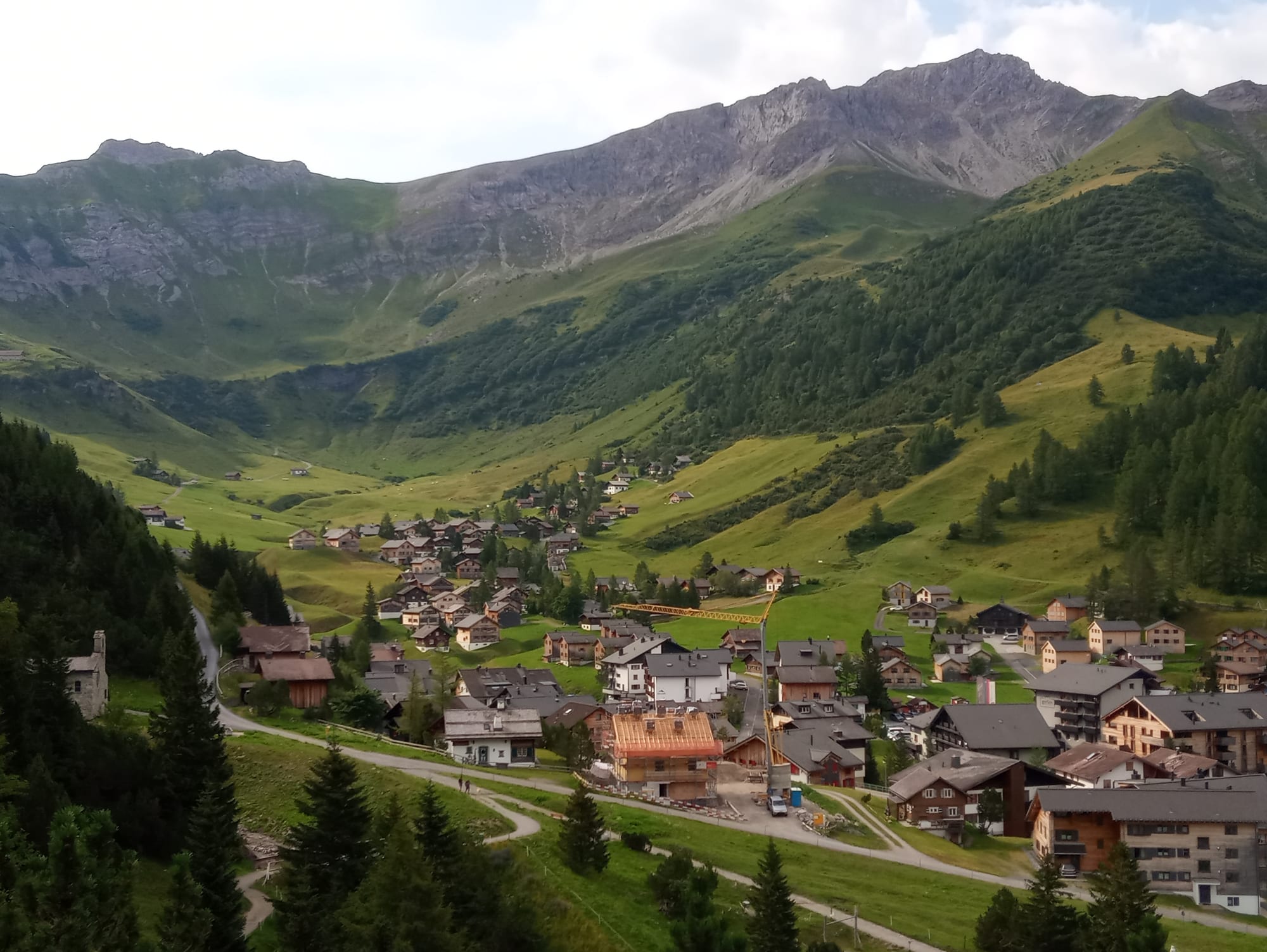
Chalets and wooden houses scattered across a green Alpine valley floor below grassy slopes, forest and a rocky ridge

Liechtenstein

Malbun

Malbun in summer, its chalets spread across the floor of the high Malbun valley. (Mislep / Wikimedia Commons · CC BY 4.0)

A small village at about 1,600 metres in a high Alpine valley, part of an exclave of the municipality of Triesenberg and less than two kilometres from the Austrian border. Summer pasture of Walser farmers for centuries, it opened to tourists in 1908 and is now Liechtenstein's only ski resort and a base for walks into the Rätikon mountains.

Neighbourhoods

  • The village centre
    • Skiing
    • Families
    • First-time visitors

    The cluster of hotels, restaurants and holiday chalets on the valley floor at the foot of the slopes, where the chairlifts start and the free children's learning area, Malbi Park, sits at the base of the runs.

    Open in Maps
  • The upper Malbun valley
    • Walking
    • Quiet and residential

    Scattered holiday houses and old alpine huts further into the glacier-carved valley, ringed by an almost circular chain of rocky peaks. The rear valley has been hit by avalanches, notably in January 1951, when an avalanche destroyed several huts, and in February 1999, when avalanches destroyed ten holiday houses and the valley was evacuated.

    Open in Maps

Things to do

Skiing and walking

  • Bergbahnen Malbunattraction

    The ski area of the village, with chairlifts on the western and eastern slopes and about 23 km of pistes; from the top of the eastern lift the Alpine ridges of Switzerland and Austria come into view.

    Open in Maps
  • Augstenbergtrail

    A mountain of about 2,360 metres in the Rätikon range above Malbun, close to the Austrian border and a popular walking goal.

    Open in Maps
  • Pfälzerhüttetrail

    A mountain hut reached in about two hours on foot from Malbun, or from the top station of the Sareis chairlift by the Fürstin-Gina-Weg path.

    Open in Maps
  • Sareiserjochviewpoint

    The pass at about 1,990 metres above the village, reached by chairlift, from which a path leads over to the Nenzinger Himmel valley in Austria.

    Open in Maps

Village sights

  • Friedenskapellelandmark

    The Peace Chapel, the highest church in Liechtenstein, built in 1950–51 in thanks for the country being spared the Second World War and painted inside by the Swiss artist Johannes Hugentobler.

    Open in Maps

Short trips from the village

  • Stegneighborhood

    The village at about 1,300 metres where the Malbun valley meets the Samina valley, beside the Steg reservoir built in 1947–49 for the Samina power station.

    Open in Maps
  • Gafleitrail

    A village of Walser origin at about 1,500 metres in the municipality of Triesenberg, starting point of several walking routes, among them the Fürstensteig.

    Open in Maps
  • Vaduzneighborhood

    The capital down in the Rhine valley, below the castle of the reigning prince, with the national art and history museums.

    Open in Maps

Seasonal events

  • Liechtenstein National Day15 August

    The national holiday, with a ceremony outside Vaduz Castle, a folk festival in Vaduz and, in the evening, torches carried along the Fürstensteig, bonfires and fireworks.

Eat and drink

Long-standing places and food districts in Malbun. Hours, ratings and directions come from your maps app, always current.

Malbun classics

  • Village restaurantsneighborhood

    The hotels and restaurants on the valley floor serve the skiers and walkers, with Liechtenstein's cheese-rich Alpine cooking.

    Open in Maps
  • Cafés and restaurants of the Vaduz Städtleneighborhood

    Down in the capital, the cafés and restaurants around the main square serve hearty Liechtenstein, Swiss and Austrian food.

    Open in Maps

Experience Malbun

History

The name Malbun comes from Romance, either alp bun, "good, productive alp", or val bun, "good, productive valley". The high valley was formed by a local glacier, and its landscape today is the result of centuries of farming as a pre-alpine pasture, left empty from Christmas until spring. The Walser, who migrated into the area from the end of the 13th century, were probably the first to settle Triesenberg permanently; a document of 1355 grants them part of the Alp Malbun "as they had it before", so they must have been grazing it earlier. The first alpine regulations date from 1562.

In 1867 a small tunnel and a narrow road replaced the steep mule track over the Kulm, making Malbun easier to reach, and tourism began in 1908 with a spa house and tourist station at Sareiserjoch. Around 1925 Malbun was still a scattering of about fifty seasonal huts. Skiers and ski tourers appeared in the 1930s, the spa house first opened in winter in 1931–32, and a post bus first ran into the valley in 1932. The Samina power station and the Steg reservoir followed in 1947–49, with a tunnel shortening the road from Triesenberg.

An avalanche destroyed several huts in January 1951. From 1959 the road was kept open all year, and the first ski lifts came in the early 1960s. In 1968 five Swiss artillery shells accidentally landed in the village, damaging a few chairs set outside. In February 1999 avalanches destroyed ten holiday houses and the whole valley was evacuated. The rival lift companies merged as Bergbahnen Malbun, which received further state loans in 2020 because of continuing losses.

Culture & Customs

Malbun belongs to Triesenberg, the highest municipality in the country's Oberland and a Walser community, known for its distinct dialect inherited from the medieval settlers. The valley's oldest culture is that of alpine farming: the pastures of Turna belong to the municipality of Triesenberg and those of Pradamee to a cooperative from Vaduz.

The village's best-known building is the Friedenskapelle, or Peace Chapel, the highest church in Liechtenstein. It was built in 1950–51 at the initiative of the parish priest of Triesenberg in thanks that Liechtenstein had been spared the cruelties of the Second World War; its bell came from the demolished old parish church of Triesenberg, and the Swiss artist Johannes Hugentobler painted its interior.

Sport has given Malbun a profile far beyond its size. It is the only ski resort in the country, and in winter 1985 Prince Charles and Princess Diana skied here. In summer Malbun has been a mountain stage finish of the Tour de Suisse cycling race, in 2004, 2007, 2011 and 2022, and the finish of the Liechtenstein Alpine Marathon.

Daily Life

Malbun is a small resort rather than a working village. Because of its isolation and the lack of transport for centuries, no trade or industry developed here; the valley was used for farming and forestry, back to the 14th century, and only in the last hundred years or so has tourism become another source of income. Today it consists largely of holiday houses, hotels and restaurants.

The year turns on two seasons. In winter the Bergbahnen Malbun lifts — three chairlifts, tow lifts and two magic carpets — serve about 23 km of pistes, and families fill the ski school and the free children's area, Malbi Park. In summer walkers head for the Augstenberg, the Schönberg, the Pfälzerhütte or over the Sareiserjoch into Austria.

The valley also serves the lowlands: drinking water collected in Malbun is used by the municipality of Vaduz to generate power at the Schlosswald power station, and the Schneeflucht drinking-water power plant opened in 2011.

Food

Malbun's food is the cuisine of Liechtenstein, influenced above all by Switzerland and Austria. Cheese and soups are central, and dairy products are everywhere thanks to a large dairy industry — fitting for a valley that has been summer pasture for centuries. Käsknöpfle are small dumplings topped with cheese or onions; Hafalaab is a soup with ham or bacon and cornmeal dumplings; and Torkarebl is a porridge dish that resembles dumplings. Saukerkas is a cheese made in Liechtenstein.

Rösti, coarsely grated potato that is fried, is a staple, as are schnitzel, smoked meats and sausages. Ribel, a grain, is eaten too. Milk is drunk as a beverage by many people, alongside coffee, cocoa and beer, and three meals a day is the norm.

In the village, the hotels and restaurants on the valley floor feed skiers and walkers. For a wider choice, the cafés and restaurants around the main square in Vaduz serve hearty Liechtenstein, Swiss and Austrian dishes.

Planning tools

Budget

Swiss prices apply, so rooms and restaurant meals are expensive, but skiing and snowboarding at Malbun are reasonably priced compared with the lift prices in neighbouring Switzerland or Austria. Much of the accommodation is in holiday chalets and hotels, and walking in summer costs nothing.

Daily Budget Midrange
USD 275–475 (hotel in Malbun, restaurant meals, lift pass or cable car)
Daily Budget Shoestring
USD 110–190 (stay down in the valley, supermarket food, buses)

Skiing here is reasonably priced compared with the expensive lift prices in neighbouring Switzerland and Austria.

Best Time to Visit

Winter for skiing and snowboarding on the village's slopes, which suit families and beginners; summer for walking to the huts, passes and peaks around the valley. The road has been kept open all year since 1959. After heavy snowfalls the valley can face high avalanche danger.

Suggested Number of Days

A short ski break or a few days of walking suits the village's size. Allow longer to see the rest of Liechtenstein down in the Rhine valley as well.

First Visit
2–3 days
With Surroundings
4–5 days

Transportation

Malbun lies at the end of the road that climbs from the Rhine valley through Triesenberg and the Gnalp–Steg tunnel to Steg and up the Malbun valley. A post bus first ran into the valley in 1932, and the road has been kept open all year since 1959. In the village everything is within walking distance, and in winter the lifts take over.

After heavy snowfall the avalanche danger can be high, and in 1999 the whole valley had to be evacuated.

Airport & Station Connections

Liechtenstein has no airport; Zurich is the nearest major one. Most visitors come by train to Buchs or Sargans in Switzerland, or Feldkirch in Austria, take a bus into Vaduz and continue up the mountain road by bus or car, past Triesenberg and Steg.

Walkability

The village is small and easy to walk, with hotels, restaurants and lifts close together on the valley floor and a circular path around it. Walking trails lead out of the village to the huts and peaks of the Rätikon, from a two-hour walk to the Pfälzerhütte to six hours to the Schesaplanahütte. In winter the paths and roads are snowy.

Safety

Liechtenstein is one of the safest countries in the world, with essentially no crime. The real hazards are alpine: changeable mountain weather, avalanches after heavy snow, and exposure on ridge routes such as the cabled Fürstensteig.

Follow avalanche warnings and any evacuation orders after heavy snowfall, keep to marked runs and paths, and check the weather before high walks. Check current official travel advice before travelling.

Climate

A mountain climate at about 1,600 metres: snowy winters, when the valley was traditionally abandoned from Christmas to spring, and cool, short summers. Conditions are far colder than in the Rhine valley.

Summer
cool and fresh at altitude — far below in Vaduz, July highs average about 25°C
Winter
cold and snowy — even down in Vaduz, January highs average only about 3°C

Local Customs

German is the official language; Triesenberg, to which Malbun belongs, is known for its distinct dialect, inherited from the Walser settlers of the Middle Ages. The Peace Chapel is a place of worship as well as a landmark.

Alpine pastures along the paths are working farmland, so gates are left as found and dogs kept close near grazing animals.

Common Payment Methods

The currency is the Swiss franc, used in Liechtenstein under a monetary union with Switzerland.