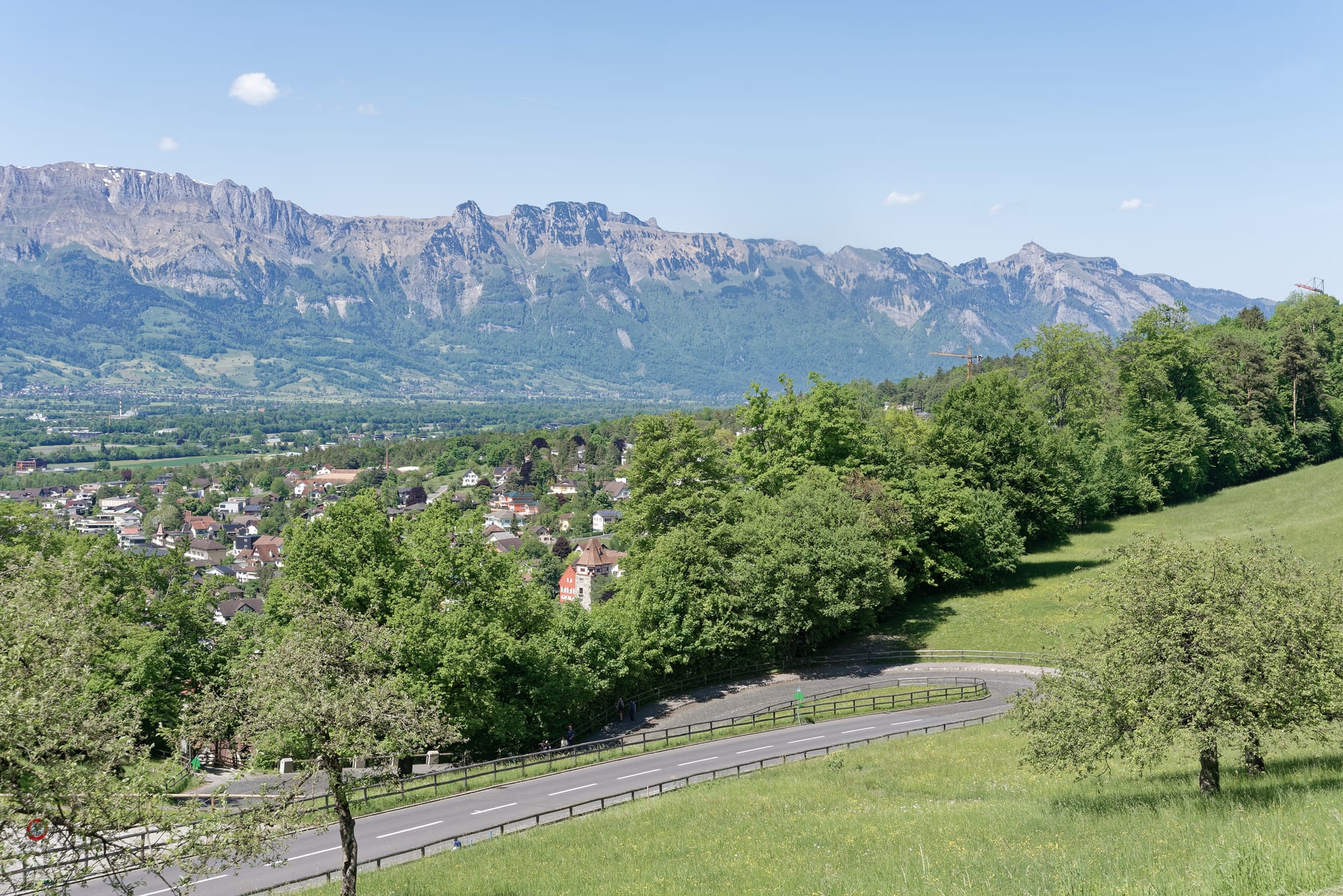
Houses among trees on a green slope above the wide Rhine valley, with a line of grey limestone mountains beyond

Liechtenstein

Vaduz

Vaduz and the Rhine valley seen from below Vaduz Castle, with the Swiss mountains across the river. (Jakub Hałun / Wikimedia Commons · CC BY 4.0)

The capital of Liechtenstein, a small town on the Rhine below the castle that is home to the reigning prince. Bought by the Liechtenstein family in 1712 and made part of a principality in 1719, it is now the seat of parliament and government, with a pedestrian centre, a national art museum, vineyards on its slopes and Switzerland across the river.

Neighbourhoods

  • Städtle
    • First-time visitors
    • Museums
    • Close to public transport

    The pedestrian main street and centre of the town, below the castle hill, with the Kunstmuseum, the National Museum, the Postal Museum, Government House and the cathedral close together, and cafés, restaurants and souvenir shops between them. The main square and bus station are here.

    Open in Maps
  • Mitteldorf
    • Historic district
    • Vineyards
    • Quiet and residential

    The old village quarter of Vaduz, with the stepped-gabled Red House, a listed medieval building, and vineyards on the slopes — among them the prince's own wine estate on the northern edge of town.

    Open in Maps
  • Ebenholz
    • Students
    • Quiet and residential

    A residential district with the University of Liechtenstein, the national university, a primary school and a Protestant church built in 1962–63.

    Open in Maps

Things to do

Castle and landmarks

  • Vaduz Castlelandmark

    The residence of the Prince of Liechtenstein on a hill above the town, with a 12th-century keep; it was burned by the Swiss in 1499. The family lives there, so it is closed to the public, but a footpath through the woods leads up to its walls and the view.

    Open in Maps
  • Vaduz Cathedrallandmark

    The neo-Gothic church of St Florin, a parish church raised to a cathedral in 1997 as the seat of the Archdiocese of Vaduz.

    Open in Maps
  • Government Houselandmark

    The seat of Liechtenstein's government, built in 1903–05 and the former home of the parliament, which since 2008 has met in a modern building of its own.

    Open in Maps
  • Red Houselandmark

    A listed medieval house with a stepped gable in the Mitteldorf quarter.

    Open in Maps
  • Schalun Castlelandmark

    The ruins of a castle in the woods about a kilometre north-east of the centre, known locally as the Wildschloss and open freely to walkers.

    Open in Maps

Museums

  • Kunstmuseum Liechtensteinmuseum

    The state museum of modern and contemporary art, housed since 2000 in a black box of tinted concrete and basalt by Morger, Degelo and Kerez; the Hilti Art Foundation's exhibition building was added in 2015.

    Open in Maps
  • Liechtenstein National Museummuseum

    The national museum of the cultural and natural history of the country, founded in 1890 in the castle and housed since 1972 in a former tavern, the Taverne zum Adler, on the main street.

    Open in Maps
  • Postal Museummuseum

    A branch of the National Museum devoted to Liechtenstein's stamps, in the Engländerbau, a commercial building put up in 1933–34 for an English company.

    Open in Maps

The Rhine and sport

  • Rheinpark Stadionattraction

    The national stadium on the bank of the Rhine, just metres from the Swiss border, home of the national team and of FC Vaduz, who play in the Swiss Super League after promotion at the end of the 2025–26 season.

    Open in Maps
  • Old Rhine Bridge Vaduz–Sevelenlandmark

    The last surviving wooden covered bridge across the Rhine into Liechtenstein, now for walkers and cyclists only, leading to Switzerland with no border checks.

    Open in Maps

Short trips from the town

  • Gutenberg Castlelandmark

    In Balzers, the southernmost municipality, an intact castle on a 70-metre free-standing rock, open to the public as a museum.

    Open in Maps
  • Feldkirchneighborhood

    The medieval town just across the border in Austria, the second most populous town in Vorarlberg.

    Open in Maps

Seasonal events

  • Liechtenstein National Day15 August

    A ceremony outside Vaduz Castle with speeches by the prince and the President of the Landtag, then a folk festival in the town and, in the evening, torches on the Fürstensteig, bonfires and fireworks over Vaduz.

Eat and drink

Long-standing places and food districts in Vaduz. Hours, ratings and directions come from your maps app, always current.

Vaduz classics

  • Cafés and restaurants around the main squareneighborhood

    The main square behind the bus station is ringed by cafés and restaurants serving hearty Liechtenstein, Swiss and Austrian food.

    Open in Maps
  • The prince's wine estaterestaurant

    The Princely Wine Cellars by a vineyard on the northern edge of Vaduz, about five minutes' walk from the central square.

    Open in Maps

Experience Vaduz

History

The name Vaduz is of Romance origin, like those of many Rhine valley towns, and is traced back to an Old Rhaeto-Romance word for "aqueduct", from the Latin aquaeductus. The settlement appears in 12th-century manuscripts as Faduzes, and the castle above it, whose keep dates from the 12th century, is first mentioned in 1322. In the Swabian War of 1499 the Swiss burned the castle and destroyed the whole village.

Vaduz owes its later importance to the ambitions of a family from far away. In the 17th century the Liechtensteins, rich landowners elsewhere in the Empire, wanted a seat in the Imperial diet, which required territory held directly from the emperor. They bought the lordship of Schellenberg in 1699 and the county of Vaduz in 1712 from the counts of Hohenems, and on 23 January 1719 Emperor Charles VI united the two as the Principality of Liechtenstein. The princes then did not set foot there for more than 120 years.

The village grew into a seat of government only slowly. A municipal law of 1864 gave it a mayor and council; Government House was built in 1903–05; and Franz Joseph II, who reigned from 1938 to 1989, lived full-time in the principality, and the castle is now the princely family's home. Vaduz gave women the vote in local affairs in 1976, eight years before the country did, became the seat of an archdiocese in 1997, and gained a new parliament building in 2008.

Culture & Customs

For a town of under 6,000 people, Vaduz holds most of the country's institutions. The Kunstmuseum Liechtenstein, in its black concrete and basalt building of 2000, is both a museum of international modern and contemporary art and the national art collection, which began with a gift of ten paintings in 1967; it also shows works from the princely family's private collection, whose main public display is in Vienna, and the Hilti Art Foundation building beside it opened in 2015. The National Museum covers the country's cultural and natural history, and there are postal and ski museums.

The princely family is central to the town's identity, its castle visible from almost everywhere. The great public occasion is the national day on 15 August, which marks both the Assumption and the country's independence: a ceremony outside the castle with speeches by the prince and the President of the Landtag, a folk festival in the town, torches along the Fürstensteig and fireworks over Vaduz.

German is the official language, spoken in an Alemannic dialect, and Vaduz has its own folk-song tradition, Köpugeäng. The poet Ida Ospelt-Amann wrote and performed in the Vaduz dialect, and the organist and composer Josef Rheinberger is among the town's notable people. FC Vaduz, which plays in the Swiss league because Liechtenstein has none of its own, is the town's football club.

Daily Life

Vaduz had 5,696 residents in 2019, which makes it the capital but not the largest municipality — neighbouring Schaan is bigger. Foreign residents make up about 42% of the population, and about two-thirds of residents are Roman Catholic, with Protestant and Muslim minorities.

The town is the seat of parliament and government. Across the country, a low tax rate and loose incorporation rules have drawn funds from abroad, and Liechtenstein has more registered companies than citizens. The University of Liechtenstein, which teaches architecture and business economics to students from around 40 countries, is in the town, along with the national grammar school. Children are assigned to Vaduz's two primary schools largely by street address.

The rhythm is that of a small, orderly town. Frequent buses link it to Schaan and on to the railway stations across the borders, and the open frontier makes Switzerland and Austria part of everyday life. Vineyards still climb the slopes behind the houses, the castle stands above it all, and the Städtle fills with day visitors buying souvenirs and passport stamps. The mayor, Florian Meier, was elected in a by-election in 2024.

Food

The cooking of Vaduz is the cuisine of Liechtenstein, strongly influenced by Switzerland and Austria. Cheese and soups are central, and dairy products are everywhere thanks to a large dairy industry. Käsknöpfle are small dumplings topped with cheese or onions; Hafalaab is a soup with ham or bacon and cornmeal dumplings; Ribel is a grain eaten locally; and Torkarebl is a porridge dish that resembles dumplings. Saukerkas is a cheese made in Liechtenstein.

Rösti — coarsely grated potato, fried — schnitzel, smoked meats and sausages are everyday food, and asparagus is frequently used. Three meals a day is the norm, and meals are often formal. Milk is drunk by many people, alongside coffee, cocoa and beer.

Wine is part of the town's identity: the old coat of arms symbolised the castle and viticulture, one vineyard still carries the old name Abtswingert, and the prince's own wine estate stands at the northern edge of town. The cafés and restaurants around the main square serve hearty Liechtenstein, Swiss and Austrian dishes.

Planning tools

Budget

Liechtenstein uses the Swiss franc and prices are Swiss, so Vaduz is expensive for rooms and restaurant meals. The town is small and many visitors come for a day from Switzerland or Austria. Bakeries, supermarkets and walks keep costs down, and the castle walk, the cathedral and the Rhine bridge cost nothing.

Daily Budget Midrange
USD 275–475 (hotel in Vaduz, restaurant meals, museum tickets)
Daily Budget Shoestring
USD 110–190 (hostel in Schaan or nearby Switzerland, supermarket food, buses)

A day pass covers the whole Liechtenstein bus network, though two single fares in and out can cost less; the tourist office sells a souvenir passport stamp.

Best Time to Visit

May to September for the warmest weather and the hillside walks, though summer is also the wettest season; 15 August, the national day, fills the town for the celebrations at the castle and the fireworks. Winters are chilly, and the castle path becomes very slippery.

Suggested Number of Days

The town itself can be seen in a day. Allow three or four days to include walks in the mountains and the rest of the principality, and more for a longer stay in the Alps or across the borders.

First Visit
1 day
With Surroundings
3–4 days

Transportation

Vaduz is small enough to cross on foot. Liechtenstein's yellow-green buses, run by LIEmobil, link it with Schaan, the rest of the country and the stations at Buchs and Sargans in Switzerland and Feldkirch in Austria, typically every 20 to 40 minutes. Vaduz has no railway station of its own: the nearest is Schaan-Vaduz, in Schaan, on the line between Feldkirch and Buchs.

The town's boundaries include six exclaves scattered across the country, which makes no practical difference to visitors.

Airport & Station Connections

Vaduz has no airport; Zurich is the nearest major one, and smaller airports at St. Gallen-Altenrhein and Friedrichshafen are also used. Most visitors take a train to Buchs or Sargans in Switzerland, or Feldkirch in Austria, and a bus into Vaduz. By car it is reached from the Swiss A13 or the Austrian A14 motorway, and long-distance coaches stop at the Rheinpark Stadion, about ten minutes' walk from the centre.

Walkability

The centre is compact and the Städtle is pedestrianised, so the museums, the cathedral and Government House are a few minutes apart. A gentle path climbs through the woods to the castle; another walk leads to the Rhine and the wooden bridge into Switzerland. The town is very small, and walking around it and its surroundings does not take long.

Safety

Liechtenstein is one of the safest countries in the world, with essentially no crime. In Vaduz the practical hazards are the slippery castle path in winter and busy traffic on the roads near the Rhine, where cars head for the Swiss motorway.

Wear suitable footwear for the castle walk in winter and take care on the road at the Swiss end of the Rhine bridge. Check current official travel advice before travelling.

Climate

An oceanic climate with warm summers and chilly winters. Every month has some precipitation, about 900 mm a year in all, with noticeably more in summer.

Summer
warm — July highs average about 25°C and lows about 14°C
Winter
chilly — January highs average about 3°C and lows about −3°C

Local Customs

German is the official language, spoken in an Alemannic dialect, and Vaduz has its own kind of folk song, Köpugeäng, influenced by Switzerland. About two-thirds of residents are Roman Catholic. The princely family lives in the castle above the town, which is a home, not a museum. There are no border controls with Switzerland or Austria.

Keep to the paths around the castle walls, as the grounds are private.

Common Payment Methods

The currency is the Swiss franc, used in Liechtenstein under a monetary union with Switzerland. Bus tickets can be bought on board.