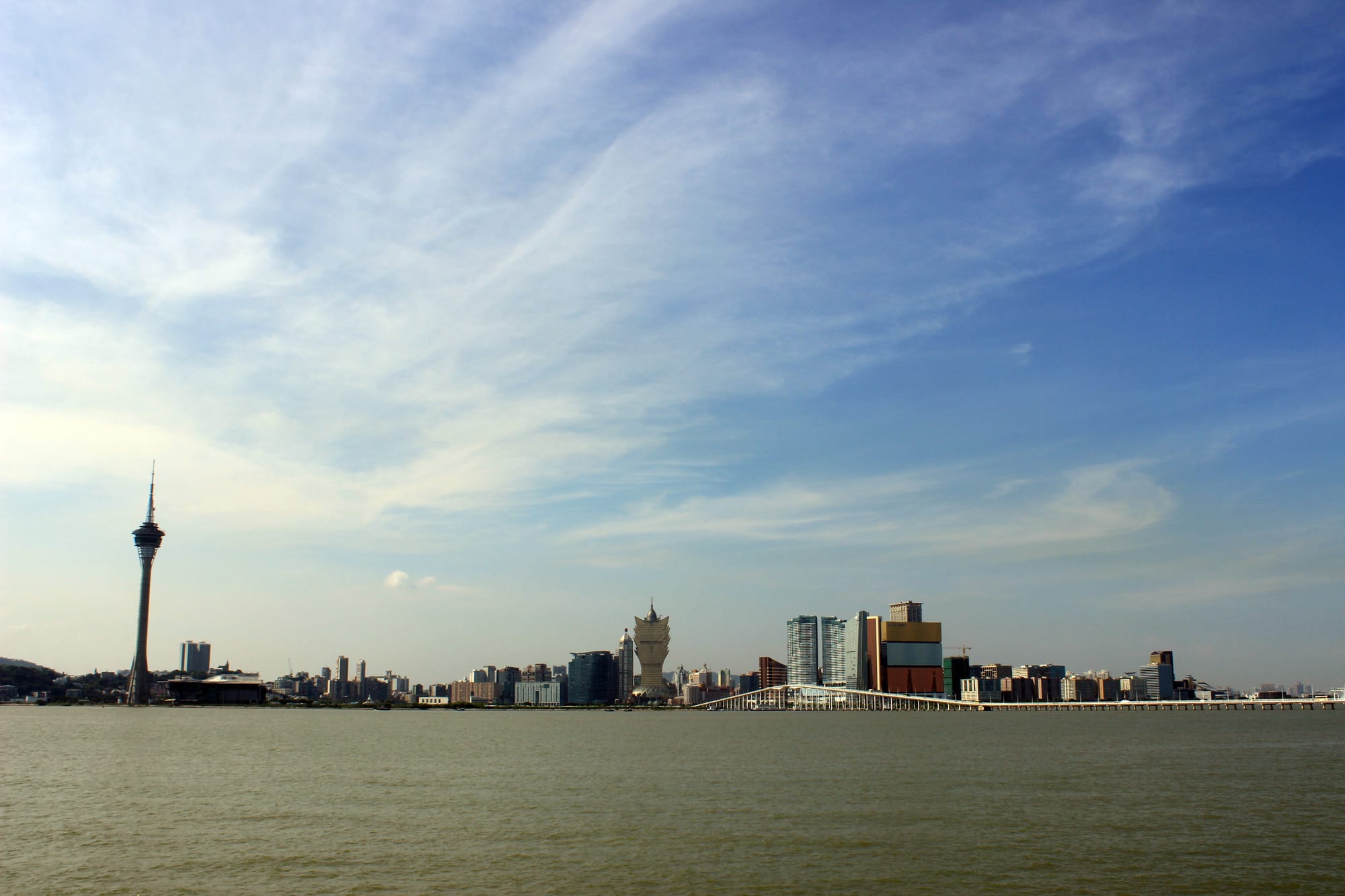
The Macau peninsula seen across open water, with the tall thin Macau Tower on the left and a bridge running to the shore

Macau

Macau

The Macau peninsula seen from Taipa across the harbour. (Mimihitam / Wikimedia Commons · CC BY-SA 3.0)

A dense city on China's south coast, made up of a peninsula and the joined islands of Taipa and Coloane. Settled by Portuguese traders from the 1550s and returned to China in 1999, it keeps a UNESCO-listed historic centre of churches, temples and squares, while the reclaimed Cotai Strip between the islands holds the casino resorts that dominate its economy.

Neighbourhoods

  • The historic centre
    • First-time visitors
    • Historic district
    • Walking

    The old core of the peninsula, from Senado Square and its wave-patterned paving up to the Ruins of St Paul's and Monte Fort, and down to A-Ma Temple. Pastel façades, baroque churches, temples and narrow lanes make up the UNESCO World Heritage Site, and it is all walked easily.

    Open in Maps
  • São Lázaro and Tap Seac
    • Arts and culture
    • Quiet and residential

    A quieter quarter east of the ruins, with a restored cluster of colonial houses around St Lazarus church, small galleries and design shops, and the wide neoclassical square of Tap Seac used for fairs and concerts.

    Open in Maps
  • The outer harbour and NAPE
    • Nightlife
    • Close to public transport

    Reclaimed land east of the old town holding the ferry terminal, the Macau Science Center, the Cultural Centre and several of the older casinos, on a grid of broad avenues facing the water.

    Open in Maps
  • Taipa Village
    • Best for food
    • Historic district

    The original village on Taipa island, a few narrow lanes of shops, bakeries and Macanese restaurants around Rua do Cunha, with the pastel Taipa Houses museum on a waterfront promenade below.

    Open in Maps
  • Cotai
    • Shows and entertainment
    • Shopping

    The strip of reclaimed land joining Taipa to Coloane, built since the 2000s with large casino resorts, hotels, malls and arenas, laid out on wide roads between the two islands.

    Open in Maps
  • Coloane
    • Beaches
    • Quiet and residential
    • Walks

    The southern island, hilly and green, with a small village of lanes and a colonial chapel, walking trails over the peak and the dark sand of Hac Sa beach.

    Open in Maps

Things to do

The historic centre

  • Ruins of St Paul'slandmark

    The carved stone façade of a seventeenth-century Jesuit church, all that survived a fire in 1835, standing at the top of a wide stairway and serving as the city's symbol.

    Open in Maps
  • Senado Squarelandmark

    The paved civic square at the heart of the old town, edged with pastel neoclassical buildings and laid with a wave pattern of black and white stone.

    Open in Maps
  • A-Ma Templelandmark

    A temple to the sea goddess Mazu on the inner harbour, dating from 1488 and older than the Portuguese settlement, built in terraces up a rocky slope.

    Open in Maps
  • Monte Fortlandmark

    The seventeenth-century Jesuit fortress above the Ruins of St Paul's, whose cannon defended the city in 1622, now a terrace with a wide view over the peninsula.

    Open in Maps
  • Guia Fortresslandmark

    A hilltop fort with a seventeenth-century chapel of frescoes and the first Western-style lighthouse on the China coast, reached by path or cable car.

    Open in Maps
  • St Dominic's Churchlandmark

    A yellow and white baroque church founded by Spanish Dominicans in the sixteenth century, just off Senado Square.

    Open in Maps
  • Mandarin's Houselandmark

    A large nineteenth-century courtyard residence built for the family of the reformer Zheng Guanying, restored and open to the public, and among the largest family houses in Macau.

    Open in Maps

Museums and modern landmarks

  • Macau Museummuseum

    A museum set inside Monte Fort covering the territory's history, trades, festivals and the meeting of Chinese and Portuguese life.

    Open in Maps
  • Macau Towerviewpoint

    A 338-metre observation tower on the southern waterfront, with restaurants, a skywalk around the outer rim and a bungee jump.

    Open in Maps
  • Macau Science Centermuseum

    A conical building designed by Pei Partnership Architects with I. M. Pei, on the outer harbour, holding interactive galleries and a planetarium.

    Open in Maps
  • Taipa Housesmuseum

    Five green Portuguese villas of 1921 on the Taipa waterfront, restored to recreate the homes of well-off Portuguese families of the early twentieth century.

    Open in Maps

Islands, beaches and walks

  • Hac Sa Beachbeach

    The largest natural beach in Macau, a stretch of dark sand on the Coloane coast backed by pines, with a park behind it.

    Open in Maps
  • Coloane Villageneighborhood

    A fishing village of narrow lanes around a cobbled square, with the small Chapel of St Francis Xavier of 1928, at the southern end of the territory.

    Open in Maps
  • Guia Hillviewpoint

    A wooded hill of 91 metres at the centre of the peninsula, with a park and a shaded walking path used by residents each morning.

    Open in Maps

Casinos and entertainment

  • The Cotai Stripattraction

    The row of large casino resorts on reclaimed land between Taipa and Coloane, several built as themed replicas of other cities, with malls, arenas and theatres attached.

    Open in Maps
  • Grand Lisboalandmark

    A gold, lotus-shaped hotel and casino tower on the peninsula, opened in 2007-08, the most recognisable of the older casino buildings on the skyline.

    Open in Maps

Seasonal events

  • Macau Grand PrixNovember

    A street race run on the Guia Circuit through the peninsula since 1954, with single-seater, touring car and motorcycle races on public roads.

  • Chinese New YearJanuary or February

    Lion dances, temple crowds and fireworks, and the busiest travel period of the year, with many mainland visitors.

  • A-Ma Festivalspring

    Offerings, opera and processions at A-Ma Temple for the birthday of the sea goddess for whom it is named.

  • Feast of the Drunken DragonMay

    A fish traders' festival in which dancers carrying carved dragon heads drink rice wine and parade through the old streets.

  • Procession of the Passion of Our LordFebruary or March

    A Roman Catholic procession that carries a statue of Christ from St Augustine's Church to the cathedral in the historic centre.

  • Macao International Fireworks Display ContestSeptember and early October

    Teams from several countries compete with displays fired over the water near Macau Tower on set evenings.

Eat and drink

Long-standing places and food districts in Macau. Hours, ratings and directions come from your maps app, always current.

Macau classics

  • Macanese restaurantsrestaurant

    Minchi, African chicken, Portuguese chicken, chilli shrimps and curry crab are the dishes of a cuisine that mixes Portuguese cooking with Asian spices, served in small family restaurants.

    Open in Maps
  • Portuguese egg tartscafe

    Flaky pastry cases filled with custard and scorched on top, the Macau version of the Lisbon pastel de nata, sold warm from bakeries across the territory.

    Open in Maps
  • Pork chop bunrestaurant

    A fried, bone-in pork chop in a crisp bread roll, a well-known Macau snack developed in the mid-twentieth century, sold in cafés and bakeries.

    Open in Maps

Food districts and markets

  • Rua do Cunha, Taipa Villageneighborhood

    A pedestrian lane of bakeries, almond cookie shops and sheets of bak kwa pork jerky grilled at the door, with restaurants in the streets around it.

    Open in Maps
  • Rua da Felicidadeneighborhood

    A red-shuttered street near Senado Square, lined with noodle shops, dried seafood sellers and small restaurants.

    Open in Maps
  • Red Marketmarket

    A three-storey red-brick market building of 1936 in the northern peninsula, selling meat, fish and vegetables to the surrounding neighbourhoods.

    Open in Maps

Cafés

  • Cha chaan teng caféscafe

    Hong Kong-style tea cafés serving milk tea, macaroni soup, toast and rice plates, the everyday lunch of much of the city.

    Open in Maps

Experience Macau

History

Portuguese traders were using the peninsula by the 1550s, tolerated by Ming officials and paying an annual ground rent, and Macau became the pivot of Portugal's trade between Goa, Nagasaki and Guangzhou. Silk and silver moved through it, and with them the Jesuits: the Church of St Paul and the college beside it, founded in 1594, trained the missionaries who went on to Japan and China, and Matteo Ricci passed through on his way north. The settlement built forts against the Dutch, who attacked and were beaten off in 1622.

Its fortunes turned in the nineteenth century, when Guangzhou opened to other Europeans and Hong Kong's deep harbour took the shipping that Macau's silting inner harbour could not. The administration licensed gambling in 1849 to raise revenue, and the city settled into a long quiet decline as a place of trade, refuge and vice. The 1887 treaty with the Qing formalised Portugal's position. After Portugal's revolution of 1974 it offered to hand the territory back; China preferred to wait, and the 1987 Joint Declaration set the terms for the handover on 20 December 1999, when Macau became a Special Administrative Region with its own Basic Law.

The city was remade after 2002, when the government ended the decades-old gaming monopoly and licensed new operators, including American companies. Gaming revenue passed that of the Las Vegas Strip in 2007, land was reclaimed between Taipa and Coloane to build the Cotai Strip, and residents began receiving an annual cash share of the windfall. The pandemic closed the borders and collapsed tourism in 2020–22; visitors have since returned, and Beijing is pressing the territory to depend less on gambling.

Culture & Customs

Macau's character comes from two traditions kept side by side rather than merged. The population is overwhelmingly Cantonese and Han Chinese, and temple life, Cantonese opera, tea houses and the lunar calendar set the everyday rhythm; on the same streets stand baroque churches, Portuguese street names on blue tiles, calçada paving laid in waves, and a legal system with Portuguese roots. The small Macanese community, of mixed Portuguese and Asian descent, has its own cuisine and its own creole, Patuá, now spoken by very few.

Festivals follow both calendars, so the year runs from Chinese New Year and the A-Ma Festival to the Procession of the Passion at Lent and the Feast of the Drunken Dragon, when fish traders dance through the old streets with carved dragon heads. The Grand Prix in November, run on public roads since 1954, is the great secular event, and the noise of it reaches every part of the peninsula.

Manners are Cantonese and businesslike: queueing, quiet in temples, no fuss over tipping. Gambling is treated as an industry rather than a spectacle, and the entry age for the tables that pay for the city is 21. Macau keeps its own border, currency and identity documents under 'one country, two systems', and locals distinguish carefully between Macau, Hong Kong and the mainland.

Daily Life

About 720,000 people live on roughly 33 square kilometres, which makes Macau the most densely populated region in the world. Most live in high-rise blocks in the northern peninsula and on Taipa, a long way in feel from the casino strips, and much of the ground the city stands on is reclaimed.

Gaming and the tourism around it account for the bulk of the economy and, directly or indirectly, most jobs, from dealers and hotel staff to the shops and restaurants that serve the visitors. Residents receive an annual cash handout from the gaming surplus, and public services and pensions are funded the same way. Property is expensive, imported labour from the mainland, the Philippines and elsewhere fills many service posts, and the population is ageing.

The city is tied ever more closely to Zhuhai across the border and to the wider Greater Bay Area: tens of thousands cross daily for work, school, cheaper shopping and family, and the bridge to Hong Kong has added another artery. Life in the old quarters is compact and walkable, with morning markets, tea and noodles for breakfast, exercise on Guia Hill at dawn, and weekends shaped by the tourist calendar rather than by the working week.

Food

Macanese cooking is often called one of the world's earliest fusion cuisines: Portuguese technique carried along the trade routes and picking up chillies, turmeric, coconut, shrimp paste and tamarind from Africa, India, Malacca and Goa. Minchi — minced beef or pork with diced fried potato, soy and a fried egg — is the household dish; African chicken is grilled under a coconut and chilli sauce; Portuguese chicken comes in a mild turmeric and coconut gratin; and curry crab, chilli shrimps and salt cod turn up on the same menus.

Alongside it runs excellent Cantonese cooking — roast meats, dim sum, congee and noodles — and the Portuguese food of the mainland tradition, bacalhau in several forms, grilled sardines and caldo verde. The snacks are what most visitors remember: the Macau-style egg tart with its blistered top, the pork chop bun, almond cookies pressed in wooden moulds, and sheets of bak kwa jerky grilled at shop doors in Taipa Village and near the Ruins of St Paul's.

Drinks follow the same double history. Milk tea and lemon tea in the cha chaan teng cafés, Chinese tea with dim sum, and Portuguese wine, vinho verde and port imported since colonial times and still widely sold. Coffee is drunk as an espresso in the Portuguese manner in the older cafés.

Planning tools

Budget

Room rates swing hard: cheap midweek and expensive at weekends and around mainland holidays, when visitor numbers surge. Food can be very cheap in bakeries, food courts and cha chaan teng cafés, and dear in the resort restaurants. The casinos subsidise a good deal of the city — free shuttle buses between the ferry terminals, the border and the resorts are open to anyone — which keeps transport costs down.

Daily Budget Midrange
USD 150–370 (hotel, restaurant meals, a show, taxis)
Daily Budget Shoestring
USD 60–105 (guesthouse, food courts and bakeries, buses, or a day trip from Hong Kong)

Coming midweek, or as a day trip from Hong Kong, makes the difference; the historic centre, the churches and the beaches cost nothing.

Best Time to Visit

October to December, when the air is dry, clear and warm and the typhoon season has passed; the Grand Prix takes over the peninsula's streets in November. Summer is hot, humid and storm-prone. Chinese New Year and the mainland holiday weeks bring heavy crowds and higher prices.

Suggested Number of Days

Macau is small, and many people see it on a single long day from Hong Kong. Two days allows both the peninsula and the islands without rushing, and three suits anyone who wants the beaches, the walking trails and a slower look at the museums.

First Visit
1–2 days
With Surroundings
3 days

Transportation

The territory is about 33 square kilometres, so nothing is far. Free casino shuttle buses link the ferry terminals, the airport, the border crossings and the resorts and are widely used by visitors. Public buses are cheap and frequent, taxis are metered, and a Light Rapid Transit line opened in 2019 runs on Taipa and across to the peninsula. The historic centre is best on foot.

Buy a rechargeable Macau Pass card or use contactless payment on buses, and expect queues at the border crossings at weekends.

Airport & Station Connections

Most visitors arrive by ferry from Hong Kong, a crossing of about an hour to the outer harbour or Taipa terminals, or overland from Zhuhai at the Gongbei and Hengqin border posts. The Hong Kong–Zhuhai–Macau Bridge, opened in 2018, carries shuttle buses across the Pearl River estuary in about 40 minutes. Macau International Airport is on Taipa, with mainly regional flights.

Walkability

The old centre is one of the most walkable places in Asia: dense, flat in parts and steep in others, with lanes closed to traffic and sights a few minutes apart. Pavements elsewhere are narrow and traffic is heavy, Cotai's distances are longer than they look, and summer heat and humidity make any walk harder. Coloane has proper hill trails.

Safety

Macau is very safe for visitors, with low violent crime. Pickpocketing happens in crowds around the main sights and in the casinos, and the pawnshop and loan-shark fringe around the gaming floors does not usually touch tourists. The real local harm is problem gambling and the debt that follows it. Typhoons between May and October are the main natural hazard, and the low-lying old town can flood in a severe storm.

Set a firm limit before entering a casino, watch belongings in crowds, and check typhoon signal warnings in summer, when transport and ferries stop at higher signals. Check current official travel advice before travelling.

Climate

Humid subtropical, the same pattern as Hong Kong across the estuary. Summers are hot, wet and sticky with a real typhoon risk; autumn is warm, dry and clear and is the best season; winters are cool and sometimes damp, with occasional cold northerly spells.

Summer
hot and humid, about 29–33°C from May to September, with heavy rain and typhoons
Winter
cool, about 14–20°C from December to February, drier but sometimes grey and damp

Local Customs

Cantonese and Portuguese are both official, and English is widely understood in hotels and tourism. Dress is casual, though temples and churches ask for covered shoulders and quiet. Photography is restricted inside casinos and on gaming floors, and staff will stop it. Tipping is not expected beyond rounding up, and a service charge is usually added in hotels and larger restaurants. Two hands are used to pass a business card or a gift.

Entry to casinos is restricted to those aged 21 and over, with identification checked at the door.

Common Payment Methods

The currency is the Macanese pataca (MOP), pegged to the Hong Kong dollar, which is accepted almost everywhere in practice, though change is given in patacas and patacas are not usually accepted in Hong Kong. Cards and mobile wallets are standard in hotels, casinos and larger shops; small cafés, bakeries and market stalls prefer cash. ATMs are plentiful.