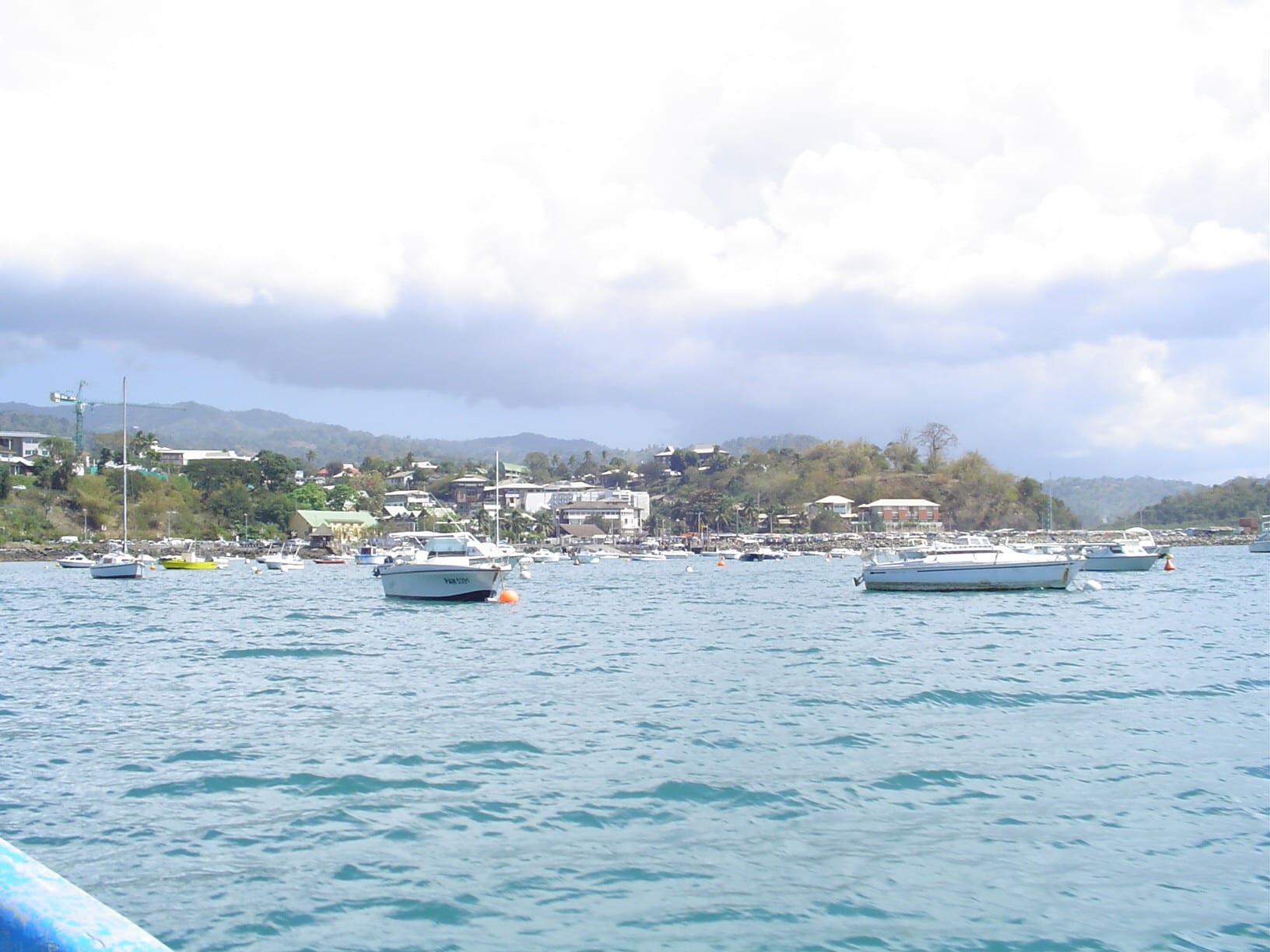
The Mamoudzou waterfront seen from the lagoon

Mayotte

Mamoudzou

Mamoudzou seen from the lagoon, with boats moored off its waterfront. (mwanasimba from La Réunion / Wikimedia Commons · CC BY-SA 2.0)

The main town and prefecture of Mayotte, a French overseas department in the Comoros archipelago, built on a steep shore of Grande-Terre facing the islet of Petite-Terre across one of the world's largest enclosed lagoons. It is the island's port, market and administrative centre, and the place where its poverty, migration and post-cyclone rebuilding are most visible. This page is written to explain the city, not to encourage travel.

Neighbourhoods

  • The centre and the barge landing
    • First-time visitors
    • Markets
    • Close to public transport

    The few flat streets by the water where the barge from Petite-Terre docks, holding the market, the prefecture, banks, shops and most of the town's offices. It is busy from dawn and almost empty after dark.

    Open in Maps
  • Kaweni
    • Local life

    The district immediately north of the centre, combining an industrial and commercial zone with large areas of self-built housing on the slopes above it. Much of that housing was destroyed by Cyclone Chido in December 2024 and rebuilding continues.

    Open in Maps
  • Mtsapéré and the southern slopes
    • Quiet and residential
    • Local life

    Residential hillside quarters of the commune, with mosques, schools, small shops and steep lanes between concrete houses and older bangas. The main road along the coast links them to the town.

    Open in Maps
  • Petite-Terre
    • Beaches
    • Close to the airport
    • Quiet and residential

    The smaller island across the channel, reached by the barge, holding the airport, the old capital of Dzaoudzi and the town of Pamandzi.

    Open in Maps

Things to do

Across the channel

  • Dzaoudzineighborhood

    The old administrative capital on Petite-Terre, a rocky headland joined to the rest of the islet by a causeway, and the base of the Foreign Legion detachment since 1973.

    Open in Maps
  • Pamandzineighborhood

    A commune on Petite-Terre that holds Dzaoudzi–Pamandzi International Airport, the only airport in Mayotte with scheduled services.

    Open in Maps
  • Dziani Dzahaviewpoint

    A crater lake on Petite-Terre, whose name means "crater lake" in Shimaore, known for its underwater lava-tube caves.

    Open in Maps

The lagoon and the coast

  • Pointes et plages de Saziley et Charifoubeach

    Headlands, beaches and mangroves in the south-east of Grande-Terre, protected since 1997, whose beaches are a nesting site for green and probably hawksbill turtles.

    Open in Maps

Short trips on Grande-Terre

  • Mont Chounguiviewpoint

    A distinctively conical volcanic peak in the south of Grande-Terre, at 593 metres the island's second-highest point and visible from far out at sea.

    Open in Maps
  • Tsingoni Mosquelandmark

    A mosque in the village of Tsingoni, west of Mamoudzou, the royal mosque when Tsingoni was the island's capital, whose carved coral mihrab dates from 1538; it is considered the oldest active mosque in France.

    Open in Maps

Seasonal events

  • Eid al-Fitrvaries with the lunar calendar

    The end of Ramadan is the island's main public celebration, with prayers, new clothes, visiting between households and shared meals in every village.

  • Eid al-Adhavaries with the lunar calendar

    The feast of sacrifice, marked with communal prayers and the distribution of meat among families and neighbours.

  • Bastille Day14 July

    The French national day, marked with official ceremonies as it is across the republic.

  • Humpback whale seasonroughly July to October

    Humpback whales pass through the waters around Mayotte during these months and come into the lagoon to give birth.

Eat and drink

Long-standing places and food districts in Mamoudzou. Hours, ratings and directions come from your maps app, always current.

Mamoudzou classics

  • The central marketmarket

    The town's market sells fish, cassava, green banana, breadfruit, coconut and other local produce, with cooked food sold alongside the stalls.

    Open in Maps
  • Street grills and snack countersneighborhood

    Counters and braziers around the barge landing and the market sell grilled chicken, zebu and fish skewers with bata-bata — boiled cassava, green banana or breadfruit — chilli sauce and fried bread.

    Open in Maps

Across the channel

  • Petite-Terre's restaurantsneighborhood

    Restaurants on Petite-Terre, near the airport and the old capital of Dzaoudzi, serve Mahorais and French dishes to arriving and departing travellers.

    Open in Maps

Experience Mamoudzou

History

Mamoudzou is an old settlement that became a capital late. Mayotte shares the Swahili-coast history of the Comoros — Bantu-speaking settlers, Arab and Persian traders, Malagasy migration and a series of small sultanates — and the island's political centre was once inland at Tsingoni, whose royal mosque has a mihrab dating from 1538. When the Sultan of Mayotte sold the island to France in 1841, the French chose the rocky islet of Dzaoudzi on Petite-Terre as their base, easily defended and easily supplied, and it remained the seat of the colonial administration for more than a century.

Dzaoudzi was cramped, and by the 20th century the administration had outgrown it. Mamoudzou was chosen as the capital in 1977, the year after the second of the referendums in which Mayotte chose to remain French while the other Comoros islands went to independence; the council and the prefecture moved there in 1987, though Mamoudzou formally became the chef-lieu only in 2023. The change turned a small town into the island's port, prefecture and commercial centre.

Growth since has been rapid and largely unplanned. Departmentalisation in 2011 brought French law and new institutions, and the town filled with offices, schools and shops, while hillsides around it filled with self-built housing as people arrived from the rest of the island and, in large numbers, from the Comoros. Water shortages became a crisis in 2023. In December 2024 Cyclone Chido devastated the island, destroying most informal settlements and cutting power to the great majority of it, and the reconstruction — with a French law passed in July 2025 to "refound" Mayotte — is the dominant fact of the town's recent history.

Culture & Customs

Mamoudzou is a French prefecture town and a Comorian one at the same time. Around 97 per cent of the population of Mayotte is Muslim, and Islam — Sunni, with strong local Sufi and devotional practice — sets the rhythm of the week, the calendar and public dress. Mosques and Quranic schools stand in every quarter; Ramadan and the two Eids are the year's main occasions; and Bastille Day is marked alongside them in the official calendar.

Mahorais society is matrilineal in important respects, with house ownership and residence often passing through women, and the grand mariage — the Comorian institution of prolonged celebration and the exchange of gold and gifts — is the great social event. The women's debaa and wadaha, a dance showing off the handling of kitchen tools, are performed at these ceremonies, m'godro is the island's popular music, and Shimaore and Kibushi carry a rich oral culture.

Everyday manners are formal and greetings matter. Women commonly wear the bright salouva and msindzano, the pale sandalwood paste applied to the face as both decoration and sun protection. Village identity is strong across the island, and inter-village rivalries have at times turned violent, a tension that shows up in the town as much as anywhere. French is the language of administration and of the schools, but Shimaore is what is spoken in the market.

Daily Life

Mamoudzou had about 71,000 residents at the 2017 census and has grown since; it is by far the largest town in Mayotte, and the daytime population is much higher again, as people come in for work, school, the market, the hospital and the administration. Official figures put the population of the whole department above 320,000, though the true number is higher and uncertain, and roughly half the island's residents are foreign nationals, mostly Comorians.

The economy is dominated by the public sector and by transfers from the French state and the EU. The prefecture, the departmental council, the hospital and the schools are the main employers, alongside the port, the commercial and industrial zone at Kaweni, and a large informal economy of market trading, transport and building work. Formal private-sector jobs are scarce and unemployment is very high, particularly among the young.

Daily life runs early: the barge and the shared taxis are full before dawn, the market is busiest in the morning, and the centre empties in the afternoon. Basic services are stretched — schools run in shifts, the single hospital is overwhelmed, and electricity and water supply are unreliable. Many households live in self-built bangas on the slopes, large areas of which were destroyed by Cyclone Chido, and rebuilding, water, migration and insecurity are the town's constant preoccupations.

Food

Food in Mamoudzou is Swahili-coast and Comorian, built on rice, cassava, green banana, breadfruit and coconut, with fish from the lagoon. The traditional Mahorais dish is mataba — cassava leaves pounded and cooked with coconut milk, eaten with rice — and fish, from swordfish and tuna to the lagoon catch, is grilled or cooked in coconut milk.

Street food is what most people eat in town. Braziers and counters around the market and the barge landing sell skewers of chicken, zebu, goat or fish with bata-bata — cassava, green banana or breadfruit boiled or steamed — a chilli sauce and pickled vegetables. Beredre, a fried bread, and cornet buck, a street snack that is an institution on the island, are sold through the day.

Sweet things are less central, though there are caramel coloda and makarara, biscuits of flour, coconut milk and vanilla, and tropical fruit in season. There is little alcohol, in keeping with the Muslim majority: the usual drinks are sweet tea, coffee, fresh coconut and fruit juices, with trembo, palm wine, made in some areas. French supermarket goods, imported and expensive, sit alongside all of this in the shops of the centre.

Planning tools

Budget

Mayotte has almost no leisure-tourism industry, and what facilities exist — a handful of hotels and guesthouses on Grande-Terre and Petite-Terre — are expensive because nearly everything is imported. Prices in Mamoudzou are European, choice is limited, and the December 2024 cyclone damaged much of the island's accommodation and infrastructure.

Daily Budget Midrange
USD 150–280 (hotel room, restaurant meals, a hire car)
Daily Budget Shoestring
USD 70–120 (a simple guesthouse room, market food, the barge and shared taxis)

Accommodation and a vehicle should be arranged well in advance, and the state of post-cyclone recovery checked before booking anything.

Best Time to Visit

May to October, the dry season, has the most settled weather and the best conditions on the lagoon, and humpback whales pass between roughly July and October. November to April is hot, humid and wet and carries the cyclone risk. Any visit has to be weighed against the island's recovery from Cyclone Chido and the current security and water situation.

Suggested Number of Days

The town itself is small and its market, port and offices can be seen in a day or two. Four to six days allow for Petite-Terre, the lagoon and the south of Grande-Terre. Sea conditions, traffic and the state of the roads change the number more than distance does.

First Visit
1–2 days
With Surroundings
4–6 days

Transportation

A frequent passenger barge crosses the channel between Mamoudzou and Petite-Terre, carrying foot passengers and light vehicles, while a separate ferry takes heavy lorries. On Grande-Terre a hire car or the crowded shared-taxi network covers the island; roads are congested around the town and poor in places, and traffic into Mamoudzou in the morning is heavy.

Journeys are slow: the road along the coast carries most of the island's traffic, and queues for the barge build up at the start and end of the working day.

Airport & Station Connections

Dzaoudzi–Pamandzi Airport is on Petite-Terre, across the channel from the town, and is the only airport in Mayotte with scheduled services, mainly to Réunion, mainland France and other destinations in Africa. Arriving passengers reach Mamoudzou by the passenger barge or by road and ferry with a vehicle; the crossing is short but subject to queues.

Walkability

The flat strip of the centre between the barge landing and the market is walkable and busy by day. Beyond it the town climbs steeply, pavements are intermittent, and the main coast road carries heavy traffic. Walking after dark is not advised, and the residential quarters on the slopes are not laid out for visitors on foot.

Safety

Several governments advise against non-essential travel to Mayotte. Violent crime, gang clashes between villages, carjackings, and stone-throwing at vehicles have risen sharply, linked to poverty and migration tensions; demonstrations and roadblocks are common, and the town and the road into it are where they most often occur. The 2024 cyclone left lasting damage, and access to clean water, power and healthcare has been strained.

Travellers should follow their government's travel advice, avoid demonstrations and travelling after dark, keep car doors locked, drink bottled or treated water, and take mosquito precautions. Malaria and dengue are present and the health system is overstretched. Check current official travel advice before travelling.

Climate

Tropical, with a hot, humid, rainy season from about November to April that carries the cyclone risk — Cyclone Chido struck in December 2024 — and a drier, slightly cooler season from May to October. Water shortages have become severe in recent dry seasons. Summer is December to February in the southern hemisphere.

Summer
November–April, hot and humid, around 24–31°C, heavy rain and the cyclone season
Winter
May–October, drier and a little cooler, around 22–29°C, the best months on the lagoon

Local Customs

Mayotte is overwhelmingly Muslim and local custom is conservative: modest dress covering shoulders and knees is expected in the town, and swimwear belongs on the beach only. Women commonly wear the bright salouva wrap and msindzano, a sandalwood-paste face decoration. Greetings in French or Shimaore come before any request, and the Ramadan fast is widely observed, when eating or drinking in public during daylight is avoided.

Ask before photographing people, particularly women, and do not photograph the police, the port or gendarmerie posts; alcohol is little consumed and is sold in few places; remove shoes and seek permission before approaching a mosque.

Common Payment Methods

The currency is the euro. Card acceptance is limited outside Mamoudzou and the main hotels, so cash is needed for the market, the barge, shared taxis and small shops. ATMs are concentrated in the town centre and on Petite-Terre, and can run out at busy times.