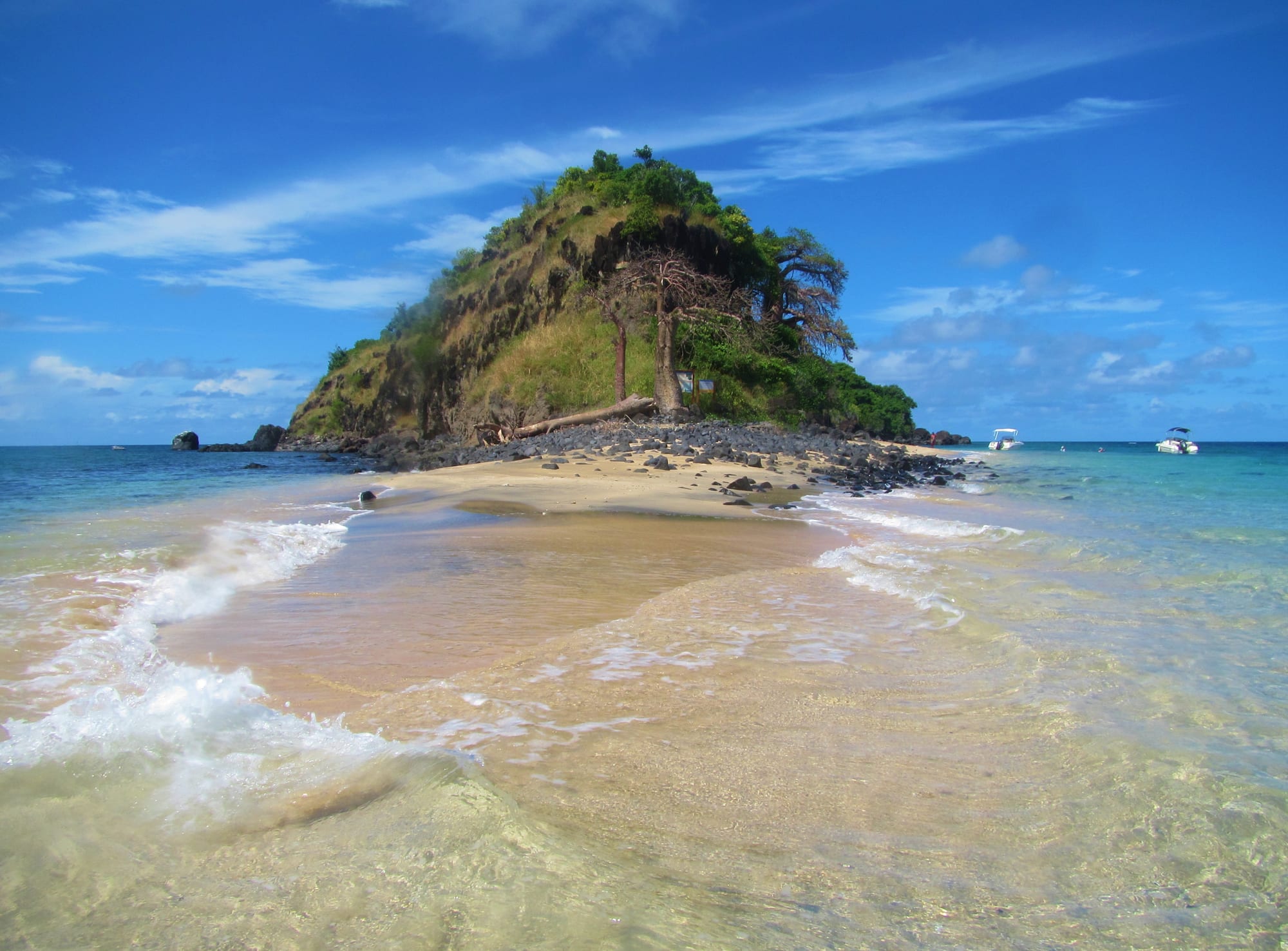
A small steep islet crowned with green bush and bare-limbed trees, reached by a golden sand spit with clear shallow waves washing in from both sides under a vivid blue sky

Mayotte

Îlot Bambo, a small uninhabited islet in Mayotte, seen from the sand spit at its western point. (Frédéric Ducarme / Wikimedia Commons · CC BY-SA 4.0)

An island group in the Comoros archipelago that is an overseas department of France and part of the European Union — the poorest part of France, overwhelmingly Muslim, claimed by the neighbouring Union of the Comoros, and struck in December 2024 by Cyclone Chido, the most powerful storm to hit the island in at least 90 years.

Explore Mayotte

History

Mayotte is part of the volcanic Comoros archipelago and shares its Swahili-coast Islamic history: Bantu-speaking settlers, Arab and Persian traders, Malagasy migration, and a series of small sultanates. In 1841 the Sultan of Mayotte sold the island to France, ahead of French protectorates over the other Comoros islands later in the century.

When the Comoros moved to independence in the 1970s, the three other islands voted to leave France; Mayotte, in referendums in 1974 and 1976, voted to stay. The Union of the Comoros has never accepted this and continues to claim Mayotte as part of its national territory. France vetoed a 1976 UN Security Council draft resolution recognising Comorian sovereignty, and the UN General Assembly passed a series of non-binding resolutions on the "Question of the Comorian Island of Mayotte" until 1995, since when it has not taken the matter up. In further votes Mahorais chose ever closer ties, and in 2011 Mayotte became France's 101st department and, in 2014, an EU "outermost region", bringing it fully under French and EU law.

Departmentalisation raised expectations far faster than living standards, and Mayotte remains by a wide margin the poorest part of France, with GDP per head a fraction of the national figure. It is also a magnet for migration from the Comoros — many people cross the 70-kilometre channel in small kwassa-kwassa boats, a route on which an estimated 12,000 people have died — and about a third of the island's residents are thought to be undocumented. Water shortages became a crisis in 2023, and in December 2024 Cyclone Chido devastated the island, flattening informal settlements: 40 people were confirmed killed with dozens more missing, most shanty towns were destroyed, 85 per cent of the island lost power, and local officials called it the most violent and destructive cyclone since 1934. Reconstruction has been slow, and in July 2025 the French Parliament passed a law to "refound" Mayotte and tackle its poverty.

  • Mayotte: The Island That Chose France — A Muslim, Comorian island in the Mozambique Channel that voted to stay French when the rest of the Comoros left in 1975 — now the poorest, and most contested, department of France

Culture & Customs

Mayotte is around 97 per cent Muslim, and Islam — Sunni, of the Shafi'i school — shapes daily life, dress, and the calendar, alongside respect for spirits (djinns) and traditional healers. This makes Mayotte culturally distinct within France, and questions of laïcité, family law, and polygamy (now legally ended for new marriages) have been sensitive.

Society is matrilineal in important respects: house ownership and residence often pass through women, and the elaborate grand mariage — the Comorian institution of prolonged celebration and the exchange of gold and gifts — is a major social occasion. Women's bright salouva wraps and msindzano (a sandalwood-paste face decoration) are everyday sights.

Music and dance — the women's deba and wadaha (the "pestle dance"), and mgodro — mark ceremonies, and Shimaore and Kibushi carry a rich oral culture. Village identity is strong, and inter-village rivalries have at times turned violent.

  • Mayotte: Where the Bride Keeps the House — A Sufi-shaped Islam, a family home that passes through women, and a wedding season of processions, salouva and sandalwood masks on a French island that remains Comorian in its customs

Daily Life

Official figures put the population above 320,000, making Mayotte one of the most densely populated parts of France, though the true number is higher and uncertain. Roughly half the residents are foreign nationals, mostly Comorians, and many live in bangas — self-built shacks — in informal settlements, large areas of which were destroyed by Cyclone Chido.

The economy is dominated by the public sector and by transfers from the French state and the EU; formal private-sector jobs are scarce, unemployment is very high, and much activity is informal. Basic services are stretched: schools run in shifts, the single hospital is overwhelmed, electricity and water supply are unreliable, and the 2024 cyclone set recovery back years.

For most Mahorais, daily life revolves around the extended family, the mosque and Quranic school, the market, subsistence farming and fishing, and the constant pressures of poverty, migration, and, since late 2024, rebuilding.

  • Mayotte: A Day Rebuilt After the Storm — France's poorest and most crowded department, where Comorian and Malagasy roots run through a mosque-centred, Shimaore-speaking daily life, and where the December 2024 cyclone is still reshaping what an ordinary day actually involves

Food

Mahorais food is Swahili-coast and Comorian in character, based on rice, cassava, green banana, breadfruit, and coconut. Mataba — pounded cassava leaves stewed with coconut milk and eaten with rice — is the traditional Mahorais dish, served in quantity at weddings, and pilaou, a fragrant rice pilaf from the Zanzibar archipelago, is eaten across the Comoros, alongside fish grilled or cooked in coconut milk and the cinnamon, vanilla, and other spices the islands have long grown and traded.

Beredre, a fried bread, and cornet buck, little brioche cones filled with meat and sweet potato, are local staples, and the street food is grilled skewers of chicken, zebu, goat, or fish eaten with bata-bata — cassava, green banana, or breadfruit boiled or steamed — with a chilli sauce and pickled vegetables. Puddings are less central, though there are caramel coloda and makarara, biscuits of flour, coconut milk, and vanilla, and mango, lychee, guava, and passion fruit in season.

There is little alcohol, in keeping with the Muslim majority; the drinks are sweet tea, coffee, fresh coconut, and fruit juices, with trembo (palm wine) made in some areas.

  • Mayotte: Food and the National Dish — Green banana and fish simmered together in coconut milk, on a small French island that shares its cuisine closely with the wider Comoros archipelago

Attractions & Natural Wonders

Mayotte's defining feature is its lagoon — one of the largest and deepest enclosed coral lagoons in the world, wrapped by a barrier reef with a rare stretch of double reef. It holds turtles (green turtles come ashore in their thousands each year to nest on its beaches), reef sharks, rays, dolphins, and, in season, humpback whales, and diving and snorkelling are the main visitor activities.

On land, Mont Choungui is a steep, near-conical peak in the south with a panoramic climb over the lagoon, and the interior has patches of remnant forest and ylang-ylang and vanilla plantations — Mayotte was long a major producer of the ylang-ylang essence used in perfume. The îlot de sable blanc, a sandbank in the lagoon that appears and disappears with the tide, is a much-photographed boat trip.

Petite-Terre has the Dziani Dzaha crater lake, whose mineral-laden waters are unfit for swimming, and the old administrative quarter of Dzaoudzi, linked to Pamandzi by a causeway. Tourist infrastructure across the island is minimal, and any visit at present has to be planned around the recovery from Cyclone Chido and the security situation.

  • Mayotte: Six Attractions and Natural Wonders — One of the largest and deepest lagoons in the world, ringed by a barrier reef, a volcanic peak dropping straight to turquoise water, and a green crater lake unlike anywhere else in France

Planning basics

Budget

Mayotte has almost no leisure-tourism industry, and what facilities exist — a handful of hotels and guesthouses on Grande-Terre and Petite-Terre — are expensive because nearly everything is imported. The December 2024 cyclone damaged much of the island's infrastructure and accommodation, and recovery is ongoing.

Daily Budget Note
Expect European prices with limited choice; there is no established backpacker scene

Check your government's travel advice and the state of post-cyclone recovery before planning any trip; arrange accommodation and a vehicle in advance.

Visa Requirements

Mayotte is part of France but not part of the Schengen Area, and it operates its own entry regime. Citizens of the EU, UK, US, Canada, Australia, and many others can enter visa-free with a passport, but a French visa (including a Schengen visa) is not valid for Mayotte: travellers who need a visa must get a separate one valid for Mayotte.

Typical Stay
90 days visa-free for most Western passports; a Schengen visa alone does not cover Mayotte

If you need any French visa, make sure it is a visa valid for Mayotte; a mainland-France or Schengen visa is not valid there.

Safety

Mayotte has the highest crime rate of any French department. Violent crime, gang clashes between villages, carjackings, and stone-throwing at vehicles are serious problems, linked to poverty and migration tensions; demonstrations and roadblocks are common. The 2024 cyclone left lasting damage, and access to clean water, power, and healthcare has been strained.

Health
Malaria and dengue are present — take precautions; the health system is overstretched and was hit hard by the cyclone; water quality is unreliable in shortages

Follow your government's travel advice, avoid demonstrations and travelling after dark, keep car doors locked, drink bottled or treated water, and take mosquito precautions.

Climate

Tropical. A hot, humid, rainy season runs from about November to April and carries the cyclone risk — Cyclone Chido struck in December 2024 — and a drier, slightly cooler season from May to October. Water shortages have become severe in recent dry seasons.

Dry Season
May–October
Wet Season
November–April (cyclone risk)

Transportation

Dzaoudzi–Pamandzi Airport, on Petite-Terre, has flights to mainland France, Réunion, and destinations in Africa; a frequent passenger barge (ferry) links Petite-Terre with Mamoudzou on Grande-Terre. A hire car or the crowded shared-taxi network gets you around Grande-Terre, where roads are congested and, in places, poor.

Fly in via Réunion, use the barge between the two islands, and hire a car for Grande-Terre, allowing for heavy traffic around Mamoudzou.

Best Time to Visit

May to October, the dry season, has the most settled weather and the best conditions for the lagoon. Humpback whales pass between roughly July and October. Any visit should be weighed against the island's post-cyclone recovery and current security and water situation.

Events
Eid al-Fitr and Eid al-Adha, widely observed; Bastille Day (14 July)

Currency

The currency is the euro. Card acceptance is limited outside Mamoudzou and the main hotels; carry cash. ATMs are concentrated in Mamoudzou and on Petite-Terre.

Symbol
€
Currency Code
EUR — euro

Language

French is the official language and the language of administration and schooling, though fluency is uneven. Shimaore, a dialect of the Bantu Comorian language, and Kibushi, a Malagasy language, are the everyday spoken languages. Arabic is used in Quranic schooling.

Official Language
French
Everyday Languages
Shimaore and Kibushi