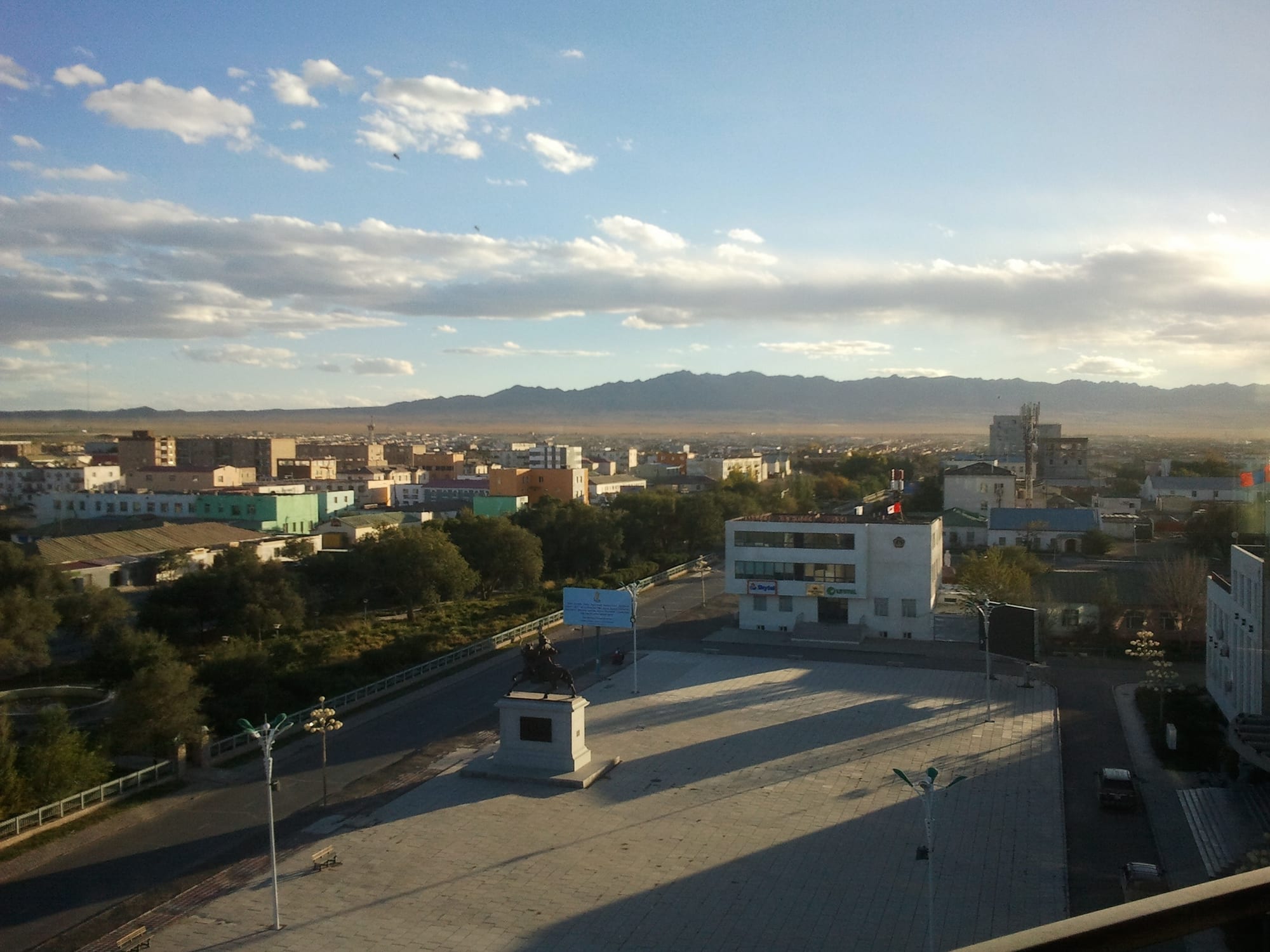
A desert town of low white and painted buildings seen from above at dusk, with a paved square and an equestrian statue below and a long mountain ridge behind

The Gobi & Eastern Mongolia, Mongolia

Dalanzadgad

Dalanzadgad at dusk, with the Gurvan Saikhan range rising behind the town. (Yastanovog / Wikimedia Commons · CC BY-SA 4.0)

The capital of Ömnögovi, Mongolia's southernmost province, a low desert town of about 33,000 people below the Gurvan Saikhan mountains some 540 kilometres south of Ulaanbaatar. Its airport and paved road make it the base for the Gobi's best-known sights, and the copper and coal mines of the South Gobi have reshaped its economy since the 2000s.

Neighbourhoods

  • The centre and the square
    • First-time visitors
    • Close to public transport

    A small grid of paved streets around the main square and its equestrian statue, with the provincial government building, the theatre, banks, hotels and the larger shops. Restaurants and guesthouses are concentrated here, and the mountains are visible at the end of most streets.

    Open in Maps
  • The market and bus area
    • Best for food
    • Local life

    The market yard of stalls and container shops east of the centre sells meat, flour, dairy, clothing and hardware to herding families from across Ömnögovi. Shared cars and minivans to the districts and to Ulaanbaatar gather nearby.

    Open in Maps
  • The ger districts
    • Quiet and residential
    • Local life

    Fenced plots of gers and small houses cover most of the town's area, spreading towards the desert on all sides. Water is trucked or carried from wells in much of the area, and camels and goats are kept in some of the yards.

    Open in Maps
  • The airport road
    • Close to public transport
    • Quiet and residential

    The road out to the airport on the northern edge of town, where newer hotels, offices, fuel stations and businesses connected with the mining industry have been built. Tour vehicles collect arriving passengers here before setting out into the desert.

    Open in Maps

Things to do

In the town

  • Gobi Museum of Nature and Historymuseum

    The provincial collection in the centre, covering Gobi natural history, dinosaur finds, herding life and local history.

    Open in Maps
  • Dalanzadgad central marketmarket

    The town market, where herders buy supplies and sell cashmere, camel wool and hides, and the busiest place in Dalanzadgad in the morning.

    Open in Maps
  • Dalanzadgad Airporttransit hub

    The airfield on the edge of town, given a paved runway in 2007, with regular flights from Ulaanbaatar that bring most visitors to the Gobi.

    Open in Maps

The mountains and the park

  • Gobi Gurvansaikhan National Parkpark

    Mongolia's largest national park, covering the Gurvan Saikhan ranges, gorges, gravel plains and dunes that begin just outside the town.

    Open in Maps
  • Yolyn Amattraction

    A deep, narrow gorge in the Gurvan Saikhan mountains holding an ice field that lasts well into the summer, though in recent years it has melted away by September; it is walked from a car park at the valley mouth.

    Open in Maps

Short trips from the town

  • Flaming Cliffslandmark

    The red sandstone escarpment at Bayanzag where American expeditions of the 1920s identified the first recognised nests of dinosaur eggs.

    Open in Maps
  • Khongoryn Elsattraction

    A dune belt about 100 kilometres long and up to 80 metres high running along the foot of the Gobi Altai, known as the singing sands for the sound the slopes make as they shift.

    Open in Maps

Seasonal events

  • NaadamJuly

    The provincial festival of wrestling, archery and horse racing, held at the stadium and on the gravel plain outside the town.

  • Tsagaan Sarlate January or February

    The lunar new year, when families across the Gobi visit their elders with buuz and dairy, and the town fills with relatives from the districts.

  • Thousand Camel Festivalearly March

    Two days of camel racing, camel polo and camel-herding contests held each March at Bulgan in Ömnögovi, a celebration of the province's Bactrian herds.

Eat and drink

Long-standing places and food districts in Dalanzadgad. Hours, ratings and directions come from your maps app, always current.

Gobi classics

  • Camel milk and khoormogmarket

    Bactrian camel milk is drunk fresh or fermented into khoormog, a sour, slightly fizzy drink particular to the Gobi provinces.

    Open in Maps
  • Goat and mutton dishesrestaurant

    Goat is the Gobi's feast meat, cooked as boodog with hot stones sealed inside the carcass; canteens serve mutton buuz, khuushuur and tsuivan every day.

    Open in Maps
  • Bortsmarket

    Meat cut into strips and air-dried through the winter, shaved into soups and noodles, a Gobi staple sold at the market.

    Open in Maps

Where to eat

  • The central streetsneighborhood

    Guanz canteens and a few hotel restaurants around the square serve Mongolian dishes alongside Russian-influenced soups and cutlets, with Korean and Chinese dishes appearing on some menus.

    Open in Maps
  • Dalanzadgad marketmarket

    Stalls of meat, dried curd, flour and imported goods, and the place to buy food and water before a long drive into the desert.

    Open in Maps

Experience Dalanzadgad

History

People have crossed and grazed this part of the Gobi for thousands of years, and the rocks around the town hold a much older record: the sandstone beds of Ömnögovi are among the world's richest dinosaur sites. The expeditions led by Roy Chapman Andrews of the American Museum of Natural History reached Bayanzag, north-west of the town, in the 1920s and found the first nests of dinosaur eggs to be recognised as such, and Soviet, Polish and Mongolian teams continued the work through the 20th century.

Dalanzadgad itself is a 20th-century creation, laid out as the administrative centre of Ömnögovi province, a cluster of buildings on the gravel plain below the Gurvan Saikhan. Under the socialist system it acquired the standard provincial equipment — a square, government offices, a theatre, a hospital, schools, an airfield and blocks of flats — while the herders of the province were organised into collectives raising camels, goats and sheep.

The change that matters most came after 2000, when the South Gobi's mineral wealth was developed: the Oyu Tolgoi copper and gold deposit and the Tavan Tolgoi coalfield, both within the province, turned Ömnögovi into the centre of Mongolian mining. Dalanzadgad grew quickly, gaining hotels, shops and a paved road to the capital, and its airport was rebuilt to handle the traffic. Tourism grew alongside, as flights made the Gobi's gorges, dunes and dinosaur cliffs reachable in a few days rather than a week.

Culture & Customs

The South Gobi is camel country, and that shapes local identity. Bactrian camels supply milk, wool, meat and transport, and families take pride in their herds; the Thousand Camel Festival at Bulgan in this province brings two days of camel racing and camel polo each March. Herders live far apart around scarce wells, which makes hospitality a serious obligation rather than a courtesy: tea and milk are offered to anyone who arrives.

The town's own culture is a provincial-capital mixture. Its Naadam in July draws wrestlers and riders from every district, the theatre and cultural centre stage concerts and the long-song and horsehead-fiddle traditions that the Gobi shares with the rest of the country, and the museum keeps the dinosaur and ethnographic collections that visitors come for. Buddhist practice, broken by the purges of the 1930s, has revived in a small way, and ovoo cairns on the passes are maintained and circled.

Mining has brought a second population — engineers, drivers, contractors and their families, Mongolian and foreign — and with it a debate that runs through local life about water, grazing land, dust and who benefits from the wealth underground. People in Dalanzadgad tend to be direct about both the jobs and the costs.

Daily Life

About 33,000 people live in Dalanzadgad, one of the larger towns of the Gobi, and the population has grown steadily since the mines opened. Most live in ger districts rather than in the small centre of flats, keeping animals in fenced yards on the town's edges. Work is in the provincial administration, the hospital and schools, the market, transport and construction, and in mining-related jobs on rotation at Oyu Tolgoi and Tavan Tolgoi, which take workers away for weeks at a time.

Water governs everything. It is pumped from wells and boreholes, trucked to parts of the ger districts, and its use by the mines is one of the most contested subjects in the province. Electricity, heating coal and most goods arrive by road from the north or from the Chinese border, and prices are higher than in central Mongolia.

Outside town, families herd goats above all, for the cashmere that pays for everything else, along with camels, sheep and horses, and they watch the season for drought and for dzud. Summer brings tour vehicles, dust and long days; winter empties the roads and turns the town inward. Air quality suffers on still winter days from stove smoke, and road dust is constant in the dry months.

Food

Gobi cooking is built on what the desert supports. Goat is the meat of celebration, cooked as boodog, in which a carcass is sealed and cooked from the inside with fire-heated stones. Mutton fills the everyday dishes: buuz, steamed dumplings of minced meat and fat; khuushuur, fried and flattened; tsuivan, hand-cut noodles steamed over meat; and guriltai shul, a noodle and mutton soup. Borts, meat air-dried in strips through the winter, is shaved into soups when fresh meat is short.

Camel dairy sets the region apart. Bactrian camel milk is drunk fresh and fermented into khoormog, a sour, faintly sparkling drink, and camel cream and curds appear alongside the usual white foods — öröm, tarag and hard dried aaruul — made from goat, sheep and cow milk. Salted milk tea is offered to every visitor, and in summer families make airag from mare's milk where horses are kept.

The town adds what a provincial capital and a mining centre bring: bakeries with Russian-style bread, shops full of Chinese imports from the border crossings, and restaurants serving Korean and Chinese dishes beside Mongolian ones. Vegetables and fruit are trucked in and cost more than in the north, and melons grown in the Gobi's irrigated plots appear in late summer.

Planning tools

Budget

Dalanzadgad is more expensive than most Mongolian provincial towns because of the mining industry, which keeps hotel rooms in demand. Meals and market food remain cheap. The large costs are the flight or the long drive from Ulaanbaatar, the hired 4x4 and driver needed for the desert, and the ger camps near the main sights.

Daily Budget Midrange
USD 100–220 (private 4x4 and driver-guide, ger camps with meals, a domestic flight to Dalanzadgad)
Daily Budget Shoestring
USD 30–50 (a share of a budget tour, basic ger camps or guesthouses, canteen meals)

Share a vehicle with other travellers, and consider flying one way and driving the other to cut two long days on the road.

Best Time to Visit

June to September, with May and September often more comfortable than the hottest weeks of July and August. Spring brings strong winds and dust storms, and winter is bitterly cold and windy, though the desert is clear and the camel festivals fall in the cold months.

Suggested Number of Days

The town itself takes only a few hours. Almost everyone uses it as a base: allow four to six days for the gorge, the dunes and the dinosaur cliffs, since the distances between them are long and the tracks slow.

First Visit
1 day
With Surroundings
4–6 days

Transportation

The centre can be walked, and taxis and shared cars cover the ger districts and the airport road. Beyond the town everything needs a vehicle: a paved road runs north towards Ulaanbaatar and there are roads to the mines, but the sights lie off the tarmac on desert tracks. Nearly all visitors hire a 4x4 with a driver, arranged through hotels, camps or an agency in the capital.

Use a driver who knows the Gobi tracks, and fill the fuel tank and water containers in town before setting out.

Airport & Station Connections

Dalanzadgad Airport, on the edge of town, has flights from Ulaanbaatar taking a little over an hour, and it is the usual way in. By road the capital is about 550 kilometres north, eight to ten hours on a mostly paved route through Mandalgovi, served by long-distance buses and shared minivans. Many travellers arrive as part of a driving loop through the Gobi rather than directly.

Walkability

The centre is small and level, and the square, the market, the museum and the hotels are within about a kilometre of each other. Away from that core the ger districts are large, unpaved and unlit, and there is no shade from the summer sun, so walking is tiring in the heat and unpleasant in a dust storm.

Safety

Crime against visitors is uncommon, though petty theft in the market and drunkenness on weekend nights occur, and the mining traffic makes the roads the real hazard: heavy coal trucks, fast drivers and unlit vehicles after dark. In the desert the dangers are heat and dehydration, dust storms, flash floods in dry gorges and breakdowns far from help.

Carry more water and fuel than seems necessary, avoid driving at night, keep out of dry riverbeds in a storm, and leave word of the intended route with someone in town. Check current official travel advice before travelling.

Climate

A cold desert climate at about 1,470 metres, with very little rain, wide swings between day and night, and strong winds. Spring is the dustiest season, summer hot by day and cool after dark, and winter long, dry and severely cold.

Summer
warm to hot and very dry, typically 25–30°C by day in July, with much cooler nights
Winter
cold and windy, with January nights near −15°C and milder days, and little snow

Local Customs

Gobi hospitality is taken seriously because households live far apart: visitors to a ger are given tea or camel milk at once, and it is received with the right hand. Ovoo cairns on passes are circled three times clockwise with a stone added. Herders' camps are homes, so permission is asked before entering, photographing people or approaching animals, and gates and enclosures are closed again behind visitors.

Tipping is not traditional, though drivers and guides are usually given something at the end of a trip; do not take fossils, bones or eggshell fragments, which is illegal.

Common Payment Methods

The currency is the Mongolian tögrög. Dalanzadgad has bank branches and cash machines, and cards are accepted in hotels, fuel stations and the larger shops, but ger camps, market traders and drivers in the countryside want cash. This is the last dependable place to withdraw money before the desert.