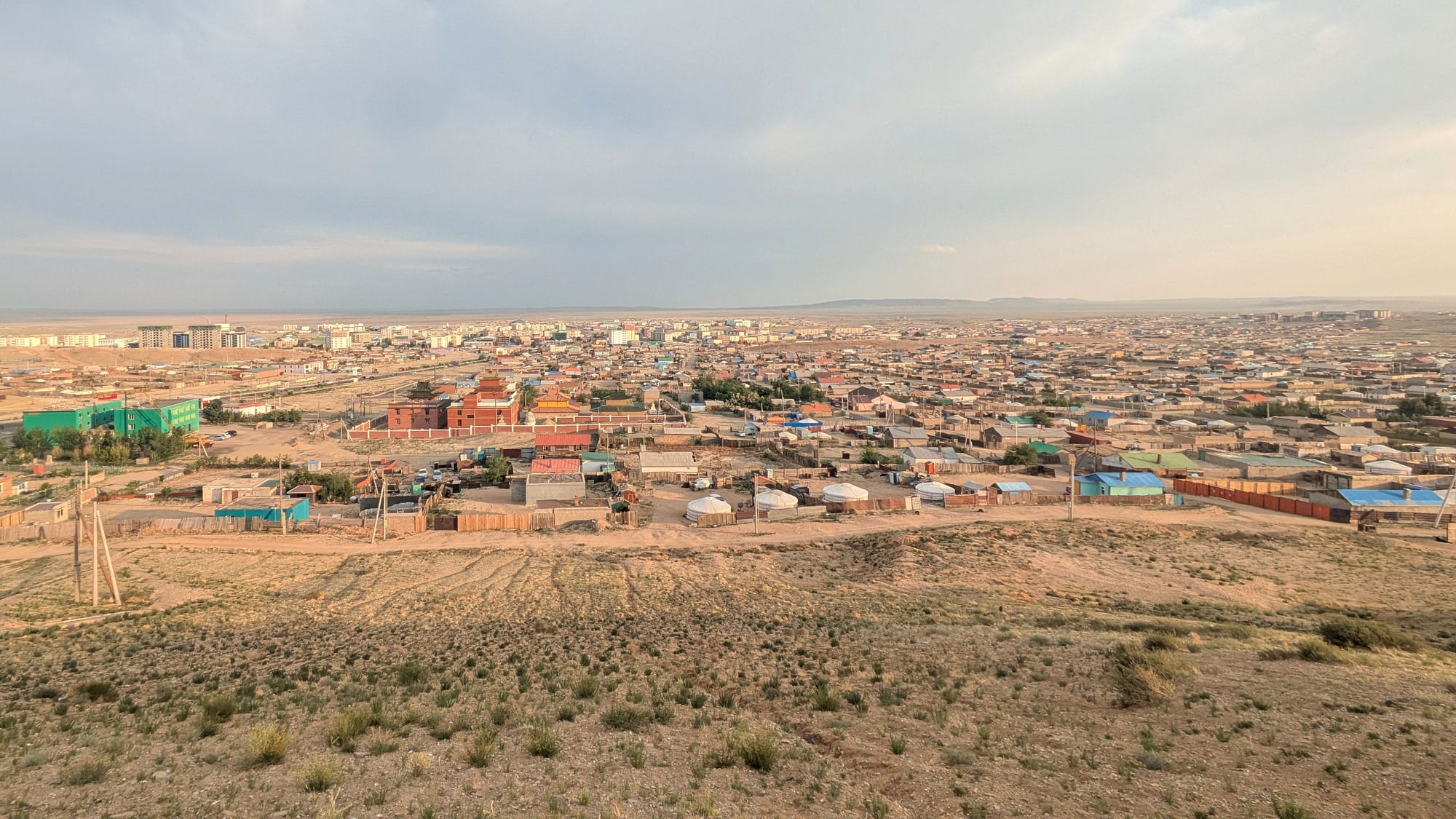
A low desert town of flat-roofed houses, fenced compounds and white gers spread across bare sandy ground, with apartment blocks on the horizon

The Gobi & Eastern Mongolia, Mongolia

Sainshand

Sainshand seen from the high ground north of the town, in Dornogovi province. (Chinneeb / Wikimedia Commons · CC BY 4.0)

The capital of Dornogovi province, in the eastern Gobi, on the railway between Ulaanbaatar and the Chinese border. A Soviet-era railway and administrative town on bare desert steppe, it is known above all as the country of the nineteenth-century lama-poet Danzanravjaa, whose monastery and desert meditation grounds lie a short drive out of town.

Neighbourhoods

  • The town centre
    • First-time visitors
    • Museums
    • Close to public transport

    A small grid of Soviet-built apartment blocks, provincial government offices, shops and a square, with the museums and most of the town's guesthouses within a few minutes' walk of each other. Almost everything a visitor needs is here.

    Open in Maps
  • The railway quarter
    • Close to public transport
    • Local life

    The streets around the station on the Trans-Mongolian line, where the overnight trains from Ulaanbaatar stop and freight heads on to the Chinese border. Railway housing, kiosks and canteens serving passengers and crews give it a working, transient feel.

    Open in Maps
  • The ger districts
    • Local life
    • Quiet and residential

    Fenced plots of gers and single-storey houses spreading outwards to the edge of the desert, where many families keep animals and heat with stoves in winter. Streets are unpaved and services thinner than in the centre.

    Open in Maps

Things to do

In the town

  • Danzanravjaa Museummuseum

    A small provincial museum devoted to the nineteenth-century lama, poet and playwright Danzanravjaa, holding objects from his monastery that were hidden through the communist decades and returned after 1990.

    Open in Maps
  • Sainshand railway stationtransit hub

    The station on the Trans-Mongolian Railway where night trains between Ulaanbaatar and Zamyn-Üüd call, and the reason the modern town exists.

    Open in Maps

Short trips from the town

  • Khamar Monasterylandmark

    The monastery founded in 1820 by Danzanravjaa, a Red Hat centre that grew to some 500 monks and more than 80 temples before its destruction in 1937 and its rebuilding from 1990, standing alone in the desert south of Sainshand.

    Open in Maps
  • The meditation grounds at Khamarattraction

    Stupas and a line of caves in the desert north of the monastery, where monks would retreat to meditate for 108 days at a time on ground Danzanravjaa chose for the spiritual energy he believed it held; pilgrims come from across Mongolia.

    Open in Maps
  • The eastern Gobi steppeviewpoint

    Flat gravel plain and low ridges begin at the edge of town, grazed by Bactrian camels and goats and crossed by unmarked tracks.

    Open in Maps

Seasonal events

  • NaadamJuly

    The provincial and district Naadam festivals bring wrestling, horse racing and archery to Sainshand and the surrounding sums in midsummer.

  • Tsagaan SarJanuary or February

    The lunar new year, when families visit elders, stack buuz and dairy on the table and the town empties towards the countryside.

Eat and drink

Long-standing places and food districts in Sainshand. Hours, ratings and directions come from your maps app, always current.

Sainshand basics

  • Town canteensrestaurant

    Small guanz canteens around the centre and the station serve the Mongolian standards — steamed buuz dumplings, fried khuushuur pastries, tsuivan noodles and mutton soup — to drivers, railway crews and office workers.

    Open in Maps
  • The town marketmarket

    The covered market and the shops around it sell flour, mutton, dried curd, imported Chinese goods and the dairy that herding families bring in from the surrounding desert.

    Open in Maps

Experience Sainshand

History

The eastern Gobi was crossed for centuries by caravan routes between the Mongolian steppe and China, and the area around present-day Sainshand was monastery country long before it was a town. In 1820 the lama Danzanravjaa (1803–1856), a poet, playwright, painter and physician, founded Khamaryn Khiid in the desert south of the present town and built around it a monastic settlement with a school, a library and museum, and a touring theatre troupe that performed his own plays. His writings, and the religious treasures of his monastery, gave this stretch of desert a cultural weight out of proportion to its population.

The modern town is a twentieth-century creation. It grew around a well and a station on the line from Ulaanbaatar to the Chinese border, completed in 1956, and it is the administrative centre of Dornogovi province. Soviet-era planning gave it apartment blocks, a power supply and the offices that still occupy the middle of town, while herding families kept their gers on the edges.

Khamaryn Khiid was destroyed in 1937, as almost every monastery in Mongolia was in that decade. Its portable treasures survived because the monastery's custodians buried them in the hills after the revolution of 1921 and passed a map of the place down the family; the present curator unearthed twenty-four boxes of manuscripts and relics in 1991 and put them in a small museum in Sainshand. Since then the monastery has been rebuilt, the museum in town has opened, and Sainshand has added wind power and a role as a railway and mining service town to its older life as a provincial seat.

Culture & Customs

Sainshand's identity is bound up with Danzanravjaa, known locally as the Noyon Khutagt, whose combination of Buddhism, poetry and theatre made him an unusual figure in nineteenth-century Mongolia and a lasting local hero. His songs are still sung, the museum in town carries his name, and the monastery and meditation grounds in the desert draw Mongolian visitors who come as pilgrims rather than as sightseers, tying ribbons, walking circuits and leaving offerings.

Around that runs ordinary Gobi life. Buddhism practised alongside older shamanic custom, ovoo cairns hung with blue silk scarves on ridges and at road junctions, and the horse and camel culture of the desert steppe all shape the year. Local Naadam festivals in July bring wrestling, horse racing and archery to the town and to the surrounding districts, and the lunar new year of Tsagaan Sar empties the apartment blocks as families drive out to elders in the countryside.

Manners are steppe manners: hospitality to anyone who arrives, tea and dairy offered and accepted with the right hand, and a reluctance to refuse food. Visitors are still uncommon enough to attract friendly curiosity. Russian is understood by older residents and English by some younger ones, but in a town this size a phrasebook and patience go further than either.

Daily Life

About 25,000 people live in Sainshand, which makes it one of the larger towns of the Gobi provinces but still small enough to cross on foot. The population divides between the concrete centre, where flats have piped heating and water, and the fenced ger plots on the outskirts, where households burn coal or dung in stoves through the winter and collect water from standpipes.

Work comes from the railway, the provincial administration, schools and the hospital, from trade with the mining and freight traffic moving between the capital and the Chinese border, and from herding in the surrounding sums, where families keep camels, goats, sheep and horses across huge, thinly grassed ranges. Cashmere from goats is the main source of cash for many herding households. Wind turbines on the plain outside town supply power to the national grid.

The rhythm of the day is set by the trains, which arrive and leave at night, and by the seasons, which are severe at both ends. Water is the constant concern in a province with almost no surface supply, and dust, drought and the deep-cold dzud winters that kill livestock are recurring worries. Younger people leave for Ulaanbaatar to study and often stay, a drift the province shares with most of rural Mongolia.

Food

Gobi eating is meat and dairy, and Sainshand's canteens serve the Mongolian standards: buuz, steamed mutton dumplings eaten by the dozen at festivals; khuushuur, the same filling flattened and fried; tsuivan, thick flat noodles fried with meat and whatever vegetables are to hand; and banshtai tsai, small dumplings in salty milk tea. Suutei tsai, tea boiled with milk and salt, is poured for every visitor and drunk all day.

The desert supplies its own specialities. The two-humped Bactrian camel gives milk that is drunk fresh or fermented into khoormog, sour and slightly sparkling, and camel and goat meat are more common here than the beef of the northern steppe. Goat is the feast meat, cooked as khorkhog with fire-heated stones in a sealed churn, or as boodog, roasted from the inside with hot stones packed into the carcass. Strips of air-dried meat, borts, keep through the winter.

Dairy is the summer food: öröm, a thick clotted cream skimmed from boiled milk and eaten with bread; aaruul, hard dried curds stacked on ger roofs to dry; tarag, a set yoghurt. In town, the market and small shops sell flour, rice, tinned goods and Chinese imports that arrive by rail, and vegetables are expensive and limited. Airag, lightly alcoholic fermented mare's milk, appears in summer, though it belongs more to the grasslands than the desert.

Planning tools

Budget

Sainshand itself is inexpensive: guesthouses and small hotels are modest, canteen meals cost little and the train from Ulaanbaatar is cheap. What raises the bill is transport beyond the town, since Khamar Monastery and the desert sights need a hired vehicle and driver, usually arranged through a guesthouse or a tour company in the capital.

Daily Budget Midrange
USD 100–220 (a hotel room, a hired 4x4 with driver for the desert, meals out, a night at a ger camp)
Daily Budget Shoestring
USD 25–45 (a guesthouse bed or basic hotel room, canteen meals, the overnight train, shared transport)

Share a vehicle to Khamar Monastery with other travellers, and draw cash in Ulaanbaatar or at a bank in the centre before heading into the desert.

Best Time to Visit

June to September, when days are hot and dry and the desert tracks are passable, with May and September often more comfortable than midsummer. Spring brings strong winds and dust storms. Winter is bitterly cold but clear, and the town is at its busiest around the July Naadam.

Suggested Number of Days

The town is small and can be seen in a day, often between two night trains. Two or three days allow for the desert monastery and its meditation grounds, and for the long drives that reaching them involves.

First Visit
1 day
With Surroundings
2–3 days

Transportation

The town is walkable end to end, and most visitors get around on foot or in shared taxis. Everything beyond the built-up area needs a four-wheel drive vehicle with a driver: the desert tracks are unsigned and distances are measured in hours rather than kilometres. Minibuses and shared cars run to other provincial towns.

Arrange a driver through a guesthouse the day before, agree the route and the price in advance, and carry water for any trip out of town.

Airport & Station Connections

Sainshand sits on the Trans-Mongolian Railway, roughly 450 km south-east of Ulaanbaatar; overnight trains take around nine to eleven hours and are the usual way to arrive, continuing to Zamyn-Üüd on the Chinese border. A paved road follows much the same line, with buses and shared cars taking the best part of a day. Road and rail carry almost all traffic.

Walkability

Flat, open and easy to walk, with the museums, market and offices within a few blocks of one another. Pavements give out at the edge of the centre, streets in the ger districts are sand and gravel, and there is little shade in summer or shelter from the wind in winter.

Safety

Crime is low and the town is quiet, with the usual caution advised around drunkenness late at night. The real hazards are environmental: summer heat and dehydration, dust storms in spring, extreme cold in winter, and breaking down far from help on desert tracks. Heavy freight traffic uses the road and rail corridor to the border.

Carry more water than seems necessary on any desert trip, keep out of dry watercourses during storms, avoid driving at night, and approach a ger calling out so the dogs are called off. Check current official travel advice before travelling.

Climate

Cold desert, with very large swings between day and night and between seasons. Rain is scarce and falls mostly in July and August, the sky is clear for most of the year, and wind is constant.

Summer
hot and dry — daytime highs commonly 25–35°C, with much cooler nights
Winter
severely cold and windy — often −15 to −30°C, with little snow but long spells below freezing

Local Customs

Tipping is not customary, though rounding up a bill or paying a driver a little extra for a long day is appreciated. Ger etiquette matters in the countryside: enter with the left foot, do not step on the threshold, accept food and drink with the right hand and move clockwise inside. At Khamar Monastery and the meditation grounds, visitors walk clockwise around stupas, keep their voices down and ask before photographing monks or worshippers.

Dress modestly at religious sites, remove hats indoors at the monastery, and do not photograph people, homes or animals without asking first.

Common Payment Methods

The currency is the Mongolian tögrög. Banks and ATMs in the centre generally work, and larger shops and hotels take cards, but this is a cash town and anything outside it — drivers, ger camps, market stalls — expects notes. US dollars can be changed at a bank but are not spent directly.