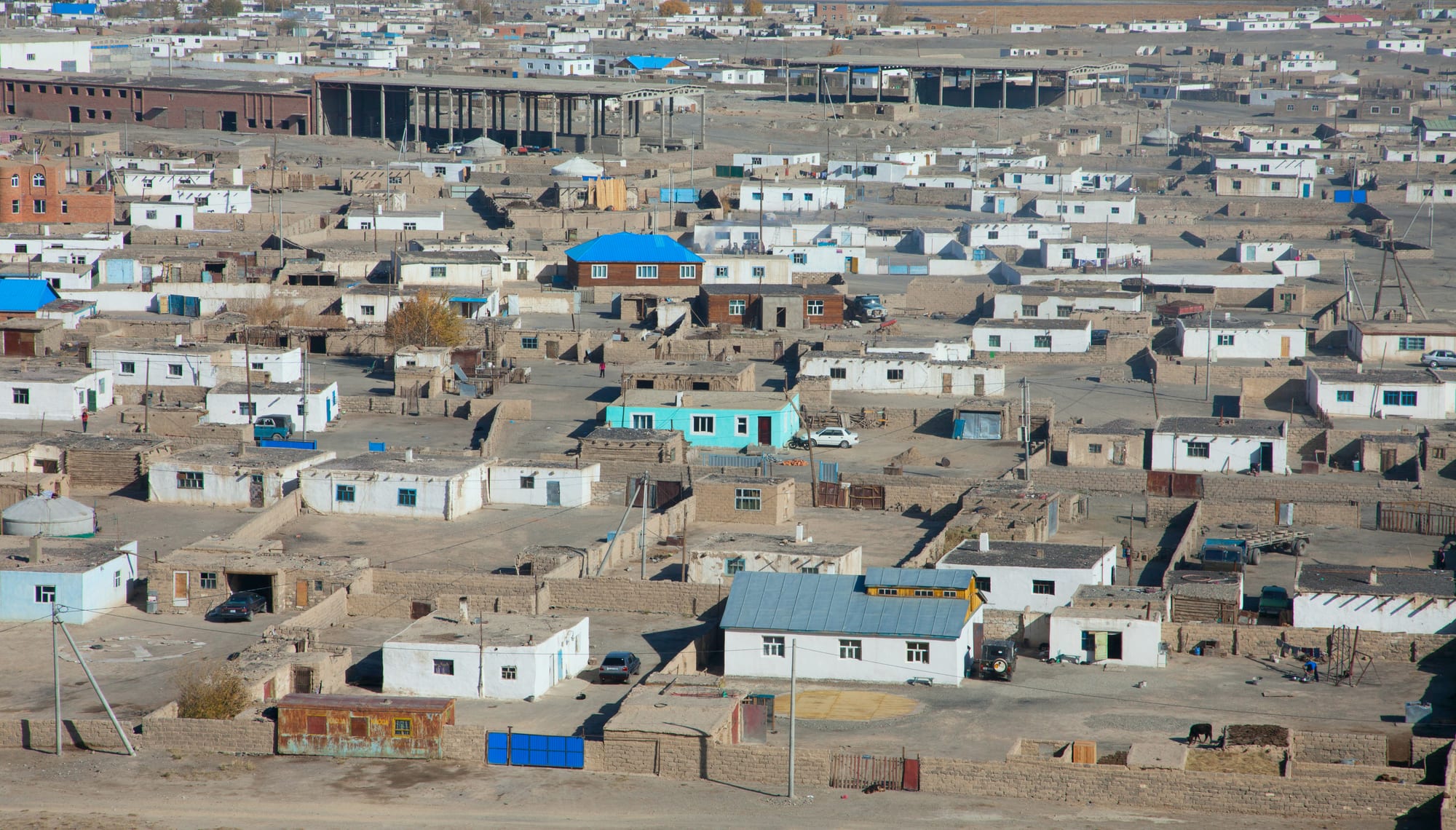
Rows of low white-walled houses in fenced yards spreading across a dusty plain, seen from a hill above the town

The Altai & Western Mongolia, Mongolia

Ölgii

The white-walled houses and fenced yards of Ölgii, the capital of Bayan-Ölgii province in western Mongolia. (Alexandr frolov / Wikimedia Commons · CC BY-SA 4.0)

The capital of Bayan-Ölgii, Mongolia's only Kazakh-majority province, set on the Khovd river in the far west at about 1,700 metres among bare mountains. A low town of white-walled houses, mosques and a busy market, it is the base for trips into the Altai and for meeting the Kazakh eagle hunters who gather here each autumn.

Neighbourhoods

  • The town centre
    • First-time visitors
    • Close to public transport

    The few paved streets around the main square, the provincial government building and the museum, with guesthouses, shops, a handful of restaurants and the offices of local tour operators. Almost every arrangement for a trip into the Altai is made within a short walk of here.

    Open in Maps
  • The bazaar quarter
    • Markets
    • Local life

    The blocks around the market, where traders sell flour, mutton, felt, boots, saddles and Chinese and Russian goods brought in by road. It is the busiest part of town in the morning and the place to see the mix of Kazakh and Mongol life.

    Open in Maps
  • The residential lanes
    • Quiet and residential
    • Local life

    Most of Ölgii is single-storey — whitewashed mud-brick and timber houses inside fenced yards on unpaved lanes, with a ger often pitched beside the house for summer. Livestock, stacked firewood and satellite dishes fill the yards.

    Open in Maps
  • The riverside and the hills above
    • Walks and viewpoints

    The Khovd river runs along the edge of town with willow thickets and irrigated plots beside it, while the bare ridges above give a view over the whole grid of white roofs to the mountains beyond.

    Open in Maps

Things to do

The town and its river

  • Khovd Riverattraction

    The river that runs past the town from the Altai lakes to Khar Us Nuur, lined with willows and irrigated plots and crossed by the main bridge out of Ölgii.

    Open in Maps

Mountains and lakes nearby

  • Tolbo Lakeattraction

    A freshwater lake at 2,080 metres on the road south towards Khovd, with a treeless shoreline where families camp through the summer, warmest for swimming around the middle of July.

    Open in Maps
  • Tsambagaravattraction

    A glaciated massif on the boundary between Bayan-Ölgii and Khovd provinces, rising to 4,193 metres at Tsast Uul; the stand-alone snow-capped mountain of the Mongolian Altai and a sacred mountain of the region.

    Open in Maps

The Altai

  • Altai Tavan Bogd National Parkpark

    A park of 6,362 square kilometres on the triple border with Russia and China, holding Mongolia's highest peaks, its glaciers, the lakes Khoton, Khurgan and Dayan, and the UNESCO-listed Petroglyphic Complexes of the Mongolian Altai.

    Open in Maps
  • Khüiten Peakattraction

    Mongolia's highest mountain at 4,356 metres, with the Chinese border running across its summit, reached by a trek from the road-head to a base camp below the glaciers.

    Open in Maps
  • Potanin Glacierattraction

    The longest glacier in Mongolia, about 14 kilometres below the Tavan Bogd peaks and the usual objective of treks into the park; like most glaciers it has been retreating and thinning.

    Open in Maps
  • Khoton Lakeattraction

    A freshwater lake in Tsengel district inside Altai Tavan Bogd National Park, one of the three lakes below the Tavan Bogd massif, with herding camps on its shores in summer.

    Open in Maps

Seasonal events

  • Golden Eagle FestivalOctober

    Around seventy Kazakh hunters ride in with their trained golden eagles to compete in calling the birds down from the hills, in traditional dress and in horsemanship, in the town and on the steppe a few kilometres outside it.

  • NauryzMarch

    The spring new year, celebrated by Kazakh families with visits, music and the grain and meat dish nauryz köje.

  • NaadamJuly

    The national festival of wrestling, archery and horse racing, held in the province in mid-July alongside Kazakh contests such as horseback games.

Eat and drink

Long-standing places and food districts in Ölgii. Hours, ratings and directions come from your maps app, always current.

Kazakh tables

  • Beshbarmak in the town's restaurantsrestaurant

    The dish of the province — boiled mutton or horse meat served over broad sheets of noodle with onion broth — is the centrepiece of Kazakh meals and appears in most dining rooms in town.

    Open in Maps
  • Guesthouse and homestay mealsrestaurant

    Kazakh families who take guests cook for them, usually meat and noodles, fried baursak dough puffs and endless milk tea, with embroidered wall hangings around the room.

    Open in Maps

Market and bakeries

  • Ölgii bazaarmarket

    Flour, mutton, dried curd, kurt, tea and imported groceries alongside boots, felt and saddlery, and the place to buy supplies before a trip into the mountains.

    Open in Maps
  • Bread and baursak stallsmarket

    Small bakeries and market stalls sell dense loaves and baursak, squares of fried dough piled up for guests and taken on journeys.

    Open in Maps

Experience Ölgii

History

The Mongolian Altai has been inhabited for thousands of years, and the valleys around Ölgii hold one of Asia's densest concentrations of rock carvings, Bronze Age deer stones, burial mounds from the Scythian era and stone figures left by the Turks of the 6th to 8th centuries. In later centuries this was the country of the Oirats, the western Mongols, whose Dzungar Khanate was destroyed by the Qing in the 1750s, after which the frontier was watched from garrison towns further south and east.

Kazakh herders of the Abak-Kerei and other groups moved into these mountains from the west during the 19th century, crossing from what is now Kazakhstan and Xinjiang with their herds, and settled the high pastures. Ölgii grew as their market and administrative centre. In 1940 the communist government created Bayan-Ölgii as a Kazakh-majority province with Ölgii as its capital, giving the community its own schools, newspapers and theatre in the Kazakh language — an unusual arrangement in a highly centralised state.

The socialist decades brought collectivised herding, a hospital, a teacher training college and brick and timber buildings among the mud-brick houses. After 1990 the province was shaken by emigration: tens of thousands of Mongolian Kazakhs took up Kazakhstan's invitation to settle there, though a good number later returned. Since then the town has lived on herding, cashmere, cross-border trade with Russia and China, and a growing stream of visitors drawn by the eagle hunters and the mountains, with the Golden Eagle Festival in October now the fixed point of its year.

Culture & Customs

Ölgii is a Kazakh town in a Mongolian state. Kazakh is heard on the streets far more than Mongolian, signs appear in both languages, and the town has mosques and Kazakh-language schools. Most people are Sunni Muslims, though practice is often relaxed and shaped by herding life. Houses are hung with brightly embroidered felt wall hangings, tüskiiz, made by women of the family, and the two-stringed dombra is the instrument played at gatherings.

The best-known tradition is hunting with golden eagles. Eagles are taken young and trained to hunt foxes and hares from horseback in the winter months, when the foxes show against the snow; an estimated 250 eagle hunters live in the province. The Golden Eagle Festival each October brings around seventy hunters in fox-fur hats and embroidered coats to compete in calling their birds down from the hills and in horsemanship, and winter trips with hunters have become a small industry of their own.

Kazakh and Mongol customs sit side by side. Nauryz in March is the Kazakh spring new year, marked with visits and a grain and meat dish, while Naadam in July brings wrestling, archery and horse racing as everywhere in Mongolia. Hospitality is emphatic: a guest is seated, fed and given tea before any business is discussed, shoes come off at the door, and refusing food outright is impolite. Bride-price negotiations, large weddings and the naming of babies are the social events that fill the town's calendar.

Daily Life

Ölgii had a population of about 50,000 in 2024, the great majority of them Kazakh, with Uriankhai, Dörvöd, Khalkha and Tuvan minorities in the province around it. Most families live in single-storey houses inside fenced yards, often with a ger pitched beside the house in summer; a few Soviet-era blocks stand near the centre. Water is carried from standpipes in much of the town and coal and dung fuel the stoves, which fill the still winter air with smoke.

The province lives from herding sheep, goats, horses, yaks and camels, and cashmere is the main cash earner. Ölgii itself runs on the provincial administration, schools, the hospital, trade and transport, and increasingly on tourism — guides, drivers, guesthouses and the festival. Irrigated plots along the Khovd river grow potatoes and vegetables in a short season. Goods arrive by long road haulage or by air, which makes most things dearer than in the capital.

Life is oriented as much west and north as east: cross-border ties with Kazakhstan, where many relatives now live, and trade with Russia through the crossing beyond Tsagaannuur. Young people leave to study in Ulaanbaatar or Kazakhstan, and some do not come back. Hard winters remain the great threat to the province: a dzud can kill a family's herd in weeks and push them into the town, and the drift of former herders into Ölgii and the capital has grown since the 1990s.

Food

Kazakh cooking sets the table here, and it is heavier on meat and dough than the Mongolian norm. The feast dish is beshbarmak — mutton or horse meat boiled and laid over broad sheets of noodle, with an onion broth poured over and the meat distributed by seniority, traditionally eaten with the hands. Kazy, a rich sausage of horse meat, is sliced for guests, and baursak, small squares of fried dough, are piled on the table at every gathering. Kurt, hard balls of dried salted curd, travel well and are chewed on long rides.

Dairy is constant. Milk tea is poured throughout the day, often with a spoonful of cream or butter, and in summer there is fermented mare's milk and, from the yak herds of the high valleys, thick cream and butter. Horses and sheep are slaughtered in late autumn to lay down meat for the winter, and strips of it are dried as borts for soups in the cold months.

Mongolian dishes are eaten as well, especially by the province's Mongol families and in the town's canteens: buuz, khuushuur, tsuivan and mutton noodle soup. Bread is important in a way it is not further east, and shops sell dense loaves alongside Russian biscuits and sweets brought over the border. Vegetables are scarce and largely limited to potatoes, carrots, onions and cabbage. Alcohol is sold in the town, but many Kazakh households drink little or none of it, and guests do better to accept tea.

Planning tools

Budget

Reaching the far west costs more than staying there. A domestic flight from Ulaanbaatar or a drive of several days is the big expense, while guesthouses, homestays with Kazakh families and canteen meals in Ölgii are inexpensive. Trips into the Altai need a 4x4, a driver-guide, park fees and sometimes packhorses, and prices in town rise around the Golden Eagle Festival in October.

Daily Budget Midrange
USD 100–210 (guesthouse or ger camp, a 4x4 and driver-guide, park fees, packhorses in the Altai)
Daily Budget Shoestring
USD 20–40 (guesthouse or homestay, canteen meals, shared minivans)

Book flights and accommodation well ahead for the October festival, share a vehicle with other travellers for the drive into the park, and carry enough cash for the whole trip.

Best Time to Visit

Late June to early September for trekking, riding and the Altai lakes, when the high valleys are green and the tracks passable. The Golden Eagle Festival falls in October, when it is already cold and clear. Nauryz in March is the main Kazakh celebration, and winter eagle-hunting trips run from November in serious cold.

Suggested Number of Days

The town needs a day or two, and most of that is spent arranging things. A trip into Altai Tavan Bogd takes several more, because of the long drive each way and the walking beyond the road-head; festival visits add a day or two again.

First Visit
1–2 days
With Surroundings
5–8 days

Transportation

Scheduled flights link Ölgii with Ulaanbaatar, and the overland drive from the capital takes several days. Shared minivans run to Khovd, Ulaangom and other provincial centres on rough roads. Everything in town is within walking distance, and taxis are informal. Beyond the town, travel means a hired 4x4 with a driver, as there is no public transport to the park or the lakes.

Permits are needed for Altai Tavan Bogd, which lies in a border zone, and are arranged through a local agency or the park office in Ölgii before setting out.

Airport & Station Connections

Ölgii Airport lies just outside the town, with regular flights to Ulaanbaatar and Khovd and occasional ones to Ulaangom and to Almaty in Kazakhstan; schedules vary by season and are prone to weather delays. By road the capital is about 1,600 kilometres away, a drive of several days only partly on paved highway, with scheduled buses three days a week. A road crossing into Russia lies beyond the village of Tsagaannuur, north-west of the town.

Walkability

The town is small, flat and easily crossed on foot in half an hour, with the market, museum, square and guesthouses close together. Most lanes are unpaved and dusty in summer, muddy in spring and icy in winter, and there is little street lighting. Dogs in yards are a reason to keep to the main lanes after dark.

Safety

Crime is low and the town is calm. The risks are distance and weather rather than people: cold nights even in summer at altitude, sudden storms and snow in the mountains, river crossings and glaciers in the Altai, long stretches without fuel or phone signal, and vehicle breakdowns far from help.

Travel into the mountains with an experienced local driver or guide, carry warm clothing and spare supplies, and keep permits and passport at hand near the borders, where wandering too close to the frontier can bring trouble with border guards. Check current official travel advice before travelling.

Climate

A high, dry and extreme continental climate, drier and windier than central Mongolia, with strong sunshine at altitude. Rain is scarce, summer days are warm but nights cool sharply, and winter is long and bitterly cold.

Summer
warm by day, 20–28°C in the town, with cold nights; much cooler in the Altai, where frost and snow are possible at any time
Winter
very cold — often −20 to −35°C, dry, with snow in the mountains and ice on the Khovd river

Local Customs

Bayan-Ölgii is a Kazakh and largely Sunni Muslim province, and manners here differ from the rest of Mongolia. Kazakh is the everyday language, greetings are exchanged with both hands, and guests are fed generously whether or not they are hungry. Shoes come off at the door of a house, and modest dress is expected, particularly around mosques.

Ask before photographing people, eagles or the inside of homes; accept at least a little of the food and tea offered; and be discreet about alcohol, which some families do not keep or drink.

Common Payment Methods

The currency is the Mongolian tögrög (MNT). There are banks and ATMs in the town, but cards are accepted in few places and not at all outside it, so cash for the whole trip should be drawn here or in Ulaanbaatar. Guides, drivers, homestays and park fees are paid in cash.