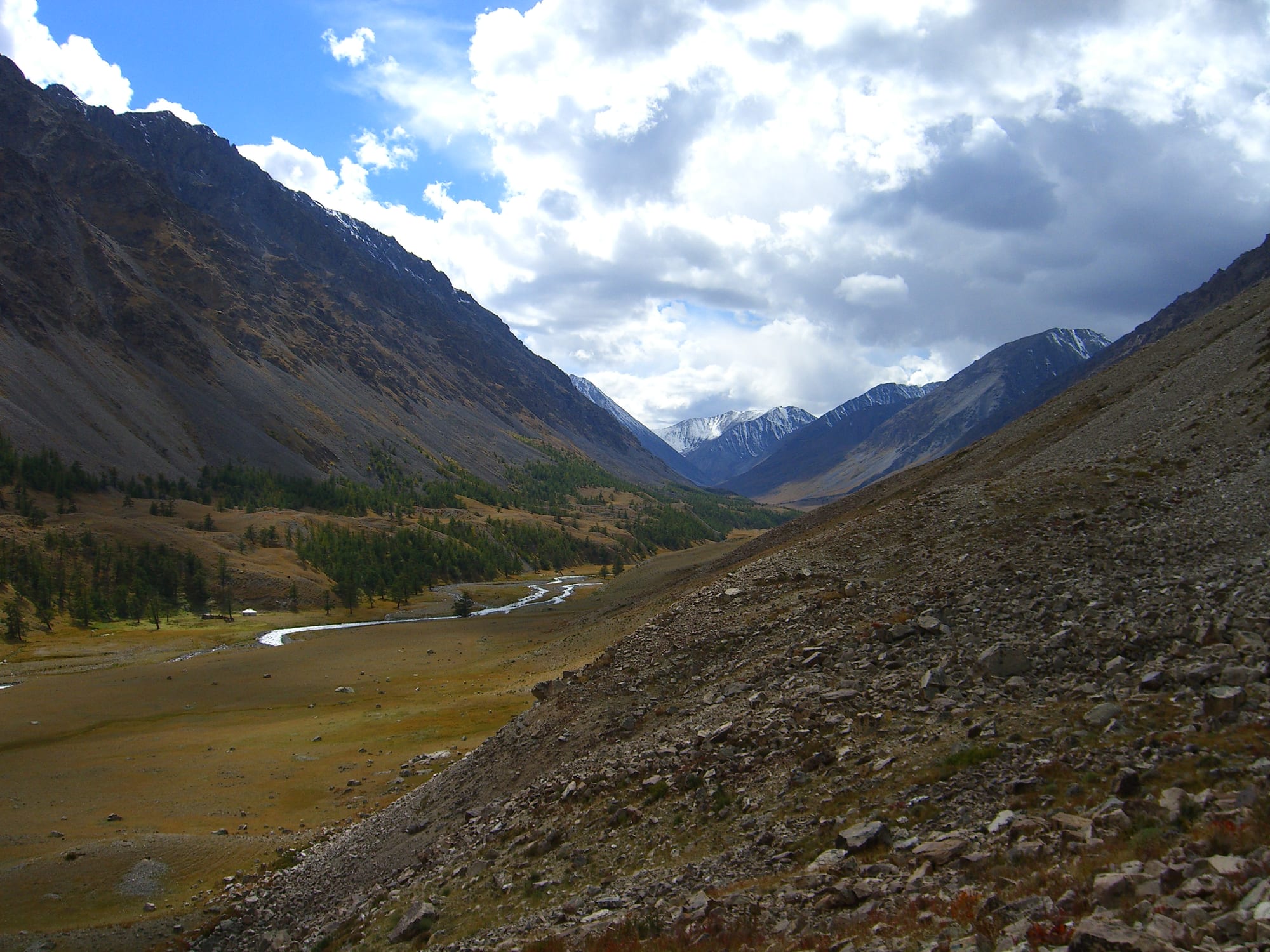
A river winding through a broad valley of larch and autumn grass between steep scree slopes and snowy peaks

Mongolia

The Altai & Western Mongolia

A summer valley in Altai Tavan Bogd National Park, Bayan-Ölgii province, in Mongolia's far west. (Altaihunters / Wikimedia Commons · CC BY-SA 3.0)

Mongolia's far west, running from the glaciers of the Altai on the Russian and Chinese borders across the Great Lakes Depression to the Khangai foothills of Zavkhan and the desert edge of Govi-Altai. It is the country's most ethnically mixed corner, home to Kazakh eagle hunters and the western Mongol peoples.

Explore The Altai & Western Mongolia

History

The Altai has been inhabited for tens of thousands of years, and its valleys hold one of Asia's densest records of prehistoric life: rock carvings of ibex, elk and chariots, Bronze Age deer stones, burial mounds of the Scythian era and stone figures left by the Turks of the 6th to 8th centuries. The mountains were a crossroads between the Mongolian plateau, Siberia and Central Asia.

After the Mongol Empire this was the land of the Oirats, the western Mongols, who in the 17th century built the Dzungar Khanate, a steppe power that fought the Khalkha Mongols and the Qing for decades. The Qing destroyed the Dzungars in the 1750s, and to control the frontier they relied on garrison towns: Uliastai in Zavkhan, founded in 1733 and seat of the Qing governor, and Khovd, moved to the Buyant river after 1757 as the administrative centre of the far west. In 1912, after Mongolia declared independence, Mongol forces besieged and took the Qing fortress of Khovd.

Kazakh herders settled in the Mongolian Altai, and in August 1940 the communist government created Bayan-Ölgii as a Kazakh-majority province. The region's political weight grew under Yumjaagiin Tsedenbal, Mongolia's long-serving communist leader, who came from Uvs. After 1990 many Kazakhs moved to independent Kazakhstan, though some later returned.

Culture & Customs

Bayan-Ölgii is Mongolia's Kazakh province. Kazakh is the everyday language, most people are Sunni Muslims, and Ölgii has mosques and Kazakh-language schools. Kazakh homes, including the white felt tents used in summer, are hung with brightly embroidered wall hangings, and the dombra, a two-stringed lute, is the favourite instrument. Nauryz, the spring new year, is widely celebrated.

The region's best-known tradition is hunting with golden eagles. Young eagles are taken from the wild, trained over years to hunt foxes and hares in winter, and often released back into the wild after years of service. The Golden Eagle Festival in Ölgii each October brings hunters on horseback in traditional dress to compete in calling their birds and in horsemanship.

The rest of the west is a patchwork of Mongol groups, among them the Dörvöd of Uvs and other peoples descended from the Oirats, alongside Khalkha in Zavkhan and Govi-Altai. Several keep distinct dialects, clothing and musical traditions.

Daily Life

The west is thinly populated. Ölgii, Khovd and Ulaangom are the main towns, each home to a few tens of thousands of people, while Uliastai and Altai are smaller. Most people outside the towns are herders of sheep, goats, yaks, horses and camels, and many families move between high summer pastures and sheltered winter camps.

Cashmere from the goats is the main cash earner, and Khovd has irrigated farms along the Buyant river that grow vegetables and melons. Harsh winters and drought hit hard here, and dzud years have pushed many families to move to the provincial centres or to Ulaanbaatar. Tourism, focused on the eagle hunters and the Altai, is a growing source of income around Ölgii.

The distance from the capital shapes everything: goods arrive by long road haulage, prices are higher, and many young people leave for study or work. In Bayan-Ölgii, cross-border ties with Kazakhstan and trade with Russia's Altai Republic keep the province facing west as much as east.

Food

Kazakh cooking sets the western table apart. The feast dish is beshbarmak, boiled mutton or horse meat served over broad sheets of noodle with onion broth, traditionally eaten by hand. Kazy is a rich horse-meat sausage, baursak are puffs of fried dough piled on the table for guests, and kurt, hard balls of dried salty curd, are carried on long journeys. Horses and sheep are slaughtered in late autumn to lay down meat for the winter.

Across the rest of the region, herding families eat mutton and goat, dried meat (borts) and the summer dairy foods of the Mongol steppe, while yak milk and butter are common in the high Altai and the Khangai. Tea with milk is poured constantly, and fermented mare's milk is drunk in summer.

Farming adds a few specialities: Khovd is known across Mongolia for its watermelons and melons, grown on irrigated fields near the town.

Attractions & Natural Wonders

In Bayan-Ölgii, Altai Tavan Bogd National Park contains Khüiten Peak, Mongolia's highest mountain, and the Potanin Glacier, its longest, reached by a trek from the road-head to a base camp below the ice. Lower down lie the long lakes of Khoton, Khurgan and Dayan, with larch forest and Kazakh summer camps. The Petroglyphic Complexes of the Mongolian Altai, a UNESCO World Heritage Site, include rock-art valleys at Tsagaan Salaa and around the upper Tsagaan Gol. Ölgii itself is the base for meeting the Kazakh eagle hunters and for the Golden Eagle Festival.

To the north-east, the Uvs Nuur Basin, a UNESCO World Heritage Site shared with Russia, centres on Uvs Lake, a vast saline lake among steppe, dunes and the snowy Kharkhiraa and Türgen mountains near Ulaangom. Khyargas Lake lies further south in the same province.

Khovd province holds Khovd town, once a Qing garrison, the Khar Us lakes of Khar Us Nuur National Park with the Jargalant Khairkhan massif above them, and the Tsenkher cave with prehistoric paintings. In Zavkhan, Uliastai sits in a mountain valley near the sacred Otgontenger, and the Govi-Altai province runs south towards the Gobi deserts of the Chinese border, where the Great Gobi reserves shelter wild camels and the rare Gobi bear.

Cities in The Altai & Western Mongolia

Planning basics

Budget

The west costs more to reach than to stay in. A domestic flight or a long overland drive is the biggest single expense, and once in Ölgii, Khovd or Ulaangom, guesthouses, canteens and homestays with Kazakh families are cheap. Trips into the Altai need a 4x4, driver and often packhorses or camels, and the Golden Eagle Festival pushes up prices in Ölgii.

Daily Budget Midrange
USD 100–210 (ger camp or guesthouse, a 4x4 and driver-guide, park fees, packhorses in the Altai)
Daily Budget Shoestring
USD 20–40 (guesthouse or homestay, canteen meals, shared minivans)

Book the flights to Ölgii or Khovd early for early October, and share a vehicle for the drive into Altai Tavan Bogd.

Safety

Crime is low. The risks are distance, altitude and weather: glaciers and river crossings in the Altai, sudden storms and snow in summer, long stretches without fuel or phone signal, and vehicle breakdowns far from help. Border zones require permits, and wandering too close to the frontier can bring trouble with border guards.

Travel with an experienced local driver or guide, carry warm clothing and spare supplies, and keep permits and passport at hand near the borders. Check current official travel advice before travelling.

Climate

The west is higher, drier and more extreme than central Mongolia. The Altai carries permanent snow and glaciers, with cold nights even in summer, while the Great Lakes Depression is semi-desert with hot summer days. The Uvs basin traps cold air and is bitterly cold in winter. Rain is scarce, and wind is constant on the open plains.

Summer
warm on the lake plains, 20–30°C; much cooler in the Altai, with frost and snow possible at any time at altitude
Winter
very cold, −20 to −40°C in the Uvs and Khovd basins, with deep snow in the mountains

Transportation

Scheduled flights link Ulaanbaatar with Ölgii, Khovd and Ulaangom, and the overland drive from the capital takes several days, partly on paved road. Within the region, shared minivans run between provincial centres, but reaching the national park and the lakes needs a 4x4 with a driver. A road border crossing at Tsagaannuur leads into Russia's Altai Republic.

Arrange permits for Altai Tavan Bogd, which lies in a border zone, through a local agency or park office in Ölgii before setting out.

Best Time to Visit

Late June to early September for trekking and the Altai lakes, when the high valleys are green and passable. The Golden Eagle Festival in Ölgii is held in early October, when it is already cold. Kazakh families celebrate Nauryz, the spring new year, in March, and winter eagle-hunting trips run from November with serious cold.