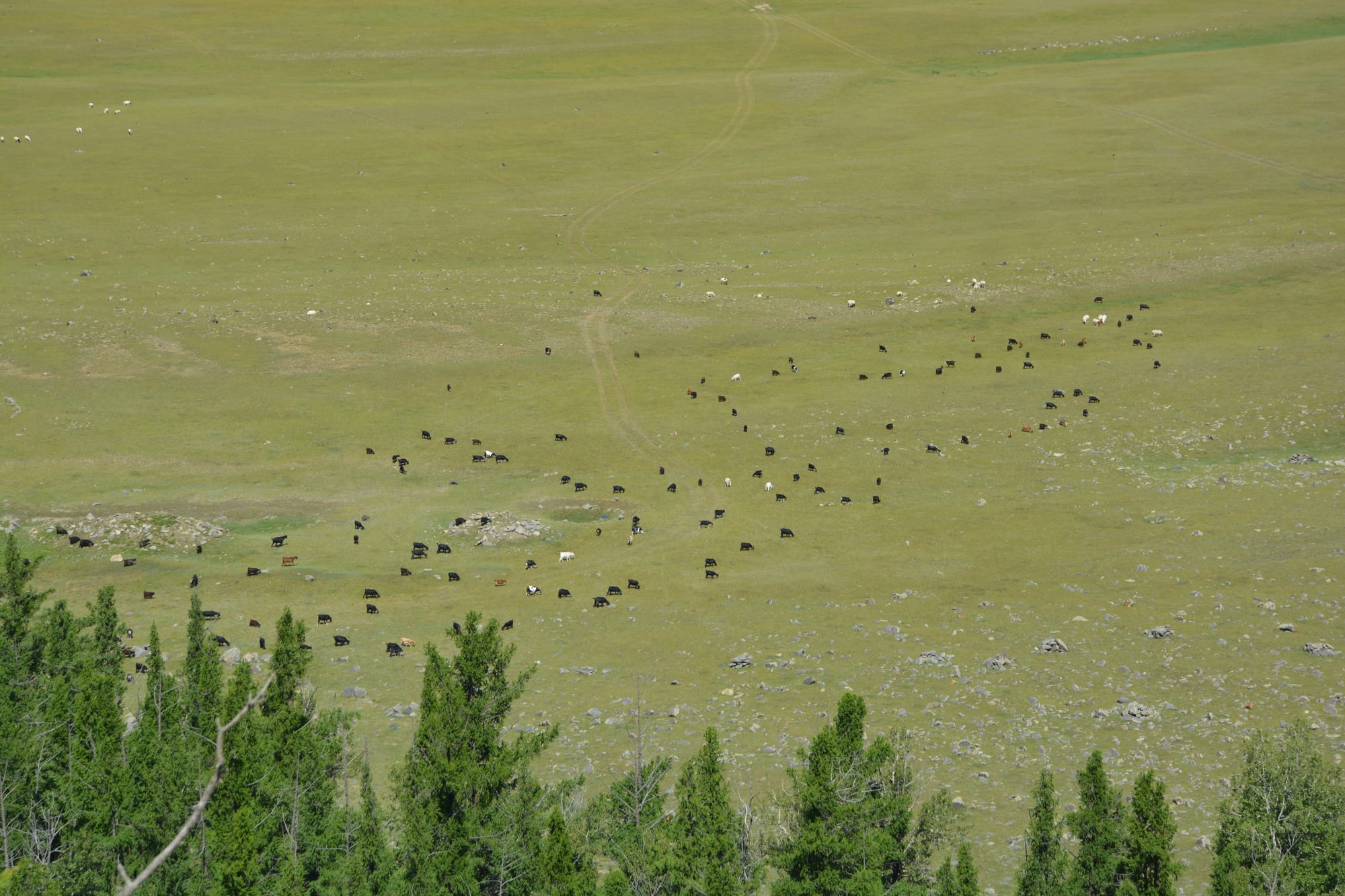
A herd of sheep and goats grazing across a wide green valley floor, seen from above over the tops of conifers

Mongolia

Khövsgöl & Northern Mongolia

Herds grazing in the Orkhon valley, the UNESCO-listed cultural landscape of central Mongolia's Khangai. (Jonashtand / Wikimedia Commons · CC BY-SA 4.0)

The forested north and the green Khangai heartland, from Lake Khövsgöl and the taiga on the Russian border south through Bulgan and the mining city of Erdenet to the Orkhon valley of Arkhangai and Övörkhangai. This was the seat of the steppe empires, and it holds Karakorum, Erdene Zuu and the country's richest pastures.

Explore Khövsgöl & Northern Mongolia

History

The Orkhon valley was the political heart of the steppe for well over a thousand years. Xiongnu remains have been found in the region's valleys, and the Turkic khaganates of the 6th to 8th centuries ruled from the Orkhon, leaving the Orkhon inscriptions at Khöshöö Tsaidam — the oldest known texts in a Turkic language. The Uyghur Khaganate then built its walled capital, Ordu-Baliq, on the river in the 8th century.

Genghis Khan chose the valley as a base, and his son Ögedei built Karakorum there as the imperial capital in the 1230s. Ambassadors, merchants and missionaries came from across Eurasia; the Flemish friar William of Rubruck described its silver fountain tree in 1254. After Kublai Khan moved the capital to China the city declined, and a Ming army sacked it in 1388. In 1585 Abtai Sain Khan founded Erdene Zuu beside the ruins, using their stones, and in the 17th century Zanabazar built his hermitage at Tövkhön on a mountain above the valley.

In the far north, the Darkhad and the reindeer-herding Dukha, who crossed from Tuva, lived at the edge of the empire and kept shamanic traditions. The purges of the 1930s shut almost every monastery, although part of Erdene Zuu survived as a museum. In the 1970s a Soviet–Mongolian venture opened a vast copper mine in the hills of Orkhon, and the city of Erdenet grew up around it.

Culture & Customs

The Khangai is regarded as classic Mongolian herding country, with rich pastures, yak herds, fine horses and families that have used the same seasonal camps for generations. Local Naadam festivals in the district centres are closer to their rural roots than the capital's, and the Orkhon valley's herders are well known for their horse racing.

The north is also the stronghold of Mongolian shamanism. The Darkhad of western Khövsgöl are famous for their shamans, who perform rituals with drums, and ovoo cairns around the lake serve as places of offering. The Dukha, a small Turkic-speaking people, herd reindeer in the taiga, riding and milking them and moving camp with their tepee-like tents as the lichen is grazed out.

Buddhism has revived around the old monasteries: Erdene Zuu again has resident monks, and the Zayain Khüree monastery in Tsetserleg houses a museum. In Erdenet, a sizeable Russian-speaking community gave the city a different, more urban character.

Daily Life

Erdenet, with more than 110,000 people, is Mongolia's second city and depends on the copper and molybdenum mine and processing plant, one of the largest in Asia and long the country's biggest earner. The other centres are much smaller: Mörön in Khövsgöl, Arvaikheer in Övörkhangai, Tsetserleg in Arkhangai and Bulgan, each a provincial town of a few tens of thousands at most, with a square, a theatre, markets and a ring of ger districts.

Beyond the towns this is herding country, with some of Mongolia's highest densities of livestock. Yak herding is common in Arkhangai, and families sell dairy, meat, wool and cashmere. Overgrazing, degraded pastures and dzud winters are recurring worries, and around Khövsgöl the growth of tourism has brought debates about camps, rubbish and pollution on the lakeshore.

Summer is the busy season, with herders moving to river pastures, tourists passing through Kharkhorin and families from the capital visiting relatives in the countryside. Winter is long and quiet, spent in sheltered camps in the valleys.

Food

The Khangai is dairy country. Yak and cow milk become tarag (yoghurt), öröm, a thick skin of clotted cream, aaruul, hard dried curds, and eezgii, a toasted cheese curd. In summer herders make airag from mare's milk, and skimmed milk is distilled into a light milk spirit, shimiin arkhi.

Meals are built on mutton, beef and yak meat, cooked as buuz, khuushuur and noodle soups, and for guests as khorkhog, cooked with hot stones. Around Lake Khövsgöl, fish such as lenok and grayling are caught and eaten, a rarity in Mongolian cooking, though fishing is regulated. The Dukha drink tea with reindeer milk and make cheese from it.

The forests add wild blueberries, lingonberries and pine nuts in late summer and autumn, and Erdenet's bakeries and shops reflect the Russian influence of its mining community.

Attractions & Natural Wonders

In Khövsgöl, Lake Khövsgöl stretches north towards the Russian border within a national park, with Khatgal on its southern tip as the base for camps, boat trips and walks along the shore. West of the lake lies the Darkhad valley, from which riders set out into the taiga to visit the reindeer herders. Khövsgöl is rich in deer stones, carved Bronze Age monoliths, and Mongolia's deer stone monuments were added to the UNESCO World Heritage List in 2023.

The Orkhon valley, a UNESCO World Heritage cultural landscape, holds the ruins of Karakorum at Kharkhorin, where a museum stands, and beside them the Erdene Zuu monastery inside its stupa-lined wall. Elsewhere in the valley are the Orkhon waterfall, the Tövkhön hermitage and the ruins of Ordu-Baliq, as well as the site of the Khöshöö Tsaidam inscriptions.

In Arkhangai, Tsetserleg has the Zayain Khüree monastery, Tsenkher hot springs lie in a valley of the same province, and the road west passes the Taikhar rock before reaching Terkhiin Tsagaan Lake and the Khorgo volcano. In the north, Erdenet's vast open-pit mine can be seen from viewpoints above the city, and Bulgan has the Uran Togoo extinct volcano.

Cities in Khövsgöl & Northern Mongolia

Planning basics

Budget

Costs are close to the national average. Kharkhorin, Tsetserleg and Khatgal have guesthouses and ger camps for every budget, while the Tsenkher springs and the Khövsgöl lakeshore camps charge more in high season. A trip to the reindeer herders is the region's big expense, needing a guide, horses and several days in the saddle.

Daily Budget Midrange
USD 85–200 (ger camp with meals, a 4x4 and driver-guide, horse hire, park fees)
Daily Budget Shoestring
USD 20–40 (guesthouse or basic ger camp, canteens, shared minivans)

Pay for a reindeer-herder visit through a guide who works with the Dukha community, and bring cash for park entry at Khövsgöl.

Safety

Crime is low outside Erdenet and the larger towns. The practical risks are muddy and flooded tracks in the summer rains, river crossings, cold lake water, horse riding accidents on remote trails and the long distance from medical help, especially in the taiga.

Ride with a local guide on reliable horses, carry rain gear and warm layers, and avoid swimming far out in Khövsgöl. Check current official travel advice before travelling.

Climate

The north is cooler and wetter than the rest of Mongolia, with forest on the northern slopes and lush summer pastures in the Khangai. Lake Khövsgöl freezes over completely in winter, and the Darkhad valley and Mörön have long, bitterly cold winters. Summer rain falls mostly in July and August, turning tracks to mud.

Summer
mild, 15–25°C by day, cold nights around the lake and in the taiga, frequent afternoon showers
Winter
long and severe, −20 to −40°C in the north, somewhat milder in the Orkhon valley

Transportation

A paved road runs west from Ulaanbaatar to Kharkhorin and Tsetserleg, a long day's drive, and another runs north through Bulgan to Mörön and on to Khatgal. Flights link the capital with Mörön, and a train runs from Ulaanbaatar to Erdenet via Darkhan. Beyond the main roads, Tsenkher, the Orkhon waterfall and the Darkhad valley need a 4x4 or horses.

Combine the Orkhon valley and Khövsgöl in a single loop with a driver-guide, allowing at least a week.

Best Time to Visit

Mid-June to early September, when the lake is ice-free, the valleys are green and the horse trails to the taiga are open; July brings local Naadam festivals in the provincial and district centres. September is cold at night but clear. Winter visits to a frozen Khövsgöl are possible.