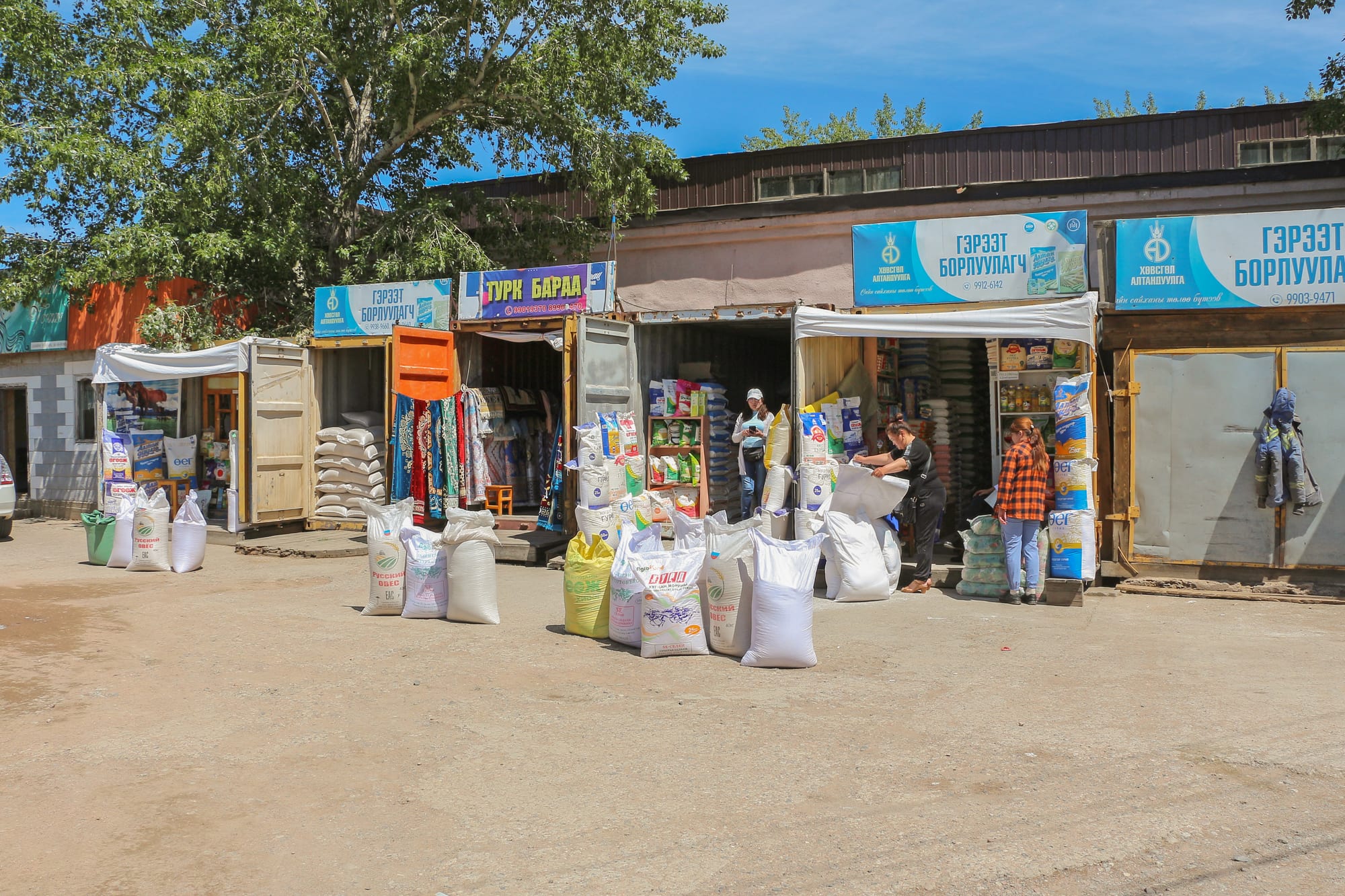
Stalls and shipping-container shops at an open market, with sacks of flour and rice stacked on the dusty ground and shoppers in the doorways

Khövsgöl & Northern Mongolia, Mongolia

Mörön

The central market in Mörön, the trading centre for Khövsgöl province. (Bernard Gagnon / Wikimedia Commons · CC0)

The capital of Khövsgöl province in northern Mongolia, a low town of about 47,000 people on the Delgermörön river some 670 kilometres from Ulaanbaatar. It is the administrative and market centre for one of the country's richest herding regions, and its airport and bus stands make it the gateway to Lake Khövsgöl, 100 kilometres to the north.

Neighbourhoods

  • The centre and the square
    • First-time visitors
    • Close to public transport

    A few blocks of Soviet-era flats, provincial government buildings, the theatre and a central square laid out around a monument. Hotels, banks and restaurants are concentrated here, and the streets are wide, paved and lined with young trees.

    Open in Maps
  • The market quarter
    • Best for food
    • Local life

    The zakh, a walled yard of stalls, shipping containers and shops east of the centre, selling flour, cuts of mutton, boots, saddlery, felt and imported goods. It is the busiest part of town in the morning, and the departure point for shared minivans to Khatgal and the districts.

    Open in Maps
  • The ger districts
    • Quiet and residential
    • Local life

    Fenced plots of gers and small wooden houses cover most of the town's area, spreading up the low slopes on every side. Water comes from standpipes, stoves burn coal and wood through the winter, and horses and cattle are kept in the yards.

    Open in Maps
  • The river flats
    • Walks
    • Quiet and residential

    The Delgermörön runs past the edge of town through willow scrub and gravel bars. It is where families picnic and swim in the short summer, and a concrete bridge just south of the town carries the road over it.

    Open in Maps

Things to do

In the town

  • Danzandarjaa Monasterylandmark

    The town's Buddhist monastery, built on the western edge of Mörön and reopened in 1990 to replace the far larger Mörön monastery destroyed in 1937, with up to forty monks and a collection of thangka.

    Open in Maps
  • Mörön central marketmarket

    The provincial market, where herding families buy supplies and sell wool, cashmere, hides and dairy, and where minivans to the countryside gather.

    Open in Maps
  • Mörön Airporttransit hub

    The province's airfield on the edge of town, with flights to Ulaanbaatar that carry most visitors heading for Lake Khövsgöl.

    Open in Maps

The river and the steppe

  • Delgermörönattraction

    The river that gives the town its name, flowing past Mörön and joining the Ider at Tömörbulag to form the Selenge.

    Open in Maps

Short trips from the town

  • Lake Khövsgölattraction

    A deep, clear freshwater lake among forested mountains, reached in about two hours on the paved road north from the town.

    Open in Maps
  • Khatgalattraction

    The wooden village at the southern tip of Lake Khövsgöl, the base for boat trips, horse riding and journeys into the taiga.

    Open in Maps

Seasonal events

  • NaadamJuly

    The provincial festival of wrestling, archery and cross-country horse racing, held at the stadium and on the steppe outside town.

  • Tsagaan Sarlate January or February

    The lunar new year, when relatives from the districts fill the town and households serve mountains of buuz and dairy to visitors.

Eat and drink

Long-standing places and food districts in Mörön. Hours, ratings and directions come from your maps app, always current.

Mörön classics

  • Buuz and khuushuurrestaurant

    Steamed mutton dumplings and the fried flat version are the everyday meal in the town's canteens, served with salted milk tea.

    Open in Maps
  • Yak dairy and aaruulmarket

    Khövsgöl is yak country, and the market sells thick öröm cream, soured tarag and trays of hard dried curd brought in by herding families.

    Open in Maps
  • Tsuivan and mutton soupsrestaurant

    Hand-cut noodles steamed over mutton, and noodle soups thickened with flour, are the staples of the guanz around the market.

    Open in Maps

Where to eat

  • The central marketmarket

    Stalls of meat, flour, dairy and imported goods with cheap canteens along the edge, the best place in town to see what Khövsgöl produces.

    Open in Maps
  • Restaurants around the central squareneighborhood

    The hotels and larger restaurants of the centre serve Mongolian dishes alongside Russian-influenced soups, cutlets and salads.

    Open in Maps

Experience Mörön

History

The town is younger than most of the sights around it. The Delgermörön valley has been grazed and fought over for millennia: Bronze Age herders raised the deer stones that stand on the steppe nearby, carved with stylised stags and belts of weapons, and the region later lay within the Turkic khaganates and then the Mongol empire. Khövsgöl is rich in such monuments, and the country's deer stone sites were added to the UNESCO World Heritage List in 2023.

Mörön itself grew from a monastery. Mörön monastery, founded in 1809–11 on the banks of the Delgermörön, drew a settlement of monks, traders and herding families to the riverside, as monastic centres did across Khalkha Mongolia. It held about two thousand monks in the early 20th century, and was destroyed in 1937 in the purge that closed more than seven hundred monasteries across Mongolia and killed many lamas.

The modern town was laid out in the socialist decades as the capital of Khövsgöl aimag, with a square, a theatre, a hospital, schools and blocks of flats built among the ger yards, an airfield, and state farms and herding collectives in the surrounding districts. The economy was organised around wool, meat, hides and the transport of goods north to Khatgal and the lake. After 1990 the collectives were broken up and herds returned to family hands; a new and much smaller monastery, Danzandarjaa, opened in 1990, the road to the lake was eventually surfaced, and tourism heading for Khövsgöl became a steady part of local income.

Culture & Customs

Mörön is a provincial capital in a herding aimag, and its culture is that of the countryside brought into town. Families keep animals on the outskirts even while holding salaried jobs, relatives arrive from the districts for schooling, medical care and paperwork, and the week's rhythm turns around the market. Khövsgöl's Naadam in July is the year's high point, with wrestling in the stadium, archery, and long cross-country horse races ridden by children across the steppe outside town; the province's horses and riders have a strong national reputation.

The aimag is ethnically varied for Mongolia. Khalkha make up most of the population, but the province is also home to Darkhad, Uriankhai and Buryat communities, and to the Dukha reindeer herders of the north-western taiga, so dialects, dress and songs differ from district to district. Shamanic practice is more visible here than in most of the country, alongside a revived Buddhism centred on Danzandarjaa monastery.

Everyday manners are those of ger hospitality: milk tea offered at once, snuff bottles exchanged between men of an older generation, the right hand or both hands used to give and receive, and an easy assumption that a visitor will be fed. Ovoo cairns on the passes around the town are circled three times clockwise, with a stone or a small offering added.

Daily Life

About 47,000 people live in Mörön, which makes it the fifth-largest town in Mongolia and by far the biggest settlement in Khövsgöl. Most of them live in ger districts of fenced plots rather than in the small core of flats, and the town spreads widely over the flat valley floor. Work is in provincial administration, the hospital, schools, shops and transport, in the market's trade, and in the wool, cashmere, meat and dairy that come in from the herding districts.

Mornings are the busy part of the day: the market fills, minivans load and leave for the countryside, and the afternoon is quieter. Heating through the long winter comes from coal and wood stoves in the ger districts, and the smoke settles over the town in still, cold weather, a smaller version of the air pollution that affects Ulaanbaatar. Water in much of the town is carried from standpipes.

The pressures are those of rural Mongolia generally: dzud winters that can destroy a family's herd, degraded pasture from growing animal numbers, and the steady movement of young people to Ulaanbaatar for university and work. Tourism heading to Lake Khövsgöl adds summer income through drivers, guides and guesthouses, and the road north has cut the journey to the lake to about two hours.

Food

Mörön eats what Khövsgöl produces: mutton, beef, yak meat and dairy, with flour and rice brought in by truck. Buuz, dumplings of minced meat and fat steamed in tiers, are the standard meal and the festival food at Tsagaan Sar; khuushuur are the same filling flattened and fried; tsuivan is hand-cut noodles steamed above the meat so the flavour rises into them. Guriltai shul, mutton noodle soup, and bantan, a thick flour broth, appear in every canteen.

The white foods are the region's pride. Yak milk makes a heavy öröm, the clotted cream skimmed from the top of boiled milk and eaten with bread and sugar; tarag is the soured milk that stands in for yoghurt; aaruul, milk curd pressed and dried hard, is sold in trays at the market and chewed all year. Eezgii, curd cooked slowly until it toasts and browns, is another dairy staple. Mare's milk fermented into airag is drunk through the summer.

Restaurants in the centre add Russian-influenced dishes that arrived in the socialist decades — beetroot and cabbage salads, fried cutlets, potato with dill — and bakeries sell heavy loaves of white bread. Fish from the lakes and rivers of the province, grayling and lenok, is eaten more here than in most of Mongolia, and in late summer the market fills with blueberries, lingonberries and pine nuts gathered in the northern forests.

Planning tools

Budget

Mörön is a working provincial town rather than a resort, and prices reflect that: hotel rooms, canteen meals and market food are inexpensive, and most spending goes on getting here and on the onward trip to the lake. Vehicle hire with a driver is the main expense, along with the flight from Ulaanbaatar if the two-day drive is avoided.

Daily Budget Midrange
USD 85–200 (hotel or ger camp with meals, a 4x4 and driver-guide, horse hire, park fees)
Daily Budget Shoestring
USD 20–40 (guesthouse or simple hotel, canteen meals, shared minivans)

Draw cash here before heading into the countryside, where machines are scarce, and ask at the market yard about shared minivans rather than booking a whole vehicle.

Best Time to Visit

June to early September, when the roads are open, the steppe is green and the lake season is under way; the provincial Naadam in July is the liveliest time in town. May and late September are clear, cold at night and much quieter. Winter is severe, though flights continue and the town functions normally.

Suggested Number of Days

Most travellers pass through in a day, long enough for the market, the monastery and the deer stones outside town. Three or four days make sense for anyone using Mörön as a base for the lake or for trips into the surrounding districts, which need a vehicle.

First Visit
1 day
With Surroundings
3–4 days

Transportation

The centre is small enough to walk, and taxis, shared cars and minivans cover the rest, gathering at the market. Shared minivans and jeeps run north to Khatgal and out to the district centres, leaving when full. There is no railway. Visitors heading beyond the paved roads hire a 4x4 with a driver, arranged through hotels and guesthouses.

Agree fares before getting into a shared car or taxi, and expect departures to the countryside to wait until a vehicle is full.

Airport & Station Connections

Mörön Airport is on the edge of town, with scheduled flights from Ulaanbaatar that take about an hour and a half. By road the capital is roughly 670 kilometres away, a long day and a half of driving on mostly paved road through Bulgan; long-distance buses and minivans make the trip overnight. A paved road runs 100 kilometres north to Khatgal on Lake Khövsgöl, about two hours.

Walkability

The centre, the market and the monastery lie within a couple of kilometres of one another on flat ground, and walking between them is easy. The ger districts spread much further and have unpaved, unlit lanes with loose dogs, so most people use a taxi after dark. Pavements are icy from November to March.

Safety

Serious crime is uncommon, and the town is calm by day. The usual cautions are petty theft in the market crowds and around the bus stands, drunkenness in the evenings, and loose dogs in the outer districts. Road conditions and long distances to help are the larger risk for anyone driving on into the countryside.

Keep valuables close in the market, use a taxi rather than walking through the ger districts at night, and check the weather before setting out on unsurfaced roads. Check current official travel advice before travelling.

Climate

A dry continental climate at about 1,300 metres, with a short warm summer and a long, severely cold winter. Most rain falls in July and August, and the swing between day and night temperatures is wide in every season.

Summer
warm, typically 20–26°C by day, cooling sharply at night, with afternoon showers in July and August
Winter
extremely cold, often −25 to −35°C, with thin snow, clear skies and smoke from stoves settling over the town

Local Customs

Manners here are rural Mongolian. Tea with milk is offered as soon as a guest enters a home or ger and is accepted with the right hand; the threshold is stepped over, never on. At the monastery, walk clockwise around temples and prayer wheels and ask before photographing monks. Dress is practical, and modest clothing is expected in religious buildings.

Tipping is not customary, although guides and drivers are usually given something at the end of a trip; ask permission before photographing people or their herds.

Common Payment Methods

The currency is the Mongolian tögrög. Mörön has bank branches and ATMs, and cards are accepted in hotels and larger shops, but market traders, minivan drivers and countryside guesthouses want cash. This is the last reliable place to withdraw money before the lake and the western districts.