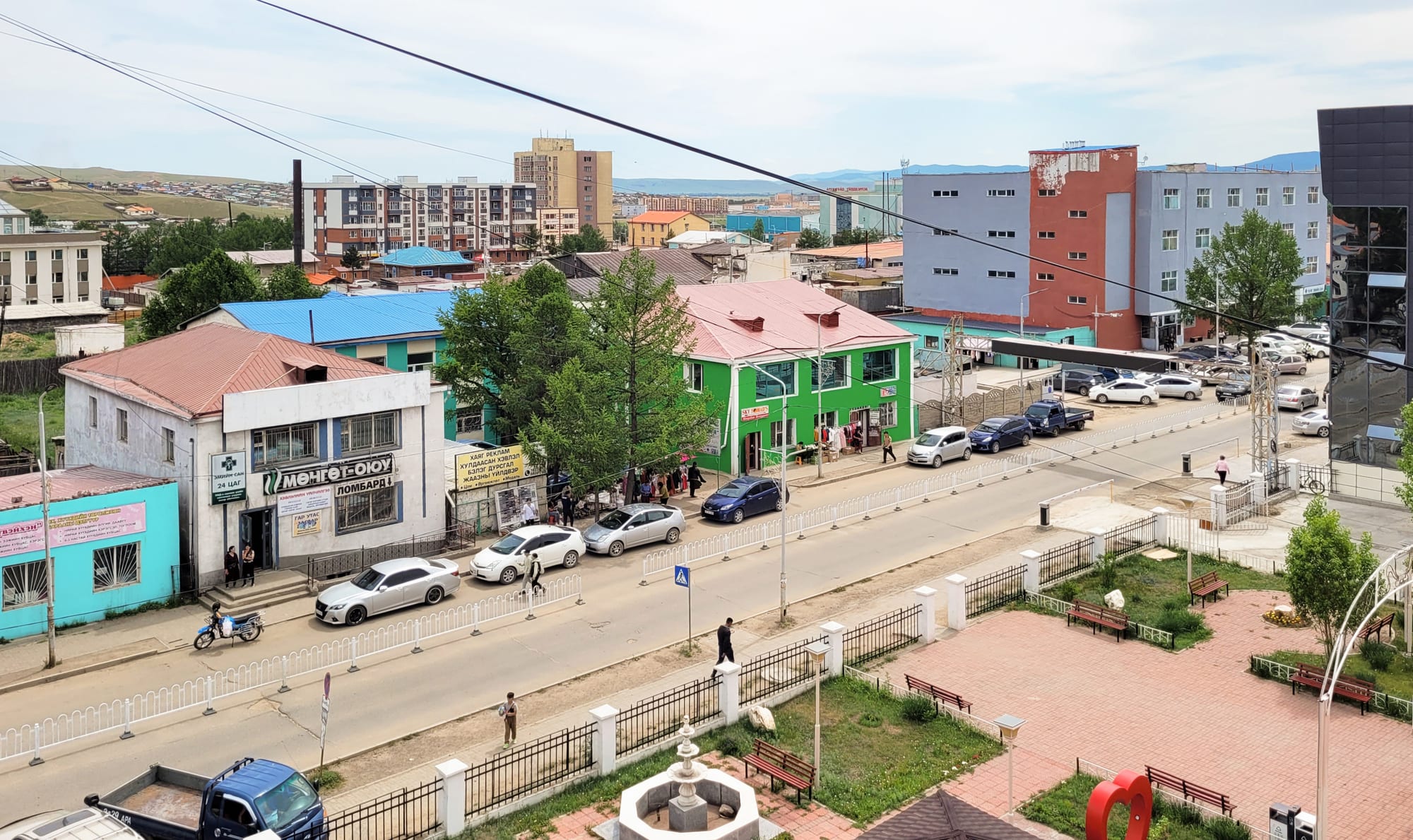
A paved main street of low painted shops and apartment blocks in a mountain town, with a small park, benches and parked cars in the foreground

Khövsgöl & Northern Mongolia, Mongolia

Tsetserleg

The centre of Tsetserleg, capital of Arkhangai Province, below the hills of the Khangai. (Bernard Gagnon / Wikimedia Commons · CC0)

The capital of Arkhangai province, set on the north-eastern slopes of the Khangai mountains, a long day's drive west of Ulaanbaatar. Unusually green and wooded for a Mongolian town, it grew around the Zayain Khüree monastery, whose surviving temples now hold the provincial museum, and it serves the rich yak-herding valleys, hot springs and rock monuments of the surrounding countryside.

Neighbourhoods

  • The centre
    • First-time visitors
    • Close to public transport

    A compact grid of paved streets below the monastery hill, with the provincial government building, a square, the theatre, banks, hotels and the larger shops. Most guesthouses and restaurants are within a few minutes' walk of one another here.

    Open in Maps
  • The monastery slope
    • Historic district
    • Walks

    The northern edge of town, where the surviving temples of Zayain Khüree stand against a rocky hillside with the provincial museum inside them. A path climbs past a painted rock face and a Buddha image to the ridge, giving a view over the whole town.

    Open in Maps
  • The ger districts
    • Quiet and residential
    • Local life

    Fenced plots of gers and small wooden houses spreading up the valley sides and along the stream, where most residents live. Lanes are unpaved, livestock is kept in the yards, and smoke from stoves hangs over them on winter mornings.

    Open in Maps

Things to do

In the town

  • Zayain Khüree Monasterylandmark

    A monastery built by the first Khalkha Zaya Pandita in the 17th century and enlarged by his successors into a complex of temples with hundreds of monks; the surviving buildings now house the Museum of Arkhangai Province.

    Open in Maps
  • Bulgan Mountainviewpoint

    The steep, partly wooded hill directly above the monastery, climbed on a rough path past a painted Buddha image for a view over the town and the valley.

    Open in Maps
  • Tsetserleg central marketmarket

    The town market, where herding families from across Arkhangai buy supplies and sell dairy, wool, cashmere and hides.

    Open in Maps

Short trips from the town

  • Taikhar Chuluulandmark

    An 18-metre granite rock beside the Khoit Tamir river at Ikh-Tamir, about 22 kilometres north of the town, carrying more than 150 petroglyphs and inscriptions in Old Turkic, Sogdian, Uyghur, Mongolian, Tibetan, Manchu and Chinese, and surrounded by legends about how it came to be there.

    Open in Maps
  • Tsenkher hot springsattraction

    Hot springs in a forested valley of Tsenkher district, south of the town, piped into bathing pools at the ger camps built around them.

    Open in Maps
  • Ögii Lakeattraction

    A freshwater lake on the road east, a Ramsar site known for its fish and its birdlife, with ger camps along its shore.

    Open in Maps

Seasonal events

  • NaadamJuly

    The provincial festival of wrestling, archery and long-distance horse racing, held at the stadium and on the grassland outside town.

  • Tsagaan Sarlate January or February

    The lunar new year, when families from the districts come into town to visit elders over piles of buuz and dairy.

Eat and drink

Long-standing places and food districts in Tsetserleg. Hours, ratings and directions come from your maps app, always current.

Tsetserleg classics

  • Yak dairymarket

    Arkhangai is yak country, and the market sells thick öröm clotted cream, soured tarag, hard aaruul curds and the toasted curd called eezgii.

    Open in Maps
  • Buuz, khuushuur and tsuivanrestaurant

    Steamed mutton dumplings, their fried flat version and hand-cut steamed noodles are what the town's canteens serve, with salted milk tea alongside.

    Open in Maps
  • Airagmarket

    Fermented mare's milk, mildly alcoholic and sharply sour, sold from churns by families along the roads of Arkhangai through the summer.

    Open in Maps

Where to eat

  • The central streetsneighborhood

    Small guanz and a few larger restaurants near the square serve Mongolian dishes and Russian-influenced soups, salads and cutlets.

    Open in Maps
  • Tsetserleg marketmarket

    Stalls and container shops selling meat, flour, dairy and household goods for the surrounding herding districts.

    Open in Maps

Experience Tsetserleg

History

The Khangai valleys around Tsetserleg were the heartland of the steppe empires long before the town existed. Bronze Age monuments, Turkic-era stones and the ruins of imperial capitals lie within a day's ride, and the pastures here were prized by every power that held central Mongolia. The town itself grew out of a religious foundation: Zayain Khüree, built by the first Khalkha Zaya Pandita, Luvsanperenlei (1642–1715), and enlarged by his successors into one of the larger monasteries of Khalkha Mongolia, with several temples, a printing tradition and hundreds of monks.

A settlement of traders, craftsmen and herding families gathered around the monastery walls, as it did at monastic centres across the country. The suppression of Buddhism ended the monastery: the sixth Zaya Pandita, Jambatseren, was killed in 1932 and the main Güden temple was turned into a museum, and the rest of Mongolia's monasteries were closed later in the decade. The surviving temples hold the Museum of Arkhangai Province.

Under the socialist system Tsetserleg was rebuilt as the capital of Arkhangai aimag, gaining a square, apartment blocks, a theatre, a hospital and schools, while the surrounding herds were organised into collectives producing wool, meat and dairy. After 1990 the collectives were dissolved and animals returned to families. The paved road from Ulaanbaatar and the growth of travel through the Khangai brought guesthouses and ger camps, and the town became a natural stop between Kharkhorin and the lakes to the west.

Culture & Customs

Arkhangai thinks of itself as classic Mongolian herding country, and Tsetserleg carries that identity. Yaks and their khainag crossbreeds are herded throughout the province, its horses have a strong reputation, and its Naadam in July is followed closely, with wrestling in the stadium, archery and cross-country races ridden by children over the open grassland. Singing, the horsehead fiddle and the long song tradition of the Khangai are still taught and performed locally.

Buddhism shapes the town's landmarks even where practice was broken. The monastery hill is a place of pilgrimage as well as a museum, with an ovoo cairn at the top, prayer flags, and a Buddha image painted on the rock face; people climb it at the new year and at other auspicious times, circling clockwise. Shamanic practice is present in the province too, as it is throughout northern Mongolia.

Manners are rural and unhurried. Guests entering a home or ger are given milk tea and dairy before anything is discussed, snuff bottles are still exchanged among older men as a greeting, and things are passed and received with the right hand. Relatives from the districts stay with town families when they come in for school terms, hospital visits or paperwork, so households are often larger than they look.

Daily Life

About 16,000 people live in Tsetserleg, which makes it a middling provincial capital, and the town has a noticeably different look from most of them: trees line the streets, hills close in on three sides, and the built centre of flats and offices is small against the ger districts spreading up the slopes. Work is in the provincial administration, the hospital, schools, the market and transport, together with the dairy, meat, wool and cashmere that come in from the surrounding districts.

Herding is the economy behind everything else. Arkhangai families keep yak, horses, cattle, sheep and goats, moving between seasonal camps in the valleys, and cashmere is the main source of cash income. Summer brings visitors passing between Kharkhorin, the hot springs and the Khangai lakes, which supports guesthouses, drivers and guides for a few months.

The difficulties are the familiar rural ones. Winter is long, heating comes from coal and wood stoves, and smoke settles in the bowl the town sits in during still weather. Dzud winters, when deep cold follows a poor summer, can kill livestock in numbers a family cannot recover from, and pasture degradation from growing herds is widely discussed. Young people leave for Ulaanbaatar to study and often stay there.

Food

Tsetserleg eats the food of the Khangai, which means dairy before anything else. Yak milk gives the region's öröm, a thick clotted cream skimmed from the top of boiled milk and eaten with bread; tarag, soured milk close to yoghurt; aaruul, curd dried hard in trays on roofs and fences and chewed through the year; and eezgii, curd cooked until it toasts and crumbles, a speciality of these valleys. Suutei tsai, tea boiled with milk and salt, is drunk all day.

Meat dishes are the national ones, made with mutton, beef and yak. Buuz are steamed dumplings of minced meat, fat and onion; khuushuur the same filling flattened and fried; tsuivan hand-cut noodles steamed over the meat; guriltai shul a mutton and noodle soup. Khorkhog, mutton cooked in a sealed churn with fire-heated stones, is the dish prepared for guests and celebrations at camps around the town.

Summer adds airag, mare's milk fermented in a leather or plastic churn and drunk by the bowl, and shimiin arkhi, a light spirit distilled from milk. The forests and hills give wild blueberries, lingonberries and pine nuts in late summer, sold by the bag at the market. Restaurants in the centre also serve the Russian-influenced food of the socialist decades, and bakeries sell heavy white loaves.

Planning tools

Budget

Tsetserleg is inexpensive: guesthouse beds, hotel rooms and canteen meals cost little, and the museum charges a small entry fee. The budget goes on transport, since the hot springs, the rock monuments and the Khangai lakes all need a vehicle, and on the ger camps out of town, which charge considerably more than accommodation in the centre.

Daily Budget Midrange
USD 85–200 (ger camp with meals, a 4x4 and driver-guide, horse hire, site fees)
Daily Budget Shoestring
USD 20–40 (guesthouse, canteen meals, shared minivans from Ulaanbaatar)

Carry cash for the countryside, where cards are rarely accepted, and share a vehicle with other travellers for the springs and the lakes.

Best Time to Visit

June to early September, when the Khangai valleys are green, the ger camps are open and the provincial Naadam is held in July. Late May and September are clear and quiet, with cold nights and frost. Winter is long and severe, though the town is reached easily enough on the paved road and the hot springs are at their best in the cold.

Suggested Number of Days

A day or two covers the monastery museum, the hill above it and the market. Allow three to five for the hot springs, the rock monuments and the lakes and volcano further west, all of which involve long drives on rough roads.

First Visit
1–2 days
With Surroundings
3–5 days

Transportation

The town is small and flat enough in its centre to walk, with taxis and shared cars for the ger districts. Minivans and buses run to Ulaanbaatar, Kharkhorin and the district centres, leaving from the market when full. There is no railway; the town has a small airport with a grass runway, but nearly everyone arrives by road. Trips into the Khangai are made by hired 4x4 with a driver or on horseback.

Arrange vehicles through a guesthouse, and allow far more time than the distances suggest once off the paved road.

Airport & Station Connections

A paved road runs west from Ulaanbaatar, most of a day by car; buses and shared minivans make the trip daily from the capital's western bus station. Kharkhorin is around 120 kilometres to the south-east, a common stop on the same route, and the road continues west towards Terkhiin Tsagaan Lake and Khövsgöl province.

Walkability

The centre is easily walked: the square, the museum, the market and the guesthouses stand within a kilometre of one another, and the path up the hill starts behind the temples. The ger districts climb the valley sides on unpaved, unlit lanes, and winter ice makes the slopes hard going from November to March.

Safety

The town is quiet and crime against visitors is unusual, with petty theft in the market and drunkenness late in the evening the main nuisances. Loose dogs guard some compounds in the ger districts. The larger risks lie outside: rough tracks, river crossings, sudden cold and long distances from medical help in the Khangai.

Avoid walking alone through the outer districts at night, keep clear of unfamiliar dogs, and carry warm and waterproof layers even in summer. Check current official travel advice before travelling.

Climate

A cold continental mountain climate. Summers are short, mild and comparatively wet, winters long and cold, and nights cold in every season; a local microclimate gives the town cooler summers and milder winters than most of Mongolia.

Summer
mild, typically 18–24°C by day, with cold nights and frequent showers in July and August
Winter
cold but mild by Mongolian standards, usually −15 to −25°C at night and milder by day, rarely below −30°C, with thin snow

Local Customs

The monastery is a museum but the hillside above it remains a place of worship, with an ovoo cairn and a rock-painted Buddha image; walk clockwise, leave offerings where they are and ask before photographing worshippers. In gers, tea is offered immediately and taken with the right hand, the threshold is stepped over rather than on, and gifts brought from town are welcomed.

Tipping is not traditional, although drivers and guides are usually given something at the end of a trip; ask permission before photographing people or their animals.

Common Payment Methods

The currency is the Mongolian tögrög. The town has bank branches and cash machines, and cards work in hotels and the larger shops, but the market, minivan drivers, horse owners and countryside camps take cash only. Withdraw enough here before heading further into Arkhangai.