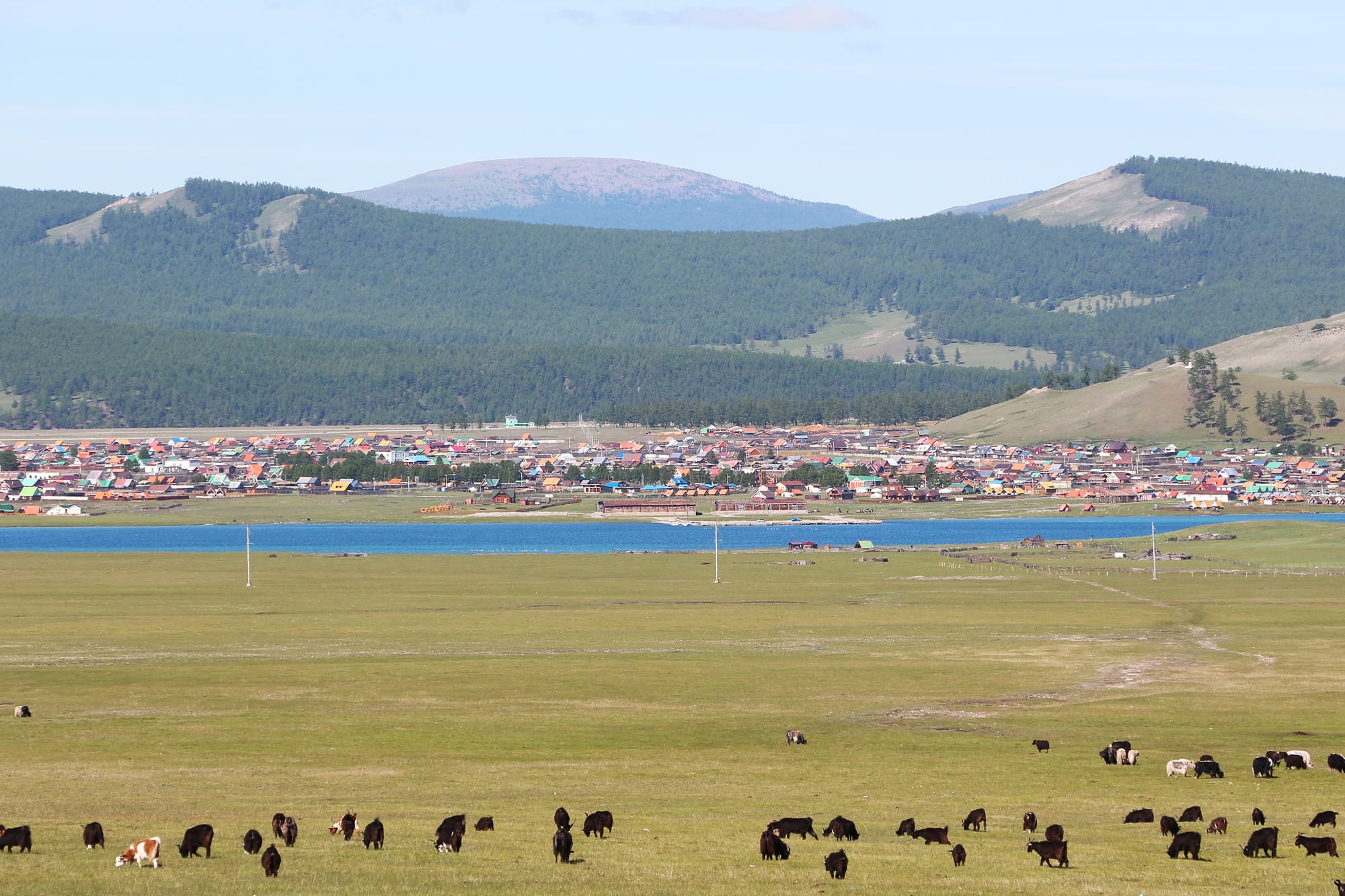
A village of brightly roofed wooden houses along a blue lake shore, with grazing yaks on grassland in front and forested hills behind

Khövsgöl & Northern Mongolia, Mongolia

Khatgal

Khatgal at the southern end of Lake Khövsgöl, with yaks grazing on the flats below the village. (Bernard Gagnon / Wikimedia Commons · CC0)

A village of wooden houses and log fences at the southern tip of Lake Khövsgöl in northern Mongolia, about 100 kilometres north of the provincial capital Mörön. Built as a lake port and wool-washing centre, it lost that trade after 1990 and now lives from the national park at its gates, with ger camps, boats, horses and forest trails along the shore.

Neighbourhoods

  • The village centre
    • First-time visitors
    • Local life

    A loose grid of log houses behind wooden palisade fences, with shops, a school, a small hospital and the district offices. Guesthouses, tour operators and drivers offering horses and boats are concentrated here, and it is where minivans from Mörön stop.

    Open in Maps
  • The lake shore and the harbour
    • Boat trips
    • Walks

    North of the houses the ground opens onto the water, with a jetty, moored boats and the remains of the Soviet-era port. Paths follow the shoreline into larch forest, and the national park entrance gate is a short way up the road along the lake.

    Open in Maps
  • The camps along the western shore
    • Quiet and residential
    • Riding

    Ger camps and herding families are spread for many kilometres north of the village along the lake's western side, reached by rough tracks. They are quieter than Khatgal itself, sit directly on the water among trees, and are the usual base for riding and multi-day walks.

    Open in Maps

Things to do

The lake and the park

  • Lake Khövsgölattraction

    A deep, clear freshwater lake 136 kilometres long that holds almost 70 per cent of Mongolia's fresh water and freezes over completely each winter.

    Open in Maps
  • Egiin Golattraction

    The lake's only outflow, leaving the water beside Khatgal and running south-east to join the Selenge, popular for fishing and rafting.

    Open in Maps

Short trips from the village

  • Mörönattraction

    The provincial capital south of the lake, with the airport, the provincial museum and the market most visitors pass through on the way in.

    Open in Maps
  • Darkhad Valleyattraction

    A broad valley of lakes and pasture west of Khövsgöl, known for its shamans and as the way in to the reindeer-herding taiga.

    Open in Maps
  • Khoridol Saridagviewpoint

    A protected mountain range of forest and bare ridges rising west of Lake Khövsgöl, crossed by riding trails from the lakeshore.

    Open in Maps
  • Tsagaannuurattraction

    A village beside a lake in the Darkhad valley, the usual starting point for riding trips to the Dukha reindeer-herding camps in the taiga.

    Open in Maps

Seasonal events

  • Blue Pearl Ice Festivallate winter

    Khövsgöl province's ice festival, with races, wrestling, ice sculpture and horse-drawn sleighs on the frozen lake off the village, the main event of the cold season.

  • NaadamJuly

    The district festival of wrestling, horse racing and archery, held on the grassland outside the village in the same days as the national holiday.

  • Tsagaan Sarlate January or February

    The lunar new year, when families visit their elders with piles of buuz and dairy foods, the quietest and coldest time for visitors.

Eat and drink

Long-standing places and food districts in Khatgal. Hours, ratings and directions come from your maps app, always current.

Khatgal classics

  • Lake fishrestaurant

    Lenok and grayling from Khövsgöl are grilled or fried at camps and guesthouses, an unusual thing to find on a Mongolian table; fishing is licensed and seasonally restricted.

    Open in Maps
  • Yak dairymarket

    The herds around the lake are largely yak, and their milk becomes thick öröm cream, tarag yoghurt and the dried curds sold from houses and roadside stalls.

    Open in Maps
  • Buuz, khuushuur and tsuivanrestaurant

    Steamed mutton dumplings, their fried flattened version and hand-cut steamed noodles are the standard meals in the village canteens.

    Open in Maps

Where to eat

  • The village canteens and guesthouse kitchensneighborhood

    A handful of small guanz and guesthouse dining rooms near the centre serve soups, dumplings and milk tea; most ger camps along the shore cook for their own guests.

    Open in Maps

Experience Khatgal

History

Khatgal exists because of the water beside it. The lake had long been fished and grazed around by Darkhad and Khalkha herders, but the settlement took shape in the early 20th century as a trading point on the route between Russia and inner Mongolia, where goods were transferred between carts, pack animals and boats. A wool-washing plant was built here in the Soviet-aligned decades, and the village became a small industrial centre: wool from the surrounding aimag was cleaned, baled and shipped north across the lake and on into Siberia. Khatgal was the seat of the new Khövsgöl aimag from 1931 until the administration moved to Mörön in 1933.

The lake port was the heart of that economy. Barges carried fuel, timber and wool the length of Khövsgöl, and trade with the Soviet Union kept the village in work. When the Soviet system ended after 1990 the traffic stopped almost at once, the wool factory closed, and a place of about 7,000 people in 1990 was down to some 3,700 by 1994. Rusting hulls and empty sheds on the shore date from that collapse.

What replaced it was the national park around the lake and the tourism that followed. Ger camps opened along the western shore through the 1990s and 2000s, the road from Mörön was surfaced, and Khatgal became the gateway for boat trips, riding and journeys to the Dukha reindeer herders of the taiga. The village is smaller than in its port years, and its wooden houses and log fences still have the look of a place built for a different purpose.

Culture & Customs

Khatgal sits where the Mongolian steppe world meets the Siberian forest, and both are present. The district is mainly Khalkha and Darkhad, herding yak, horses, sheep and goats on the flats at the lake's southern end, while to the north-west in the taiga live the Dukha, a small Turkic-speaking people who herd reindeer, ride and milk them and move camp with the lichen. Visits to their camps are made on horseback over several days and arranged through guides connected to the families.

Shamanism is unusually strong in this corner of Mongolia. The Darkhad valley west of the lake is known across the country for its shamans, who drum and wear ironwork-heavy costumes, and the lake itself is regarded as a mother water, with ovoo cairns and scarf-hung trees at the headlands. Buddhist practice sits alongside it without much friction, as it does throughout the north.

Life in the village follows the visitor season and the ice. Summer brings outsiders, work and Naadam, held in July with wrestling on the grass and cross-country horse races ridden by children. In late winter the frozen lake becomes a road and a festival ground, with sleighs, skating and ice sculpture. Hospitality is the same as in the countryside: tea with milk is offered immediately, guests sit to the left of the door, and the exchange of small gifts matters more than punctuality.

Daily Life

Roughly 3,000 people live in the sum, a figure that swells with seasonal workers each summer and thins again in autumn. Households combine several kinds of income: herding yak and horses, running a guesthouse or a handful of gers, driving, guiding, hiring out horses, working for the park administration, or holding one of the salaried jobs at the school, clinic and district office. Fishing supplements the diet where it is licensed.

The village is built of wood, unusually for Mongolia, with single-storey houses inside tall log palisades and gers standing in many of the yards. Heating is by stove, water comes from wells and the lake, and power supply has historically been patchy. Supplies arrive by road from Mörön, so prices in the shops are higher than in the provincial capital and choice is narrow, especially outside summer.

The concerns people discuss are the ones the region shares: overgrazing on the shore pastures, rubbish and sewage from camps reaching the lake, the future of mining licences in the wider aimag, and dzud winters that can kill a family's herd in a season. Young people leave for Mörön and Ulaanbaatar to study and often do not come back, while the tourist season brings some of them home for a few months each year.

Food

The kitchen here is the northern Mongolian one, built on yak and mutton. Buuz, steamed dumplings of minced meat, fat and onion, and khuushuur, the same filling fried flat, are what canteens make; tsuivan, hand-cut noodles steamed over meat, and guriltai shul, a mutton and noodle soup, fill out the rest of the menu. Ger camps cook khorkhog for groups, mutton sealed in a churn with hot stones.

Dairy is the region's speciality, and the lake basin's yaks give it richness. Öröm is the thick clotted cream skimmed from boiled milk, eaten with bread and sugar; tarag is soured milk close to yoghurt; aaruul, hard dried curd, dries in trays on roofs and fences through late summer; eezgii is a toasted, crumbly curd. Salted milk tea, suutei tsai, is drunk all day and offered to every visitor.

Fish is what makes Khatgal unusual. Lake Khövsgöl holds lenok and grayling, and grilled or pan-fried fish appears at camps and guesthouses in a country where many people traditionally did not eat it at all; catches are regulated and seasonally closed. Late summer adds forest gathering — blueberries, lingonberries and pine nuts from the larch and cedar woods — sold by the bag along the road to Mörön.

Planning tools

Budget

Khatgal is cheap to stay in and costly to reach. Guesthouse beds and canteen meals are among the lowest prices in Mongolia, while the drive or flight from Ulaanbaatar, national park entry, boat hire, horses and guided trips into the taiga are what fill the budget. Lakeshore camps charge considerably more in July and August than in the shoulder months.

Daily Budget Midrange
USD 85–200 (lakeshore ger camp with meals, a 4x4 and driver-guide, horse hire, park fees)
Daily Budget Shoestring
USD 20–40 (guesthouse or basic ger camp, canteen meals, shared minivan from Mörön)

Bring enough cash for park entry, horses and boats, as card payment is unreliable in the village and there are few machines.

Best Time to Visit

Mid-June to early September, when the lake is ice-free, the camps are open and the trails north are passable. July and August bring the warmest water, the Naadam races and also the heaviest rain and mud. Late winter is the other season, with a frozen lake, the ice festival and temperatures far below freezing.

Suggested Number of Days

Two or three days are enough for the village, the shore and a boat or a short ride. Allow five to seven for longer riding trips along the western shore or a journey to the reindeer-herding families in the taiga, which involves several days on horseback and a guide.

First Visit
2–3 days
With Surroundings
5–7 days

Transportation

The village is small enough to walk across, and there is no public transport within it. Shared minivans and jeeps run to Mörön, and most visitors arrive with a hired vehicle or a tour. Along the lake, movement is by 4x4 on rough tracks, on horseback, or by boat from the jetty; the eastern and western shores are not linked by a road around the north.

Arrange horses, boats and drivers through the guesthouse or camp rather than at the roadside, and allow far longer than the distance suggests on lakeside tracks.

Airport & Station Connections

Most visitors fly from Ulaanbaatar to Mörön, an hour and a half in the air, then drive about 100 kilometres north on a paved road, roughly two hours. Driving the whole way from the capital takes a long day and a half, around 800 kilometres. Shared minivans link Mörön's market with the village, and onward travel to the eastern shore or the Darkhad valley needs a hired 4x4.

Walkability

Khatgal is entirely walkable: the houses, shops and jetty lie within a kilometre or two on flat ground beside the water, and forest paths start at the edge of the village. Streets are unpaved, dusty in dry weather and churned to mud after rain, there is no street lighting to speak of, and the camps further along the shore are too far apart to reach on foot.

Safety

Crime is rare and the village is quiet. The real risks are outdoors: the lake is very cold even in August and sudden squalls make small boats dangerous, tracks flood in the summer rains, riding accidents happen on rough ground, and loose dogs guard some compounds. Medical care beyond first aid means a journey to Mörön or Ulaanbaatar.

Wear a life jacket on boats, do not swim far from shore, ride with a local guide on horses chosen for beginners, and carry warm and waterproof layers in any month. Check current official travel advice before travelling.

Climate

Cold and comparatively wet by Mongolian standards, at about 1,650 metres beside a large body of water. Summers are short and mild with frequent afternoon showers; winters are long and severe, and the lake freezes hard enough to be driven on. Frost is possible in any month.

Summer
mild, typically 15–22°C by day, with cold nights near or just above freezing and regular rain in July and August
Winter
severe, commonly −25 to −35°C, with deep cold settling over the frozen lake from January to March

Local Customs

Lake Khövsgöl is treated as sacred: ovoo cairns and trees hung with blue ceremonial scarves stand at viewpoints and headlands, and offerings are left there rather than removed. Washing with soap in the lake, and throwing rubbish into it, are strongly disapproved of. Visits to Dukha reindeer-herding families are arranged through guides who work with the community, and their camps are homes rather than attractions.

Ask before photographing people, herds or shamanic sites, accept tea with the right hand when entering a ger, and do not remove anything left at an ovoo.

Common Payment Methods

The currency is the Mongolian tögrög. The village has a bank branch and a shop or two that accept cards, but ATMs are few and connections drop out, so most transactions are in cash. Park fees, horses, boats and family-run guesthouses generally take nothing else; withdraw what is needed in Mörön or Ulaanbaatar.