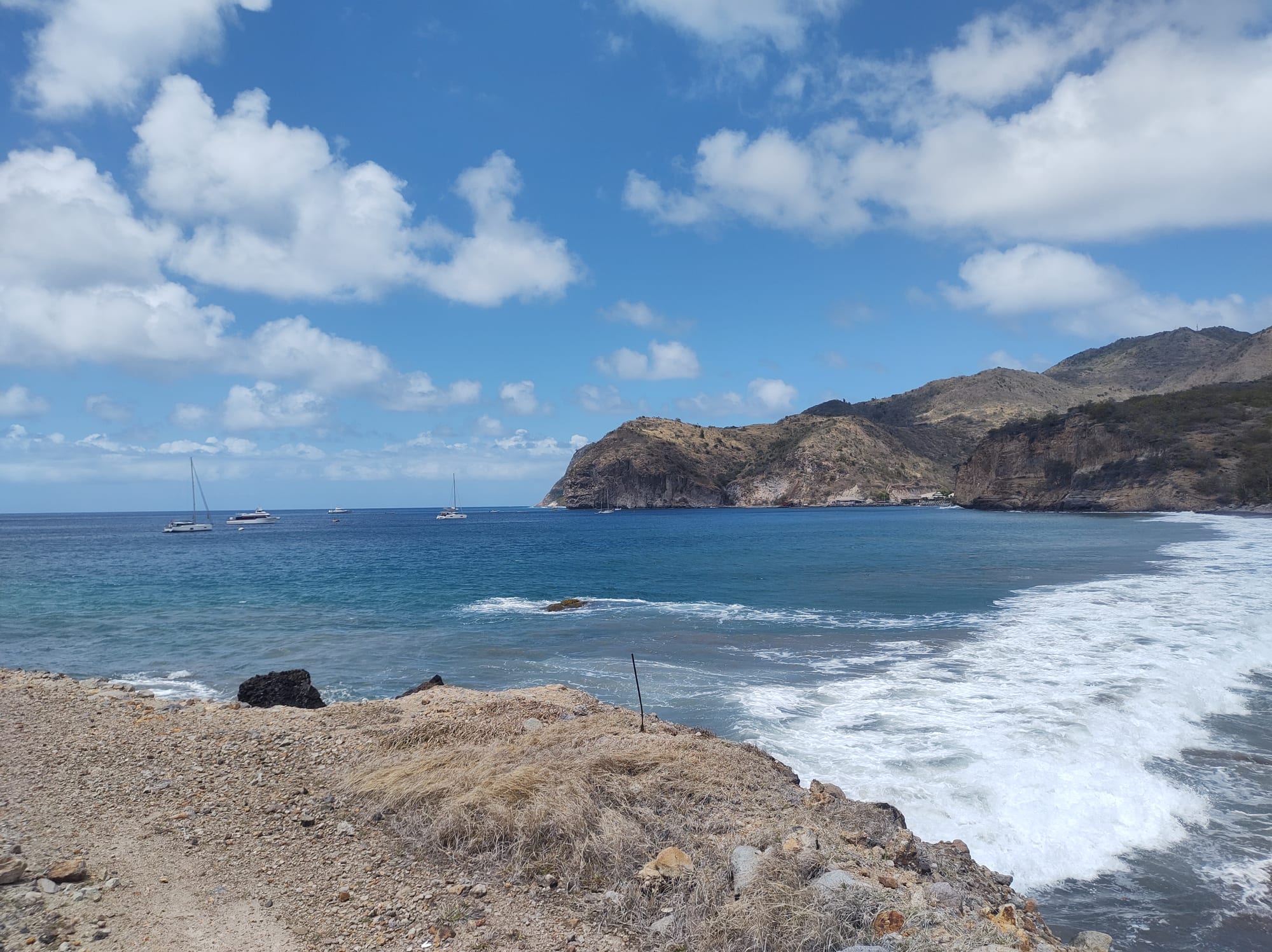
A curving bay of deep blue water with white surf breaking on a stony shore, sailing boats at anchor and dry brown headlands under a sky of white clouds

Montserrat

Brades

Carr's Bay, on the coast near Brades. (Addshore / Wikimedia Commons · CC BY-SA 4.0)

A small settlement on the north-west coast of Montserrat that has served as the seat of government since 1998, after the Soufrière Hills volcano buried the old capital, Plymouth. Interim government offices, a bank, shops and a library line its main road, while a new port and capital take shape next door at Little Bay.

Neighbourhoods

  • Brades and the Main Road
    • First-time visitors
    • Government and services

    The interim seat of government, strung along the Brades Main Road on the north-west shore. Government offices, the post office in Government House, the public library, two banks, a pharmacy and a handful of shops and eateries make it the island's working centre, though it feels more like a large village than a capital.

    Open in Maps
  • Little Bay
    • Ferry and boats
    • Beaches
    • Museums

    The bay just north of Brades where the island's seaport stands and a new capital is being built. It holds the Montserrat Cultural Centre, the National Museum, a beach with bars, and the pier used by dive and boat-tour operators.

    Open in Maps
  • Davy Hill
    • Quiet and residential

    A village on the saddle between the Centre Hills and Silver Hill, a short way north-east of Brades across the Collins River. It is home to a few hundred people.

    Open in Maps
  • Salem and Olveston
    • Local life
    • Schools and churches
    • Quiet and residential

    The most populous town on the island, further south on the west coast, evacuated in 1997 and resettled the following year. The secondary school and community college are here, and George Martin's AIR Studios stood nearby; the Volcano Observatory is just outside it, at Flemmings.

    Open in Maps

Things to do

Brades and Little Bay

  • National Museum of Montserratmuseum

    A small museum on the main road in Little Bay, opened in 2012 and run by the Montserrat National Trust, telling the island's story from pre-Columbian times to the present.

    Open in Maps
  • Montserrat Cultural Centreattraction

    The island's auditorium and concert venue at Little Bay, built partly with money raised by the 1997 Music for Montserrat concert in London, with a wall of bronze hand-prints left by musicians who once recorded on the island.

    Open in Maps
  • Carr's Bay Gun Batterylandmark

    An old coastal gun battery on Carr's Bay, near Little Bay, now used as a picnic area, with the ruins of the master's house of Carr's Plantation visible nearby.

    Open in Maps

The volcano

  • Montserrat Volcano Observatorymuseum

    The observatory at Flemmings, near Salem, that has watched the Soufrière Hills volcano since 1995, with an observation deck, a visitor centre and a documentary film about the eruption and its impact.

    Open in Maps
  • Soufrière Hillsviewpoint

    The volcano that came back to life in 1995, last erupted in 2013 and has rendered more than half of the island uninhabitable; it is seen from a good distance, from the Observatory or the viewpoint at Jack Boy Hill on the east side.

    Open in Maps
  • Plymouthviewpoint

    The old Georgian capital, abandoned in 1997 after pyroclastic flows and mudflows buried it and still the island's capital in law; access to the hazard zone depends on the Observatory's assessment, and boat tours that pass it may not land.

    Open in Maps

Hills and island sights

  • Centre Hillspark

    A forest reserve in the middle of the island with hiking trails, one of only two areas where the critically endangered Montserrat oriole, the national bird found nowhere else, still lives.

    Open in Maps
  • AIR Studios ruinslandmark

    The abandoned studio near Salem where George Martin's AIR recorded Dire Straits, the Police, Paul McCartney and Elton John in the 1980s, abandoned after Hurricane Hugo in 1989 and now in ruins.

    Open in Maps
  • John A. Osborne Airporttransit hub

    The island's only airport, at Gerald's in the north, opened in 2005 with a 1,946-foot runway and a public tunnel beneath it, the only one of its kind in the Caribbean.

    Open in Maps

Seasonal events

  • St Patrick's Festivalten days around 17 March

    Montserrat's best-known festival, held at venues in Salem, Brades, Little Bay and Cudjoe Head, celebrating the Irish heritage and remembering the enslaved people's uprising planned for St Patrick's Day 1768.

  • Calabash FestivalJuly

    A festival of African and Caribbean culture and music.

  • December FestivalDecember to New Year's Day

    The island's carnival, the biggest holiday of the year, with calypso and soca competitions, street dancing and masquerade, ending with a street parade on 1 January.

Eat and drink

Long-standing places and food districts in Brades. Hours, ratings and directions come from your maps app, always current.

Brades classics

  • Goat waterrestaurant

    The national dish — a stew of goat on the bone, often with breadfruit, green pawpaw and dumplings in a tomato base, served with crusty bread rolls at weddings, parties and funerals.

    Open in Maps
  • Tina's Restaurantrestaurant

    A green wooden building on the Brades Main Road known for local lunches.

    Open in Maps

Beach bars

  • Pont's Beach Viewrestaurant

    A bar on the beach at Little Bay, known for its Sunday barbecue.

    Open in Maps
  • Bunkum Bay Beach Barrestaurant

    A beach bar at St Peter's, just south of Brades, that also serves snacks.

    Open in Maps

Experience Brades

History

Brades was a small estate settlement on the north-west coast until the Soufrière Hills volcano came back to life in July 1995. As eruptions destroyed the south of the island, Plymouth, the capital, was evacuated and then abandoned in 1997 under pyroclastic flows and mudflows. Interim government buildings were put up at Brades, which became the temporary capital in 1998. The move was meant to be short-term, but Brades has remained the de facto capital ever since, while Plymouth remains the capital in law.

The north had seen its own losses. Hurricane Hugo damaged about 90 per cent of the island's buildings in 1989, and Salem, further down the west coast, was itself evacuated in August 1997 before being resettled in 1998. The island's library is one of many institutions that had to begin again here: the new library built in Plymouth in 1997 never opened, and the public library at Brades replaced it.

The permanent answer is a new town and port at Little Bay, next to Brades. Names suggested for it have included Port Diana, after Diana, Princess of Wales, and St Patrick's. Site work began in 2013 and construction of the port in May 2019; after delays from Hurricanes Irma and Maria in 2017 and the pandemic, the United Kingdom's Caribbean infrastructure fund granted £28.3 million for the harbour in June 2022.

Culture & Customs

Montserratian culture mixes African, British and Irish strands, and the African influence is the strongest — in the creole speech, folk tales, songs and the jumbie dance. Traditional string bands play the ukulele and the shak-shak, a rattle made from a calabash gourd, and the island's best-known musician, the soca bandleader Alphonsus "Arrow" Cassell, recorded "Hot! Hot! Hot!" in 1982. Calypso and community choirs perform at special occasions through the year.

The two great festivals reach Brades and Little Bay directly. Since 1985 St Patrick's Day has been extended into a ten-day holiday that celebrates Irish ancestry and commemorates the uprising planned for 17 March 1768; events are spread across Salem, Brades, Little Bay and Cudjoe Head. The December Festival, the local carnival, runs through the month with Calypso King and Soca King competitions, street dancing and masquerade, ending on New Year's Day with a parade.

Little Bay's Cultural Centre, completed in 2006, links the town to the island's recording years. It was funded partly by the 1997 Music for Montserrat concert at the Royal Albert Hall, organised by George Martin with musicians who had recorded here, and it serves as the island's concert hall, cinema and meeting place.

Daily Life

Brades Estate counted 393 residents in 2018, though the wider Brades area is often put at around 1,000; the whole island had 4,386 people in the 2024 census, about 11 per cent fewer than in 2011. Just over half of Brades's residents were born on Montserrat, and many of the rest came from Jamaica and Guyana. Pentecostal and Methodist churches have among the largest congregations.

The town is a working centre rather than a resort. Government offices, the Attorney-General's Chambers, the post office and philatelic bureau, the library, a pharmacy, two banks, the tourist board and the island's airline have their offices here. Younger children attend Brades Nursery and Brades Primary School, built by the Methodist Church in 1966; older students travel to the secondary school and community college in Salem.

The island's economy relies heavily on budget support from the United Kingdom, along with construction and a little tourism. Power is an ongoing concern: exploratory geothermal wells have found good resources, and a solar plant was commissioned in 2019. Life is car-dependent and unhurried, set by the flights to Antigua and the Observatory's reports. Reuben Meade returned as Premier in October 2024.

Food

Goat water is the national dish and the food of every celebration — weddings, parties and funerals alike. It is a stew of goat on the bone, often with breadfruit, green pawpaw and dumplings in a tomato base, served with crusty bread rolls or with rice and boiled dasheen leaves. It is popularly believed to descend from Irish stew made with goat instead of lamb, and the island's tourism authority says the authentic version uses meat from a male goat, cooked over a wood fire.

Everyday cooking is built on fish, seafood and chicken, grilled, fried or roasted, alongside saltfish and fish cakes, pumpkin soup, johnnycakes and ducana, a sweet-potato and coconut dumpling. Most eating places are casual, and the main choice is usually between chicken and seafood, with a red-meat option.

Few places open in the evening for dinner. Local lunch spots stand along the Brades Main Road, and beach bars at Little Bay and Bunkum Bay serve snacks and barbecues. There are no international fast-food chains on the island.

Planning tools

Budget

Montserrat is not a luxury island: places to stay are a handful of small hotels, guesthouses and villas, and local meals are inexpensive. The main costs are getting there from Antigua and hiring a car, and some properties add a service charge and accommodation tax on top of the room rate. Shop prices are high.

Daily Budget Midrange
USD 180–350 (small hotel or villa, restaurant meals, a guided volcano tour, car hire)
Daily Budget Shoestring
USD 90–150 (guesthouse, local lunches, a shared car)

Check what taxes and service charges a room price includes, and allow for car hire, which is the practical way to get around the north of the island.

Best Time to Visit

December to April is the drier season. The St Patrick's Festival in March and the December Festival are the liveliest times in Brades and Little Bay. Rain is a little more common from July to November, which is also the hurricane season. In any season the volcano's alert level is worth checking before travelling.

Suggested Number of Days

Two or three days cover the town, the volcano viewpoints and a walk in the hills. Four or five allow for diving, more trails and the beaches. Weather, ferry schedules and boat conditions can change the number.

First Visit
2–3 days
With Surroundings
4–5 days

Transportation

Traffic drives on the left on a single main two-lane road along the island's east and west coasts, and there are no traffic lights. Hire cars are available, and a temporary local driving licence can be obtained at the police station in Brades or Salem. Taxis and buses run, mostly during the day, and bicycles can be hired. Walking between villages is hard work on steep roads.

There are only two petrol stations on the island, so keep the tank topped up.

Airport & Station Connections

John A. Osborne Airport at Gerald's, in the north of the island, takes small planes from Antigua — a flight of about 20 minutes — and, since 2025, scheduled flights to Sint Maarten. A passenger ferry from Antigua to the port at Little Bay, north of Brades, has run on and off in recent years, so whether one is operating needs checking in advance.

Walkability

The government offices, banks and shops along the Brades Main Road are close enough to walk between, and Little Bay is next door. Beyond that, the island's roads climb and drop steeply between villages, so most people drive or take a taxi from one settlement to the next.

Safety

Crime is very low. The defining hazard is the volcano: the southern hazard zone around the Soufrière Hills is closed to the public, access to the zones in the centre of the island varies with volcanic activity, and the Montserrat Volcano Observatory sets and publishes the levels. Brades and the north lie outside the hazard zones.

Respect every hazard-zone boundary and follow the Observatory's current guidance; entry to controlled areas needs official permission. Hurricanes are possible from June to November. Check current official travel advice before travelling.

Climate

Tropical and warm all year, cooled by steady breezes. Across the island temperatures run at around 79–88°F, with a drier season from December to April and a wetter one from July to November. The hills catch more rain.

Summer
July to November is the wetter season and the hurricane season, warm and humid, with temperatures across the island at around 79–88°F
Winter
December to April is the drier season, still warm at around 79–88°F across the island

Local Customs

English is spoken everywhere, with a local accent and creole influences. Montserrat keeps St Patrick's Day as a public holiday, one of very few places in the world to do so. Pentecostal and Methodist congregations are among the largest in Brades. Hitch-hiking by day and in the early evening is treated as normal: point a finger in the direction of travel.

Some accommodation adds a service charge of around 10 per cent; ask before photographing people, and do not feed the large iguanas that are common around the island.

Common Payment Methods

The currency is the East Caribbean dollar (EC$), pegged at EC$2.70 to the US dollar, and US dollars are accepted. There are only two cash machines on the island, both on the Brades Main Road, and the Bank of Montserrat's cannot withdraw from foreign accounts. Shops take cash and may not accept debit cards, so arriving with cash is sensible.