History
Columbus named the island in 1493 for a monastery near Barcelona. From 1632 it was settled by Irish colonists, most of them coming over from nearby Saint Kitts; the first wave was largely Protestant Anglo-Irish, and they brought in Catholic Irish indentured servants — all of which made Montserrat unusually Irish, a fact still marked by Erin, the figure of Ireland, with her harp on its flag. Sugar plantations were worked by enslaved Africans; a revolt planned for St Patrick's Day in 1768 was betrayed and crushed, and is now commemorated alongside the Irish heritage.
After emancipation in 1834 sugar gave way to limes, whose juice was shipped in casks to England by the barrel-load, and the island stayed a quiet colony. From 1979 to 1989 George Martin's AIR Studios made it a rock-recording destination: Dire Straits' Brothers in Arms, along with albums by Elton John, the Police, and Paul McCartney, were made here. Hurricane Hugo flattened the island in 1989.
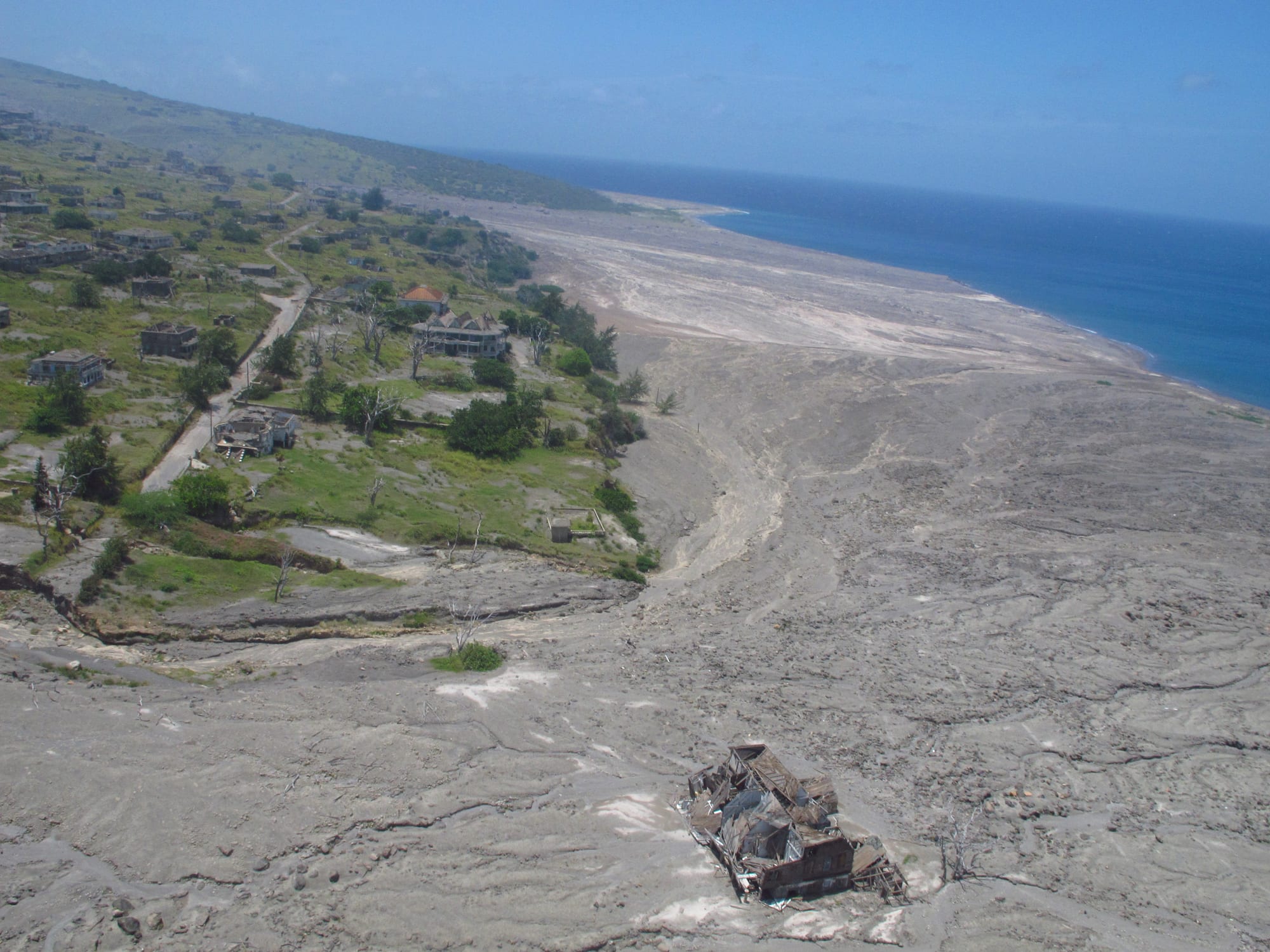
Then, in July 1995, the long-dormant Soufrière Hills volcano began to erupt. Pyroclastic flows destroyed the capital, Plymouth, and the airport; nineteen people were killed by a pyroclastic surge at Streatham in June 1997; and the southern half of the island became an Exclusion Zone. Two-thirds of the islanders fled, most of them to the United Kingdom, leaving fewer than 1,200 people here in 1997; the population has since climbed back towards 5,000. The seat of government moved to Brades, a new town and port are being built at Little Bay in the north, and the volcano has been relatively quiet since early 2010, though it is monitored around the clock.
- Montserrat: The Island With a Buried Capital — The "Emerald Isle" of the Caribbean, settled by Irish Catholics and enslaved Africans — a quiet British colony until a volcano woke in 1995, buried its capital, and drove away two-thirds of its people