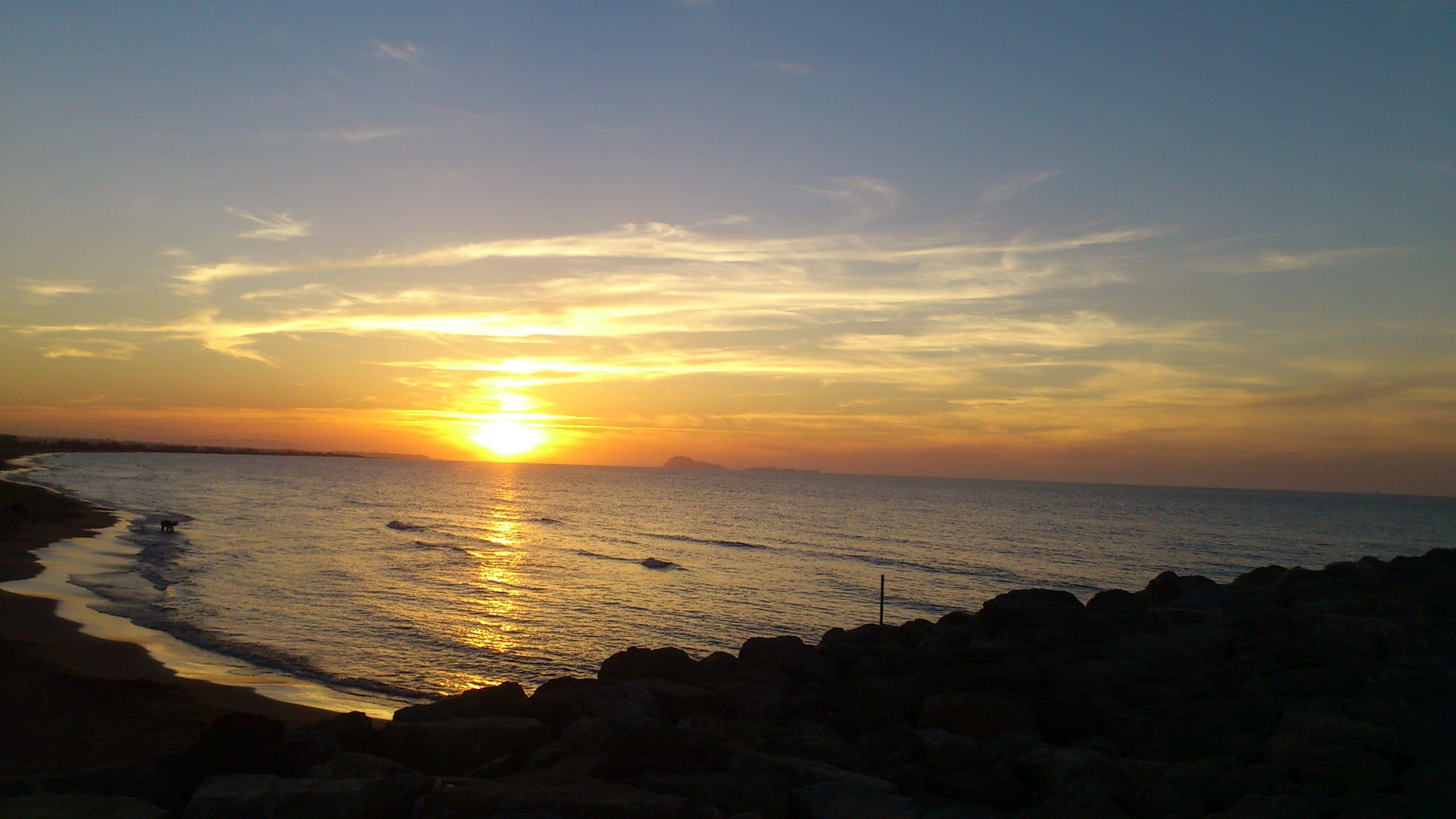
A low sun over a calm sea with gentle surf running onto a wide sandy beach and dark boulders in the foreground

Oujda & the Oriental, Morocco

Saïdia

Sunset over the beach beside the marina at Saïdia, on Morocco's Mediterranean coast. (Meryem BOURAS / Wikimedia Commons · CC BY-SA 4.0)

A Mediterranean beach town in the far north-east of Morocco, set on a long strip of fine sand between the mouth of the Moulouya and the Algerian frontier. Long a modest summer resort for families from Oujda and the diaspora, it gained a marina and a large planned resort development in the 2000s, and remains quiet out of season.

Neighbourhoods

  • The old town
    • First-time visitors
    • Local life
    • Budget stays

    The original village behind the eastern end of the beach, a grid of low houses, small hotels, cafés and shops around a 19th-century kasbah built to watch the frontier. It is where the town's year-round life happens and where the seafront promenade begins.

    Open in Maps
  • The beach and promenade
    • Beaches
    • Families
    • Evening walks

    A strip of fine golden sand runs for about 14 km westwards, backed for part of its length by a promenade of cafés, ice-cream stands and seasonal beach clubs. The water shelves gently, and in summer the sand is crowded from late afternoon until dark.

    Open in Maps
  • The marina and resort district
    • Boating
    • Golf
    • Resort stays

    West of the old town, a marina of some 740 berths sits at the centre of a planned resort development of apartment blocks, hotels and golf courses laid out in the 2000s. It is busy in summer, subdued for much of the rest of the year.

    Open in Maps
  • Towards the Moulouya
    • Nature
    • Quiet and residential
    • Birdwatching

    The western end of the strand runs towards the mouth of the Moulouya river, where dunes, pine plantations, lagoons and marshes replace building and the coast becomes a protected wetland.

    Open in Maps

Things to do

The beach and the marina

  • Saïdia beachbeach

    One of the longest sandy beaches in Morocco, known as the Blue Pearl, running from the Algerian frontier westwards towards the Moulouya with shallow, calm water.

    Open in Maps
  • Saïdia marinaattraction

    A modern yacht harbour with pontoons, waterfront cafés and shops at the heart of the resort development, and the base for boat trips along the coast.

    Open in Maps
  • The kasbah and old villagelandmark

    The walled fort at the eastern end of town, built in 1883 for Sultan Hassan I to watch movement across the frontier, and the small streets of shops and cafés around it.

    Open in Maps

Nature and the river mouth

  • Moulouya Riverattraction

    The Moulouya, 520 km long, reaches the sea about 10 km west of the town, in an estuary of dunes, lagoons and reedbeds that is a protected site and a stop for migrating birds.

    Open in Maps
  • Chafarinas Islandsviewpoint

    Three islets administered by Spain and claimed by Morocco, lying 3.3 km off Ras Kebdana to the west, visible from the coast road on clear days and holding colonies of Audouin's gull and Scopoli's shearwater.

    Open in Maps

Short trips from the town

  • Ras El Maattraction

    A fishing town about 20 km west at the tip of the coast, also called Ras Kebdana or Cap de l'Eau, with a small harbour, seafood restaurants and views out to the islands offshore.

    Open in Maps
  • Berkaneattraction

    The market town about 30 km inland, centre of an irrigated plain famous across Morocco for its clementines.

    Open in Maps
  • Taforaltattraction

    A village in the Beni-Snassen mountains where the Grotte des Pigeons has produced some of the oldest known shell beads and a large prehistoric cemetery.

    Open in Maps
  • Oujdaattraction

    The regional capital about 60 km south, with a walled medina, gardens and a music scene shared with western Algeria.

    Open in Maps
  • Nadorattraction

    The port city on the Marchica lagoon to the west, reached along the coast road past Ras El Ma.

    Open in Maps

Seasonal events

  • The summer seasonJuly and August

    The town fills with Moroccan families and with returning emigrants from Europe; concerts, funfairs and beach events run through the school holidays.

  • Folk music festivalAugust

    A festival of traditional music held in the town each August, at the height of the holiday season.

  • Bird migration at the Moulouyaspring and autumn

    Waders, flamingos, terns and herons gather in the estuary and its lagoons as birds move between Europe and Africa.

Eat and drink

Long-standing places and food districts in Saïdia. Hours, ratings and directions come from your maps app, always current.

Saïdia classics

  • Grilled fish and seafoodrestaurant

    Restaurants along the promenade and around the marina grill sardines, sea bream and prawns landed along this coast, usually served with chermoula, bread and salad.

    Open in Maps
  • Ras El Ma fish stallsmarket

    The fishing harbour west of town sells the day's catch beside simple places that fry or grill it on the spot.

    Open in Maps

Cafés and street food

  • Promenade caféscafe

    Mint tea, coffee, fresh juice and ice cream along the seafront, at their busiest late in the evening when the beach empties.

    Open in Maps
  • Summer street foodmarket

    Stalls sell grilled corn, msemen, doughnuts and karan, the eastern Moroccan chickpea-flour slice, through the holiday season.

    Open in Maps

Experience Saïdia

History

Saïdia owes its existence to the frontier. The village grew around a kasbah built in 1883 for Sultan Hassan I at the point where the Oued Kiss, the boundary with French Algeria, reaches the Mediterranean, in a period when Morocco was trying to mark and hold its eastern limit. The kasbah, a square enclosure with corner towers near the eastern end of the beach, remains the oldest structure in town.

Under the French protectorate the setting made it a summer resort rather than a garrison. It became popular first with French settlers and then with families from Oujda, Berkane and the Algerian border towns, who came to camp and swim on the sand, and small hotels, cafés and holiday villas appeared behind the beach in the town that came to be known as the Blue Pearl. The closure of the land border with Algeria in 1994 ended the cross-border holiday traffic that had been part of that trade, and for a time the resort relied on Moroccan visitors and on emigrant families returning each summer from Europe.

The largest change came in the 2000s, when Saïdia was chosen for one of the national tourism plan's coastal resort schemes. A marina, golf courses, apartment blocks and hotels were built on the dunes west of the old village on a scale far beyond the existing town, with mixed results: parts filled slowly, ownership and management changed, and the development sits alongside rather than within the older resort. The estuary of the Moulouya to the west was protected, limiting building at that end of the strand.

Culture & Customs

Saïdia's culture is seasonal. For most of the year it is a small eastern Moroccan town, conservative and quiet, where Arabic in the region's eastern dialect is spoken alongside Tamazight from the surrounding countryside and Tarifit from Riffian families, and where the mosque, the café and the market set the pace. From June the population multiplies, and the town takes on the character of its visitors.

Those visitors are overwhelmingly Moroccan. Families come from Oujda, Berkane, Nador, Fès and Casablanca, and the diaspora arrives from the Netherlands, Belgium, France, Germany and Spain, driving down through Europe or crossing on the ferries, so Dutch and Spanish are as common as French on the promenade in August. Summer is the season for weddings, family reunions and long evenings, and the beach fills late in the day when the heat has gone out of the sun.

Music heard here is the music of the Oriental: rai from the Oran region across the border, reggada from the plains and the Beni-Snassen with its shoulder dance and shouldered rifles, and the Andalusian repertoire performed at formal occasions. Manners follow the rest of Morocco — greetings before business, hospitality offered readily, modest dress away from the sand — and visitors who observe that are treated with easy friendliness.

Daily Life

Only a few thousand people live in Saïdia through the winter, and the number rises many times over in July and August. The year-round economy is tourism, fishing along the coast and farming in the irrigated plain behind the town, where citrus, vegetables and olives grow on land watered from the Moulouya. Many households depend on the summer for most of their income, running apartments, cafés, beach concessions and shops for three months and closing for much of the rest.

Remittances and diaspora property matter as much as visitors. A large share of the holiday apartments belong to families living in Europe, standing empty outside the school holidays, and building has continued along the strip between the village and the marina. The resort development brought construction work and hotel jobs, though many of them are seasonal as well.

Out of season the rhythm is slow: fishing boats, school runs, the daily market, and cafés along the front where men sit over tea with the shutters of the summer businesses down behind them. Water is the underlying worry, as it is throughout eastern Morocco, with the Moulouya's flow reduced by drought and by the dams upstream that irrigate the plain, and with the estuary's wetlands sensitive to any further loss.

Food

Fish dominates. Sardines, anchovies, sea bream, sea bass, red mullet and prawns come off boats along this coast and at Ras El Ma to the west, and are grilled over charcoal or fried simply, usually with chermoula, a marinade of coriander, garlic, cumin, paprika and lemon. Fish tagines cooked with tomato, peppers and preserved lemon are the sit-down version, and platters of mixed fried fish are the standard seaside meal.

The inland cooking of the Oriental appears alongside it. Karan, the baked chickpea-flour and egg slice associated with Oujda, is sold from carts in summer; harira soup, berkoukes made with large couscous grains, and tagines of lamb from the high plateaux are eaten at home; and mechoui, whole roast lamb, marks weddings and feasts, of which there are many in August.

Berkane's clementines and oranges are pressed into juice at every café, and the plain also supplies olives, olive oil, melons and tomatoes. Summer street food runs to grilled corn, msemen pancakes, doughnuts and ice cream along the promenade, and pastry shops sell honeyed briouats and almond sweets. Mint tea is drunk all day, and alcohol is confined to licensed hotels and restaurants in the resort district.

Planning tools

Budget

Prices swing with the season. In July and August the resort hotels and holiday apartments fill and rates rise sharply; in spring and autumn the same rooms are among the cheapest on the Moroccan coast. Food, taxis and beach costs stay low all year.

Daily Budget Midrange
USD 75–160 (resort or mid-range hotel, restaurant meals, a hire car for the coast and the mountains)
Daily Budget Shoestring
USD 25–45 (budget hotel or rented apartment out of season, café meals, buses and grand taxis)

Rates and crowds both fall sharply after August; rented apartments are the usual choice for longer family stays.

Best Time to Visit

June and September give warm sea, long days and space on the sand. July and August are hot and crowded, with the town at its liveliest and prices at their highest. Spring is mild and good for the estuary and the mountains inland, and winter is quiet, with many places closed.

Suggested Number of Days

A day or two is enough for a first look at the town and its seafront. Three to five suit a seaside stay that also takes in the coast west of town and the mountains and orchards inland; longer if the point is the beach itself.

First Visit
1–2 days
With Surroundings
3–5 days

Transportation

The town is small and flat, and most of it is walkable, with petits taxis for the length of the beach and the marina district. Grand taxis and buses run to Berkane, Ahfir, Oujda and Nador, more frequently in summer, and a hire car is the practical way to reach the estuary, Ras El Ma and the Beni-Snassen.

Services thin out considerably outside the summer season, so check how late the last shared taxi runs before making a day trip.

Airport & Station Connections

Oujda-Angad Airport, about 50 km south, is the usual arrival point, with domestic flights and services to several European countries; Nador's airport lies to the west. Oujda is the nearest railway station, at the end of the line from Fès, and is linked to Saïdia by road in around an hour. Most visitors arrive by car, by bus or by grand taxi, and many come off ferries from Spain.

Walkability

Everything in the old town is within a few minutes on foot, and the promenade makes an easy walk of several kilometres beside the sand. The marina and resort district are spread out and separated from the village by a long stretch of seafront, so covering the whole strip on foot takes well over an hour.

Safety

Saïdia is a calm family resort with little crime beyond occasional petty theft on a crowded beach. The Algerian border lies a short distance east and is closed, fenced and patrolled; the beach ends there. Sea currents can be strong when the wind gets up, and not every stretch of sand is supervised.

Swim near the supervised sections in summer, keep well away from the frontier and any military positions, and do not photograph border installations. Use official guides booked through a riad or a licensed agency, keep bags across the body in medinas, and avoid the cannabis-growing Ketama area of the Rif. Check current official travel advice before travelling.

Climate

A semi-arid coastal climate, warm and dry in summer, mild and damp in winter, tempered by sea winds. Autumn and winter bring more than four fifths of the year's rain; the sea is warmest from July to September.

Summer
warm and sunny, on average 27–30°C by day and 19–22°C at night
Winter
mild, on average 17–20°C by day and 9–12°C at night, with most of the year's rain

Local Customs

Saïdia is more relaxed than inland towns but still Moroccan and Muslim: swimwear belongs on the beach, and shoulders and knees are covered in the streets, shops and cafés. Many families here have relatives in Europe, so French, Spanish and Dutch are heard along with Arabic and Tamazight.

Ask before photographing people on the beach, expect alcohol to be limited to licensed hotels and restaurants, and expect the town to keep late hours through the summer.

Common Payment Methods

The currency is the Moroccan dirham. Cash machines are in the old town and at the marina, hotels, resorts and larger restaurants take cards, and beach cafés, taxis, fish stalls and market traders expect cash. Machines can run out at summer weekends, so it is worth drawing money in Berkane or Oujda.