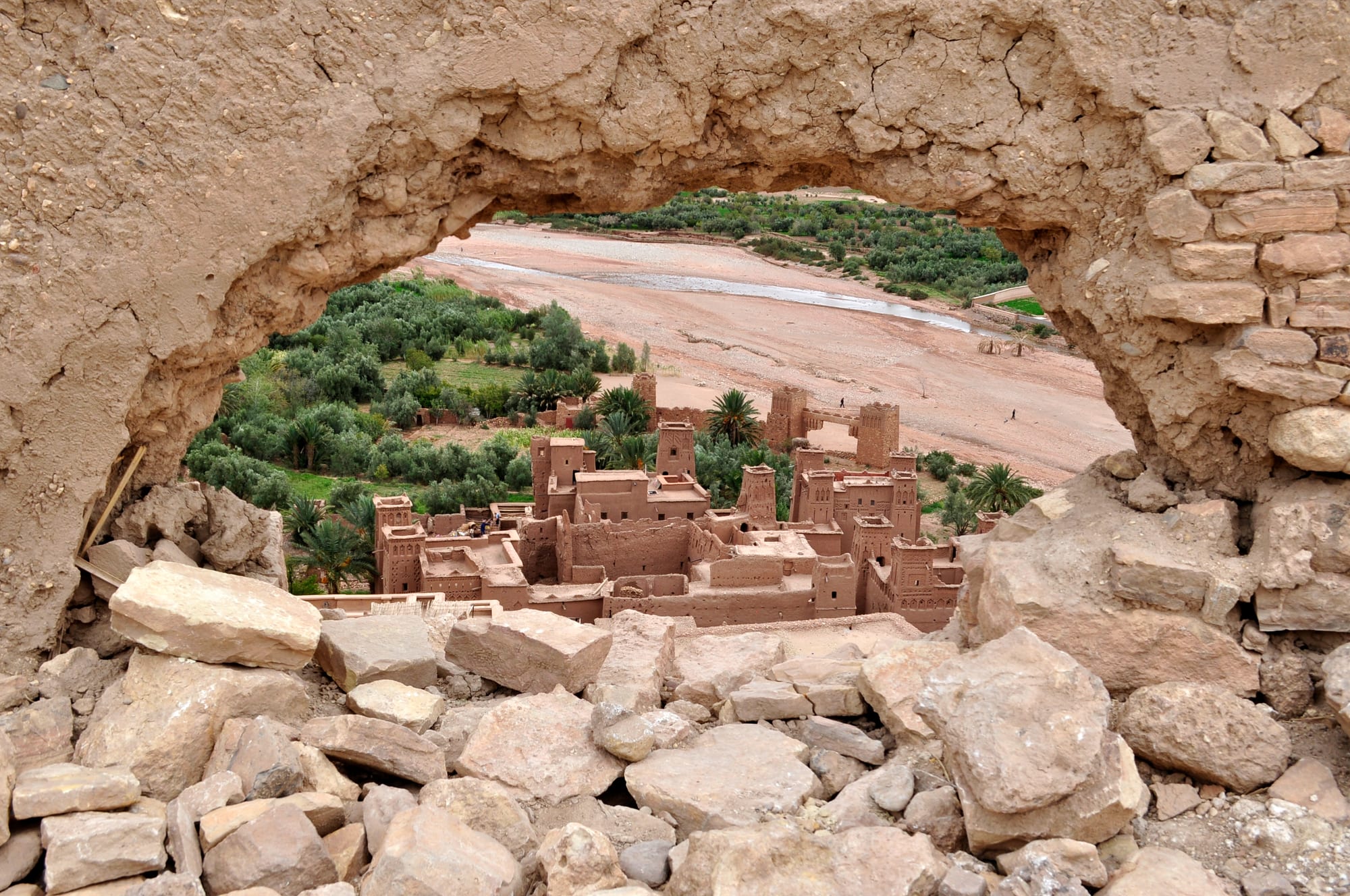
A cluster of red-earth kasbah towers and flat-roofed houses stacked on a hillside above a shallow river, with bare hills beyond

Morocco

The ksar of Aït Benhaddou, a fortified earthen village on an old caravan route between the Sahara and Marrakesh. (Elena Tatiana Chis / Wikimedia Commons · CC BY-SA 4.0)

A kingdom of the far northwest of Africa, running from Atlantic and Mediterranean coasts over the Atlas mountains to the Sahara — an Arab and Amazigh society never ruled by the Ottomans, with imperial cities, a living craft tradition, and a powerful monarchy.

Explore Morocco

History

Berber (Amazigh) kingdoms and Roman towns such as Volubilis gave way, after the Arab conquest of the late seventh century, to a Muslim Morocco whose first dynasty, the Idrisids, founded Fez. From here came a run of powerful Berber empires: the Almoravids, who built Marrakesh and ruled as far as al-Andalus in Spain; the Almohads, who raised the Koutoubia and the tower that became Seville's Giralda; and the Marinids, who covered Fez in carved medersas. Uniquely in the region, Morocco was never absorbed by the Ottomans.

European pressure ended Moroccan independence in 1912, when the Treaty of Fez made most of the country a French protectorate, with Spanish zones in the north and south and an international regime in Tangier. A nationalist movement formed around Sultan Mohammed V, who was briefly exiled, and full independence came in 1956.

His son Hassan II ruled from 1961 to 1999 through a repressive period known as the "Years of Lead", survived two coup attempts, and in 1975 sent the "Green March" of civilians into the former Spanish Sahara. That territory, Western Sahara, is a United Nations non-self-governing territory and the subject of a long dispute: Morocco occupies and administers roughly 70 per cent of it, including all the main towns, and calls it its Southern Provinces, while the Algerian-backed Polisario Front holds the rest and runs the Sahrawi Arab Democratic Republic from exile in Tindouf in Algeria. A mined sand wall, the Berm, divides the two. A UN-monitored ceasefire held from 1991 until fighting resumed in 2020, the promised referendum has never taken place, and in October 2025 the UN Security Council pointed to Morocco's autonomy plan as a basis for negotiations. King Mohammed VI, on the throne since 1999, has overseen family-law reform and a 2011 constitution adopted after Arab Spring protests, while keeping the monarchy firmly at the centre of power.

  • Morocco: The Western Kingdom — The one North African land the Ottomans never took — home of Berber empires that ruled Muslim Spain, a sharifian monarchy since the 1660s, a French protectorate for 44 years, and the disputed Western Sahara

Culture & Customs

Islam — Sunni, of the Maliki school, with strong Sufi brotherhoods and their moussem festivals — is woven through daily life, and it coexists with an Amazigh identity that has grown more assertive, now visible in the Tifinagh script on official signs. The rituals of hospitality are constant: sweet mint tea poured from height, the neighbourhood hammam, and the bargaining theatre of the souk.

Craft is a living tradition — zellige tile mosaics, the leather tanneries of Fez, knotted carpets, brass and cedar work, and argan oil pressed by women's cooperatives in the southwest. Music runs from Andalusian classical orchestras to the Afro-Islamic trance of Gnawa, celebrated at its own festival in Essaouira, to a large modern rap and fusion scene.

Morocco is moderate by regional standards but conservative in the countryside. Alcohol is sold discreetly, Ramadan reshapes the rhythm of the day, and football is a national passion — never more so than after the team reached the World Cup semi-finals in 2022. Morocco hosted the 2025 Africa Cup of Nations, played over December 2025 and January 2026, and was awarded the title when an appeal board ruled that Senegal had forfeited the final (Senegal has appealed to the Court of Arbitration for Sport). The country will co-host the 2030 World Cup with Spain and Portugal, and a 115,000-seat stadium, planned as the world's largest football stadium, is under construction at El Mansouria near Benslimane, east of Casablanca, with an opening planned for 2027.

  • Morocco: A Hand on the Heart — A Sunni Muslim kingdom with deep Amazigh roots, where greetings take their time, guests are fed before questions are asked, and the year turns on Ramadan, the feast of the sheep and the galloping salute of the tbourida

Daily Life

Morocco is urbanising fast along the Casablanca–Rabat–Kénitra corridor, its economic spine, served by Africa's first high-speed train. That connected, modernising urban middle class contrasts sharply with poorer rural areas — the mountains, the oases, the Rif — where services are thinner, illiteracy among older rural women is high, and young people leave for the cities or abroad.

The economy rests on tourism, agriculture (a big employer, badly hit by years of drought), phosphates — Morocco has the world's largest known reserves — and a booming car and aerospace manufacturing sector exporting through the Tangier Med port. Remittances from a large diaspora in France, Spain, and the Low Countries are a major inflow, and the country is investing heavily in solar and wind power.

Water stress and repeated poor rains are the pressing everyday problem for farming regions, and youth unemployment keeps emigration a constant aspiration. A September 2023 earthquake in the High Atlas south of Marrakesh killed around three thousand people and damaged many mountain villages. In late September and October 2025 the biggest protests since 2011 — youth-led, organised online under the name GenZ 212 — spread through Casablanca, Rabat, Tangier, Fez and other cities, demanding better schools and hospitals and criticising the money going into the World Cup and the Africa Cup of Nations; the 2026 finance bill proposed raising health and education spending by about 16 per cent. At the general election of 23 September 2026 the Authenticity and Modernity Party won the most seats, and on 29 September the King appointed its leader, Fatima Ezzahra El Mansouri, as head of government — the first woman to hold the post.

Food

The tagine — meat or vegetables slow-cooked in the conical earthenware pot — is the everyday dish, in versions such as lamb with prunes, or chicken with preserved lemon and olives. Couscous is traditionally the Friday meal, steamed over a broth of meat and vegetables. Harira, a tomato, lentil, and chickpea soup, breaks the fast in Ramadan.

For special occasions there is pastilla, a pie of pigeon or chicken with almonds, cinnamon, and sugar in paper-thin warqa pastry; mechoui, whole slow-roasted lamb; and, in Marrakesh, tanjia, meat cooked for hours in an urn in the embers of the hammam furnace. Breads — round khobz, flaky msemen, spongy baghrir — accompany everything, with olives, preserved lemon, and the spice blend ras el hanout.

Mint tea is the national drink, and fresh orange juice is cheap and everywhere. Wine is made, notably in the Meknès–Fès region, and beer too, but both are consumed quietly. Street stalls sell snail broth, grilled meats, and, on the coast, sardines straight off the boats.

  • Morocco: Food and the National Dish — Friday couscous, the slow-cooked tagine, a spice trade that never stopped, and an Amazigh kitchen layered with Andalusi, Saharan and French borrowings

Attractions & Natural Wonders

The imperial cities are the heart of a visit. Marrakesh has the Jemaa el-Fna square with its performers and food stalls, the Koutoubia minaret, the Bahia Palace, the Saadian Tombs, and the Majorelle Garden. Fez holds one of the world's largest car-free urban areas in its old medina, the tanneries, and the Qarawiyyin, founded as a mosque in 857-859 and often called the oldest university. Meknes, with the vast gates and granaries of Moulay Ismail, sits near Roman Volubilis and the shrine town of Moulay Idriss; Rabat has the Kasbah of the Udayas and the Hassan Tower.

The blue-washed town of Chefchaouen climbs the Rif. The High Atlas offers trekking to Toubkal, the highest peak in North Africa, from the village of Imlil, and gentler valleys such as the Ourika and Aït Bouguemez. South of the mountains lie the kasbah country of Aït Benhaddou and Ouarzazate, the palm-lined Draa Valley, the Dades and Todgha gorges, and the Saharan dune fields of Erg Chebbi at Merzouga and Erg Chigaga at M'Hamid.

On the Atlantic, walled and windswept Essaouira is a fishing port cooled by strong trade winds, Taghazout draws surfers, and Casablanca has the enormous Hassan II Mosque built out over the sea. Tangier guards the strait, with the Caves of Hercules at Cap Spartel nearby.

Planning basics

Budget

Morocco offers a wide range. Riads (courtyard guesthouses), medina restaurants, trains, and shared taxis keep costs low; the resorts of Marrakesh and the coast and organised desert tours cost much more. Bargain for goods and for unmetered taxis.

Daily Budget Midrange
MAD 800–2,000 / USD 80–200 (mid-range riad, restaurants, a hired car or driver, a desert tour)
Daily Budget Shoestring
MAD 300–550 / USD 30–55 (hostel or basic riad, local eateries, trains and CTM buses)

Trains and CTM/Supratours coaches are comfortable and cheap; agree taxi fares before setting off, as petits taxis often don't use the meter for tourists.

Visa Requirements

Citizens of the EU, the UK, the US, Canada, Australia, New Zealand, and many other countries can enter visa-free for up to 90 days. Passports should be valid for the stay. Overstays are fined on departure.

Typical Stay
90 days visa-free for most Western passports

Safety

Morocco is generally safe for visitors, with low violent crime, but the medinas of Marrakesh and Fez are known for persistent touts, "faux guides", and scams, and for moped bag-snatching. Reckless driving is a real hazard. Terrorism is a background risk that Moroccan security works hard against; attacks are rare but have happened.

Western Sahara
Most governments advise against travel to much of Western Sahara, especially near the berm, where landmines remain; the coastal road to Dakhla is more travelled.

Use official guides booked through your riad or a licensed agency, keep bags across the body in medinas, and avoid the cannabis-growing Ketama area of the Rif.

Climate

Varied. The Atlantic coast is mild and breezy all year; the interior and the imperial cities have hot summers — Marrakesh can pass 40°C in July and August — and cool winters with cold nights. The High Atlas is alpine, holding snow into early summer, and the Sahara is scorching by day and cold at night, best from October to April.

Coast
Mild, 15–26°C year-round; Essaouira windy
Marrakesh
Winter 7–19°C; summer highs around 35–38°C, sometimes above 40°C

Transportation

Casablanca's Mohammed V is the main airport, with international flights also to Marrakesh, Fez, Tangier, and Agadir. The Al Boraq high-speed train links Tangier, Rabat, and Casablanca, and a good conventional network reaches Fez, Meknes, and Marrakesh. CTM and Supratours coaches and shared "grand taxis" cover the rest. Car hire suits the Atlas and desert circuits.

Drive with great care — unlit carts, pedestrians, and animals make night driving on rural roads dangerous.

Best Time to Visit

March–May and September–November are the most comfortable across the whole country, good for cities, trekking, and the desert. Summer suits only the coast and the high mountains; winter is the season for warm desert days and for skiing above Marrakesh. During Ramadan, daytime hours and dining are reduced.

Events
Fes Festival of World Sacred Music (about ten days in early June); Gnaoua World Music Festival, Essaouira; rose festival, Kelaat M'Gouna (May)

Currency

The currency is the Moroccan dirham (MAD), a restricted currency that is hard to obtain or exchange outside the country. Change money on arrival and convert unspent dirhams before leaving. Cards work in cities, hotels, and larger shops; carry cash for medinas, taxis, and rural areas.

Symbol
DH / د.م.
Currency Code
MAD — Moroccan dirham

Language

Arabic and Tamazight (Amazigh) are the official languages. Everyday speech is Moroccan Arabic (Darija) and three Amazigh varieties. French is widely used in business, government, and media; Spanish lingers in the north; and English is growing among young people and in tourism.

Also Widely Used
French; Spanish in the north
Official Languages
Arabic, Tamazight (Amazigh)