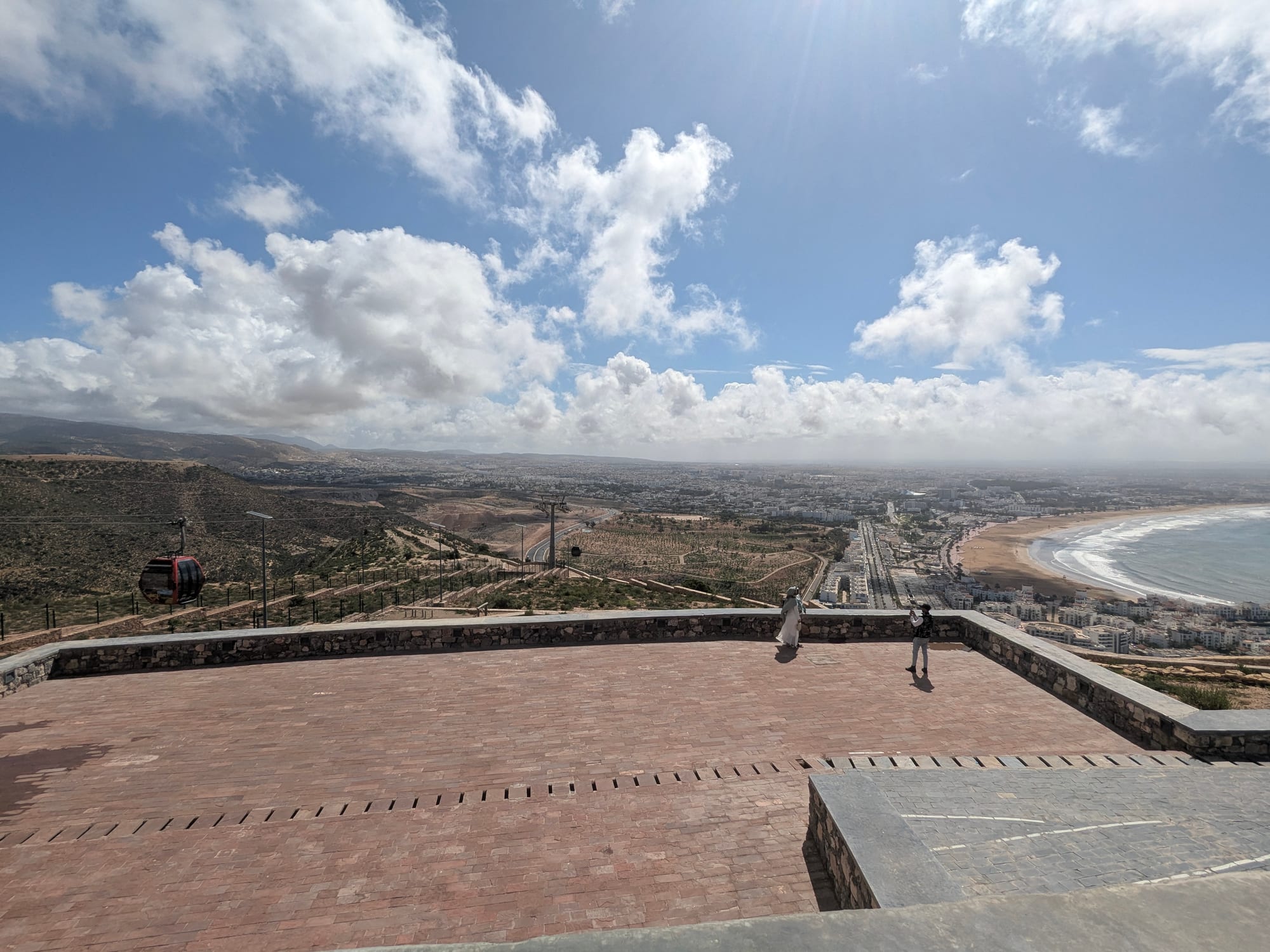
View from a stone-walled terrace on a bare hill over a white low-rise city and a wide curving sandy bay under tall clouds

Agadir, the Drâa Valley & the South, Morocco

Agadir

Agadir and its bay seen south from the hilltop kasbah of Agadir Oufella. (Abdeaitali / Wikimedia Commons · CC BY-SA 4.0)

Morocco's main Atlantic resort city, at the mouth of the Souss valley in the Amazigh south. An earthquake destroyed the old town in 1960 and the city was rebuilt on a modern plan below its ruined hilltop kasbah, combining a long sandy bay and a marina with the country's most important fishing port and a large inland market.

Neighbourhoods

  • Founty and the beachfront
    • First-time visitors
    • Beaches
    • Resorts

    The hotel quarter laid out behind the southern end of the bay, between the promenade and the Oued Souss. Low blocks in gardens, seafront cafés and the wide paved corniche give it a calm, planned feel that is quite unlike an old Moroccan city.

    Open in Maps
  • Talborjt
    • Best for food
    • Budget stays
    • Local life

    The rebuilt version of a quarter that the 1960 earthquake destroyed, set back from the sea around Place Lahcen Tamri. Small hotels, grill restaurants, juice bars and bus offices make it the busiest part of town for travellers who are not staying in a resort.

    Open in Maps
  • The Marina and the port
    • Waterfront walks
    • Seafood

    North of the beach, where a yacht basin of white apartment blocks and terraces adjoins the working fishing port. The port's grill stalls and the harbour's trawlers are the reason most visitors walk this far.

    Open in Maps
  • Souk El Had and the city centre
    • Markets
    • Shopping
    • Local life

    The commercial heart inland from the hotels, around one of Morocco's largest walled markets and the avenues of the 1960s reconstruction. Administrative buildings, banks and everyday shops fill the blocks between wide boulevards.

    Open in Maps
  • Anza
    • Quiet and residential
    • Surfing

    A coastal district at the northern edge of the city on the road towards Taghazout, part industrial, part fishing village, with a beach used by local surfers and canneries and fish restaurants along its main avenue.

    Open in Maps

Things to do

Famous landmarks

  • Agadir Oufellalandmark

    The ruined kasbah above the port, on a hill rising 236 metres from the shore, where the Saadians seized the height in 1540 and a fortress was built on the summit later in the 16th century. The 1960 earthquake destroyed the old town it enclosed, the walls were restored in 2002, and the earthquake of 8 September 2023 caused further damage; the terrace gives the widest view of the bay. A 1,700-metre cable car has run up to it from the Tildi bridge since July 2022.

    Open in Maps
  • Agadir Marinalandmark

    A yacht harbour built beside the port, ringed by white low-rise buildings, cafés and a promenade at the northern end of the beach.

    Open in Maps
  • Souss-Massa National Parkpark

    A coastal park of dunes, scrub and river mouths south of the city, best known as one of the last refuges of the northern bald ibis.

    Open in Maps

Beaches and the seafront

  • Agadir Beachbeach

    A sheltered sandy crescent several kilometres long, with a paved promenade, lifeguards in season and gentle surf compared with the coast further north.

    Open in Maps
  • Anza Beachbeach

    The beach at the city's northern edge, a local surfing spot in a district of canneries and small fish restaurants.

    Open in Maps

Museums and culture

  • Amazigh Heritage Museummuseum

    A small city museum of Berber jewellery, carpets, tools and domestic objects from the Souss and the Anti-Atlas, explaining the region's Amazigh culture.

    Open in Maps
  • Medina of Agadirattraction

    A craft village at Ben Sergao, about 4.5 km from the centre, created in 1992 by the artist Coco Polizzi and built with traditional Berber techniques on five hectares, with artisan workshops, a museum and a garden.

    Open in Maps

Markets

  • Souk El Hadmarket

    One of the biggest souks in Morocco, a walled market selling vegetables, spices, argan oil, pottery, clothes and household goods, busiest at the weekend.

    Open in Maps

Short trips from the city

  • Paradise Valleytrail

    A section of the Tamraght valley in the western High Atlas, with palms and rock pools, about 40 km north-east on the road towards Imouzzer.

    Open in Maps
  • Taghazoutneighborhood

    The surf village about 20 km north, with long right-hand point breaks and beach cafés.

    Open in Maps
  • Taroudantattraction

    A market town about 80 km inland, enclosed by complete earthen ramparts, with souks and the High Atlas behind it.

    Open in Maps
  • Tiznitattraction

    A walled town roughly 90 km south, long known for silver jewellery made and sold in its medina.

    Open in Maps

Seasonal events

  • Festival TimitarJuly

    A large open-air festival of Amazigh music and music from around the world, held in the city every summer since 2004, bringing rwais singers and groups from across the south together with international acts.

  • Ramadanvaries with the lunar calendar

    During the fasting month cafés and restaurants are quiet by day and the city fills after sunset, when families eat harira and pastries along the corniche.

Eat and drink

Long-standing places and food districts in Agadir. Hours, ratings and directions come from your maps app, always current.

Agadir classics

  • The port fish grillsrestaurant

    A row of open-air stalls inside the fishing port where sardines, sole, prawns and squid are chosen from the counter and grilled over charcoal with bread, salad and cumin.

    Open in Maps
  • Souk El Hadmarket

    The city's main market, the place to buy argan oil and amlou, olives, dates, spices and Souss honey, with cheap food stalls inside the walls.

    Open in Maps

Food districts

  • Talborjtneighborhood

    Streets of grill houses, tagine kitchens, juice bars and pastry shops around Place Lahcen Tamri, where most of the city's everyday eating out happens.

    Open in Maps
  • The corniche and marina cafésneighborhood

    Seafront terraces along the promenade and around the yacht basin, used for coffee, mint tea and long evenings rather than for traditional cooking.

    Open in Maps

Experience Agadir

History

Agadir takes its name from the Amazigh word for a fortified granary, and the site was a minor anchorage until the Portuguese built the fort of Santa Cruz do Cabo de Gué on the shore in 1505. The Saadians, rising in the Souss and the Drâa, took it in 1541 and made it a port for the sugar and saltpetre of the valley behind. The Saadians had seized the hill above the fort in 1540, and a fortress was built on its summit later in the century. For two centuries the trade of the south passed through the bay, until the sultan Mohammed ben Abdallah turned it away from 1760 in favour of Essaouira, which he was building to the north.

The town revived under the French protectorate, when a modern harbour was cut, the sardine fleet grew and the first hotels appeared along the bay. On the night of 29 February 1960 an earthquake of magnitude 5.8, shallow enough to shake the surface violently, destroyed almost the whole town in about fifteen seconds. Between 12,000 and 15,000 people were killed, about a third of the population, and in the old Talborjt quarter nine buildings in ten were destroyed or badly damaged.

Reconstruction moved the city about 1.6 km further south and built it to mandatory seismic standards, in the modernist architecture of the early 1960s — wide boulevards, low concrete blocks and separate zones for hotels, housing, industry and administration — by architects including Jean-François Zevaco and Elie Azagury, with Le Corbusier consulted. The fishing port and the canning factories grew alongside the beach hotels; Agadir was the world's leading sardine port in the 1980s, and it is now Morocco's leading seaside resort and the economic centre of the Souss.

Culture & Customs

This is a Chleuh city — the Tashelhit-speaking Amazigh of the Souss and the Anti-Atlas — and their language is heard in the market, in taxis and on local radio far more than in northern Moroccan cities. The tradition of the rwais, the travelling Amazigh poet-singers who accompany themselves on the ribab and the lotar, is rooted in this region, and the village ahwach, a line dance of drums and massed voices, still appears at weddings and festivals. The Timitar festival each July turns that heritage into a large open-air event on the city's squares.

Because almost nothing survived 1960, Agadir has no medina in the usual Moroccan sense and little visible age; its identity is instead built on the sea, on the Soussi reputation for trade and thrift, and on a mixed population drawn from the mountains and oases of the whole south. The craft village built on the southern edge of the city was an attempt to give that missing old town a substitute.

Customs are those of Morocco generally, kept a little more lightly in the hotel zone than elsewhere. Friday is the day of the couscous meal and the midday prayer; Ramadan slows the daytime and fills the evenings; football is followed passionately, and the local club Hassania Agadir draws a loyal support. Visitors are expected to dress modestly away from the beach, to greet before asking, and to accept mint tea when it is offered.

Daily Life

The commune of Agadir recorded 504,768 people at the 2024 census, and greater Agadir, counting Inezgane, Aït Melloul, Dcheira and the other neighbouring communes, well over 1.2 million — the urban core of the Souss-Massa region. Growth has been rapid, fed by migration from the Anti-Atlas and the oases, and the built-up area now runs several kilometres inland from the bay.

The economy stands on three legs. Tourism fills the seafront hotels, mostly with European visitors in winter and Moroccans in summer. The port is the country's most important fishing harbour and the centre of a sardine canning and fish-processing industry. Inland, the Souss plain under its plastic greenhouses supplies much of Europe's winter tomatoes and citrus, and the packing houses, transport firms and seasonal labour that go with it shape the towns around the city. Groundwater depletion and repeated drought are the region's central worry, and seawater desalination, contracted for Agadir in 2014, is part of the answer.

Daily rhythm follows the heat only loosely here, because the coast stays temperate: shops open early, close for a long midday break and stay busy into the evening, when families walk the corniche. Housing costs in the beach quarters are high by Moroccan standards, so most residents live in the inland districts and commute by bus, shared taxi or moped.

Food

The port sets the tone. Sardines, landed at what was the world's leading sardine port in the 1980s, are grilled whole over charcoal and eaten with bread, tomato salad and cumin, along with sole, sea bream, prawns and squid taken from the ice at the front of the stall. Fried fish sold in paper, and fish tagine with peppers, potato and a chermoula marinade of coriander, garlic, cumin and lemon, are the everyday coastal dishes.

The Souss is argan country, and Agadir is where its products are sold: cooking oil pressed from the tree's kernels, and amlou, a thick spread of argan oil, roasted almonds and honey eaten at breakfast with bread. Tagines here often use goat or lamb with seasonal vegetables; couscous, usually of barley in the south, is the Friday dish. Breakfast means harsha, a semolina griddle cake, or flaky msemen with honey and olive oil, and harira soup returns every evening in Ramadan.

Souk El Had is the place where all of it is bought, from spices and preserved lemons to Souss honey and dates brought over from the Tafilalet. Mint tea, poured from a height into small glasses, punctuates the day, and freshly pressed orange juice — the Souss grows the oranges — is sold on nearly every corner. Alcohol is available in hotels and licensed restaurants but is not part of ordinary café life.

Planning tools

Budget

Agadir is one of the cheaper beach destinations on the Atlantic, and package rates at the big seafront hotels are often lower than booking independently. Food at the port grills, in Talborjt and at Souk El Had costs very little; resort restaurants, excursions to the desert or the Atlas, and car hire are what lift a daily budget.

Daily Budget Midrange
USD 95–230 (seafront hotel or riad, restaurant meals, a hire car or driver, a day trip inland)
Daily Budget Shoestring
USD 25–50 (guesthouse or hostel in Talborjt, market and grill meals, city buses and shared taxis)

Agree the fare with a petit taxi before setting off, since fares are often not metered for visitors, and buy argan oil from a cooperative or the market rather than from a roadside stop.

Best Time to Visit

The climate is mild all year, which is the city's main asset. Autumn and spring are the most comfortable, with warm sea air and clear days; winter is the peak European season, sunny by day and cool after dark. Summer is warm rather than hot on the coast, but busy with Moroccan holidaymakers, and morning sea fog is common in July and August.

Suggested Number of Days

Two or three days covers the beach, the kasbah hill, the market and the port. Four to six allow the surf coast, the hills inland and a walled town or two in the Souss. Beach holidays here often run a week or more at a single hotel.

First Visit
2–3 days
With Surroundings
4–6 days

Transportation

The city is spread out and laid out for cars, with wide boulevards and long blocks. Petits taxis (orange) work within the city, grands taxis and minibuses run to Inezgane, the regional transport hub a few kilometres inland, and from there to towns across the Souss. City buses cover the main corridors, and a bus rapid transit line runs along the central avenues.

Most trips to Taghazout, Paradise Valley or the national park are easiest by hire car, grand taxi or an organised excursion, as scheduled services are infrequent.

Airport & Station Connections

Agadir–Al Massira Airport lies about 20 km south-east of the centre, in the commune of Temsia, and has flights from many European cities as well as Casablanca. The drive in takes roughly half an hour by taxi. There is no railway: CTM and Supratours coaches connect Agadir with Marrakesh in about three and a half hours, and with Essaouira, Casablanca and the southern towns, while grands taxis fill in shorter routes from Inezgane.

Walkability

The beach promenade is long, flat and pleasant, and the hotel quarter, the marina and the port can all be walked in a morning. Inland, the rebuilt city is a grid of wide avenues with more space than shade, so the market and the centre are usually reached by taxi. The climb to the kasbah on the hill is steep and exposed in the sun.

Safety

Agadir is a comparatively relaxed city with low violent crime. The usual problems are pickpocketing and bag-snatching in crowded market areas, persistent sellers and would-be guides along the promenade, and unmetered taxi fares. The Atlantic has strong currents and undertow, so swimming is safest between the lifeguards' flags.

Use official guides booked through a riad or a licensed agency, keep bags across the body in medinas, and avoid the cannabis-growing Ketama area of the Rif. Check current official travel advice before travelling.

Climate

A mild semi-arid climate cooled by the Atlantic, with sunshine nearly all year and very little rain, most of it between November and March. Sea temperatures stay cool because of the current running down the coast.

Summer
warm rather than hot — days generally 25–28°C, with morning sea fog and cool evenings
Winter
mild and sunny — days around 15–22°C, nights around 10°C, with occasional rain

Local Customs

Agadir is used to beach tourism and dress on the seafront is relaxed, but swimwear belongs on the sand; covering shoulders and knees is expected in the market, in the older quarters and in the smaller towns inland. Greetings matter: a handshake and a few words before business, and 'salam alaikum' goes a long way. Mosques are not open to non-Muslims. Bargaining is normal in the souk and not in shops with marked prices.

Ask before photographing people, especially women and market traders; tip small amounts for service; alcohol is served in hotels and licensed restaurants rather than in ordinary cafés, and during Ramadan eating or drinking in the street by day is best avoided.

Common Payment Methods

The currency is the Moroccan dirham, which is difficult to obtain outside the country, so most visitors change money or withdraw on arrival. ATMs are plentiful in the hotel quarter and the centre, and cards are accepted in hotels, supermarkets and larger restaurants. The market, taxis, the port grills and small cafés are cash businesses, and small notes are useful.