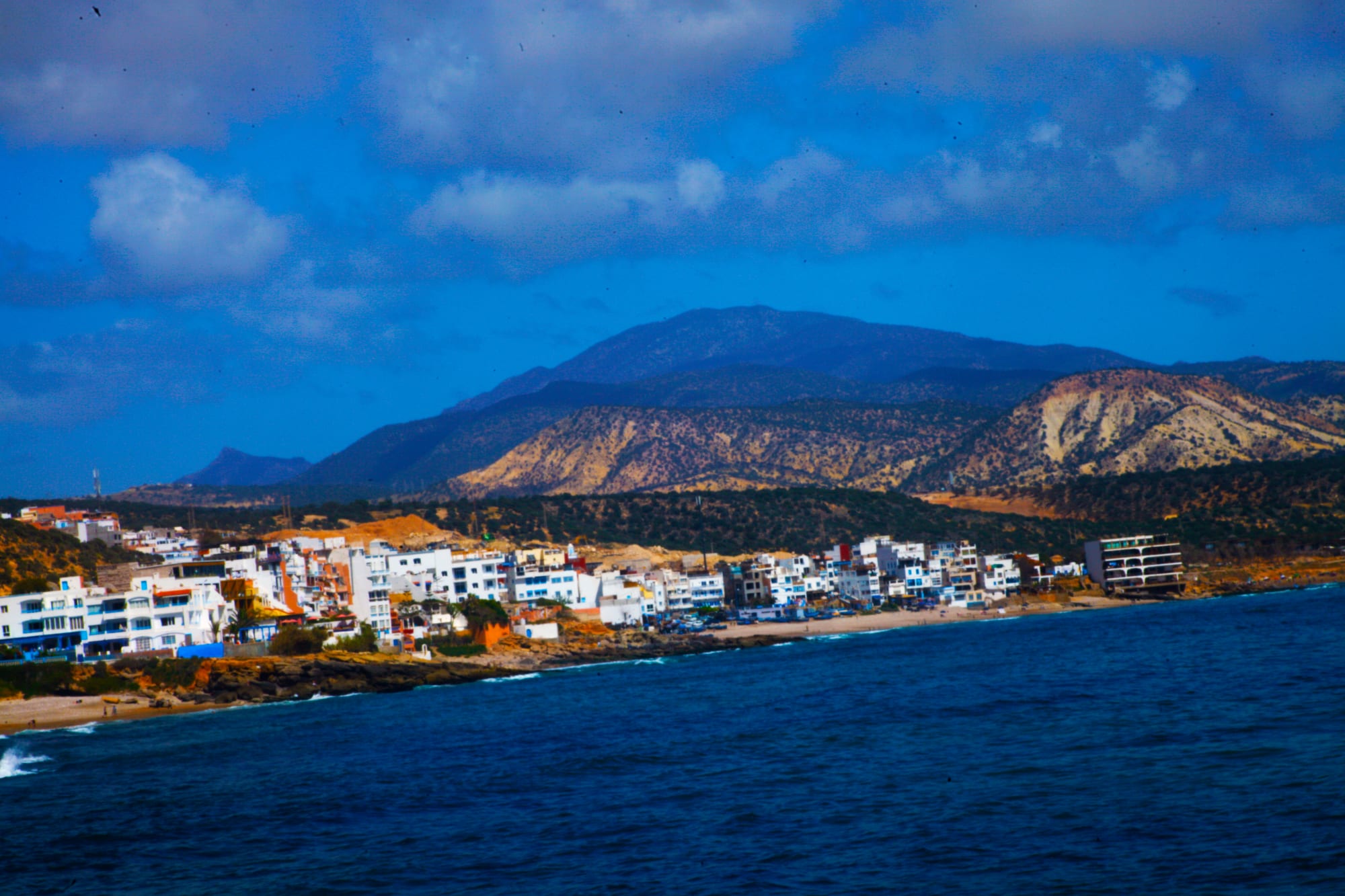
A cluster of white and pale buildings on a rocky Atlantic shore, with dark hills rising behind and surf breaking along the coast

Agadir, the Drâa Valley & the South, Morocco

Taghazout

The village of Taghazout on the Atlantic coast north of Agadir. (AJSPARK4444 / Wikimedia Commons · CC BY-SA 4.0)

A fishing village on the Atlantic coast about 20 km north of Agadir, built on a headland where the Anti-Atlas foothills meet the sea. Long right-hand point breaks made it one of Morocco's best-known surf destinations from the late 1960s onwards, and surf schools, guesthouses and cafés now sit alongside the boats and a large resort development on the bay to the south.

Neighbourhoods

  • The old village
    • First-time visitors
    • Budget stays
    • Beach cafés

    A tight cluster of whitewashed and blue-painted houses on the headland above the fishing beach, threaded with narrow lanes. Guesthouses, surf schools, board hire, small grocers and rooftop cafés fill nearly every building, and boats are still pulled up on the sand below.

    Open in Maps
  • Taghazout Bay
    • Resorts
    • Golf
    • Quiet stays

    A planned tourism development on the bay towards Agadir, with hotels, apartments and a golf course set back from a long beach. It is spacious, modern and quiet compared with the village, and a short drive from it.

    Open in Maps
  • Tamraght
    • Surf camps
    • Quiet and residential
    • Best for food

    A village a few kilometres south on the road to Agadir, above the mouth of a valley of banana plantations. Surf camps, yoga retreats and small cafés have spread through it, and the beach below it is one of the area's main beginner spots.

    Open in Maps
  • Aourir
    • Local life
    • Markets
    • Best for food

    Known as the banana village for the plantations and roadside stalls along the Tamraght valley, about 7 km south. It is more of a working Moroccan town than a surf base, with a market and everyday shops.

    Open in Maps

Things to do

Surf and beaches

  • Anchor Pointbeach

    The long right-hand point break about 3 km north of the village and its best-known wave; in the right conditions a ride runs from the point through Hash Point to the beach break at Panorama's.

    Open in Maps
  • Killer Pointbeach

    One of the named surf breaks on the rocky shore north of the village, in the line of waves that runs from Anchor Point past Killers and Mysteries to Boilers further up the coast.

    Open in Maps
  • Taghazout beachbeach

    The sandy bay below the village, used by fishing boats, beginners' surf lessons and swimmers, with cafés along the front.

    Open in Maps
  • Tamraght and Banana Beachbeach

    A wide sandy beach a few kilometres south, below the banana valley, with gentler waves that make it the main teaching spot on this coast.

    Open in Maps
  • Tamribeach

    A long exposed beach north of the village beside a banana-growing town, picking up swell when other spots are flat, with river-mouth wetlands that attract birds.

    Open in Maps

Inland and short trips

  • Paradise Valleytrail

    A stretch of the Tamraght river valley in the mountains about 20 km inland, with palms, boulders and rock pools, reached by the road towards Imouzzer.

    Open in Maps
  • Agadirattraction

    The resort city about 20 km south, with a long bay, a fishing port, the hilltop kasbah of Oufella and the large Souk El Had market.

    Open in Maps
  • Imsouaneattraction

    A fishing town up the coast to the north, set in a sheltered bay known for a long, slow point break that suits beginners and longboarders.

    Open in Maps
  • Souss-Massa National Parkpark

    A coastal park of dunes and river mouths south of Agadir, one of the last refuges of the northern bald ibis.

    Open in Maps

Eat and drink

Long-standing places and food districts in Taghazout. Hours, ratings and directions come from your maps app, always current.

Village kitchens

  • Fish grills on the seafrontrestaurant

    Small places along the front and in the lanes grill the day's sardines, sea bream and squid over charcoal, served with bread, salad and cumin.

    Open in Maps
  • Surf cafés and juice barscafe

    Rooftop and street-level cafés serving coffee, mint tea, smoothies, breakfasts and Moroccan staples such as msemen and omelettes to a mostly young crowd between sessions.

    Open in Maps

Nearby food stops

  • Aourir banana stallsmarket

    Roadside stands along the Tamraght valley selling the small, sweet bananas grown in the plantations behind, together with prickly pears, honey and argan oil.

    Open in Maps
  • Souk El Had, Agadirmarket

    The big walled market in the city to the south, the place for argan oil, amlou, spices, dates and fish bought straight from the stalls.

    Open in Maps

Experience Taghazout

History

Taghazout was a small Amazigh fishing settlement on a rocky headland, part of the Chleuh coast between Agadir and Cap Rhir, living on sardines, a little farming in the valleys behind and the argan trees on the slopes. Its name is Tamazight, and the village had no particular importance in the histories of the Souss, which were written around Agadir's port and the inland market towns.

That changed in the 1960s and 1970s, when travellers driving south through Morocco found the long right-hand waves peeling off the points north of the village. Anchor Point, 3 km north of the village, became known to surfers abroad, and a small counterculture scene grew in the village alongside the fishermen, with rooms rented in family houses and cafés opening along the front. The 1960 earthquake that destroyed Agadir had left the coast north of the city largely untouched, and Taghazout stayed a village while the city was rebuilt as a resort.

From the 2000s the state took an interest in the coast. Taghazout Bay, a large planned tourism zone of hotels, apartments and a golf course, was developed on the bay between the village and Agadir, and the coast road was improved. The old village kept its own character, growing upwards and outwards with guesthouses, surf camps and yoga retreats, and drawing longer-staying visitors and remote workers through the winter, while the fleet of small boats still works from the beach below.

Culture & Customs

Two ways of life share a small space. One is that of a southern Moroccan village: Tamazight-speaking, Muslim, organised around family, the mosque, the market at Aourir and the fishing season. The other is the international surf culture that arrived in the 1960s and never left — board racks, dawn checks of the swell, camps full of Europeans in winter, and a local generation of Moroccan surfers who now compete and coach.

The meeting has been mostly easy, but it has rules. Villagers expect visitors to cover up away from the beach, to keep noise out of the residential lanes at night, and to treat the fishing beach as a workplace rather than a photo backdrop. Alcohol is not part of village life, and Ramadan changes the daytime rhythm even at the height of the surf season.

The wider Souss culture is present too: argan oil pressed by women's cooperatives in the hills behind, Chleuh music at weddings, and the hospitality of tea offered before any conversation about business. Yoga and wellness retreats have added a third layer since the 2010s, and the village now has more studios, vegan cafés and long-term visitors than anywhere else on this coast — a mix that some residents welcome for the income and others find has pushed rents beyond local reach.

Daily Life

A few thousand people live in the village, while the neighbouring town of Aourir counted about 22,000 at the 2004 census; with Tamraght between them they form the built-up strip along this part of the coast. Fishing continues from the beach with small open boats, selling to local buyers and restaurants, but tourism is now the main employer: guesthouses, surf schools, camps, cafés, vans, board repair and construction.

The seasons are pronounced. From September to April the village is full of surfers and long-stay visitors, and rooms are hard to find; in the heat of summer the crowd shifts to Moroccan families on holiday; late spring is quiet. Many young men from the village work as instructors and guides, and families rent out floors of their houses, which has raised incomes and rents at the same time.

The pressures are those of a small place that grew quickly: water supply on a dry coast, waste and drainage, building on the slopes above the village, and traffic on a narrow coast road. Banana plantations in the Tamraght valley and argan and almond groves in the hills provide the other local income, and Agadir, half an hour south, supplies the hospitals, offices and big markets.

Food

Fish comes first. Sardines, sea bream, mackerel, sole and squid are grilled over charcoal and served with bread, tomato and onion salad and cumin, or cooked as a tagine with peppers, potato and chermoula, the marinade of coriander, garlic, cumin, paprika and lemon. Fried fish in paper and bowls of fish soup are the cheap staples along the front.

The Souss supplies the rest. Argan oil, pressed from the kernels of trees that grow on the slopes behind the village, is used for dipping and dressing, and amlou — argan oil blended with roasted almonds and honey — is the breakfast spread. Bananas from the Tamraght valley are sold at roadside stalls, along with prickly pears in summer and honey from the hills. Tagines of chicken with preserved lemon and olives, and barley couscous on Fridays, are the standard Moroccan meals in village kitchens.

Breakfast is the meal the surf camps have made their own: msemen and harsha with honey, olive or argan oil, eggs, olives, yoghurt and fruit, alongside smoothies and coffee. Mint tea, very sweet and poured from height, runs through the day, and freshly pressed orange juice is sold on the main street and in Agadir's market.

Planning tools

Budget

Taghazout is cheap by the standards of European surf towns and has been shaped by long-stay visitors: guesthouses, shared surf camps and flats are the usual accommodation, and food from the village kitchens costs little. Board and wetsuit hire, lessons and airport transfers are the extras, and the resort hotels on the bay sit in a different bracket entirely.

Daily Budget Midrange
USD 95–230 (apartment or resort hotel, restaurant meals, lessons or guided surf trips, a hire car)
Daily Budget Shoestring
USD 25–50 (guesthouse or surf-camp bed, café meals, board hire, shared taxis)

Weekly and monthly rates for rooms and surf packages are far cheaper than daily ones, and the village has few cash machines, so bring dirhams from Agadir.

Best Time to Visit

Autumn and winter, roughly September to April, bring the Atlantic swells that the point breaks need, along with mild, sunny days and cool water. Summer is calmer, warmer and busier with Moroccan holidaymakers, and suits swimming and beginners rather than experienced surfers. The village is quietest in late spring.

Suggested Number of Days

A couple of days is enough to see the village and the nearest breaks. Surfers usually stay a week or more, since conditions change from day to day, and the extra time also covers the coast north and the valleys inland.

First Visit
2–3 days
With Surroundings
5–7 days

Transportation

The village is small and walkable end to end. Along the coast, grands taxis and local buses run between Agadir, Aourir, Tamraght and Taghazout through the day, and surf camps run their own vans to whichever break is working. A hire car helps for the beaches further north and the roads inland.

Agree the fare before getting into a shared taxi, and expect the coast road to be busy and narrow at weekends.

Airport & Station Connections

Agadir–Al Massira Airport, in the commune of Temsia, is about 40 km south-east, roughly an hour by taxi or transfer, with flights from many European cities. From Agadir, local buses and grands taxis take half an hour up the coast road. Coaches serve Agadir rather than the village itself, and there is no railway in southern Morocco.

Walkability

Everything in the village can be reached on foot, though the lanes are steep, narrow and often stepped between the road above and the beach below. Walking along the shore towards the points is easy at low tide and blocked by rocks at high tide. The neighbouring villages are a few kilometres apart along a road with little pavement, so most people use a taxi or a van.

Safety

The village is relaxed and crime is low, with petty theft from rooms and beaches the main concern. The sea is the real hazard: strong currents, rip currents at the river mouths, rocks and urchins at the reef breaks, and cold water that needs a wetsuit for most of the year. Beaches are not generally patrolled by lifeguards outside the main resort stretches.

Use official guides booked through a riad or a licensed agency, keep bags across the body in medinas, and avoid the cannabis-growing Ketama area of the Rif. Check current official travel advice before travelling.

Climate

Mild and dry all year, cooled by the Atlantic and the current running down the coast, with sunshine on most days and little rain outside the winter months. Sea temperatures stay cool even in summer, and morning fog is common in the warm months.

Summer
warm rather than hot — days generally 24–28°C, with sea fog in the early morning
Winter
mild and sunny — days around 18–21°C, nights near 10°C, with occasional Atlantic storms

Local Customs

The village is used to surfers, but it remains a Moroccan fishing village where most families are conservative. Swimwear and bare chests belong on the beach, not in the lanes or the shops, and modest dress is appreciated away from the sand. Tamazight and Arabic are the everyday languages, with French and English common in the camps. Greetings before requests are normal, and the mosque and prayer times set the rhythm of the day.

Ask before photographing fishermen or residents, keep noise down late in residential lanes, and note that alcohol is limited to a few licensed hotels and restaurants rather than village cafés.

Common Payment Methods

The Moroccan dirham is used everywhere and mostly in cash: guesthouses, cafés, board hire and taxis often do not take cards, and the few cash machines in the village can run empty at weekends. Agadir, half an hour away, has plentiful banks and ATMs, and larger hotels on the bay accept cards.