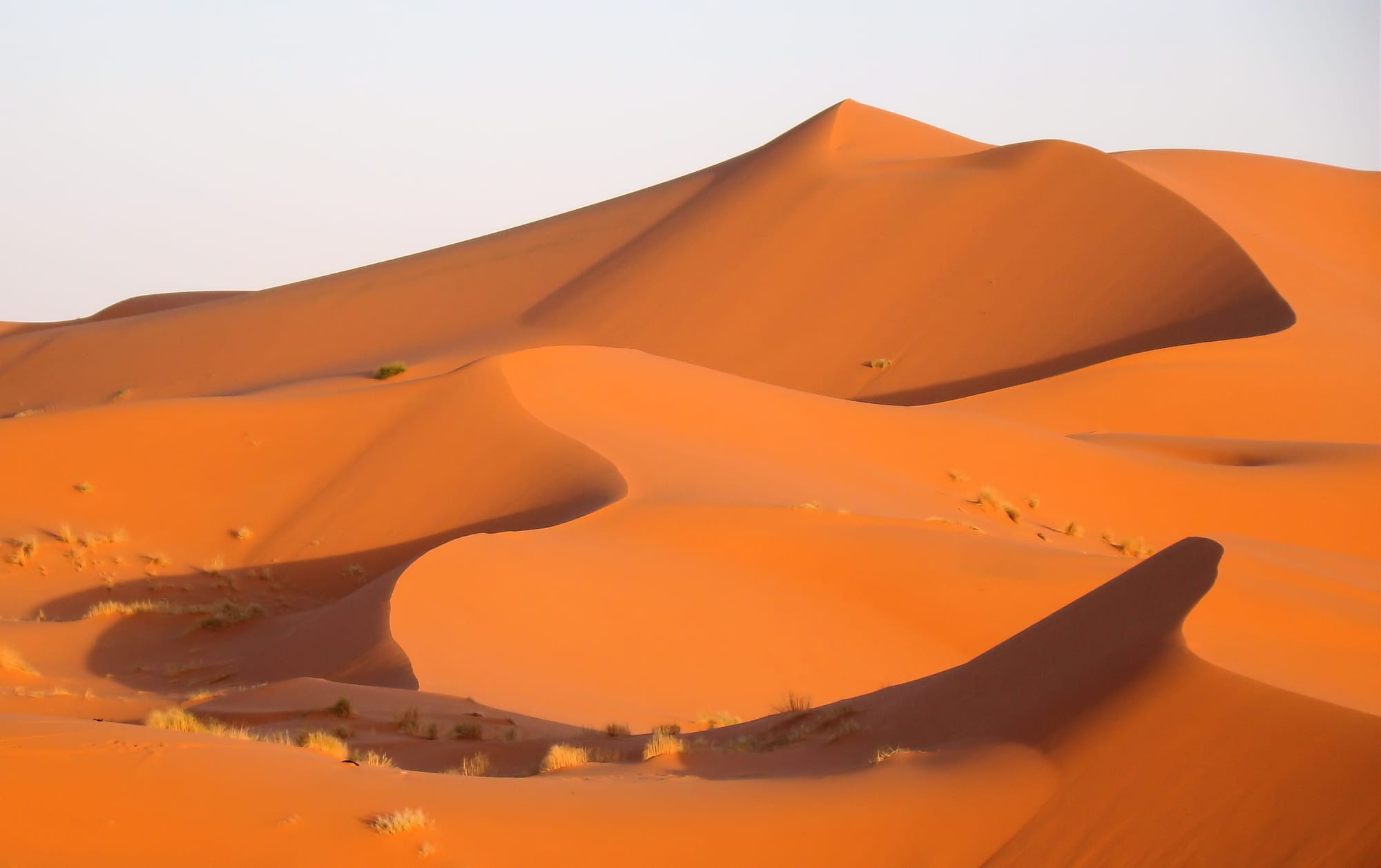
Tall orange sand dunes with sharp crests and long shadows under a pale sky, with tufts of grass in the hollows

Morocco

Agadir, the Drâa Valley & the South

The dunes of Erg Chebbi near Merzouga, in the Tafilalet close to the Algerian border. (Bjørn Christian Tørrissen / Wikimedia Commons · CC BY-SA 3.0)

Southern Morocco below the High Atlas, from the Atlantic resort of Agadir and the Souss plain through the Anti-Atlas to the kasbahs, palm oases and gorges of Ouarzazate, the Drâa and the Tafilalet, and out to the Saharan dunes of Merzouga and the desert town of Guelmim. It is the country's Amazigh south and its gateway to the Sahara.

Explore Agadir, the Drâa Valley & the South

History

The oases of the south were the northern end of the trans-Saharan caravan routes. Sijilmasa, founded in the Tafilalet in the 8th century near today's Rissani, grew rich on gold from West Africa exchanged for salt, cloth and horses, and the Drâa valley carried caravans towards Timbuktu. The Souss plain and the Anti-Atlas were home to Amazigh farming communities with their fortified granaries, the agadirs, a Berber word for a fortified building that is also the city of Agadir's name.

Two Moroccan dynasties came from here. The Saadians rose in the Drâa valley and the Souss in the early 16th century, leading resistance against the Portuguese, who had built a fort at Agadir, and took the fort in 1541 before going on to rule the country. The Alaouites, Morocco's reigning dynasty, come from the Tafilalet, from where they took power in the 17th century. Taroudant served for a time as a Saadian capital, and its walls date largely from that era.

The French subdued the south late: the Aït Atta of Jbel Saghro held out until the battle of Bougafer in 1933, and the "lords of the Atlas" controlled much of the region through kasbahs such as those of the Glaoui family. Spain held the enclave of Sidi Ifni until 1969. In 1960 an earthquake destroyed Agadir, killing between 12,000 and 15,000 people, and the city was rebuilt as a modern resort. Further south, beyond Tan-Tan, lies Western Sahara, a territory that Morocco controls for the most part and claims, and which the Polisario Front's Sahrawi Republic also claims; Globeway covers it separately.

Culture & Customs

The Souss is the heartland of the Chleuh, the Tashelhit-speaking Amazigh of the south-west. Soussi merchants run corner shops across Morocco, and the region's rwais — travelling Amazigh poet-singers — and the ahwach dances of the villages are central to its identity. Tiznit is known for its silver jewellery.

East of the Atlas, the oases hold a mixed population of Amazigh groups such as the Aït Atta, Arabic-speaking tribes and the Haratin, and a culture built around palm groves, irrigation channels and earthen ksour. Festivals mark the harvests: the rose festival at Kelaat M'Gouna in May, the date festival at Erfoud in autumn, and the betrothal moussem at Imilchil in the high mountains of Midelt province. Tamegroute near Zagora is home to an old Sufi zawiya with a library of manuscripts, and its potters make a distinctive green-glazed ware.

Around Guelmim and Tan-Tan the culture is Hassaniya-speaking and nomadic in origin, closer to the Sahrawi world: camel herding, tents, the guedra dance performed by women kneeling to a drumbeat, and the Tan-Tan moussem, a gathering of desert tribes recognised as UNESCO intangible heritage.

Daily Life

Souss-Massa has around three million people, Drâa-Tafilalet about 1.6 million and Guelmim-Oued Noun under half a million. Greater Agadir, including Inezgane and Aït Melloul, approaches a million; Taroudant, Tiznit, Ouarzazate, Errachidia, Guelmim and Tinghir are the main towns.

Agadir combines beach tourism with a major fishing port and a large food-processing industry, and the Souss-Massa plain is the country's main producer of export tomatoes and citrus, grown under plastic greenhouses that depend on dwindling groundwater. In the oases, families farm dates, henna and alfalfa in the shade of palm groves and rely heavily on remittances. Ouarzazate lives on tourism, the film studios that have hosted many Hollywood productions, and the Noor solar power complex nearby. Guelmim and Tan-Tan are trading and administrative towns with large military and civil-service populations.

Drought is the defining issue: several dry years have shrunk the palm groves of the Drâa, and migration to the cities is heavy. Days follow the heat, with long midday pauses and life moving outdoors in the evening.

Food

The Souss is argan country. Oil pressed from the kernels of the argan tree, by hand in women's cooperatives or in modern presses, is used for cooking, and amlou, a paste of argan oil, almonds and honey, is eaten with bread. Around Taliouine, in Taroudant province, farmers grow saffron, and Agadir's port grills sardines and other fresh fish daily.

The Tafilalet is date country and the original home of the large, soft Mejhoul, and Rissani and Merzouga are known for medfouna, a flatbread stuffed with minced meat, onions and spices, baked under the desert sand. Kelaat M'Gouna distils rose water, used in pastries and cosmetics. Tagines here are often cooked over charcoal with seasonal vegetables and goat or lamb, and in the Guelmim area camel meat and camel milk appear on the table.

Barley couscous, harsha semolina griddle cakes and honey from the Souss mountains complete the southern breakfast, alongside mint tea poured with ceremony at every stop.

Attractions & Natural Wonders

Agadir has a long sandy bay, a seafront promenade and the ruined kasbah of Agadir Oufella on the hill above the port. Just north, Taghazout and the neighbouring breaks draw surfers, and Paradise Valley lies in the hills inland; the Souss-Massa National Park to the south shelters the rare northern bald ibis. Taroudant, inland, has its ramparts and souks, and Tafraoute sits among the pink granite and almond trees of the Anti-Atlas, near the Ameln valley. Tiznit's walled medina and the coast at Sidi Ifni and Legzira, with its sea arch, lie south, and Guelmim, beyond, is the traditional gateway to the Sahara.

Over the High Atlas, Ouarzazate has the Taourirt kasbah and its film studios, and Aït Benhaddou, a UNESCO World Heritage Site, is a short drive away. East along the road of the kasbahs lie the Skoura palm grove, Kelaat M'Gouna's rose gardens, the Dadès gorge above Boumalne and the Todra gorge near Tinghir. South of Ouarzazate, the Drâa valley runs through palm groves to Zagora, Tamegroute and M'Hamid, the base for the dunes of Erg Chigaga.

In the Tafilalet, the Ziz valley leads south from Errachidia to Erfoud, known for fossils, and Rissani, beside the ruins of Sijilmasa. Beyond lie Merzouga and the dunes of Erg Chebbi, where camel treks lead to desert camps, and the Khamlia village of Gnawa musicians.

Cities in Agadir, the Drâa Valley & the South

Planning basics

Budget

Agadir's beach hotels and the desert camps of Merzouga and Zagora span every price range; simple guesthouses and kasbah hotels in the oases are good value. The main extra costs are desert excursions, camel treks and private drivers, since distances are long and public transport is thin off the main roads.

Daily Budget Midrange
USD 95–230 (kasbah hotel or resort, restaurant meals, a car or driver, a comfortable desert camp)
Daily Budget Shoestring
USD 25–50 (hostel or guesthouse, local cafés, CTM and Supratours coaches, a basic desert camp)

Book desert camps directly or through the guesthouse rather than from touts on the road; renting a car gives the most freedom between the oases.

Safety

The south is generally safe and relaxed. Risks are practical: heat, dehydration and flash floods, long drives on roads shared with trucks and animals, and pushy guides in Merzouga and Zagora. The border with Algeria is closed and militarised, and off-road trips should stay well clear of it. South of Tan-Tan lies Western Sahara, where travel advice is more restrictive.

Travel with a reputable guide in the dunes, never cross dry riverbeds in a storm, and check the latest advice before heading south of Guelmim. Check current official travel advice before travelling.

Climate

Agadir has a mild Atlantic climate with sunshine nearly all year. Inland the climate becomes desert: Ouarzazate, Zagora and Merzouga are very hot in summer and cold at night in winter, with little rain; occasional sandstorms blow in spring, and rare storms bring flash floods. The high passes of the Atlas can see snow.

Summer
25–28°C in Agadir; 40–45°C in the Drâa, Tafilalet and around Guelmim
Winter
mild, 15–22°C in Agadir; sunny days and near-freezing nights in the desert and oases

Transportation

Agadir has an international airport, and Ouarzazate, Errachidia, Zagora and Guelmim have domestic ones. There are no passenger railways: CTM and Supratours coaches link Agadir with Marrakech and the south, and Marrakech to Ouarzazate takes about four hours over the Tizi n'Tichka pass. Grand taxis and minibuses fill the gaps, and most visitors to the desert travel by hire car or with a driver.

Drive the long desert stretches by day, fill up whenever possible, and allow a full day from Marrakech to Merzouga by road.

Best Time to Visit

October to April is the season for the desert and oases, with warm days and cold nights; spring brings almond blossom in the Anti-Atlas and the rose festival at Kelaat M'Gouna in May. Agadir and the surf coast work year-round, with the best waves in autumn and winter. Summer is extremely hot inland.