History
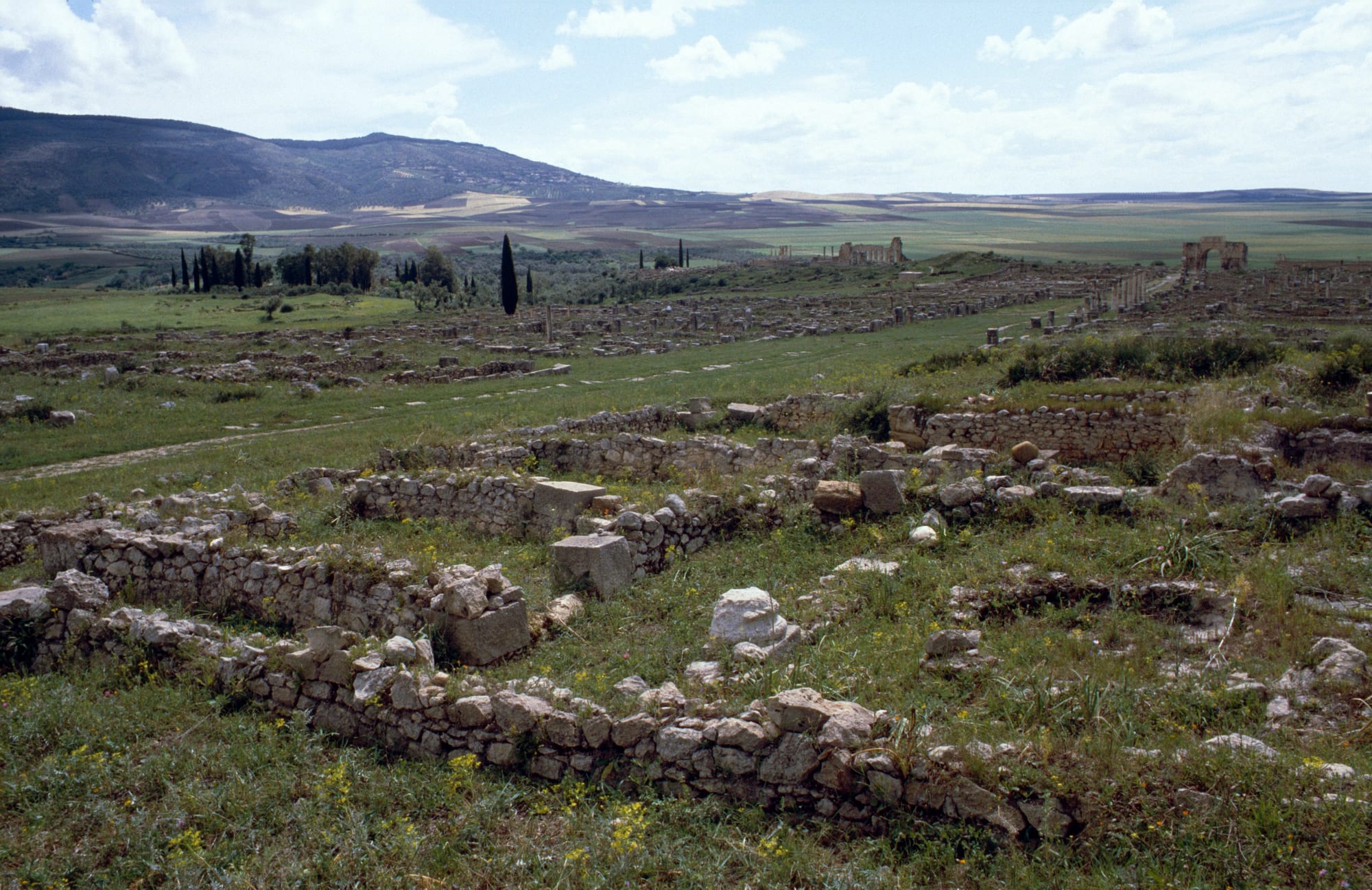
Long before Fès, the Saïss plain was the edge of Roman Africa. Volubilis, a Mauretanian town that grew under Rome into the chief city of the province's interior, prospered on olive oil and grain, and was still inhabited after the Romans withdrew. In the late 8th century Idris I, a descendant of the Prophet fleeing the Abbasids, arrived there, won the support of local Amazigh tribes and founded the first Muslim dynasty in Morocco; his tomb at Moulay Idriss, a few kilometres from the ruins, became a major place of pilgrimage.
Idris I founded Fès in 789 and his son Idris II enlarged it; refugees from Córdoba and Kairouan settled its two banks, and in 857 or 859 Fatima al-Fihri founded the Qarawiyyin mosque, which grew into a centre of learning. Under the Marinids in the 13th and 14th centuries Fès was the capital of Morocco, and the dynasty built Fès el-Jdid, the royal city beside the old medina, and the carved medersas that still stand. Sultan Moulay Ismail, who reigned from 1672 to 1727, made Meknès his capital instead, raising walls, gates, palaces and huge granaries and stables.
The Treaty of Fez establishing the French protectorate was signed in the city in 1912 and was followed by a violent uprising there; the French then moved the capital to Rabat. Fès kept its prestige as the seat of old merchant families and scholars who shaped the nationalist movement, while the French built new towns beside the medinas and the hill station of Ifrane in the Middle Atlas. After independence, many wealthy Fassi families moved to Casablanca and Rabat, and the Fès medina, a UNESCO World Heritage Site, has since been the focus of long restoration programmes.