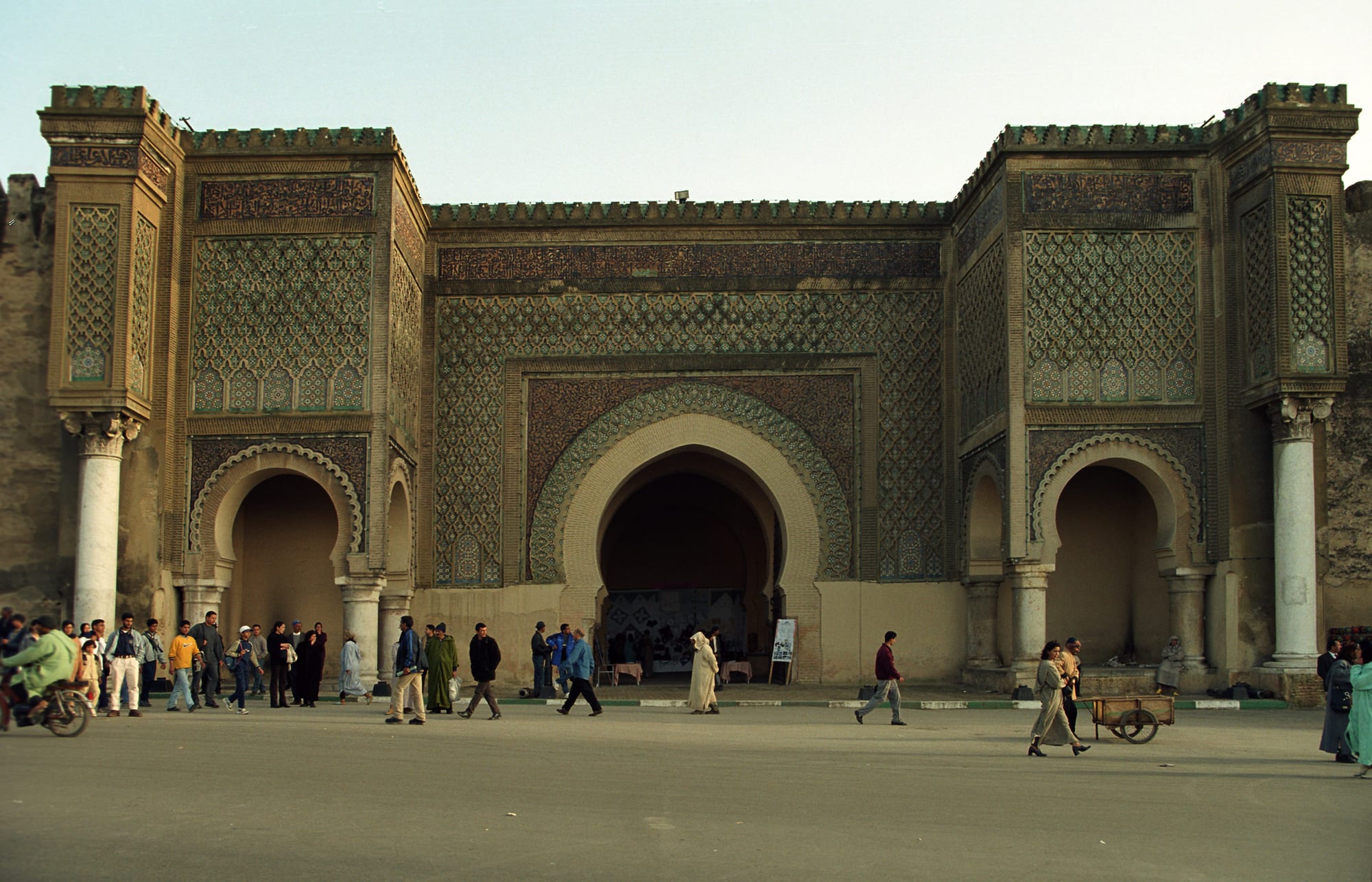
A huge tiled gateway with a horseshoe arch and green-and-brown zellige panels, with people crossing the open square in front of it

Fès, Meknès & the Middle Atlas, Morocco

Meknes

Bab Mansour, the monumental gate to Moulay Ismail's imperial city, seen from Place el-Hedim in Meknes. (Jerzy Strzelecki / Wikimedia Commons · CC BY 3.0)

One of Morocco's four imperial cities, on the Saïss plain about 60 kilometres west of Fès. Sultan Moulay Ismail made it his capital in the late 17th century and ringed it with walls, gates, granaries and stables on a scale nothing else in the country matches. The historic city has been a UNESCO World Heritage Site since 1996.

Neighbourhoods

  • The medina and Place el-Hedim
    • First-time visitors
    • Historic district
    • Markets

    The walled old town north of the imperial quarter, entered from the broad square of Place el-Hedim. Covered souks sell textiles, metalwork, olives and preserved lemons, and the Bou Inania madrasa, the Dar Jamaï museum and the Grand Mosque are all within a few lanes of each other. It is far smaller and calmer than the medina of Fès.

    Open in Maps
  • The imperial city
    • Historic district
    • Monuments
    • Quiet walks

    The vast walled enclosure south of Bab Mansour, built by Moulay Ismail — the mausoleum that holds his tomb, the ruined Dar el-Makhzen palace, the Heri es-Souani granaries and the Agdal Basin. Long empty avenues run between rammed-earth ramparts, and distances between the monuments are considerable.

    Open in Maps
  • Berrima and the Mellah
    • Historic district
    • Local life

    The quarter west of the imperial city, laid out when Moulay Ismail moved the Jewish community to a new mellah beside his palace. Its grid of narrow streets, synagogue buildings and small workshops is residential and little visited.

    Open in Maps
  • Ville Nouvelle and Hamria
    • Cafés and restaurants
    • Close to public transport
    • Hotels

    The French-built new town on the far side of the Boufekrane valley, laid out in the 1910s and 1920s with wide avenues, balconied apartment blocks, pavement cafés and most of the city's banks and larger hotels. The railway station is on this side.

    Open in Maps
  • Toulal and the southern suburbs
    • Quiet and residential
    • Local life

    Newer housing districts spreading south and west of the old centre, where most of the city's population now lives. There is little for visitors beyond neighbourhood markets and a clear sense of ordinary Moroccan city life.

    Open in Maps

Things to do

The imperial city

  • Bab Mansourlandmark

    The monumental gate to Moulay Ismail's palace quarter, faced in zellige tilework and flanked by ancient marble columns probably from Volubilis, finished in 1732.

    Open in Maps
  • Mausoleum of Moulay Ismaillandmark

    The tomb complex of the sultan who made Meknes his capital, set around tiled courtyards and fountains.

    Open in Maps
  • Heri es-Souanilandmark

    Moulay Ismail's enormous grain store, a forest of thick earthen arches with deep wells and water-wheel chambers; the royal stables, often confused with it, stood further south.

    Open in Maps

The medina

  • Bou Inania Madrasalandmark

    A 14th-century Marinid college of carved cedar, stucco and zellige around a small courtyard, with a roof terrace over the medina.

    Open in Maps
  • Dar Jamaï Museummuseum

    A palace built in 1882 for a grand vizier's family, with an Andalusian garden, a museum since 1920 and reopened in 2022 as the National Museum of Music.

    Open in Maps
  • Great Mosque of Mekneslandmark

    The principal mosque of the medina, founded under the Almoravids and rebuilt by the Marinids; non-Muslims may see it only from outside.

    Open in Maps
  • Place el-Hedimattraction

    The open square between the medina and Bab Mansour, cleared of houses by Moulay Ismail and now lined with cafés and food stalls.

    Open in Maps

Short trips from the city

  • Volubilisattraction

    The excavated Roman provincial town about 30 kilometres north, a UNESCO World Heritage Site since 1997, with mosaic floors, a basilica and a triumphal arch.

    Open in Maps
  • Moulay Idriss Zerhounattraction

    The whitewashed pilgrimage town on two hills above Volubilis, built around the tomb of Idris I.

    Open in Maps
  • Zerhounviewpoint

    The olive-covered massif north of the city, whose slopes hold shrines, villages and long views over the Saïss plain.

    Open in Maps
  • El Hajebattraction

    A small town on the escarpment about 30 kilometres south, where the plain gives way to the first ridges of the Middle Atlas.

    Open in Maps

Seasonal events

  • Moussem of Sheikh al-Kamilaround the Prophet's birthday, Mawlid

    The pilgrimage and festival of the Aissawa brotherhood, whose founder is buried in the city, drawing followers from across Morocco for processions and trance music.

  • International Agriculture ShowApril

    Morocco's national agricultural fair, held on showgrounds in the city, with livestock, machinery, regional produce and large crowds.

  • Ramadanvaries with the lunar calendar

    Cafés and kitchens fall quiet by day and the medina fills after sunset, when harira, dates and pastries are sold from stalls around Place el-Hedim.

Eat and drink

Long-standing places and food districts in Meknes. Hours, ratings and directions come from your maps app, always current.

Food districts and markets

  • Place el-Hedim stallsmarket

    Grills, snail broth, fried fish and bowls of harira are sold from stands around the square, busiest in the evening.

    Open in Maps
  • The medina souksneighborhood

    Covered lanes of olive sellers, spice merchants, preserved lemons, dried fruit and bakeries, with small eating houses serving tagines at midday.

    Open in Maps
  • The covered market off Place el-Hedimmarket

    A produce hall known for pyramids of olives in every cure, pickles, cheeses and the local honey.

    Open in Maps

Cafés and restaurants

  • Ville Nouvelle cafésneighborhood

    Pavement cafés along the avenues of the new town serve mint tea, coffee and French-style pastries, and are the city's main evening meeting places.

    Open in Maps
  • Riad restaurants in the medinaneighborhood

    Restored courtyard houses serve set Moroccan menus of salads, pastilla and tagines, often with wine from the surrounding vineyards.

    Open in Maps

Experience Meknes

History

Meknes takes its name from the Miknasa, a Zenata Amazigh tribe that settled the Saïss plain and founded a group of villages here in the 10th century. The Almoravids fortified the site in the 11th century, and the Almohads and Marinids who followed gave the medina its walls, its Great Mosque and the Bou Inania madrasa. For six hundred years it was a prosperous but secondary town, overshadowed by Fès an hour's ride away.

Its transformation came with Moulay Ismail, the Alaouite sultan who reigned from 1672 to 1727 and chose Meknes as his capital. Over more than fifty years he built an imperial city on a scale that astonished visiting European embassies: kilometres of rammed-earth walls, monumental gates, palaces, barracks for his Black Guard, gardens, a reservoir and the enormous granaries and stables of Heri es-Souani, raised by conscripted labour and by Christian captives taken at sea. He was often compared to his contemporary Louis XIV, and had begun his palace complex before news reached him of the work under way at Versailles.

After his death the court returned to Fès and Marrakesh, and much of the imperial city was left unfinished or allowed to decay; the earthquake that destroyed Lisbon in 1755 damaged it further. Under the French protectorate after 1912 Meknes became a garrison and farming centre, and a Ville Nouvelle grew across the valley among vineyards and olive groves planted by settlers. The historic city is a UNESCO World Heritage Site, and restoration of the walls, gates and granaries has continued.

Culture & Customs

Meknes has the manners of a provincial capital that was once an imperial one: proud of its monuments, less used to tourists than Fès, and slower in pace. Craftsmen in the medina still work in inlaid and engraved metal, alongside carpet weaving, woodwork and embroidery, and the Dar Jamaï palace houses the national museum of music.

Religious life is strong. The tomb of Moulay Ismail is visited by Moroccans as well as by travellers, and the city is the home of the Aissawa, a Sufi brotherhood founded by Sheikh al-Kamil, Mohamed ben Aissa (1465–1526), whose followers gather for a large moussem around the Prophet's birthday with processions, drumming and trance music that carries far beyond Morocco in reputation.

The surrounding plain is farming country, and the agricultural show held in the city each April is a national event that fills the hotels. Meknes is also the centre of Moroccan wine, grown on the slopes towards El Hajeb and Moulay Idriss, which sits awkwardly beside the city's religious conservatism and is handled with discretion. Amazigh culture is close at hand: market days bring people down from the Middle Atlas, and Tamazight is heard alongside Darija in the souks.

Daily Life

About 550,000 people live in the city, making it one of Morocco's larger urban centres, though the population has spread outward into districts such as Toulal and Marjane rather than upward. The medina remains densely inhabited, the Ville Nouvelle holds the offices and the schools, and the growth of recent decades has gone to housing estates on the southern and western edges.

The economy rests on farming and food processing — olives and olive oil, cereals, fruit and wine — together with textiles, a military presence that dates from the protectorate, the regional administration and Moulay Ismail University. Tourism matters but brings fewer visitors than Fès, and many people commute or migrate there, to Casablanca or abroad for work. Youth unemployment is a persistent problem, as across urban Morocco.

Days begin early with the markets and the bread ovens, slow in the heat of the afternoon, and pick up again in the evening, when families walk on Place el-Hedim, around the Agdal Basin and along the avenues of Hamria. Friday means couscous at home after the midday prayer. Water is a growing worry: years of poor rainfall have hit the farms of the Saïss plain hard and restrictions on irrigation and public fountains have followed.

Food

Meknes eats much as the rest of northern Morocco does, with a stronger accent on what the plain produces. Olives are the emblem — green, black, cracked, cured with lemon or harissa and piled in the covered market — and the local oil goes into almost everything. Tagines of lamb with prunes and almonds, chicken with preserved lemon and olives, and Friday couscous steamed over a vegetable broth are the standards of the home kitchen.

Street food is best around Place el-Hedim, where stalls sell harira, the tomato, lentil and chickpea soup, bowls of babbouche or snail broth drunk for its peppery liquor, grilled kefta and merguez, fried sardines, and sfenj, ring doughnuts fried to order in the morning. Pastry shops make chebakia, sesame and honey dough folded into flowers, and kaab el ghzal, the almond-filled crescents called gazelle horns. Camel meat is sold from a few specialist butchers in the medina.

Mint tea, poured from height into small glasses, punctuates the day, and freshly squeezed orange juice is sold from carts. Meknes sits at the heart of Morocco's wine country, with vineyards under the Guerrouane and Beni M'Tir names producing reds, rosés and the pale vin gris; it is served in licensed restaurants and hotels rather than openly.

Planning tools

Budget

Meknes is one of the better-value imperial cities: riads, guides and taxis cost less than in Fès or Marrakesh, and the medina is small enough to see without hiring anyone. The main extra costs are a grand taxi or a driver for Volubilis and Moulay Idriss and entry tickets to the monuments.

Daily Budget Midrange
USD 70–150 (riad or mid-range hotel, restaurant dinners, petits taxis, a grand taxi to Volubilis)
Daily Budget Shoestring
USD 25–45 (hostel or basic riad, medina food stalls, city buses and shared taxis)

Agree the fare with a petit taxi before setting off, and share a grand taxi to Moulay Idriss rather than chartering one.

Best Time to Visit

March to May and September to November are the most comfortable, with green fields on the Saïss plain in spring and the olive and grape harvests in autumn. Summer is hot and dusty in the middle of the day, though the evenings are pleasant. Winter is cool and wet but the monuments are quiet.

Suggested Number of Days

The walled city and its monuments fit comfortably into a day and a half. Allow three or four days to add the Roman and pilgrimage sites north of the city and a run up into the Middle Atlas. Travellers using Meknes as a base rather than Fès stay longer.

First Visit
1–2 days
With Surroundings
3–4 days

Transportation

The city divides into the old town and the Ville Nouvelle, separated by the Boufekrane valley, and petits taxis link the two cheaply. City buses cover the outer districts, grand taxis leave from set ranks for Moulay Idriss, Azrou and El Hajeb, and the imperial city's long walls make a taxi useful even within the historic quarter.

Petits taxis are shared, so a driver may pick up other passengers along the way; fares are per person.

Airport & Station Connections

Meknes is on the main railway between Fès and Rabat, roughly 40 minutes from Fès and about three and a half hours from Casablanca, with two stations in the new town. The nearest airport is Fès–Saïss, about 60 kilometres east. Coaches and grand taxis serve the same routes, and many visitors arrive on a day trip from Fès.

Walkability

The medina is compact and flat enough to cross on foot in twenty minutes, and Place el-Hedim to Bab Mansour is a short stroll. The imperial city is another matter: the walled enclosure is several kilometres across, and the walk from the mausoleum to the Heri es-Souani granaries takes half an hour in the open sun. The Ville Nouvelle is a taxi ride away.

Safety

Meknes is calm by the standards of Morocco's tourist cities, with far fewer touts and faux guides than Fès or Marrakesh. Ordinary precautions against pickpocketing apply in crowded souks and around Place el-Hedim at night, and traffic on the main avenues is fast and unpredictable.

Bags are best kept closed and in front in the souks, and the busy roads between the medina and the new town need care on foot. Use official guides booked through a riad or a licensed agency, keep bags across the body in medinas, and avoid the cannabis-growing Ketama area of the Rif. Check current official travel advice before travelling.

Climate

A continental Mediterranean climate on a plain at around 500 metres, a little cooler than Fès. Summers are hot and dry, winters cool and damp, and most rain falls between November and April.

Summer
hot and dry — July and August days are commonly 32–38°C, with cooler nights
Winter
cool and wet — 5–17°C, with rain, occasional frost and snow on the Middle Atlas nearby

Local Customs

Meknes is a conservative provincial city and dress is modest, particularly in the medina and around the mausoleum, where shoulders and knees should be covered and shoes removed in the prayer areas. Non-Muslims may not enter working mosques. Greetings matter: a handshake and a few words of Arabic or French open most conversations, and photographing people, especially women, needs permission first.

Tip small amounts for service, bargain politely in the souks, and drink alcohol only in licensed hotels and restaurants rather than in public.

Common Payment Methods

The currency is the Moroccan dirham, which cannot easily be obtained abroad. Cards work in hotels, larger restaurants and supermarkets in the Ville Nouvelle, but the medina, taxis and stalls are cash only. ATMs are plentiful along the new town's avenues and around Place el-Hedim.