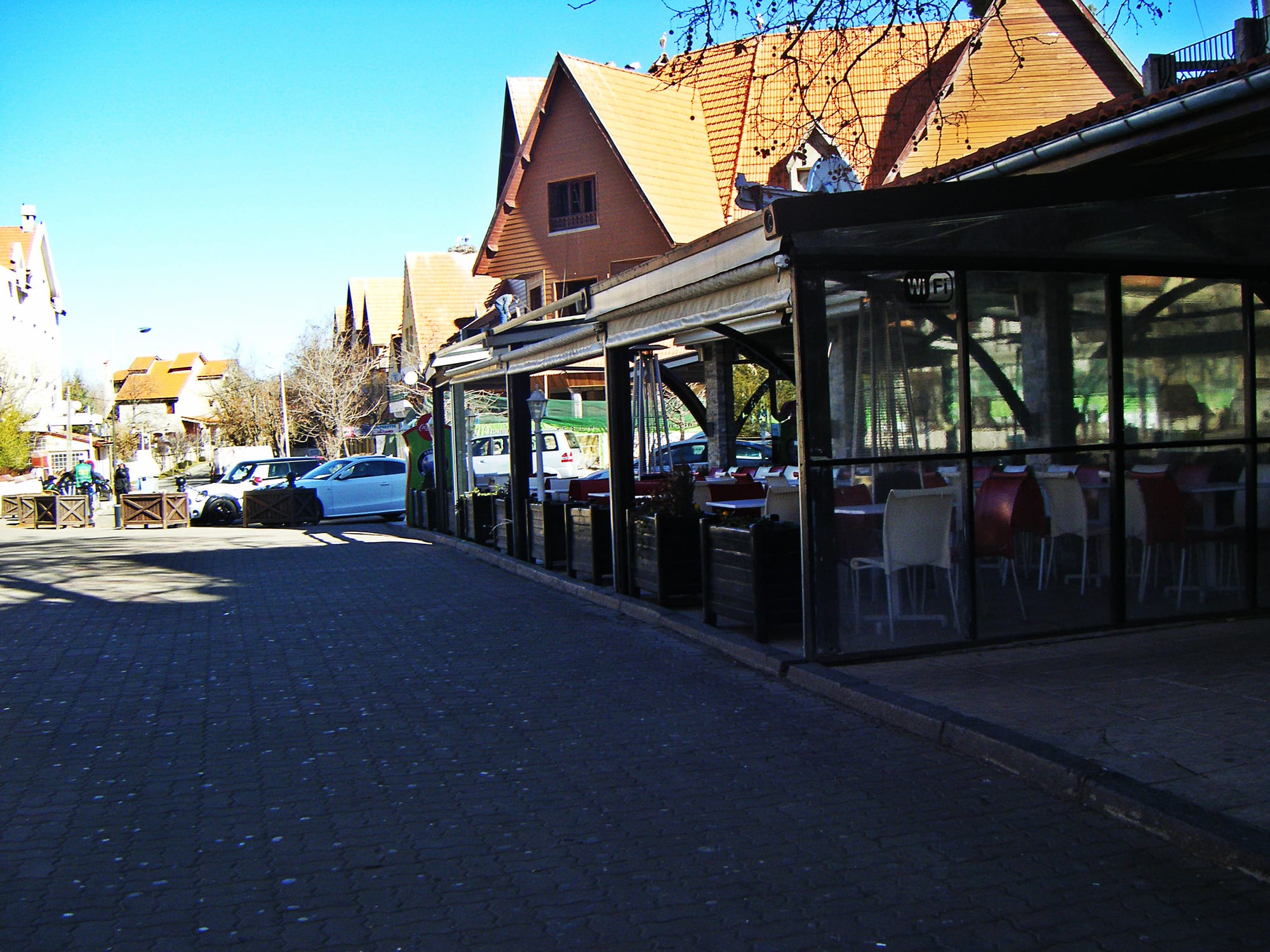
A paved street in Ifrane lined with cafés under glass verandas, with steep red-tiled alpine roofs behind under a deep blue sky

Fès, Meknès & the Middle Atlas, Morocco

Ifrane

Cafés and steep tiled roofs on a street in the centre of Ifrane, in the Middle Atlas. (Karima Lb / Wikimedia Commons · CC BY-SA 4.0)

A small town in the Middle Atlas at around 1,650 metres, built by the French in the late 1920s as a hill station and still unlike anywhere else in Morocco — steep tiled roofs, clipped lawns and cedar forest on every side. Moroccans come for snow in winter and cool air in summer, and it is the seat of Al Akhawayn University.

Neighbourhoods

  • The town centre
    • First-time visitors
    • Cafés
    • Close to the shops

    A handful of streets around the main square and the stone lion, with cafés, pizzerias, pâtisseries and shops selling honey, apples and woollens. Everything in the centre is within a few minutes' walk, and it fills with Moroccan families at weekends.

    Open in Maps
  • The villa quarters
    • Quiet and residential
    • Architecture
    • Walks

    Streets of steep-roofed houses with dormer windows and gardens, laid out under the protectorate and copied by later Moroccan owners. Many are second homes for families from Fès, Meknès and Casablanca, and much of the quarter is empty outside the holidays.

    Open in Maps
  • The university quarter
    • Students
    • Quiet and residential
    • Architecture

    The campus of Al Akhawayn University on the southern edge of town, a large landscaped site of stone-faced buildings that brings several thousand students and a good deal of the town's year-round life.

    Open in Maps
  • Zerrouka and the forest edge
    • Walks
    • Nature
    • Quiet and residential

    The slopes towards the springs and the road up to the ski ground, where the town gives way to cedar and oak woodland. Footpaths, picnic spots and small waterfalls are within walking distance of the last houses.

    Open in Maps

Things to do

In the town

  • Lion of Ifranelandmark

    A stone lion carved into a rock in 1930, the town's emblem and the place everyone is photographed, in a small park in the centre.

    Open in Maps
  • Al Akhawayn Universitylandmark

    An English-language university opened in 1995 on a wooded campus, with a mosque, sports facilities and grounds that visitors may walk in.

    Open in Maps

Forests, lakes and mountains

  • Ifrane National Parkpark

    A protected area of Atlas cedar and oak forest, high plateaux and lakes surrounding the town, home to Barbary macaques and a long list of birds.

    Open in Maps
  • Mischliffenattraction

    A small ski ground in the mountains south of the town, at around 2,100 metres, with lifts working in the snowier weeks of winter.

    Open in Maps
  • Dayet Aouaattraction

    A shallow lake about 15 kilometres north of the town at around 1,460 metres, ringed by cedars and reeds, known for waterbirds and lakeside cafés; its level varies sharply with the rains.

    Open in Maps

Short trips from the town

  • Azrouattraction

    The market town about 15 kilometres west, below the cedar forest where troops of Barbary macaques gather beside the road.

    Open in Maps
  • Sefrouattraction

    A town in the foothills towards Fès, with a medina, a long Jewish history and a cherry festival held each June.

    Open in Maps

Seasonal events

  • Ski season at MichlifenDecember to March, depending on snow

    When enough snow falls, the slopes south of the town open and Moroccan families arrive for the weekend, filling the hotels and the cafés.

  • Summer holidaysJuly and August

    City families escape the heat of the plains for the cool air of the Middle Atlas, and the town is at its busiest, with picnics in the forest and open-air cafés.

  • Ramadanvaries with the lunar calendar

    Daytime cafés and restaurants close and life shifts to the evening, when the centre fills after the fast is broken.

Eat and drink

Long-standing places and food districts in Ifrane. Hours, ratings and directions come from your maps app, always current.

Ifrane classics

  • Cafés on the main squarecafe

    Mint tea, coffee and pastries served indoors and under heaters, a fixed part of a weekend in the mountains.

    Open in Maps
  • Trout from the Middle Atlasrestaurant

    Trout from the rivers and hatcheries of the Middle Atlas, usually fried or grilled with lemon, is the local speciality on town menus.

    Open in Maps
  • Mountain honey and applesmarket

    Shops and roadside stalls sell cedar, thyme and jujube honeys and the apples grown on the plateau around the town.

    Open in Maps

Everyday eating

  • The municipal marketmarket

    A small covered market for vegetables, olives, cheese and meat, with grill stalls that cook what is bought at the counter.

    Open in Maps
  • Grills and snack bars near the centreneighborhood

    Kefta, brochettes, harira and tagines in plain dining rooms used by students and workers rather than weekend visitors.

    Open in Maps

Experience Ifrane

History

The plateau around Ifrane has been used for centuries by Amazigh groups of the Middle Atlas, who grazed flocks on the high pastures and sheltered in caves and springs; the name comes from the Tamazight word for caves. The French authorities laid out the present town from 1929, during the protectorate, as a hill station where officials and settlers could escape the summer heat of Fès and Meknès. They built it deliberately in a European mountain style, with steep tiled roofs, dormer windows, gardens and pine plantations, and added a stone lion carved into rock that became its emblem.

Ifrane grew as a summer resort and later as a winter one, once a ski ground was developed at Michlifen in the mountains to the south. After independence in 1956 the town kept its resort role, and the royal family built a palace here, which drew investment, careful maintenance and the reputation for cleanliness and order that Moroccans still associate with the place.

The most significant modern change came in the 1990s, when Al Akhawayn University was founded by royal decree in 1993, with the backing of the Moroccan and Saudi sovereigns, and inaugurated in January 1995 — an English-language, American-style university unusual in Morocco. It turned a seasonal resort into a town with a permanent student population, and Ifrane is the capital of its own province. Growth since has been driven by tourism, second homes and the forestry and farming of the surrounding plateau.

Culture & Customs

Ifrane is often called Little Switzerland, a nickname that says as much about how it is marketed as about how it looks. For Moroccan visitors it is a place of snow — often the first they have seen — of sledging, of photographs beside the lion, and of jumpers and honey bought on the way home. The town works hard at its image: flower beds, swept streets and a ban on the untidiness that characterises busier places.

Underneath the resort is an Amazigh region. The surrounding countryside belongs to the Beni M'Guild and neighbouring groups, Tamazight is widely spoken in the villages and in the markets, and weaving, carpets and the ahidous, a line dance performed to drums and chanting at weddings and moussems, remain part of rural life. Ifrane is where those two worlds meet, at the weekly markets and on the roadsides where honey, apples and wool are sold.

The university gives the town a third character again: students from across Morocco and abroad, lectures and concerts on campus, and cafés that stay busy in term time when the holiday villas are shut. Relations between students, townspeople and mountain villages are generally easy, though the gap between the manicured resort and the poorer villages a few kilometres away is obvious and openly discussed.

Daily Life

About 13,500 people live in Ifrane, a figure that multiplies on winter weekends and in August. Many houses are second homes owned by families from Casablanca, Rabat and Fès and stand empty for much of the year, which shapes everything from shop opening to property prices; younger local families increasingly live in the cheaper districts on the edges of town or in nearby villages.

Work comes from tourism and hotels, the university, the provincial administration and the royal estate, along with forestry, apple orchards, and sheep and cattle on the plateau. Winters without snow hurt the town's trade badly. Unemployment pushes many young people down to Meknès and Fès for work or study.

The daily rhythm is quieter than in Moroccan cities. Mornings are for the market and the schools, afternoons are slow, and the centre fills in the evening with families walking, students in cafés and children in the parks. Heating and firewood are a real cost from November to March, and a heavy snowfall can leave outlying villages cut off for a day or two.

Food

Ifrane's kitchen is Moroccan with a mountain accent. Trout, raised and caught in the cold rivers and lakes of the Middle Atlas, appears on almost every menu, fried or grilled with lemon and cumin, and is the dish most associated with the area. Tagines are heavier here than on the coast — lamb with prunes, beef with quince, chicken with olives — and harira, the lentil and chickpea soup, is eaten year-round rather than mainly in Ramadan.

The plateau's produce fills the shops: apples and pears from the orchards around Ifrane and Azrou, walnuts, mountain cheeses made from sheep's and goat's milk, and honey in many varieties, from dark cedar and jujube to pale thyme and orange blossom, sold in jars along the main streets. Amazigh households in the surrounding villages still make rough barley bread and tagines cooked slowly over wood.

In the centre, cafés serve mint tea, café au lait and French-style pastries that are a legacy of the protectorate, alongside pizzerias and grill houses aimed at weekend visitors. Sfenj, the ring-shaped doughnuts, and msemen, flaky griddle bread eaten with honey and butter, are the standard breakfast, and stalls sell hot chickpeas and roasted nuts on cold evenings.

Planning tools

Budget

Ifrane is more expensive than the towns below it, and prices rise at weekends, in the snow season and in high summer, when families from the cities book everything in advance. Outside those peaks, rooms are cheap and much of what there is to do — forests, lakes, walking — costs nothing.

Daily Budget Midrange
USD 70–150 (mid-range hotel or chalet, restaurant meals, a hire car or driver for the forests and lakes)
Daily Budget Shoestring
USD 25–50 (guesthouse or basic hotel, snack bars and market food, shared taxis and buses)

Book ahead for winter weekends and for August; a car makes the lakes, the cedar forest and the ski ground far easier to reach.

Best Time to Visit

Late spring and early autumn are the most comfortable, with warm days, cool nights and quiet streets. Summer is the classic season for Moroccans escaping the heat, and winter brings snow, skiing and a busy town at weekends. Autumn colour in the oak woods runs into November.

Suggested Number of Days

The town itself is small and an afternoon covers it. Two or three days suit walking in the national park, the lakes and the cedar forests, or a winter stay for the snow. Many travellers stop for a night between Fès and the desert road.

First Visit
1 day
With Surroundings
2–3 days

Transportation

The town is small enough to cross on foot. Grand taxis and buses run to Azrou, Meknès, Fès and Khénifra from ranks near the centre, and petits taxis cover local trips. There is no public transport to the ski ground or the lakes, so visitors without a car hire a taxi by the half-day.

Mountain roads can be icy or briefly blocked after heavy snow between December and March; check conditions before setting out.

Airport & Station Connections

Ifrane lies about 60 kilometres south of Fès by a good mountain road, roughly an hour and a quarter by car or shared taxi, and a similar distance from Meknès. The nearest airport is Fès–Saïss. Buses and grand taxis run several times a day from both cities, and most visitors arrive by road on the way to or from the Middle Atlas.

Walkability

One of the easiest Moroccan towns to walk: wide pavements, light traffic, parks and marked paths, with the centre, the villa streets and the university all within a couple of kilometres. Forest tracks begin at the edge of town. Pavements can be icy in winter, and the altitude makes uphill walking harder than expected.

Safety

Ifrane is considered one of the safest towns in Morocco, with very little street crime and a strong municipal presence. The real hazards are environmental: ice and fog on the roads in winter, cold nights, and getting lost or caught out by weather in the cedar forest.

Keep a safe distance from the Barbary macaques and do not feed them, as feeding harms the troops and provokes bites. Use official guides booked through a riad or a licensed agency, keep bags across the body in medinas, and avoid the cannabis-growing Ketama area of the Rif. Check current official travel advice before travelling.

Climate

A mountain climate quite unlike the plains: cold, snowy winters and warm, dry summers with cold nights. The town has recorded some of the lowest temperatures in Africa, and snow can lie for weeks in an average winter.

Summer
warm and dry days of 25–30°C, with nights that often fall below 12°C
Winter
cold — daytime highs around 5–10°C, frequent frost, and snowfall from December to March

Local Customs

The town is relaxed by Moroccan standards, with a student population and many city visitors, but it sits in a conservative rural region and modest dress is still the norm away from the campus. Alcohol is sold in some hotels rather than openly. Greetings are unhurried, and permission should be asked before photographing people.

Tip small amounts for service and for parking attendants, and take litter out of the forest and picnic areas, which suffer badly at the height of the season.

Common Payment Methods

The currency is the Moroccan dirham, which is hard to obtain outside the country. Cards are accepted in hotels, the larger restaurants and the supermarkets, but market stalls, taxis and small cafés want cash. ATMs are clustered in the centre; there are none at the lakes or the ski ground.