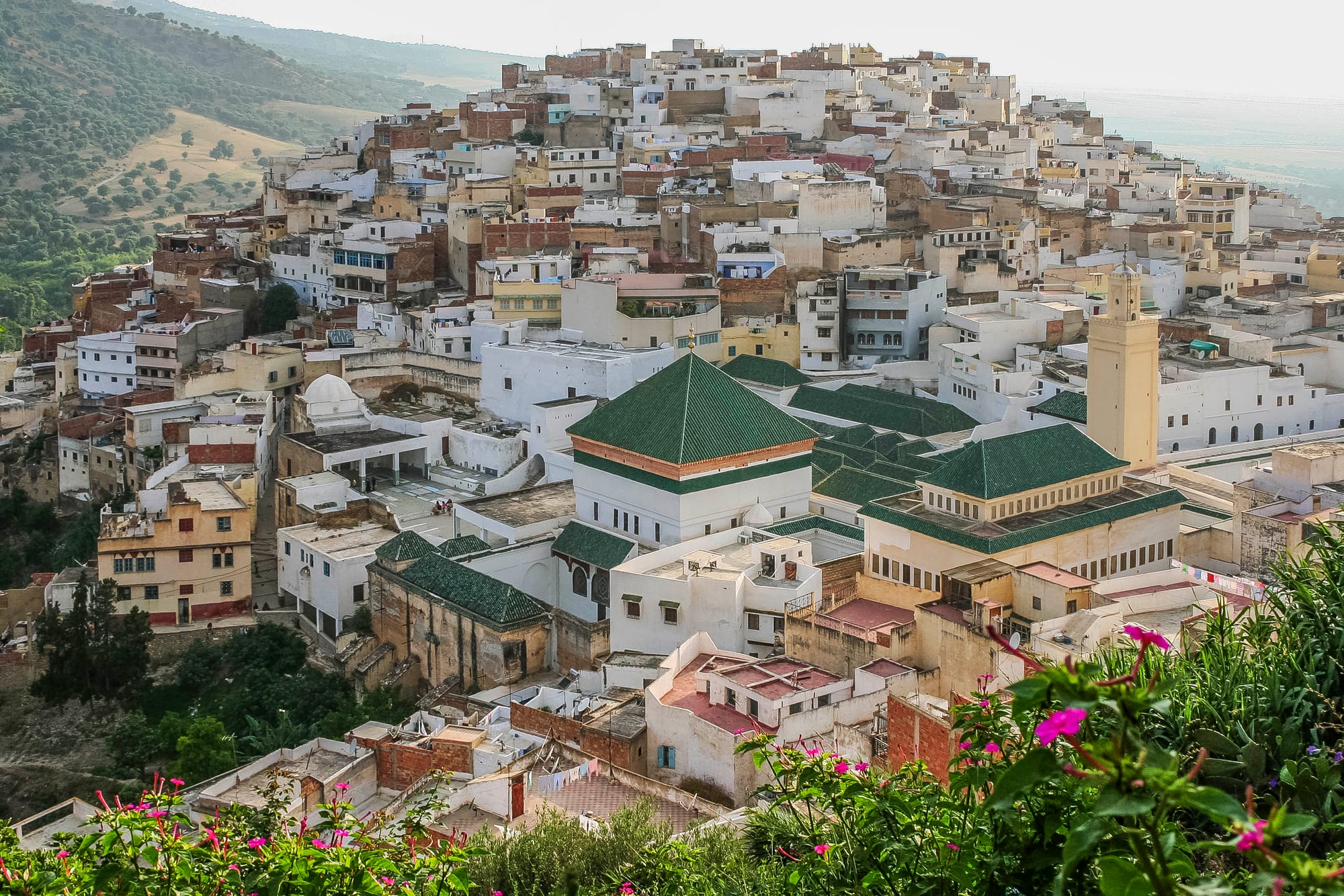
White and ochre houses packed up a hillside around a shrine with green pyramidal roofs and a pale minaret

Fès, Meknès & the Middle Atlas, Morocco

Moulay Idriss

The green-tiled roofs of the shrine of Idris I among the houses of Moulay Idriss, on the Zerhoun hillside. (Ninara / Wikimedia Commons · CC BY 2.0)

A whitewashed hill town on the slopes of the Zerhoun massif, about 25 kilometres north of Meknès, built around the tomb of Idris I, who founded Morocco's first Muslim dynasty in the late 8th century. It is one of the country's most important places of pilgrimage, and the Roman ruins of Volubilis lie a few kilometres below it.

Neighbourhoods

  • The shrine quarter
    • First-time visitors
    • Historic district
    • Pilgrimage

    The lanes below and around the sanctuary at the heart of the town, where pilgrims arrive, stalls sell candles, sweets and religious books, and the main square holds cafés and grill stands. Non-Muslims may walk the streets and the square but not enter the shrine itself.

    Open in Maps
  • Khiber
    • Views
    • Quiet and residential
    • Walks

    The higher of the town's two hills, a steep climb of stepped lanes and flat-roofed houses ending at terraces that look down on the green roofs of the sanctuary and across the plain to Volubilis.

    Open in Maps
  • Tasga
    • Quiet and residential
    • Local life

    The second hill, facing Khiber across the shrine, more residential and little visited, with small shops, bread ovens and children playing in the alleys. The two quarters have long had their own identities and rivalries.

    Open in Maps
  • The lower town and the road in
    • Close to public transport
    • Cafés

    The approach from the Meknès road, where the taxi rank, the bus stop, the weekly market ground and most of the town's parking are found, along with cheap cafés used by drivers and traders.

    Open in Maps

Things to do

In the town

  • Zawiya of Moulay Idris Ilandmark

    The sanctuary holding the tomb of Idris I, demolished and rebuilt on a grander scale by Sultan Moulay Ismail, who reigned from 1672 to 1727, with green pyramidal roofs at the centre of the town; it is a working shrine closed to non-Muslims.

    Open in Maps
  • The round minaretlandmark

    The minaret of the Sentissi Mosque, built in 1939 by a local man after his return from the hajj, faced in green tiles carrying a Quranic verse in white Kufic letters and said to be the only cylindrical minaret in Morocco, where minarets are almost always square.

    Open in Maps
  • The Khiber terracesviewpoint

    Viewpoints reached by stepped lanes above the town, giving the classic view over the shrine's roofs, the two hills and the olive slopes beyond.

    Open in Maps
  • The weekly marketmarket

    A country market on the edge of town where farmers from the Zerhoun villages sell olives, vegetables, livestock and household goods.

    Open in Maps

Short trips from the town

  • Volubilisattraction

    The Roman provincial town on the plain a few kilometres below, a UNESCO World Heritage Site with mosaic floors, a basilica and a triumphal arch.

    Open in Maps
  • Zerhounviewpoint

    The olive-covered massif the town is built on, whose tracks and villages hold shrines, springs and views over the Saïss plain.

    Open in Maps
  • Meknesattraction

    The imperial city about 25 kilometres south, with Moulay Ismail's walls, monumental gates, granaries and medina.

    Open in Maps

Seasonal events

  • Moussem of Moulay IdrissAugust

    One of Morocco's largest pilgrimages, when tens of thousands of visitors camp around the town for several days of prayer, processions, music and horsemanship.

  • Mawlidthe Prophet's birthday, varies with the lunar calendar

    A second focus of religious life in the town, marked with recitation, chanting and visits to the sanctuary.

  • The olive harvestNovember to January

    The Zerhoun slopes are picked and pressed, and fresh oil and cured olives appear in the markets and on every table.

Eat and drink

Long-standing places and food districts in Moulay Idriss. Hours, ratings and directions come from your maps app, always current.

Moulay Idriss classics

  • Grill stalls on the main squarerestaurant

    Stands around the square below the shrine cook brochettes, kefta and merguez to order, with bread, salad and mint tea.

    Open in Maps
  • Nougat and pilgrim sweetsmarket

    Stalls near the sanctuary sell slabs of sticky nougat, sugared almonds and honeyed pastries that pilgrims take home.

    Open in Maps
  • Zerhoun olives and oilmarket

    The hills around the town are covered in olive groves, and shops and market stalls sell the cured fruit and the season's oil.

    Open in Maps

Where people eat

  • Guesthouse kitchens in the old townneighborhood

    The small guesthouses in restored houses serve home-style Moroccan meals — salads, tagines, couscous — often on terraces above the shrine.

    Open in Maps
  • Cafés by the taxi rankcafe

    Plain cafés at the entrance to the town serve breakfast msemen and harira to drivers, traders and early pilgrims.

    Open in Maps

Experience Moulay Idriss

History

The town grew out of the arrival of Idris ibn Abdallah, a great-grandson of the Prophet's grandson Hasan, who fled the Abbasid defeat of his family in the east and established himself at the old Roman town of Volubilis, on the plain below the Zerhoun hills. In 789 Amazigh tribes of the region accepted him as their leader, and from that alliance came the Idrisid dynasty, the first Muslim state in Morocco. He died in 791, allegedly poisoned by the caliph's agents, and the settlement moved up the hillside from the exposed Roman site to about where the present town stands; Fès, some 50 kilometres away, became the Idrisid capital under his son Idris II.

The tomb became the focus of a small town, and for centuries the Zerhoun was a place of retreat and pilgrimage. The buildings visible today are largely later: the sanctuary was rebuilt and enlarged in the 18th century by Moulay Ismail, who was reinforcing the Alaouite dynasty's claim to descent from the Prophet, and the round green-tiled minaret of the Sentissi Mosque was built in 1939. Stone, columns and tiles were carried up from the ruins of Volubilis over many generations.

Because of the shrine, the town had a special status. Non-Muslims were barred from it altogether until 1912, and could not stay overnight until 2005, after which guesthouses began to open in restored houses. Today the sanctuary is still closed to non-Muslims, while the streets, terraces and markets are open to everyone, and the town lives on pilgrimage, olives and the visitors who come up from Volubilis.

Culture & Customs

Life in Moulay Idriss is organised around the sanctuary. Pilgrims come throughout the year, individually and in groups, to pray at the tomb of the man Moroccans regard as the founder of their country, and the town's economy, calendar and manners follow them. Candles, incense, sweets and printed prayers are sold in the lanes, and the clerical families attached to the shrine have historically held considerable standing.

The great event is the moussem in August, when tens of thousands of people camp on the slopes around the town for days of prayer, sermons, drumming and processions, along with markets and displays of tbourida, the mounted charge in which riders fire muskets in unison. Sufi brotherhoods play a large part, and the atmosphere moves between devotion and fairground. Smaller gatherings mark the Prophet's birthday and the religious holidays.

The town is divided between its two hills, Khiber and Tasga, each with its own mosque, character and long-standing rivalry, expressed most visibly during festivals. Dress and behaviour are conservative — more so than in Meknès or Fès — and visitors who cover up, greet people and ask before taking photographs are made welcome. Tamazight is heard in the surrounding villages, Darija in the town.

Daily Life

About 12,000 people live in Moulay Idriss, in houses stacked up two steep hills where almost everything is reached by steps. Families have lived in the same quarters for generations, and the town has grown outwards along the lower road rather than upwards, with newer housing, the market ground and the taxi rank at the bottom.

Work comes from olives above all — the Zerhoun is covered in groves, and picking, pressing and selling oil shape the year — together with cereals and livestock on the surrounding slopes, shops and services for pilgrims, and a small tourism business built on guesthouses and on visitors going to Volubilis. Many households also rely on wages earned in Meknès, Fès or abroad, and young people commonly leave for work or study.

The days are quiet outside the pilgrimage seasons: bread taken to the communal oven in the morning, shops open late morning and again in the evening, men in the cafés on the square, children on the steps. Water supply, steep access for building and services, and the pressure of visitor numbers during the moussem are the recurring local concerns, along with the long decline of farm incomes in dry years.

Food

Eating here is home cooking rather than restaurant cooking. Olive oil from the Zerhoun slopes and cured olives of several kinds are on every table, with round khobz bread baked in communal ovens, and the usual Moroccan repertoire of salads, harira soup, and tagines of chicken with preserved lemon and olives or lamb with prunes and almonds. Friday brings couscous steamed over a broth of meat and vegetables, and guesthouses often serve it to visitors.

The stalls around the sanctuary sell pilgrim food: slabs of nougat, sugared almonds, dates, dried figs and honeyed pastries such as chebakia and briouat, bought to eat on the spot or carried home as a blessing. Grills on the main square cook brochettes, kefta and merguez with cumin and salt, and bowls of bissara, the thick broad-bean soup, are a cheap breakfast in cold weather.

Mint tea, poured from height and heavily sugared, marks every arrival and departure, and fresh orange juice is sold in season. The surrounding plain is one of Morocco's main wine regions, but this is a shrine town: alcohol is neither sold nor drunk here, and visitors are expected to respect that.

Planning tools

Budget

One of the cheapest places to stay in the region: a handful of small guesthouses in restored houses, simple food and short taxi rides. Costs rise only around the August moussem, when rooms are scarce. Entry to Volubilis and a taxi down to the ruins are the main extra expenses.

Daily Budget Midrange
USD 60–130 (restored guesthouse with half board, a guide at Volubilis, a taxi for the day)
Daily Budget Shoestring
USD 20–40 (basic guesthouse room, market and grill food, shared taxis)

Shared grand taxis run to Meknès and to the Volubilis turning for a few dirhams; chartering one for the return trip to the ruins costs much more.

Best Time to Visit

March to May and September to November, when the Zerhoun slopes are green or the olives are ripening and the walk up to the terraces is comfortable. Summer is hot and crowded around the moussem; winter is cool, wet and very quiet, with mist on the hills.

Suggested Number of Days

Many visitors come for a few hours from Meknès. Staying overnight gives the quieter evening and early morning town, and one to two days is enough to add the Roman site below and a walk on the surrounding hillsides.

First Visit
half a day
With Surroundings
1–2 days

Transportation

The town is walked, not driven: the lanes are steep, stepped and mostly too narrow for cars, and vehicles stop at the edge of the old quarters. Grand taxis run to Meknès and to the Volubilis junction from the rank at the bottom of the town, and taxis or a hired driver cover the short distance to the ruins.

Parking is limited to the lower town, and the climb between the two hills is steep enough to need decent shoes.

Airport & Station Connections

Moulay Idriss is about 25 kilometres north of Meknès, roughly 40 minutes by grand taxi on a good road, and about 50 kilometres from Fès. There is no railway station; the nearest is at Meknès, and the nearest airport is Fès–Saïss. Most visitors come as a day trip combined with Volubilis, a few kilometres away.

Walkability

Entirely walkable and almost entirely uphill. The town climbs two steep hills in stepped lanes and alleys, so distances are short but the going is hard, and the terraces above the shrine repay the effort. Lanes are narrow, uneven and slippery after rain, which makes wheeled luggage impractical.

Safety

A quiet, conservative and closely knit town where crime against visitors is rare. The main issues are the steep, uneven lanes, the summer heat on the climb, and the crowds and traffic during the August moussem, when the population swells many times over.

Respect the boundary of the sanctuary, which non-Muslims may not enter, and ask before photographing pilgrims or the shrine. Use official guides booked through a riad or a licensed agency, keep bags across the body in medinas, and avoid the cannabis-growing Ketama area of the Rif. Check current official travel advice before travelling.

Climate

Mediterranean, like the Saïss plain below but a few degrees cooler on the hillside, with breezes that make summer more bearable than in Meknès. Rain falls between November and April, and the hills can be in cloud.

Summer
hot and dry — 30–37°C by day on the plain, a little less on the slopes, with warm evenings
Winter
cool and damp — 6–17°C, with rain, mist and occasional frost at night

Local Customs

This is first of all a religious town, and visitors are expected to behave as they would at any sanctuary: modest dress covering shoulders and knees, quiet around the shrine, and no attempt to enter it or to photograph inside. Non-Muslims may visit the town freely and stay overnight, a change from the rule that stood until 2005.

Alcohol is not sold or appropriate here, Friday and the moussem are the busiest religious times, and small tips are usual for anyone who helps with bags or directions.

Common Payment Methods

Cash in Moroccan dirhams is the rule. Guesthouses may take cards, but the market, the stalls, the cafés and the taxis do not. There are few ATMs in the town, so drawing money in Meknès or Fès beforehand is sensible.