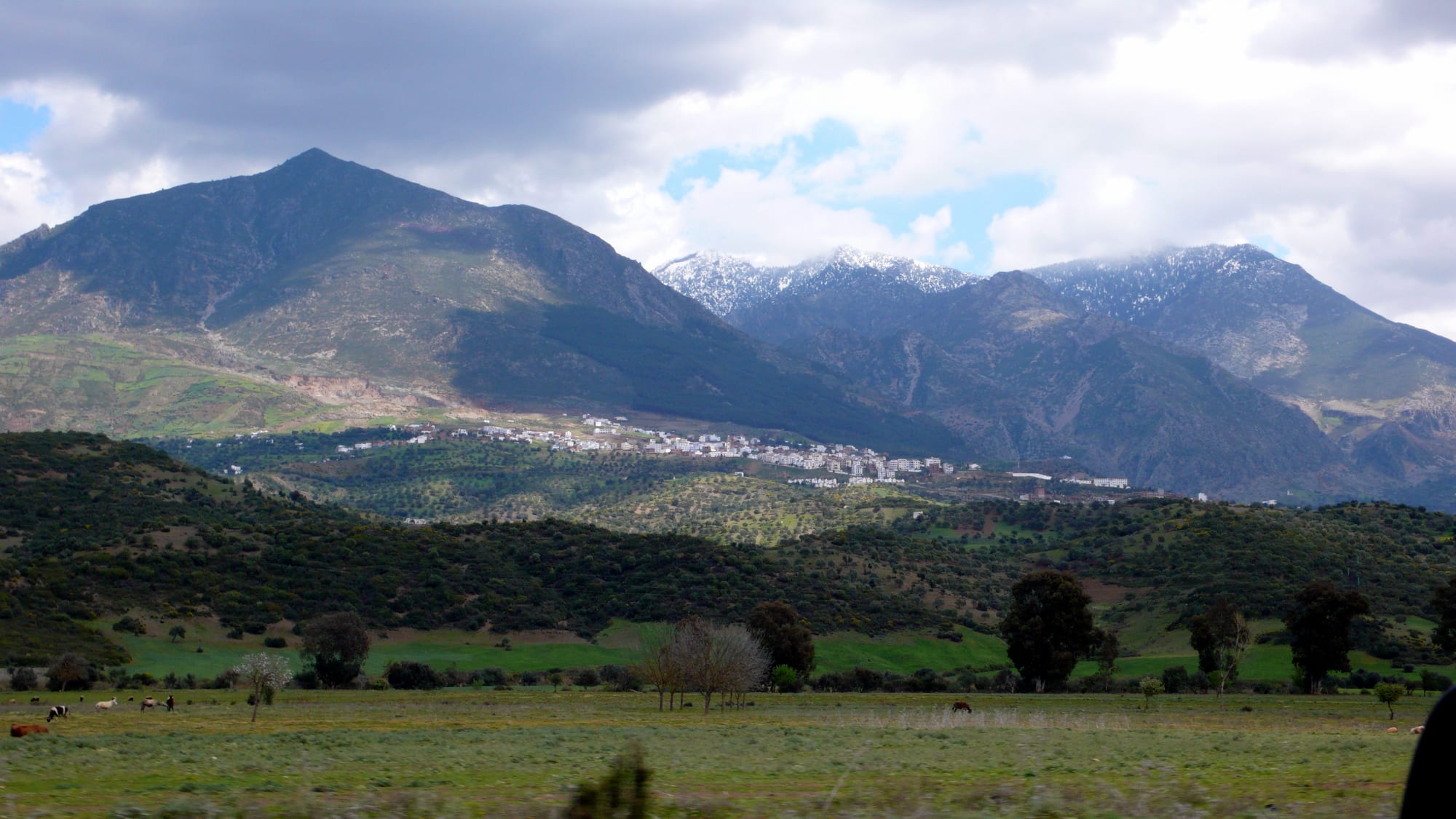
White houses of a small town spread across a green slope beneath grey mountains dusted with snow, under a cloudy sky

Morocco

Tangier, Tétouan & the Rif

Chefchaouen below the peaks of the Rif. (Gabi / Wikimedia Commons · CC BY-SA 2.0)

Morocco's northern tip, where Africa faces Europe across the Strait of Gibraltar — the port city of Tangier, Andalusian-flavoured Tétouan, the blue-washed mountain town of Chefchaouen and the green ridges of the Rif, running east to the Mediterranean coast at Al Hoceïma. It is the most Spanish-influenced corner of the country.

Explore Tangier, Tétouan & the Rif

History

Tangier is one of the oldest cities in Morocco. Phoenician traders settled here, and as Roman Tingis it became the capital of the province of Mauretania Tingitana; further down the Atlantic coast, the ruins of Lixus above the Loukkos river near Larache date back to the same Phoenician world. In 711 the Muslim army that crossed into Spain under Tariq ibn Ziyad set out from this shore, and for the next eight centuries the north was closely tied to al-Andalus across the strait.

When Christian Spain completed its conquest of Granada, refugees from Andalusia rebuilt Tétouan in the late 15th century, and Chefchaouen was founded in 1471 as a mountain base against the Portuguese, who had seized Asilah and Tangier the same year. Tangier stayed under Iberian rule until 1661, when it passed to England as part of Catherine of Braganza's dowry; the English abandoned it in 1684. Under the Alaouite sultans the north remained a zone of corsair ports, mountain tribes and European consuls.

In 1912 the north became the Spanish protectorate, governed from Tétouan, while Tangier was made an international zone run by several powers from the 1920s until independence in 1956. In the Rif, Abd el-Krim, from the Aït Ouriaghel near Al Hoceïma, led a revolt that destroyed a Spanish army at Annual in 1921 and declared a Republic of the Rif before French and Spanish forces crushed it in 1926. Relations with the state stayed tense: a Rif uprising in 1958–59 was put down by force, and in 2016–17 the Hirak protest movement in Al Hoceïma ended in mass arrests. Since the 2000s the opening of the Tangier Med port, car factories and the high-speed line have remade Tangier's economy.

Culture & Customs

The region holds two distinct mountain peoples. The Jbala of the western hills, around Chefchaouen and Ouezzane, speak a rural Arabic dialect, and their traditional dress, including the women's cloth wrap called the mendil and the chachia hat, is a strong mark of identity. East of them the Riffians speak Tarifit, an Amazigh language, and hold to a strong sense of separate identity shaped by the Rif War and decades of neglect. Spanish is still widely understood across the north, and Spanish television and football are followed closely.

Tétouan and Tangier are the region's urban cultures. Tétouan is known for its Andalusian heritage, music and crafts, and its old families trace their roots to Granada. Tangier's international-zone decades drew European and American writers and artists — Paul Bowles lived there for over half a century, and Matisse painted the city — and its cafés still trade on that reputation. Asilah's summer cultural festival, founded in 1978, invites artists to paint murals on the medina walls.

The north is conservative in the countryside and religious practice is strong, with shrine visits and local moussems in the mountains. Chefchaouen's blue walls, whose origin is variously explained, have become a symbol of the town and a draw for photographers from across the world.

Daily Life

Tangier-Tétouan-Al Hoceïma has about four million people. Tangier, the regional capital, is Morocco's fastest-changing big city: Tangier Med, one of the largest container ports on the Mediterranean, the Renault car plant at Melloussa and industrial free zones have drawn workers from across the country. Tétouan has around 470,000 people; Ksar el-Kébir, Larache, Al Hoceïma, Chefchaouen and Ouezzane are smaller centres.

Beyond the cities the economy is thinner. The Rif and Jbala hills farm olives, figs and goats on steep slopes, and cannabis has been grown here for generations; Morocco legalised its cultivation for medical and industrial use in 2021, with licensed cultivation in three provinces, Al Hoceïma, Chefchaouen and Taounate. Fishing matters at Larache and Al Hoceïma, remittances from Riffian families in Spain, the Netherlands and Belgium sustain many villages, and the cross-border porter trade with Ceuta shaped towns such as Fnideq.

Summer transforms the coast: Moroccans and emigrants on holiday fill Martil, M'diq and the beaches of Al Hoceïma, and the ferries from Spain are packed. Emigration and irregular migration towards Spain remain constant themes of daily life in the north.

Food

Northern cooking has an Andalusian and Spanish accent. A favourite cheap meal is bissara, a thick soup of dried fava beans finished with olive oil and cumin, eaten with bread, and jben, a fresh white cheese of goat's or sheep's milk, is sold in the markets. Olive oil from the hill villages is used generously.

On the coast the sea dominates: grilled sardines, sole and squid in Tangier, Larache and Asilah, and fish tagines with potatoes and peppers. Tangier's street food includes kalinti, a baked savoury tart of chickpea flour and oil sold in squares, which goes back to the city's Jewish community. Tétouan's old families are known for refined dishes such as chicken with almonds and pastries rich in almonds and honey, and the ghriba biscuits and chebakia fried in honey appear in every pastry shop in Ramadan.

Mint tea is served here, as elsewhere, but the north also drinks a lot of coffee, and Tangier's old cafés serve it strong and sweet.

Attractions & Natural Wonders

Tangier's kasbah looks across the strait from above the port, and below it the medina runs down to the Petit Socco and the Grand Socco. The American Legation, the first property owned by the United States abroad, is now a museum, and Café Hafa's terraces look out over the sea. West of the city are Cap Spartel, where the Atlantic meets the strait, and the Caves of Hercules. Down the Atlantic coast, Asilah sits inside its Portuguese ramparts, and Larache has a Spanish-era centre and the Phoenician and Roman ruins of Lixus nearby.

Tétouan's medina, a UNESCO World Heritage Site, has whitewashed streets, craft quarters and a Spanish-built new town beside it; the beaches of Martil and Cabo Negro lie just beyond. South, at the foot of the mountains, Chefchaouen's blue lanes climb from the kasbah and Plaza Uta el-Hammam to the Ras el-Maa spring. Talassemtane National Park, east of the town, has fir and cedar forest, and at Akchour trails lead up a river gorge to waterfalls and the rock arch known as God's Bridge.

The Rif mountains continue east in deep valleys and terraced slopes to the Mediterranean coast at Al Hoceïma, where the town looks over a bay with beaches such as Quemado and the offshore islets held by Spain, and Al Hoceïma National Park protects high cliffs and a wild, rocky coast. Ceuta, a Spanish city on the coast north of Tétouan, is reached through the border at Fnideq.

Cities in Tangier, Tétouan & the Rif

Planning basics

Budget

The north is cheaper than Marrakesh and the south. Tangier has the full range from hostels to international hotels, and Tétouan, Asilah and Al Hoceïma have modest hotels and guesthouses; Chefchaouen's riads are good value but fill and rise in price at weekends and in summer, when Moroccan holidaymakers pour onto the Mediterranean beaches.

Daily Budget Midrange
USD 75–170 (riad or mid-range hotel, restaurant dinners, a private driver for the mountains)
Daily Budget Shoestring
USD 25–50 (hostel or simple guesthouse, bissara and grilled-fish meals, buses and shared taxis)

Book Chefchaouen and the beach towns ahead for July and August and for Moroccan public holidays; a café breakfast of bissara costs very little.

Safety

The main towns are generally safe, with the usual touting and petty theft around Tangier's port and medina. The Rif is Morocco's main cannabis-growing area, and the interior around Ketama has a reputation for drug dealing and aggressive offers to passing drivers. Mountain roads, rain and fog make driving hazardous in winter. The areas near the Spanish cities of Ceuta and Melilla see irregular migration and a heavy police presence.

Refuse hashish offers firmly, avoid stopping in the Ketama area, and use official guides for mountain walks. Check current official travel advice before travelling.

Climate

The wettest part of Morocco. Tangier and the coasts are Mediterranean, with warm, breezy summers and mild, rainy winters; the Rif catches heavy winter rain and snow on its higher ridges, which keeps it green. The strait is known for its strong easterly and westerly winds.

Summer
warm, 25–30°C on the coast, sometimes hotter inland; cooler nights in Chefchaouen
Winter
mild and wet on the coast, 8–17°C; cold nights and snow on the high Rif

Transportation

Tangier is the transport hub: the Al Boraq high-speed train links it with Rabat and Casablanca, ferries cross to Tarifa and Algeciras in Spain, and the airport has European flights. Buses and grand taxis link Tangier, Tétouan, Chefchaouen and Asilah, and the coast road runs east to Al Hoceïma, which also has a small airport. Mountain roads in the Rif are slow and winding.

Tangier to Chefchaouen is about three hours by bus; a car or driver helps for Akchour and the Rif coast.

Best Time to Visit

April to June and September to October are the best months: green mountains in spring, warm sea in early autumn and fewer crowds. July and August are the beach season on the Mediterranean coast and busy everywhere. Winter is wet but mild in Tangier and Tétouan, and the Rif waterfalls run fullest after the rains.