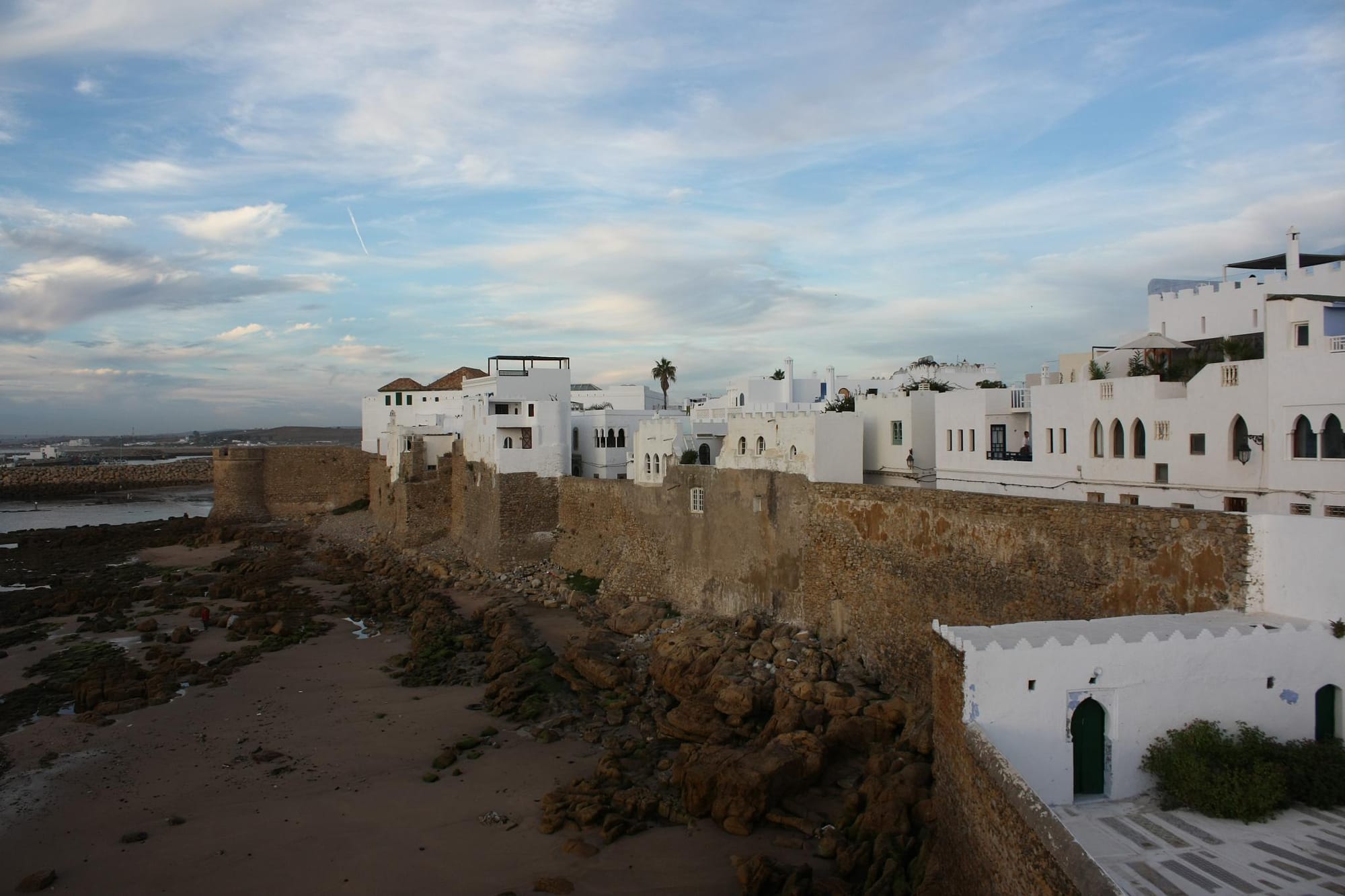
Stone ramparts topped by white houses rising straight from a rocky shore, with a beach curving away under a cloudy sky

Tangier, Tétouan & the Rif, Morocco

Asilah

The sea walls of Asilah's medina on the Atlantic coast. (Pedro Lozano / Wikimedia Commons · CC BY 2.0)

A small walled town on Morocco's Atlantic coast south of Tangier, with Phoenician and Roman origins and ramparts built by Portugal in the 15th century. Its whitewashed medina, painted in white and blue and hung with murals made for a summer arts festival held since 1978, sits directly above the sea, with long beaches to the north and south.

Neighbourhoods

  • The medina
    • First-time visitors
    • Historic district
    • Quiet and residential

    The walled old town above the sea, a small grid of whitewashed lanes painted with blue and repainted each summer with murals. Guesthouses, galleries and craft shops occupy many of the houses, and the whole quarter can be crossed in a few minutes on foot.

    Open in Maps
  • The ramparts and the sea bastion
    • Views
    • Evening walks

    The Portuguese sea walls and gateworks, intact around the old town, and the bastion at its western end reaching out over the water, where people gather to watch the sunset beside a small walled cemetery.

    Open in Maps
  • The new town
    • Close to public transport
    • Local life

    The streets outside the walls, with the market, the railway station road, banks, cheaper hotels, cafés and the everyday shops used by residents rather than visitors.

    Open in Maps
  • The beaches
    • Beaches
    • Families

    Wide sand runs north from the town towards Tangier and south past holiday apartments, with quieter coves a few kilometres down the coast. They are busy in July and August and almost empty out of season.

    Open in Maps

Things to do

The walled town

  • The Portuguese rampartslandmark

    Walls and bastions raised after Portugal took the town in 1471, still enclosing the medina and running directly above the rocks and the sea.

    Open in Maps
  • The sea bastionviewpoint

    The Portuguese bastion at the western end of the medina, reaching out to sea, the usual place to look out over the Atlantic in the evening.

    Open in Maps
  • The medina muralsattraction

    Large paintings made on the whitewashed walls of the old town by invited artists during the summer festival, renewed from year to year.

    Open in Maps
  • Raisuli Palacelandmark

    A house built on the sea wall in 1909 by Moulay Ahmed er-Raisuni, the local strongman who held the coast before the protectorate; restored, it keeps a reception room of zellij tilework, carved stucco and painted wood.

    Open in Maps
  • Sidi Mansour cemeteryattraction

    A small enclosed burial ground on the platform between the sea walls and the Portuguese bastion, above the rocks at the edge of the medina.

    Open in Maps

Beaches

  • Asilah beachbeach

    A long stretch of sand beginning at the edge of the town and running north, with cafés along the promenade and space to walk out of season.

    Open in Maps
  • The coves to the southbeach

    Sandy coves a few kilometres south of the town, reached by road or a walk along the shore, with low cliffs and seasonal cafés.

    Open in Maps

Short trips from the town

  • Lixuslandmark

    A Phoenician and Roman site on a hill above the Loukkos river near Larache, about 35 km south, with salting works, a theatre and mosaics.

    Open in Maps
  • Laracheattraction

    A port town about 40 km south with a Spanish-built centre, a small medina above the river mouth and a long beach across the water.

    Open in Maps
  • Tangierattraction

    The port city about 40 km north, with its kasbah and medina above the strait and ferries to Spain.

    Open in Maps

Seasonal events

  • International Cultural Moussem of AsilahAugust

    A cultural season founded in 1978 that brings artists to paint murals on the medina walls, with exhibitions, jazz and Moroccan music across the town.

  • Ramadan eveningsthe lunar month of Ramadan

    Cafés and the ramparts fill after sunset for weeks of late eating and visiting, while daytime hours are shortened.

  • Summer beach seasonJuly and August

    Moroccan families and emigrants returning from Europe fill the beaches, cafés and rented flats, and the town is at its busiest and most expensive.

Eat and drink

Long-standing places and food districts in Asilah. Hours, ratings and directions come from your maps app, always current.

Atlantic fish

  • Fish grills by the rampartsneighborhood

    Small restaurants clustered outside the walls and along the front grill the day's sardines, sole, sea bass and prawns plainly with salt and lemon.

    Open in Maps
  • Asilah marketmarket

    The town market outside the medina sells fish, vegetables from the surrounding plain, olives and fresh cheese, with a bigger souk on market day.

    Open in Maps

Cafés and sweets

  • Medina cafésneighborhood

    Tables set out in the whitewashed lanes and on the ramparts for mint tea, strong coffee and pastries.

    Open in Maps
  • Bissara countersneighborhood

    The northern breakfast of thick fava-bean soup with olive oil and cumin, sold cheaply from plain shopfronts near the market.

    Open in Maps

Experience Asilah

History

The site is old: Phoenician traders used this stretch of the Atlantic coast, and a settlement known to the Carthaginians and the Romans stood here, linked to the larger town of Lixus down the coast. In the 10th century it was controlled from Córdoba, and it later passed through Almoravid, Almohad and Marinid hands as a small port shipping grain from the plain behind it.

Portugal took Asilah in 1471 and rebuilt the walls, bastions and gates that still enclose the medina. It was from here that King Sebastian of Portugal set out in 1578 on the campaign that ended at the Battle of the Three Kings near Ksar el-Kébir, where he was killed and his army destroyed. Spain held the town for a period after the union of the Iberian crowns, and it was retaken for Morocco in 1692 by Moulay Ismail, after which it lived on fishing, farming and, at times, piracy.

At the turn of the 20th century Asilah was the base of Ahmed al-Raisuni, a sharif and bandit chief who kidnapped foreigners for ransom, held official posts and built a palace on the sea wall. The town then spent the protectorate decades inside the Spanish zone and declined quietly after independence. Its revival dates from 1978, when the mayor, Mohamed Benaissa, and the painter Mohamed Melehi founded a cultural festival that invited artists to paint the medina walls each summer; the whitewashing and repainting have continued since, the old town has been restored, and tourism now shapes the place.

Culture & Customs

For a town of its size Asilah has an unusual cultural life. The summer festival founded in 1978 brings painters, sculptors, poets and musicians from Morocco, the Arab world, Africa, Europe and Latin America, and its most visible result is the murals painted directly onto the whitewashed walls of the medina. Galleries, workshops and a cultural centre operate through the year, and residents are used to artists working in the street.

Everyday life remains that of a small northern Moroccan town. Spanish is widely understood, a legacy of the decades in the Spanish zone, and Spanish football and television have a following. The people of the surrounding plain and hills come in for the weekly souk, and the Jbala culture of the hinterland — its dialect, sung poetry and women's striped cloth wraps — is visible on market days.

Religious practice is steady and public life modest: the mosque sets the rhythm of the day, Ramadan reshapes the year, and drinking is not part of the town's social habits. Fishing gives the place much of its character, with boats worked from the beach and the harbour and the catch sold directly. Evening belongs to the ramparts, where families and visitors alike walk out to watch the sun drop into the Atlantic.

Daily Life

About 30,000 people live in Asilah, which makes it a small town whose population swells several times over in July and August. Most residents live outside the walls in the newer streets, while the medina has filled with guesthouses, galleries and holiday homes, some owned by Moroccans from the cities and by Europeans.

Fishing, farming on the coastal plain and tourism carry the economy, alongside work in Tangier, which is close enough to commute to by train or shared taxi and has drawn many young people to its factories and port. The summer season and the festival provide a concentrated burst of income for guesthouses, cafés and traders, and the winter is correspondingly quiet, with shuttered shops and empty beaches.

The rhythm is small-town and tied to the sea and the season: boats out early, the market busy in the morning, a long afternoon pause, and evening walks on the ramparts and the promenade. Emigration is a constant thread, with families in Spain and the Netherlands returning each summer by ferry, and the pressure of holiday building along the coast and the reliability of water supply after dry years are among the town's recurring concerns.

Food

Asilah eats what the boats bring in. Sardines grilled over charcoal are the everyday fish, with sole, sea bass, bream, squid and prawns at the grills near the walls, and fish tagines cooked with potatoes, tomatoes and peppers under the garlic-and-coriander marinade called chermoula. Fried fish sold in paper is the standard cheap lunch, eaten with bread and a wedge of lemon.

Beyond the sea the food is northern Moroccan. Bissara, a thick purée of dried fava beans dressed with olive oil, cumin and paprika, is the cheap breakfast; harira soup and brochettes fill the counters near the market; and jben, the fresh white cheese of the Jbala hills, is sold with honey and olives. Bread comes round and flat as khobz, with msemen and baghrir fried and griddled in the morning.

Sweets follow the Andalusian pattern of almonds, honey and sesame — ghriba biscuits, crescent-shaped kaab el ghzal, and chebakia during Ramadan. Mint tea is poured at every occasion and coffee is drunk strong, often as nous-nous, half coffee and half milk. Fresh orange juice is sold from carts, and figs, melons and prickly pears come from the plain behind the town in season.

Planning tools

Budget

Asilah is inexpensive outside the summer peak, with guesthouses in medina houses and small hotels in the new town. In July and August prices roughly double, rooms are scarce and flats are let by the week to Moroccan families. Fish dinners are the main daily cost and still modest by European standards.

Daily Budget Midrange
USD 70–150 (guesthouse or mid-range hotel, fish dinners, taxis, a car for Lixus and the coast)
Daily Budget Shoestring
USD 20–45 (simple guesthouse, bissara and grilled fish, trains and shared taxis)

Book months ahead for July and August and for the festival weeks; out of season the same rooms cost far less.

Best Time to Visit

May, June, September and early October are the best months, with warm days, a sea that is usable and a town that is not crowded. July and August bring the festival and the holiday season together, and everything fills. Winter is mild but wet and windy, and many places close or keep short hours.

Suggested Number of Days

The walled town is small and an unhurried day covers it. Two or three days suit a beach stay or trips down the coast. Out of season, when much is shut, less time is needed.

First Visit
1 day
With Surroundings
2–3 days

Transportation

Everything in the town is walked; the medina is closed to cars and the beaches begin at its edge. Petits taxis handle the rest, and grands taxis and coaches run to Tangier, Larache and Rabat from near the market. Trains on the Tangier–Rabat line stop at the station outside the town.

Local trains and grands taxis both reach Tangier in under an hour; a taxi is needed between the station and the medina.

Airport & Station Connections

Most visitors arrive from Tangier, about 40 km north, by train, coach or grand taxi in around an hour. Tangier Ibn Battouta Airport is the nearest airport, roughly half an hour away by road, and trains from Rabat and Casablanca stop here on the way north.

Walkability

One of the easiest towns in Morocco to walk: the medina is flat, small and free of traffic, the ramparts give a circuit above the sea, and the beach promenade continues north from the walls. The railway station is the one place that needs a taxi. Lanes are cobbled and can be slippery after rain.

Safety

Asilah is a quiet town with little crime, and the medina feels safe at night. The usual care applies with valuables on crowded summer beaches and in the market. The Atlantic here has strong currents and few or no lifeguards outside the main season, and the rocks below the ramparts are slippery.

Swim on the patrolled town beach rather than at the empty coves, keep an eye on bags on the sand, and take care on the wet rocks below the walls. Use official guides booked through a riad or a licensed agency, keep bags across the body in medinas, and avoid the cannabis-growing Ketama area of the Rif. Check current official travel advice before travelling.

Climate

An Atlantic climate, milder and breezier than inland Morocco. Summers are warm rather than hot, with sea wind most afternoons; winters are mild and wet, with storms coming in off the ocean. Sea water stays cool even in August.

Summer
warm and windy — generally 24–29°C by day, with cool evenings
Winter
mild and rainy — roughly 9–17°C, with Atlantic gales

Local Customs

The town is small and conservative outside the beach, where swimwear stays on the sand and covered shoulders and knees are expected in the medina. Spanish is widely understood alongside Moroccan Arabic and French. Alcohol is little sold and rarely drunk in public. Murals are painted on people's houses, so doorways and courtyards remain private.

Ask before photographing residents or their doorways, greet shopkeepers before asking prices, and dress modestly once away from the beach.

Common Payment Methods

The currency is the Moroccan dirham, obtained inside the country. Cash is the norm in the medina, the market and at fish grills; some hotels and larger restaurants take cards. There are ATMs in the new town near the market, and fewer of them than in Tangier, so it is worth drawing money before the weekend.