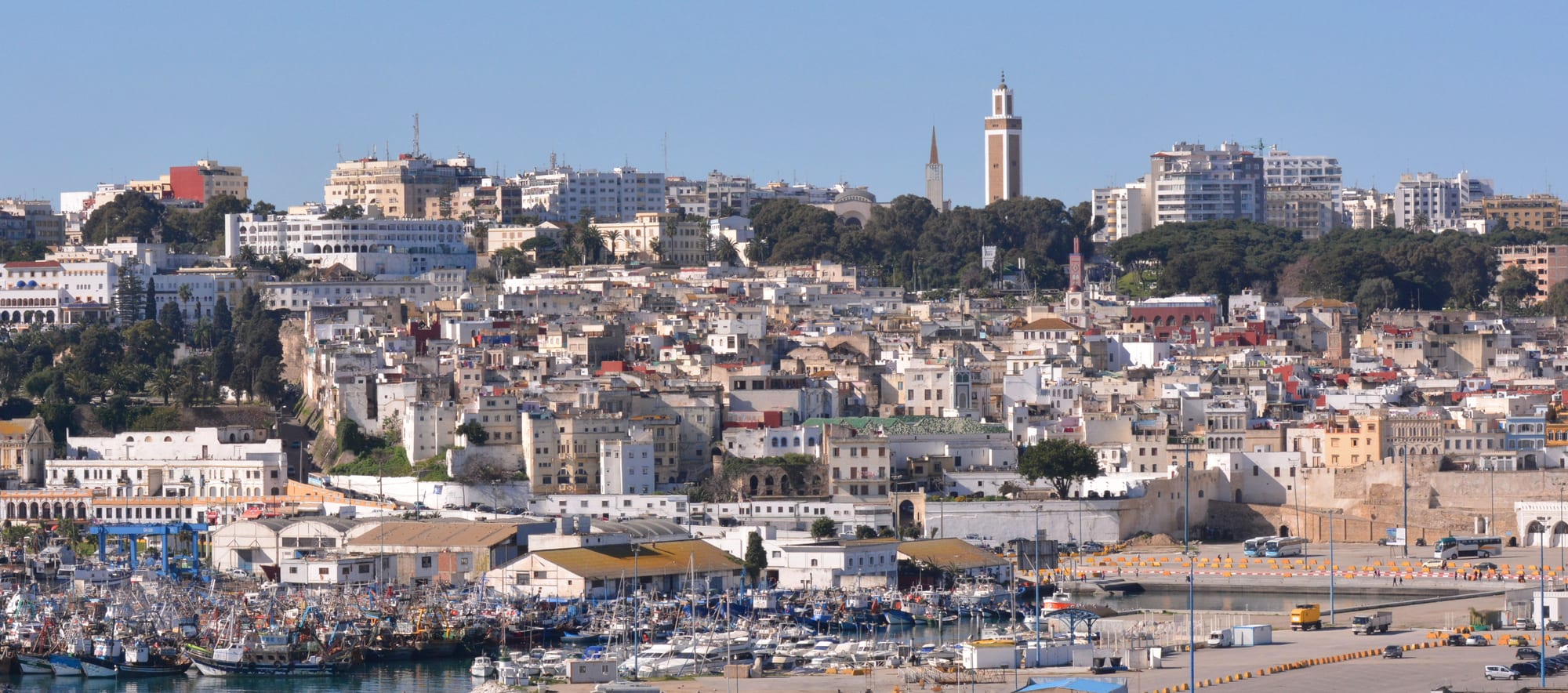
White and cream houses of Tangier rising in tiers above a harbour full of fishing boats, with a tall minaret on the skyline

Tangier, Tétouan & the Rif, Morocco

Tangier

Tangier seen from the harbour, the old town climbing the hill above the port. (Mike McBey / Wikimedia Commons · CC BY 2.0)

A port city at the north-western corner of Africa, where the Mediterranean meets the Atlantic and Spain lies visible across the Strait of Gibraltar. Phoenician and Roman in origin, held at times by Portugal and England, and run as an international zone until 1956, it drew writers and exiles for decades and has since been rebuilt around a new port, car factories and a high-speed railway.

Neighbourhoods

  • The Medina
    • First-time visitors
    • Historic district
    • Best for food

    The walled old town on the slope above the port, a compact grid of stepped lanes, small hotels and craft shops running down from the Grand Socco to the Petit Socco. Most of the city's guesthouses and its oldest cafés are here, and the sea is in view from many rooftops.

    Open in Maps
  • The Kasbah
    • Historic district
    • Views
    • Quiet and residential

    The fortified citadel at the top of the medina, entered by gates from the old town. Inside are the former sultan's palace, now a museum, whitewashed houses that foreign residents bought through the 20th century, and terraces looking north across the strait to the Spanish coast.

    Open in Maps
  • Ville Nouvelle
    • Close to public transport
    • Cafés
    • Shopping

    The European-built new town laid out from the late 19th century around Boulevard Pasteur and Place de France, with banks, cinemas, bookshops and pavement cafés. It holds most of the larger hotels and is an easy walk downhill to the medina and the beach.

    Open in Maps
  • The bay and Malabata
    • Beaches
    • Quiet and residential

    The long sandy bay curving east from the port, backed by a promenade of cafés and apartment blocks and continuing towards the headland at Malabata. It is where the city swims and walks in the evening, and busiest in July and August.

    Open in Maps
  • Marshan and Cap Spartel road
    • Quiet and residential
    • Views

    The clifftop districts west of the kasbah, with villas, consulates, gardens and open ground above the sea. The road continues through the woods of the Rmilat towards Cap Spartel, giving long views over the Atlantic.

    Open in Maps

Things to do

The medina and the kasbah

  • Kasbah Palace and museummuseum

    The former sultan's palace at the top of the walled citadel, now a museum of Moroccan and Mediterranean art and archaeology, with painted ceilings and a courtyard garden.

    Open in Maps
  • Grand Soccolandmark

    The wide square between the medina and the new town, officially Place du 9 Avril 1947, long the city's main market place and still its busiest meeting point.

    Open in Maps
  • Petit Soccolandmark

    The small square at the heart of the medina, lined with old cafés and hotels, and the centre of Tangier's social life in the international-zone years.

    Open in Maps
  • Tangier American Legationmuseum

    A building given to the United States by the sultan in 1821 and the first American diplomatic property abroad, now a museum and research centre with rooms devoted to the writer Paul Bowles.

    Open in Maps
  • Grand Mosque of Tangierlandmark

    The main mosque of the old town, its present form dating from the early 19th century, on a site occupied by religious buildings since antiquity; the interior is not open to non-Muslims.

    Open in Maps

The new town

  • Gran Teatro Cervanteslandmark

    A Spanish theatre of 1913 with a tiled facade, a landmark of the city's European quarter.

    Open in Maps
  • St Andrew's Churchlandmark

    An Anglican church consecrated in 1905, built in Moorish style, its belltower shaped like a minaret, set in a graveyard of the city's foreign residents.

    Open in Maps
  • Tangier-Ville stationtransit hub

    The modern railway station east of the centre, terminus of the line from Rabat and Casablanca.

    Open in Maps

Coast and viewpoints

  • Cap Spartelviewpoint

    The headland about 12 km west of the city where the Atlantic meets the Strait of Gibraltar, marked by a lighthouse of 1864 above pine woods and cliffs.

    Open in Maps
  • Caves of Herculesattraction

    Sea caves near Cap Spartel, part natural and part quarried for millstones, whose sea opening is said to resemble the map of Africa.

    Open in Maps

Short trips from the city

  • Asilahattraction

    A small walled Atlantic town about 31 km south, its Portuguese ramparts and white lanes painted with murals each summer.

    Open in Maps
  • Tétouanattraction

    A whitewashed city below the Rif about 60 km south-east, with a World Heritage medina and a strong Andalusian and Spanish character.

    Open in Maps
  • Tanger Medtransit hub

    A large container and ferry port about 45 km north-east of the city, the largest in Africa and on the Mediterranean, with an industrial zone behind it.

    Open in Maps

Seasonal events

  • Tanjazzautumn

    A jazz festival held over several days on open-air stages in the city, drawing Moroccan and international musicians.

  • National Film Festivalwinter

    Morocco's national film festival, held in Tangier, which screens the year's Moroccan features and shorts and awards the main national prizes.

  • Ramadan eveningsthe lunar month of Ramadan

    Cafés and squares fill after sunset for weeks of late-night eating and visiting, while many places close or shorten hours during the day.

Eat and drink

Long-standing places and food districts in Tangier. Hours, ratings and directions come from your maps app, always current.

Tangier cafés

  • Café Hafacafe

    A café opened in 1921 on terraces cut into the cliff at Marshan, serving mint tea above the strait; its regulars have included writers and musicians for a century.

    Open in Maps
  • Petit Socco cafésneighborhood

    The old cafés around the medina's small square, where coffee is drunk strong and sweet and the tables face the passing lanes.

    Open in Maps
  • Boulevard Pasteur cafésneighborhood

    Pavement cafés and patisseries along the new town's main street, the place for an evening promenade and a coffee.

    Open in Maps

Markets and fish

  • Grand Socco market streetsmarket

    Stalls of vegetables, olives, cheese and herbs spill from the square towards the medina gates, with Jbala women from the hills selling produce.

    Open in Maps
  • Port fish grillsneighborhood

    Simple grills near the fishing harbour cook the day's sardines, sole and squid plainly with salt and lemon.

    Open in Maps

Experience Tangier

History

Tangier is among the oldest cities in Morocco. Phoenician traders settled the site, and under Rome it became Tingis, capital of the province of Mauretania Tingitana that was named after it. Vandals, Byzantines and then the armies of the Muslim conquest passed through; in 711 the force that crossed into Spain under Tariq ibn Ziyad set out from this shore, and for centuries afterwards the town looked as much to al-Andalus as to the Moroccan interior.

Portugal took Tangier in 1471 and held it until 1661, when it passed to England as part of Catherine of Braganza's dowry. The English built a mole to make a harbour, found the place expensive to defend and abandoned it in 1684, blowing up their works as they left; Sultan Moulay Ismail's forces took it back. Through the 19th century the city became the diplomatic capital of Morocco, where European powers kept their legations while the sultans ruled from Fez and Marrakesh — among them the United States, whose legation building was a gift from the sultan in 1821.

In 1912 the protectorate treaties left Tangier out of both the French and Spanish zones, and from 1925 it was governed as an international zone by several powers until independence in 1956. Currency was unregulated, censorship light and residence easy, and the city filled with banks, smugglers, spies and writers. The years after independence were lean: business left for Casablanca, and the state neglected the north for decades. Since the 2000s the opening of the Tanger Med port, car factories nearby, a rebuilt city port and the high-speed railway have made Tangier one of Morocco's fastest-growing cities.

Culture & Customs

The international decades left the strongest cultural mark. Paul Bowles, an American composer and novelist, lived here for more than half a century, recorded Moroccan music and translated Tangier storytellers; William S. Burroughs wrote much of Naked Lunch in the city; Jean Genet, Tennessee Williams and the Beat writers all passed through, and Matisse painted Tangier in 1912 and 1913. Cafés rather than galleries carried that life, and several of them still trade on it.

The everyday culture is northern Moroccan. Spanish is widely understood, Spanish television and football are followed, and Spanish words run through the local Arabic. Jbala people from the hills south of the city bring their music, dress and produce to its markets, and Andalusian classical music is performed at concerts and weddings. The city is Muslim and reasonably conservative, with Friday prayers and Ramadan shaping the week and the year, but it has long been used to foreigners and is easier about dress and mixed company than the villages of the Rif.

Tangier's writers, painters and musicians are now joined by film festivals, galleries in the medina and a large student population. Football is followed passionately, the promenade along the bay is a nightly ritual, and mint tea and strong coffee are drunk at length in public — the café, not the home, is where much of the city's social life happens.

Daily Life

Tangier had about 850,000 inhabitants in 2014, and the wider prefecture is larger still; it has grown very fast since the 1990s as workers arrived from the Rif and from across Morocco. New districts of apartment blocks have spread south and east towards the industrial zones, while the medina has partly emptied of families and filled with guesthouses. The port that once handled ferries has been rebuilt for cruise ships and yachts.

The economy now rests on manufacturing and logistics as much as on trade and tourism. Tanger Med and the free zones around it, a large car plant and factories making wiring, textiles and aircraft parts employ tens of thousands, many of them women commuting by works bus. Tourism, fishing and construction fill much of the rest. Wages are low by European standards, housing costs have risen sharply, and informal work is common.

Days begin early and end late. Cafés open at dawn for coffee and bissara, offices and shops break in the afternoon, and evenings belong to the seafront and the squares. Emigration is a constant subject: many families have relatives in Spain, Belgium and the Netherlands who return each summer by ferry, and the strait is also the most visible point of irregular migration towards Europe, with its risks and its policing part of daily conversation.

Food

Tangier eats from the sea. Sardines grilled over charcoal are the everyday fish, with sole, sea bass, squid and prawns at the port grills, and fish tagines cooked with potatoes, tomatoes, peppers and the herb-and-garlic marinade called chermoula. Fried fish sold in paper is a standard cheap lunch, and the markets sell shrimp by the cupful.

The cheap breakfast of the north is bissara, a thick purée of dried fava beans poured into a bowl, dressed with olive oil, cumin and paprika and eaten with bread. The city's own street food is kalinti, a soft baked tart of chickpea flour and oil sold hot by the slice from small counters, close kin to the calentita of Gibraltar and the farinata of Genoa. Spanish habits survive elsewhere too, in fried churros dipped in coffee and in the tapas-like plates put out in some bars.

Sweets are almond-heavy — ghriba biscuits, kaab el ghzal shaped like crescents, and chebakia fried in honey and sesame during Ramadan. Mint tea is poured from a height at every occasion, but Tangier is also a coffee city, drinking it black and strong or as nous-nous, half coffee and half milk. Fresh orange juice is sold from carts at the Grand Socco, and figs, prickly pears and mountain cheese come in from the Jbala hills in season.

Planning tools

Budget

Tangier is cheaper than Marrakesh and has the widest range of rooms in northern Morocco, from medina hostels to international hotels on the bay. Prices rise in July and August, when Moroccan families and emigrants arriving by ferry fill the coast. Food is inexpensive if eaten in cafés and grills rather than hotel restaurants.

Daily Budget Midrange
USD 80–180 (riad or mid-range hotel, restaurant dinners, taxis, a driver to Cap Spartel or the Rif)
Daily Budget Shoestring
USD 25–50 (hostel or simple medina guesthouse, café breakfasts and grilled fish, city buses and petits taxis)

Book well ahead for July and August and for Moroccan public holidays; agree the fare with a petit taxi before setting off, as fares are often not metered for visitors.

Best Time to Visit

April to June and September to October are the most comfortable, with warm days, a usable sea in early autumn and fewer crowds. July and August are the busiest weeks of the year on the beaches and ferries. Winter is mild but wet and often windy, and the strait can be grey for days.

Suggested Number of Days

Two days cover the medina, the kasbah and the coast west of the city. Four or five allow the rest of the north as well. Wind, rain and a slow pace in the medina can stretch the time needed.

First Visit
2 days
With Surroundings
4–5 days

Transportation

The centre is best covered on foot, with petits taxis for anything longer; they are metered in principle and shared between passengers. City buses run to the outer districts and the beaches along the bay, and grands taxis and coaches leave for Tétouan, Chefchaouen and Asilah from stations outside the centre. Traffic on the bay road is heavy in summer.

Petits taxis stay within the city; for trips beyond it, use a grand taxi, a coach or a hired driver.

Airport & Station Connections

Tangier Ibn Battouta Airport lies about 12 km south-west of the centre, with flights to Spain, France and other European countries as well as Moroccan cities. The Al Boraq high-speed train links the city with Rabat and Casablanca from Tangier-Ville station, and conventional trains run towards Fez. Ferries cross the strait to Spain, and coaches and grands taxis connect the rest of the north.

Walkability

The medina, the kasbah and the new town make one walkable area, though the city is built on a hill and the lanes are steep and stepped in places. Walking from the Grand Socco down to the port takes about fifteen minutes, and the bay promenade gives a long, flat walk east. Surfaces are uneven, and wet weather makes the old paving slippery.

Safety

Tangier is generally safe, and violent crime against visitors is rare. The usual problems are touting and unofficial guides around the port, the Grand Socco and the medina gates, overcharging by taxis, and bag-snatching in crowded lanes and on the beach. The port area sees irregular migration towards Spain and a heavy police presence.

Decline offers of guiding or hashish firmly, and take a taxi rather than walk empty streets late at night. Use official guides booked through a riad or a licensed agency, keep bags across the body in medinas, and avoid the cannabis-growing Ketama area of the Rif. Check current official travel advice before travelling.

Climate

A Mediterranean climate strongly affected by the strait. Summers are warm rather than hot, tempered by sea breezes; winters are mild and wet. The city is known for its winds, an easterly that can blow for days and a damper westerly off the Atlantic.

Summer
warm and breezy — generally 25–30°C by day, with little rain and cooler nights than inland Morocco
Winter
mild and rainy — roughly 8–17°C, with grey spells and strong winds

Local Customs

Dress is a little more relaxed than in the countryside, but covered shoulders and knees are expected away from the beach, and mosques are not open to non-Muslims. Greetings are unhurried, with a hand on the heart after a handshake. Spanish and French are widely understood alongside Moroccan Arabic. Alcohol is served in hotels and some bars but drunk discreetly, and less openly during Ramadan.

Ask before photographing people, especially women and market traders; round up taxi fares and leave a small tip in cafés and restaurants.

Common Payment Methods

The currency is the Moroccan dirham, which is hard to obtain or exchange outside the country, so money is usually changed on arrival. Cards are accepted in hotels, larger restaurants and supermarkets, but the medina, markets, cafés and taxis run on cash. ATMs are plentiful in the new town and around the Grand Socco.