💰 Budget
Taroudant is cheap by Moroccan standards outside a small number of converted palaces and country hotels among the orange groves. Food, taxis and market goods cost little; the main variable is accommodation, which spans basic hotels inside the walls and luxury places outside them.
- Daily Budget Midrange
- USD 75–170 (riad or garden hotel, restaurant meals, a hire car or driver for the valley)
- Daily Budget Shoestring
- USD 25–45 (budget hotel or guesthouse, café meals, buses and shared grand taxis)
Prices in the souks are negotiated, and a walk or a calèche ride around the ramparts costs little; agree the fare first.
📅 Best Time to Visit
October to April, when the Souss is warm and dry and the mountains on either side are clear. Spring brings blossom in the citrus groves and almond trees, and late autumn the saffron and olive harvests inland. Summer is very hot, regularly above 40°C, and daytime life stops for several hours.
⏳ Suggested Number of Days
The walled town, its markets and a circuit of the ramparts take a day or two. Three or four allow the oases and saffron country to the east, the Anti-Atlas to the south or the coast to the west, and a hire car makes the difference.
- First Visit
- 1–2 days
- With Surroundings
- 3–4 days
🚆 Transportation
The old town is small and best crossed on foot; horse-drawn calèches circle the ramparts and petits taxis cover the newer districts. Buses and shared grand taxis leave from outside the walls for Agadir, Inezgane, Marrakesh and the valley towns, and a hire car is needed for the mountain roads.
Grand taxis leave when full rather than to a timetable, so travelling in the morning is easier than in the afternoon.
🛬 Airport & Station Connections
There is no railway. Agadir's Al Massira airport, about 60 km west, is the nearest international gateway, about an hour by road via Inezgane, where many shared taxis and buses change. Marrakesh is about 250 km north, five hours or more over the narrow Tizi n'Test pass, and Ouarzazate lies east along the Souss valley road.
🚶 Walkability
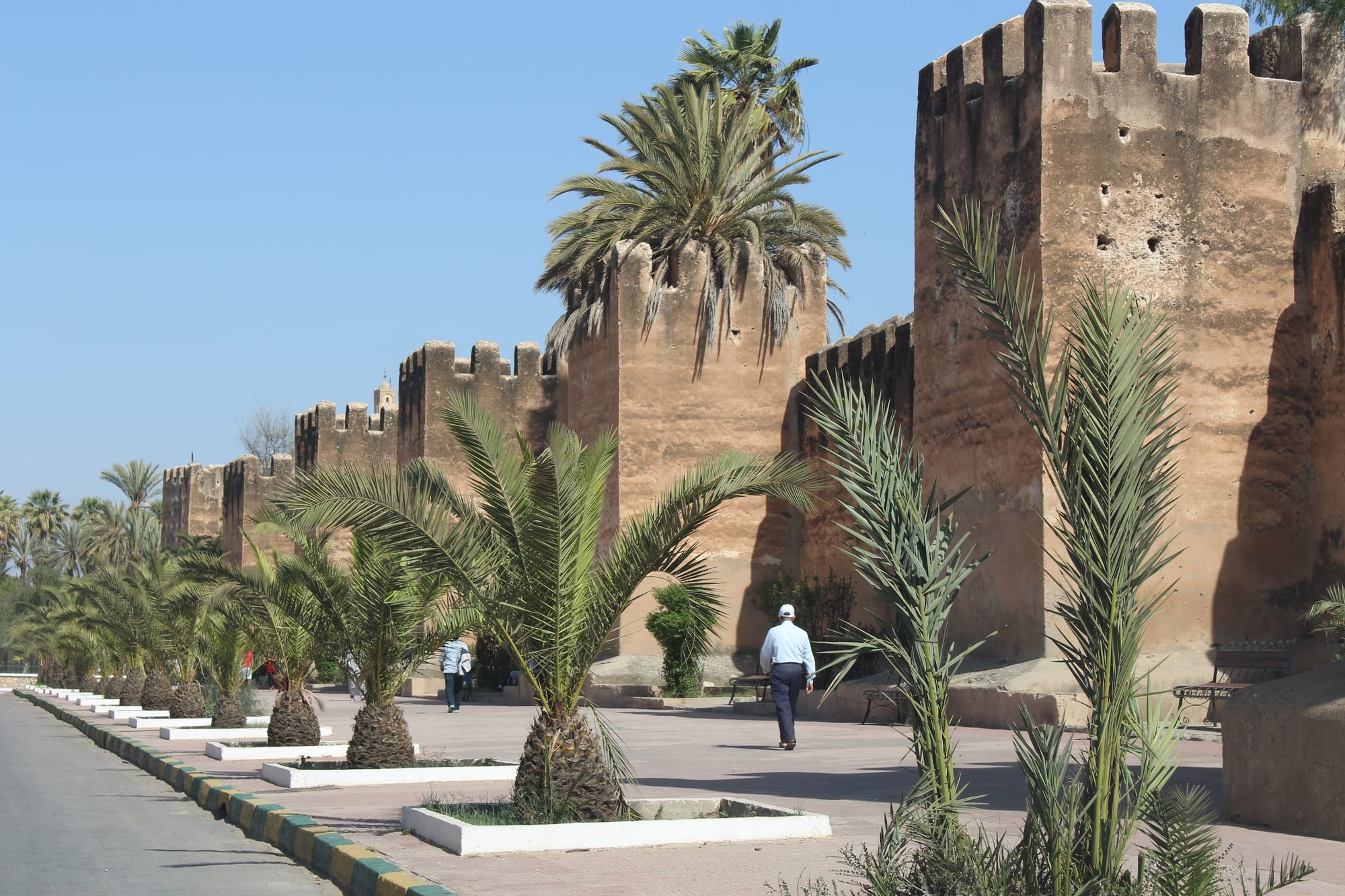
The walled town is flat and compact, and its lanes are mostly wide enough to be easy going; walking from one gate to another takes under half an hour. A full circuit outside the ramparts is several kilometres, pleasant in the cool of the morning and punishing at midday in summer. Traffic in the souks is mopeds and handcarts rather than cars.
🛡️ Safety
Taroudant is a quiet provincial town with little crime and far less hustling than Marrakesh or Fez, though guides and shopkeepers do approach visitors near the souks. The everyday hazards are heat, traffic at the gates where roads narrow, and mopeds in the market lanes.
Use official guides booked through a riad or a licensed agency, keep bags across the body in medinas, and avoid the cannabis-growing Ketama area of the Rif. Carry water and use the shaded side of the ramparts in summer. Check current official travel advice before travelling.
🌦️ Climate
A hot semi-arid climate, sheltered from the Atlantic by low hills, so it is markedly hotter than Agadir. Rain falls mainly between November and March and is unreliable; the valley has been in drought for several years.
- Summer
- very hot and dry, often 38–43°C by day, with warm evenings
- Winter
- mild and sunny, about 20–24°C by day and 5–10°C at night
🤝 Local Customs
Taroudant is Chleuh Amazigh in character, with Tashelhit spoken alongside Moroccan Arabic, and conservative in dress. Covered shoulders and knees are expected in the souks, greetings are exchanged before business, and bargaining is normal and good-humoured. Mosques are closed to non-Muslims.
Ask before photographing people, particularly women and market traders; alcohol is confined to a few hotels, and during Ramadan eating and drinking in the street by day is best avoided.
💳 Common Payment Methods
The currency is the Moroccan dirham. Banks and cash machines cluster around Place Assarag and the main avenues, hotels and larger shops take cards, and the souks, taxis and cooperatives are cash only. Small notes are useful for markets and for calèches.