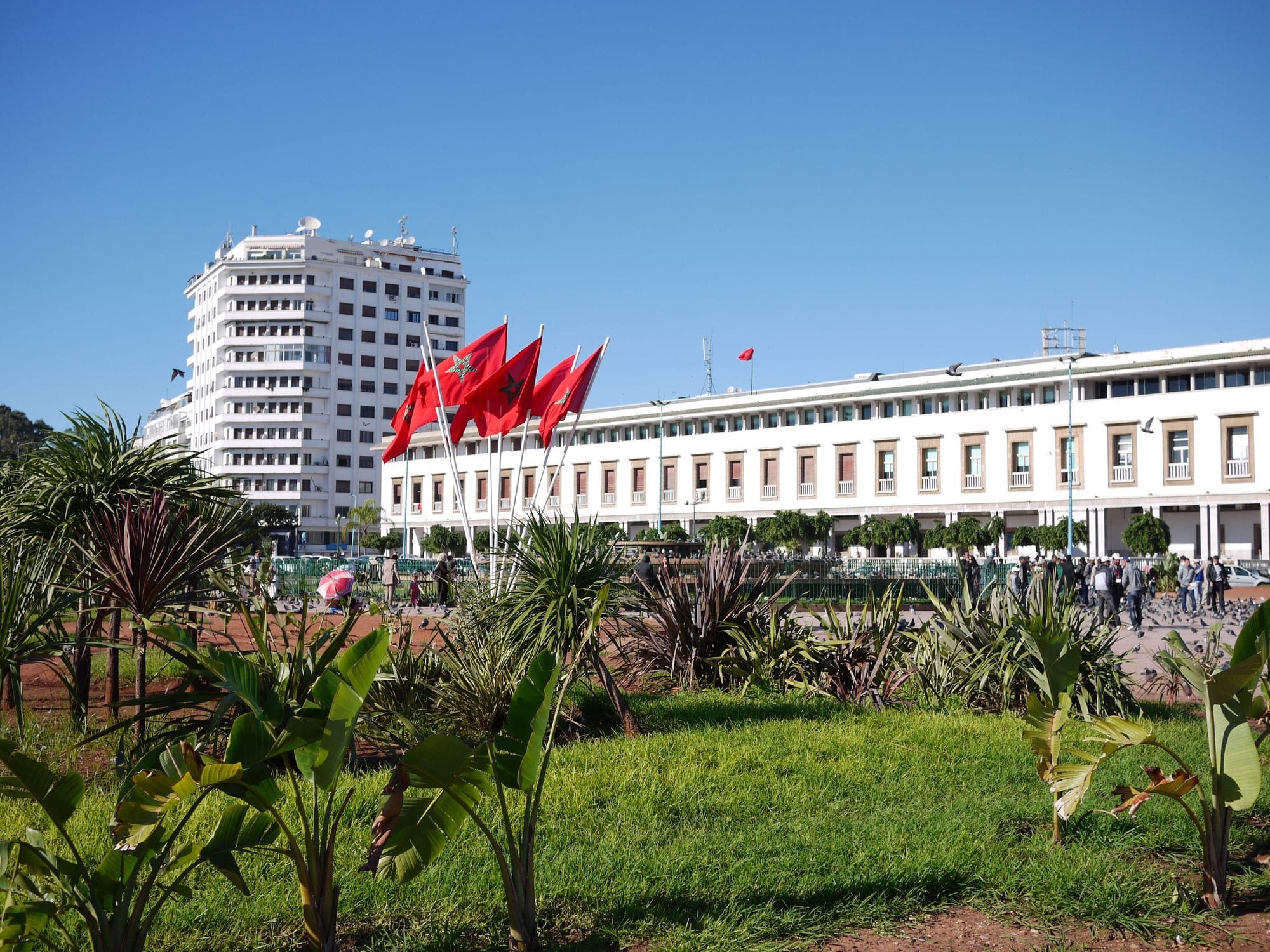
A wide civic square with Moroccan flags flying in front of long white arcaded administrative buildings under a clear blue sky

Rabat, Casablanca & the Atlantic Coast, Morocco

Casablanca

Place Mohammed V, the administrative heart of Casablanca, laid out under the French protectorate. (mustapha ennaimi / Wikimedia Commons · CC BY 2.0)

Morocco's largest city and its economic capital, on the Atlantic about 90 kilometres south of Rabat. A small port called Anfa until the French protectorate turned it into the country's harbour and industrial centre, it is now a working metropolis of banks, factories and traffic, with a centre of 1920s and 1930s architecture and the Hassan II Mosque on the seafront.

Neighbourhoods

  • The city centre
    • First-time visitors
    • Architecture
    • Close to public transport

    The grid of boulevards laid out under the protectorate between Place Mohammed V and the port, lined with 1920s and 1930s apartment blocks, cinemas and cafés in a mix of art deco and Moorish styles. Many hotels, the main station at Casa-Port and several tram lines are here, and the streets are busy day and night.

    Open in Maps
  • The old medina
    • Historic district
    • Markets
    • Local life

    The walled town that existed before the French arrived, between the centre and the port. Its lanes are narrow and workaday rather than picturesque, with clothes, hardware and food stalls, small mosques and cheap eating houses, and the Hassan II Mosque stands just beyond its northern wall.

    Open in Maps
  • Habous
    • Architecture
    • Shopping for crafts
    • Quiet walks

    A new medina built by the French in the 1920s and 1930s in a Moroccan idiom, with arcaded streets, ordered squares, bookshops, brassware and carpet dealers, and pastry shops known across the city. The Mahkama du Pacha, a courthouse in traditional style, stands on its edge.

    Open in Maps
  • Maarif
    • Best for food
    • Shopping
    • Nightlife

    A middle-class district west of the centre that has become the city's main shopping and eating quarter, with cafés and restaurants around Boulevard Massira Al Khadra and a large market. It is busy in the evening and easy to reach by tram.

    Open in Maps
  • Anfa and the Corniche
    • Beaches
    • Sea views
    • Nightlife

    The wealthiest part of the city, on the heights above the ocean, running down to Ain Diab and the Boulevard de la Corniche with its beach clubs, hotels, seafood restaurants and nightlife. Villas and gated developments spread inland from the coast road.

    Open in Maps
  • Hay Mohammadi
    • Local life
    • Music history

    A working-class district east of the centre built around the old industrial zone, known for its part in Moroccan popular music and protest culture and for the cultural centre in a former barracks. Ordinary, crowded and little visited.

    Open in Maps
  • Casablanca Finance City and Sidi Belyout
    • Business travellers
    • Close to public transport

    The business quarter near the port and the airport railway line, with the towers of the finance district, company offices and the newer hotels. Functional rather than atmospheric, but well connected.

    Open in Maps

Things to do

Famous landmarks

  • Hassan II Mosquelandmark

    Completed in 1993 on a platform partly over the Atlantic, its 210-metre minaret the second tallest in the world; guided tours admit non-Muslims outside prayer times.

    Open in Maps
  • Mahkama du Pachalandmark

    A courthouse and reception palace built in 1941 and 1942 in the Habous quarter, with carved plaster, zellige and painted cedar ceilings in traditional Moroccan style.

    Open in Maps
  • Casablanca Cathedrallandmark

    The former Sacré-Coeur church of 1930, a white art deco building with Gothic lines, no longer used for worship and now an exhibition space.

    Open in Maps
  • Place Mohammed Vlandmark

    The administrative square at the centre of the French city, laid out from 1916 to designs by Henri Prost and Joseph Marrast and ringed by the prefecture with its clock tower, the courts and the main post office.

    Open in Maps
  • Casablanca Twin Centerlandmark

    Two twenty-eight-storey towers in Maarif by the architect Ricardo Bofill, holding shops, offices and a hotel, and a landmark visible from much of the centre.

    Open in Maps

Museums and galleries

  • Museum of Moroccan Judaismmuseum

    The only Jewish museum in the Arab world, showing the religious life, crafts and domestic culture of Morocco's Jewish communities.

    Open in Maps
  • Abderrahman Slaoui Museummuseum

    The collection of the businessman Abderrahman Slaoui, open since 2012 — Moroccan jewellery, old travel posters, crystal and painting.

    Open in Maps
  • Villa des Artsmuseum

    An art deco villa near the Arab League Park, now a contemporary art gallery with changing exhibitions and a garden.

    Open in Maps

Markets and quarters

  • The old medinaneighborhood

    The pre-colonial walled town, a grid of lanes and stalls where the city's street trade concentrates.

    Open in Maps
  • Habousneighborhood

    The planned new medina of the 1920s, with arcades of craft shops, booksellers and pastry makers around quiet squares.

    Open in Maps
  • Marché Centralmarket

    The covered market on Boulevard Mohammed V, completed in 1917 to designs by Pierre Bousquet, where fish and shellfish stalls sit beside flower, fruit and spice sellers and small restaurants.

    Open in Maps

The coast and parks

  • Ain Diabneighborhood

    The seaside quarter west of the mosque, with the city's beach, beach clubs, cafés and the coast road along the Atlantic.

    Open in Maps
  • Boulevard de la Cornicheviewpoint

    The seafront promenade running from the Hassan II Mosque past Ain Diab, walked by the whole city in the evening and at weekends.

    Open in Maps
  • Arab League Parkpark

    A park of about 12 hectares in the middle of the city, west of Hassan II Boulevard and south-east of the former cathedral, with avenues of palms and gardens.

    Open in Maps
  • Sidi Abderrahmanlandmark

    A small shrine and cluster of whitewashed buildings on a rocky islet off the coast west of Ain Diab, reachable on foot at low tide.

    Open in Maps

Sport and nights out

  • Stade Mohammed Vattraction

    The oldest football stadium in Morocco, inaugurated in 1955 and seating 45,000, home to the Raja and Wydad clubs whose derby is among the fiercest in Africa.

    Open in Maps
  • Rick's Caféattraction

    A restaurant and bar in a restored riad near the old medina, opened in 2004 and modelled on the film set of Casablanca, which was never shot in the city.

    Open in Maps

Short trips from the city

  • Mohammediaattraction

    A port and beach town about 25 kilometres north-east, with a long sandy shore, a small medina and seafront restaurants.

    Open in Maps
  • Dar Bouazzabeach

    A fast-growing coastal suburb about 20 kilometres south-west with surf beaches, beach cafés and weekend crowds from the city.

    Open in Maps
  • Rabatattraction

    The capital, about 90 kilometres north-east and under an hour by train, with the Kasbah of the Udayas, the Hassan Tower and the ruins of Chellah.

    Open in Maps

Seasonal events

  • Jazzablancaearly July

    A jazz and popular music festival held over several days on open-air stages in the city.

  • L'Boulevardannual

    A festival of Moroccan rock, metal, hip hop and fusion that has been a platform for the country's young bands since 1999.

  • Ramadanvaries with the lunar calendar

    Cafés and restaurants close during daylight and the city comes alive after sunset, with soup, pastries and crowded streets late into the night.

  • Summer on the coastJuly and August

    The beaches, the Corniche and the seafront clubs are at their busiest, with concerts and outdoor events along the shore.

Eat and drink

Long-standing places and food districts in Casablanca. Hours, ratings and directions come from your maps app, always current.

Casablanca classics

  • Marché Centralmarket

    The central market, where fishmongers' stalls are surrounded by small restaurants that will cook the fish and shellfish bought a few metres away.

    Open in Maps
  • Rick's Caférestaurant

    A restaurant and piano bar in a courtyard house near the old medina, built in 2004 as a re-creation of the bar in the 1942 film.

    Open in Maps
  • Habous pastry shopsneighborhood

    The new medina's bakeries are known across Morocco for kaab el ghzal, briouat and the rest of the almond-and-honey repertoire.

    Open in Maps

Food districts and markets

  • Maarif restaurantsneighborhood

    The city's densest concentration of restaurants and cafés, from Moroccan grills to Italian, Japanese and Lebanese kitchens, busy from early evening.

    Open in Maps
  • Ain Diab seafoodneighborhood

    Restaurants and beach clubs along the Corniche serve grilled fish, fried calamari and shellfish with a view of the Atlantic.

    Open in Maps
  • Old medina food stallsneighborhood

    Cheap, quick eating — bowls of harira, snail broth, fried sardines, grilled kefta, and sfenj doughnuts fried on the corner in the morning.

    Open in Maps

Experience Casablanca

History

A Berber settlement called Anfa stood on this stretch of coast by the Middle Ages and grew into a port and a base for privateers. The Portuguese destroyed it in 1468 and returned to build a fortress there in the 16th century, which they abandoned after an earthquake. Between 1756 and 1790 Sultan Mohammed ben Abdallah rebuilt the town and its port and named it ad-Dar al-Bayda, the white house, which the Spanish rendered as Casablanca. Through the 19th century it was a modest port exporting wool and grain, with a small medina and a growing community of European merchants.

The turning point came in 1907, when French forces landed after disturbances around the building of a port railway, and again in 1912, when the protectorate was declared. Resident-General Lyautey gave the planning of the new port city to the architect Henri Prost, and Casablanca became the commercial capital. They laid out boulevards, squares and a new port beside the medina, and over the next three decades the city filled with apartment blocks, cinemas and offices in an art deco and Moorish style that has few equals. Rural migrants arrived to build and staff it, and shanty towns, the bidonvilles, spread on the edges.

In January 1943 Roosevelt and Churchill met at the Anfa Conference in the city. After independence in 1956 Casablanca became the engine of the Moroccan economy and the centre of its labour movement, with strikes and riots in 1965 and 1981 put down with force. The Hassan II Mosque was completed on the seafront in 1993, suicide bombings struck the city in May 2003, and building has gone outwards and upwards ever since, with a tram network, a finance district and continuing programmes to rehouse families from the remaining slums.

Culture & Customs

Known simply as Casa, the city is Morocco at its most modern, fastest and least ceremonious. It has the country's business culture, its advertising and film industries, its stock exchange and much of its press, and a reputation among other Moroccans for being hard-working, blunt and expensive. French is spoken freely alongside Darija, dress is more European than elsewhere, and social rules are looser, though the city is also religious and conservative in its older quarters.

Music has deep roots here. The district of Hay Mohammadi produced Nass El Ghiwane, the group that transformed Moroccan popular music in the 1970s with Gnawa rhythms and political lyrics, and the city has been the centre of Moroccan rock, metal and hip hop since the 1990s, much of it launched at the L'Boulevard festival. Art deco heritage, once neglected, is now the subject of walking tours, restoration campaigns and a good deal of local pride.

Football is close to a civic religion: the rival clubs Raja and Wydad both play at the Stade Mohammed V, and their derby fills the stadium and empties the streets. Morocco will co-host the 2030 World Cup with Spain and Portugal, and a 115,000-seat Hassan II Stadium is under construction at El Mansouria in Benslimane Province, east of the city, with an opening planned for 2027. The city is also where the country's social tensions surface first, from the strikes of the 1960s and 1980s to the youth protests of 2025.

Daily Life

About 3.2 million people live in the urban area and over 4.2 million in Greater Casablanca, making it by far the largest urban area in Morocco and one of the largest in Africa. The population came from everywhere in the country, and neighbourhood, not region of origin, is what defines people here. The contrast between the villas of Anfa, the middle-class flats of Maarif and the crowded districts of the east and south is stark.

The city produces a large share of the national economy: the port, much of Morocco's manufacturing, the banks and insurers, the finance district, retail and services. Wages are higher than elsewhere and so is the cost of living, above all housing, which is the dominant concern. Large rehousing programmes have cleared many bidonvilles, but informal settlements persist on the periphery and commuting from cheaper suburbs eats into the day.

Daily life runs on the tram, crowded buses, taxis and traffic. Cafés are the city's living rooms, full from breakfast until late; markets open early; offices keep long hours with a break in the middle of the day. Weekends belong to the Corniche, the beaches, the shopping centres and the football. Water and power costs, air pollution and the state of public services are the standing complaints, and the protests of autumn 2025 over schools and hospitals were felt strongly here.

Food

Casablanca eats from the sea. Sardines, sole, sea bream, shrimp and calamari come off the Atlantic boats, and the classic city meal is fish bought at a market stall and grilled or fried a few steps away, with cumin, salt and bread. The Marché Central in the centre is the best-known place for it, and the seafood restaurants along the Corniche at Ain Diab are the dressed-up version.

Street food is everywhere. Harira, the tomato, lentil and chickpea soup, is sold year-round from hole-in-the-wall kitchens; babbouche, snail broth, is drunk from small bowls on the pavement; and fried sardine sandwiches, kefta and merguez grilled over charcoal, and bowls of bissara, the broad-bean purée, feed the working city. Mornings begin with sfenj, ring doughnuts fried to order, or msemen, flaky griddle bread with butter and honey.

Home cooking follows the Moroccan repertoire — tagines, Friday couscous, rfissa made with shredded msemen and fenugreek broth, and pastilla for celebrations — while Habous is the place for pastries such as kaab el ghzal and briouat. The French legacy shows in the café culture: coffee and croissants at pavement tables all day, alongside glasses of very sweet mint tea, and in the bakeries and wine lists of the city's restaurants.

Planning tools

Budget

Casablanca is Morocco's most expensive city for accommodation and restaurants, with business hotels and international dining in the centre and in Maarif, but the same city also has cheap cafés, fish stalls and a tram network that costs little. Prices rise around big conferences and in high summer on the coast.

Daily Budget Midrange
USD 95–230 (mid-range hotel, restaurant meals, taxis, a guided visit to the mosque)
Daily Budget Shoestring
USD 30–55 (hostel or budget hotel, medina and market food, trams and trains)

Petits taxis rarely use the meter for visitors, so agree a fare first or use the tram, which reaches most places a visitor needs.

Best Time to Visit

April to June and September to October are the most comfortable, with warm days and a breeze off the ocean. Summer is humid, hazy in the mornings and crowded at the beaches. Winter is mild but wet, with Atlantic storms and big swell; the city works all year and is never a seasonal resort.

Suggested Number of Days

Most visits last a day or two, which covers the historic centre and the seafront. Three or four days allow the coast on either side of the city and a trip to the capital. Casablanca is more often a base or an arrival point than a destination in itself.

First Visit
1–2 days
With Surroundings
3–4 days

Transportation

Trams are the easiest way around: four tram lines cross the city from the centre through Maarif and out to the suburbs, with a flat fare and frequent services. Petits taxis, small red cars, take up to three passengers for short trips, while white grands taxis cover longer routes. Buses are slow, traffic is heavy at rush hour, and driving in the centre is difficult.

Rush hours are long in both directions, and the tram is often quicker than a taxi between the centre and Maarif or Ain Diab.

Airport & Station Connections

Mohammed V International Airport at Nouaceur, south-east of the city, is Morocco's main gateway, with a railway line into the city taking around 40 minutes to Casa-Voyageurs and Casa-Port. Trains run to Rabat in under an hour and to Marrakesh, Fès and Tangier, and coaches serve the rest of the country. The port handles cargo rather than passengers.

Walkability

The centre is flat and walkable, and the art deco streets between Place Mohammed V, the old medina and the Marché Central are best seen on foot. Beyond that the city is large and spread out: Habous, Maarif, the mosque and the Corniche are each a tram or taxi ride apart. Pavements are uneven and crossing the main boulevards takes nerve.

Safety

Casablanca has big-city crime that other Moroccan cities largely lack: bag-snatching, including by thieves on mopeds, pickpocketing in crowds and on busy streets, and occasional robbery at night in poorer districts and around the old medina. Violent crime against visitors is uncommon, and the tourist areas are policed. The Atlantic here has strong currents.

Keep phones and bags away from the traffic side of the pavement, use registered taxis after dark, and swim only at guarded beaches. Use official guides booked through a riad or a licensed agency, keep bags across the body in medinas, and avoid the cannabis-growing Ketama area of the Rif. Check current official travel advice before travelling.

Climate

Mild and oceanic, the most temperate climate in Morocco. Summers are warm and humid rather than hot, often starting with sea haze, and winters are mild and rainy. The ocean keeps temperatures within a narrow range all year.

Summer
warm and humid — 24–29°C by day, with morning cloud burning off
Winter
mild and wet — 8–18°C, with rain between November and March and heavy Atlantic swell

Local Customs

Casablanca is the most relaxed and cosmopolitan Moroccan city: dress in the centre, Maarif and on the Corniche is much as in southern Europe, though modest clothing is expected in the old medina, in Habous and at the mosque, where shoulders and knees are covered and shoes removed. French is used alongside Darija in business and in cafés. Alcohol is served in licensed hotels, bars and restaurants, not in public.

Tip small amounts in cafés and for parking attendants, ask before photographing people, and expect to negotiate prices in the medina and with taxis.

Common Payment Methods

The currency is the Moroccan dirham, which is difficult to obtain outside the country. Cards are widely accepted in hotels, restaurants, shops and supermarkets, more so than anywhere else in Morocco, but taxis, market stalls and small cafés want cash. ATMs are everywhere in the centre.