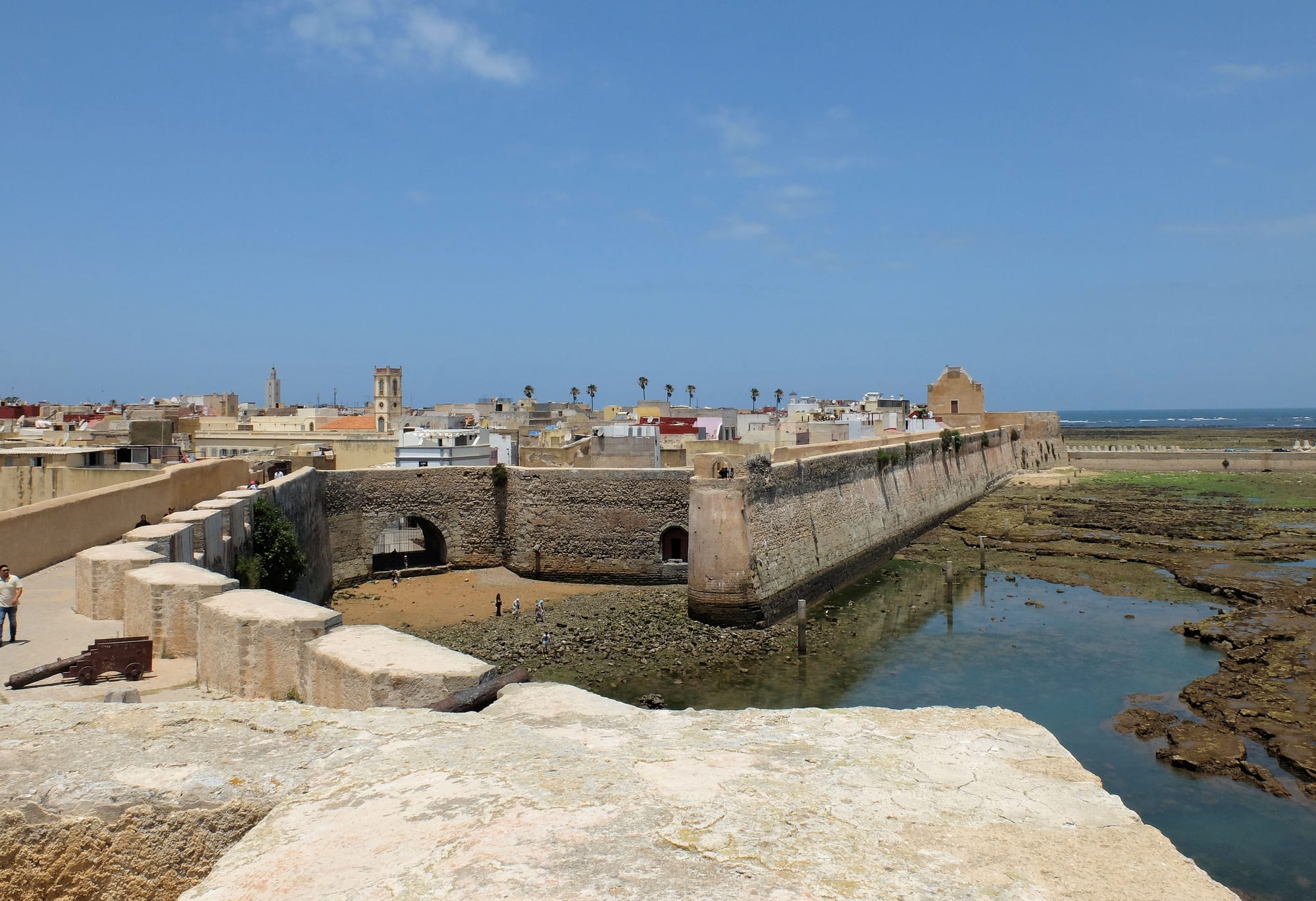
Low stone ramparts enclosing a white-walled old town beside a shallow tidal inlet, with the ocean beyond under a clear sky

Rabat, Casablanca & the Atlantic Coast, Morocco

El Jadida

The walls of the Portuguese city of Mazagan at El Jadida, seen from the Bastion of the Angel. (R Prazeres / Wikimedia Commons · CC BY-SA 4.0)

An Atlantic port about 90 kilometres south-west of Casablanca, built around the Portuguese fortress town of Mazagan, held from 1514 until 1769 and now a UNESCO World Heritage Site. Behind its ramparts and vaulted underground cistern lies an ordinary Moroccan provincial city of wide beaches, a fishing and phosphate port and the farming country of the Doukkala.

Neighbourhoods

  • The Cité Portugaise
    • First-time visitors
    • Historic district
    • Photography

    The small walled town the Portuguese built in the 16th century, entered from the port side and crossed by a single main street. Inside are the cistern, a former church, a synagogue, bastions to walk along and a handful of guesthouses and cafés in old houses.

    Open in Maps
  • The city centre
    • Best for food
    • Shopping
    • Close to public transport

    The streets immediately outside the ramparts, laid out in the French period around Place Mohammed V and Avenue Mohammed VI. Banks, the covered market, cafés, cheap hotels and the bus and grand-taxi stands are all here.

    Open in Maps
  • The seafront and the Corniche
    • Beaches
    • Families
    • Evening strolls

    A long city beach runs north-east from the port past a promenade of cafés, ice-cream stands and public gardens. It is where the city walks in the evening and where Moroccan holidaymakers gather in July and August.

    Open in Maps
  • Sidi Bouzid
    • Beaches
    • Quiet and residential

    A small resort a few kilometres south-west of the centre, with a sheltered beach below low cliffs, holiday flats and fish restaurants. It is quieter than the city beach and popular with families from Casablanca.

    Open in Maps
  • Haouzia and the northern beaches
    • Beaches
    • Golf

    The dunes and eucalyptus plantations along the coast towards Azemmour, with wide, wind-swept sand, a golf resort and little development in between.

    Open in Maps

Things to do

The Portuguese city

  • Portuguese Cisternlandmark

    A vaulted hall beneath the citadel of 1514, converted into a cistern in 1541, its floor covered by a thin film of water that mirrors the arches; Orson Welles filmed part of Othello here.

    Open in Maps
  • Church of the Assumptionlandmark

    The Portuguese Manueline church inside the walls, built in the early 16th century and later used for exhibitions and concerts.

    Open in Maps
  • Mazagan rampartslandmark

    The bastioned walls of the Portuguese fortress, among the earliest surviving examples of Renaissance military architecture built overseas, walkable most of the way round.

    Open in Maps

Beaches and the coast

  • El Jadida city beachbeach

    A broad sandy bay curving north-east from the port along the Corniche, sheltered enough for swimming and busy with Moroccan families in summer.

    Open in Maps

Short trips from the city

  • Azemmourneighborhood

    A whitewashed walled town on the Oum Er-Rbia river about 16 kilometres north-east, held by the Portuguese from 1513 until 1541 and now known for its murals and artists.

    Open in Maps
  • Oualidianeighborhood

    A lagoon village about 75 kilometres down the coast, known across Morocco for its oyster beds and sheltered swimming.

    Open in Maps
  • Jorf Lasfarattraction

    The deep-water port and phosphate-processing complex about 16 kilometres south-west, one of Morocco's main industrial zones and the site of the country's largest independent power station.

    Open in Maps
  • Moulay Abdallahattraction

    A coastal town south-west of the city, near Jorf Lasfar, built round the shrine of the saint it is named after and the site of a large summer moussem with mounted tbourida displays.

    Open in Maps
  • Casablancaneighborhood

    Morocco's largest city, about 90 kilometres north-east by motorway or train, with the Hassan II Mosque and the art deco streets of the centre.

    Open in Maps

Seasonal events

  • Moussem of Moulay Abdallah Amgharsummer

    A pilgrimage and fair at the saint's shrine south-west of the city, with tent encampments and daily tbourida, the mounted charge in which horsemen fire muskets in unison.

  • Beach seasonJuly and August

    Moroccan families and Moroccans living abroad fill the seafront, the hotels and the fish restaurants, and the promenade stays busy late into the night.

  • Ramadan eveningsthe month of Ramadan, a moveable date

    Daytime hours shorten and much of the city is closed while people fast; the cafés, bakeries and markets fill again once the fast is broken.

Eat and drink

Long-standing places and food districts in El Jadida. Hours, ratings and directions come from your maps app, always current.

El Jadida classics

  • Grilled fish at the portrestaurant

    Sardines, sea bream, sole, prawns and calamari landed a few metres away, grilled or fried and served with bread, cumin and a chopped salad.

    Open in Maps
  • Doukkala tagines and couscousrestaurant

    The farming plains behind the city supply lamb, chickpeas, pumpkin and wheat for tagines, couscous and rfissa in the small restaurants of the centre.

    Open in Maps

Markets and cafés

  • The covered marketmarket

    The city's produce and fish market just outside the ramparts, with olives, preserved lemons, spices, dates and the day's catch.

    Open in Maps
  • Corniche cafésneighborhood

    Pavement terraces along the seafront serving mint tea, coffee, fresh juices and pastries, busiest in the hour before sunset.

    Open in Maps

Experience El Jadida

History

The Portuguese seized the small Atlantic anchorage they called Mazagão in 1502 and, in 1514, built a citadel on the shore, whose vaulted underground chamber was turned into a cistern. Faced with Saadian power, they replaced it from 1541 with something far more ambitious: a compact star-shaped fortress with four bastions, thick sloping walls and a sea gate, designed by Italian and Portuguese military engineers. It was one of the first places outside Europe where the new Renaissance system of fortification was applied in full, and it proved almost impossible to storm.

Mazagan held out for more than two centuries, supplied by sea while the coast around it returned to Moroccan control. In 1769, besieged by the forces of Sultan Mohammed ben Abdallah, the garrison and the townspeople withdrew, blowing up a bastion as they left. The town stood largely empty and was known for a time as El-Mahdouma, the ruined one. Sultan Abd al-Rahman had it resettled, and in 1820 it was renamed El Jadida, the new one, and a Jewish community that traded with Europe grew up inside the walls, building the synagogue that still stands there.

Under the French protectorate the port was enlarged and a new town laid out outside the ramparts, and the town was promoted as one of Morocco's first seaside resorts. After independence it grew as a provincial capital, a fishing port and a beach resort for Casablanca, while the building of the Jorf Lasfar port and phosphate complex in the 1980s transformed the local economy. In 2004 the Portuguese city was inscribed on the UNESCO World Heritage List for its fortifications, its cistern and its church.

Culture & Customs

El Jadida belongs to the Doukkala, the Arabic-speaking farming plain between the Oum Er-Rbia river and the coast, and the culture of the plain shapes the city more than its Portuguese walls do. The Doukkala are known across Morocco for tbourida, the display in which rows of horsemen in full dress charge together and fire their muskets in a single volley; it is recognised by UNESCO as intangible cultural heritage, and the moussem at nearby Moulay Abdallah is one of the largest gatherings where it is performed, drawing thousands of riders, tents and traders each summer.

The city carries a layered history lightly. The ramparts, the church of the Assumption and the synagogue inside the Cité Portugaise are kept as monuments in a town that is otherwise entirely Moroccan and Muslim, and Portuguese visitors and researchers come regularly. The cistern has a second, cinematic fame from Orson Welles's Othello, filmed partly in El Jadida in the early 1950s.

Everyday manners are those of small-town Morocco: long greetings, glasses of mint tea poured from a height, Friday couscous, and the hammam as a weekly ritual. Summer changes the register completely, when families from Casablanca and Moroccans living in Europe arrive, the promenade fills after dark and the beach becomes the centre of social life. Football is followed closely, and the local club Difaâ Hassani El Jadidi is a source of civic pride.

Daily Life

About 238,000 people live in El Jadida at the 2024 census, with more in the towns and villages of the surrounding province. It is a provincial capital with the usual apparatus of courts, hospitals and a university, and the student population from Chouaib Doukkali University gives the centre a young feel during term.

Three things pay the bills: the sea, the plain and industry. The port handles fishing boats and coastal trade, and sardine landings feed processing plants. Inland, the Doukkala plain is one of Morocco's better-watered agricultural districts, growing cereals, sugar beet, tomatoes and fodder and supporting dairying. The largest employer of all is the Jorf Lasfar complex down the coast, where phosphate rock from the interior is turned into fertiliser for export, with a power station alongside; it brings jobs and also concern about air and water pollution.

Tourism is strongly seasonal. For ten months of the year the beachfront hotels are quiet and the city is a working town of markets, offices and traffic around Place Mohammed V; in July and August the population swells and rents jump. Housing development has spread along the coast road towards Azemmour and inland in new estates. Water supply, after years of poor rains across Morocco, and the balance between industry and the beaches are the issues people discuss.

Food

The Atlantic dominates. Sardines are the everyday fish, grilled over charcoal or stuffed in pairs around a paste of coriander, garlic, cumin and paprika and fried, and the port's stalls also sell sole, sea bream, red mullet, prawns and calamari cooked plainly to order. Oysters from the lagoon at Oualidia, down the coast, are sold in the city's fish restaurants and are the region's best-known delicacy.

From the Doukkala plain come lamb and beef for tagines, chickpeas, pumpkin and the wheat for couscous, steamed at home on Fridays over a broth of meat and seven vegetables. Rfissa, shredded msemen flatbread soaked in a fenugreek, lentil and chicken broth, is made for family occasions, and harira, the tomato, lentil and chickpea soup, breaks the fast in Ramadan. Bread is baked at home and taken to the neighbourhood oven, and khlii, meat preserved in fat, turns up in eggs at breakfast.

Street and café food follows the national pattern: bissara, a dried broad bean purée with olive oil and cumin, at breakfast; sfenj doughnuts and msemen with honey; grilled merguez and brochettes in the evening; and mint tea everywhere, often heavily sweetened. Pastry shops sell almond-filled kaab el ghzal and, in Ramadan, chebakia soaked in honey and sesame. On the Corniche in summer, the fixed points of the evening are grilled fish, fresh juices and ice cream.

Planning tools

Budget

El Jadida is cheaper than Casablanca or Rabat, with modest hotels, small seafood restaurants and free beaches. The exception is high summer, when seafront hotels and flats fill with Moroccan holidaymakers and prices climb; the luxury resort on the northern beaches sits in another price bracket altogether.

Daily Budget Midrange
USD 95–230 (seafront or Cité Portugaise hotel, seafood dinners, taxis and a hire car for the coast)
Daily Budget Shoestring
USD 25–45 (basic hotel or guesthouse, fried fish and bakery food, shared taxis and buses)

Book well ahead for July and August, when the city fills; out of season, rooms are easy to find and much cheaper.

Best Time to Visit

May, June, September and October are the most comfortable, with warm sea breezes, long light and few crowds. July and August are hot, crowded and festive; winter is mild and green but wet, with big Atlantic swells and many seasonal businesses closed.

Suggested Number of Days

The walled Portuguese town is small and can be seen in a few hours, so many visitors stop for a day or a night on the way along the coast. Two or three days allow time for the beaches and the towns and lagoons on either side.

First Visit
1 day
With Surroundings
2–3 days

Transportation

The centre and the Cité Portugaise are small enough to cross on foot. Small blue petits taxis cover the city and the nearer beaches for very little, grands taxis and buses run along the coast and inland, and a hire car makes the beaches, Azemmour and Oualidia much easier. Traffic is light outside the summer weeks.

Grands taxis to Azemmour, Oualidia and Casablanca leave from stands near the centre when they have six passengers, and seats can be bought individually.

Airport & Station Connections

Most visitors arrive from Casablanca, about 90 kilometres north-east: trains run from Casablanca to El Jadida's station on the edge of town in around two hours, and CTM and other coaches take a similar time by motorway. The nearest airport is Casablanca's Mohammed V, roughly an hour and a half away by road. Shared grands taxis link the town with Azemmour, Oualidia and Safi.

Walkability

Very walkable in the parts that matter. The Cité Portugaise, the market streets and the start of the Corniche lie within a kilometre of each other on flat ground, and the beach promenade continues for several kilometres. Sidi Bouzid and the northern beaches are too far to walk comfortably and need a taxi.

Safety

A quiet provincial city where visitors have few problems beyond opportunistic pickpocketing in the crowded summer weeks and the usual offers of unofficial guiding around the ramparts. The Atlantic is the real hazard: strong currents and rip tides affect this coast, and not all beaches are supervised.

Official guides booked through a hotel or a licensed agency are the safe choice, bags are best kept across the body in markets, and the cannabis-growing Ketama area of the Rif is best avoided. Check current official travel advice before travelling.

Climate

Mild and oceanic all year. Sea breezes keep summer heat down, morning haze is frequent, and nearly all the rain falls between November and March, when Atlantic storms bring heavy swell.

Summer
warm rather than hot, typically 18–27°C, with humid mornings and a steady onshore breeze
Winter
mild and wet, typically 9–18°C, with storms and big surf

Local Customs

This is a conservative provincial town away from the beach: covered shoulders and knees are the comfortable choice in the markets and the old quarters, even though swimwear is normal on the sand. Greetings come before business, mint tea is offered constantly, and non-Muslims may not enter working mosques.

Tipping is customary, with small change for café waiters and parking attendants and around 10 per cent in restaurants; alcohol is limited to licensed hotels and restaurants; asking before photographing people, especially women, is expected.

Common Payment Methods

The currency is the Moroccan dirham, which is difficult to obtain outside the country, so cash is usually withdrawn or changed on arrival. ATMs are easy to find around Place Mohammed V and along the main avenues. Hotels and larger restaurants take cards; the market, taxis, beach cafés and small shops are cash only.