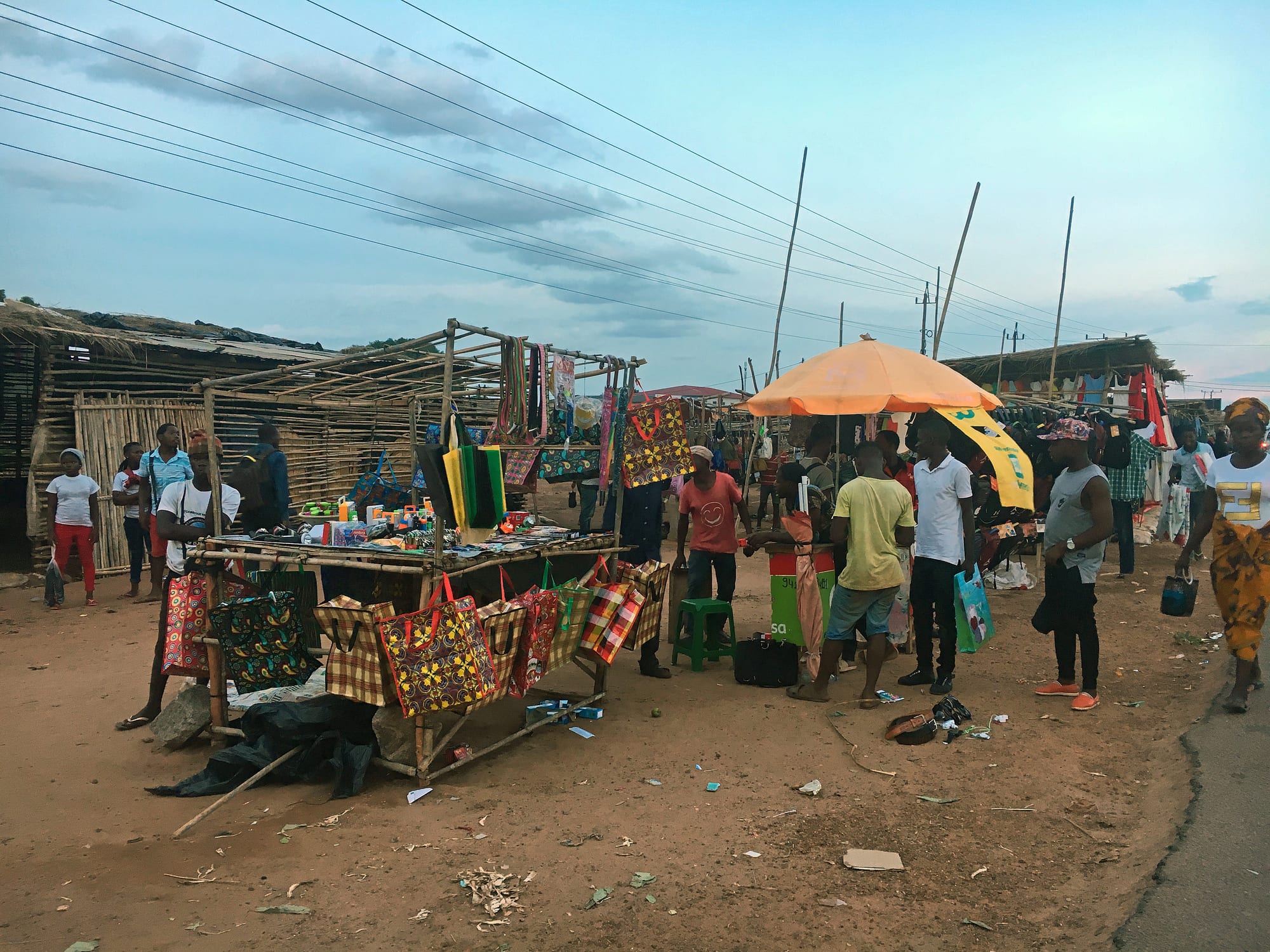
Roadside stalls of bamboo and thatch hung with printed cloth bags and goods, with traders and shoppers on red earth under a pale sky

Ilha de Moçambique, Pemba & the North, Mozambique

Nampula

Street traders at a roadside market in Nampula, northern Mozambique's largest city. (Adina Sualehe / VOA / Wikimedia Commons · Public domain)

The largest city in northern Mozambique and the capital of its most populous province, set inland among granite inselbergs on the railway from the port of Nacala. A colonial military and administrative post that grew into the north's commercial crossroads, it is a trading and transport city with a cathedral, a national ethnography museum and the region's main airport.

Neighbourhoods

  • The city centre
    • First-time visitors
    • Close to transport

    The colonial-era grid around the cathedral and the main avenues, holding the provincial government offices, banks, shops and most of the city's hotels. The railway station and the long-distance transport stands are within reach of it.

    Open in Maps
  • The market quarter
    • Markets
    • Local life

    The streets around the central and municipal markets, crowded from early morning with produce from the province, cloth, hardware and street food. It is the loudest and busiest part of the city.

    Open in Maps
  • The outer bairros
    • Local life
    • Quiet and residential

    Residential neighbourhoods spreading out on all sides in single-storey houses along red-earth roads, with their own markets, churches, mosques and football grounds. Granite hills rise among and beyond them.

    Open in Maps
  • The airport road
    • Close to transport
    • Quiet and residential

    The corridor out towards the airport and the road to the coast, with newer housing, offices, workshops and the compounds of companies and aid organisations working across the north.

    Open in Maps

Things to do

Museums and churches

  • National Ethnography Museummuseum

    The country's main ethnographic collection, covering the peoples of northern Mozambique with masks, carving, textiles, instruments and displays on initiation and daily life.

    Open in Maps
  • Cathedral of Our Lady of Fátimalandmark

    The city's twin-towered Catholic cathedral, designed by Raul Lino, built between 1941 and 1955 and inaugurated in 1956, and the seat of the archdiocese of Nampula.

    Open in Maps
  • Mosques and churches of the bairroslandmark

    Nampula's mix of faiths is visible in its neighbourhoods, where mosques serving the Makhuwa Muslim population stand near Catholic and Pentecostal churches.

    Open in Maps

Markets and streets

  • Nampula central marketmarket

    The city's main produce market, piled with cassava, maize, beans, tomatoes, mangoes and cashews brought in from across the province, with cloth and hardware alongside.

    Open in Maps
  • Craft and carving stallsmarket

    Blackwood carving from the Makonde plateau, basketry, capulana cloth and silver are sold in the city, which is the north's main trading point for crafts.

    Open in Maps
  • Nampula railway stationtransit hub

    The station on the line between the deepwater port of Nacala and Malawi, a colonial-era building that still sees freight and, at times, passenger services.

    Open in Maps

Around the city

  • The inselbergsviewpoint

    Bare granite domes rise abruptly from the plain around Nampula, visible from the city's edges and a defining feature of the province's landscape.

    Open in Maps
  • Nampula Airporttransit hub

    The region's main airport, about four kilometres from the centre, linking the north to other Mozambican cities and to Nairobi, Johannesburg and Dar es Salaam, and the usual arrival point for the coast.

    Open in Maps

Eat and drink

Long-standing places and food districts in Nampula. Hours, ratings and directions come from your maps app, always current.

Markets and food districts

  • Nampula central marketmarket

    Cassava and maize meal, dried fish, coconuts, mangoes, cashews and chillies, with stalls frying chamuças and snacks around the edges.

    Open in Maps
  • Grill restaurants in the centreneighborhood

    Small restaurants around the main avenues serve grilled chicken with piri-piri, xima with relishes, curries and cold lager.

    Open in Maps
  • Pastelarias and caféscafe

    Strong coffee, bread rolls, rissóis and custard tarts in the morning, a Portuguese habit that survives across the city centre.

    Open in Maps

Experience Nampula

History

Nampula is a twentieth-century city in an old landscape. The plain of granite inselbergs around it has been Makhuwa country for centuries, farmed and traded across to the Swahili ports of the coast, and the district lay within the sphere of the chartered Niassa Company until 1929. The town itself was founded by the Portuguese colonial army in 1907, and its growth followed the railway: the line inland from the coast, later carried through to the deepwater port of Nacala, made the settlement a depot and junction for the cotton, sisal and cashew country around it.

Colonial Nampula became the administrative capital of the province and a garrison town, raised to city status in 1956, with a grid of avenues, a cathedral inaugurated in the same year and warehouses along the tracks. Forced cotton cultivation shaped rural life across the province and left lasting bitterness. After the independence war of 1964 to 1974 and independence in 1975, most Portuguese residents left, and the city's trading economy, largely in settler and Indian hands, had to be rebuilt.

The civil war of 1977 to 1992 drove rural families into the city, and Nampula grew quickly and unevenly; it has kept growing since, on trade, transport and the services a provincial capital provides. The rehabilitation of the Nacala corridor, carrying coal from Tete to the port, and the movement of goods and people between the coast, Malawi and the interior have kept its markets busy, while the conflict in neighbouring Cabo Delgado since 2017 has made it a base for aid operations and a destination for people leaving the north.

Culture & Customs

Nampula is the cultural capital of the Makhuwa, the largest ethnic group in Mozambique, and Emakhuwa is what is spoken in its streets and markets, with Portuguese kept for school, office and officialdom. Makhuwa society is matrilineal: descent, land and family belonging are traced through the mother's line, and a mother's brother carries responsibilities that outsiders often expect of a father. Initiation ceremonies for boys and girls remain widely observed in the province and are large family occasions.

Religion is mixed and visible. Catholicism is strong — the city is an archdiocese, and its clergy have often spoken on social questions — while Islam is long established among Makhuwa communities and Pentecostal churches have spread quickly in the bairros. Masked dance traditions from the north, including the Makonde mapiko, and drumming and song at weddings and initiations are part of the region's life, and the national ethnography museum in the city exists to document them.

Everyday culture is that of a trading crossroads. Traders from the coast, Malawi and the interior meet in its markets; Makonde carvers sell through the city; football and music from Maputo, Tanzania and South Africa fill the bars; and Sunday is for church, family and the market. Manners are formal and unhurried: greetings first, deference to age, and patience prized over haste.

Daily Life

About 743,000 people lived in Nampula at the 2017 census, making it the largest city in the north and the third-largest in the country after Maputo and Matola. Most live in bairros of single-storey houses on red-earth roads spreading several kilometres from the small colonial centre, where the offices, banks and hotels remain concentrated.

The city lives on trade and transport. It is the collection and distribution point for the province's cashews and for its cotton, which is grown so widely that Nampula is known as Mozambique's cotton belt, along with maize, cassava, beans and coconut from the coast; the Nacala railway and corridor move coal, fuel and containers past it; and government, schools, the hospital, universities and a large presence of aid and development organisations provide salaried work. Most people, however, live from market trading, transport and small-scale work.

Days start before dawn, with produce arriving and chapas filling, and the markets wind down by late afternoon. The issues discussed are the price of food and transport, water and electricity supply, jobs for a very young population, crime in the busier quarters, and the pressure of people arriving from Cabo Delgado. Rain and the state of the roads set the pace of provincial life for half the year.

Food

Nampula eats between the coast and the interior. The everyday meal is xima, stiff maize or cassava porridge, with a relish of beans, pumpkin or cassava leaves cooked with ground peanuts, dried fish brought up from the coast, or chicken. Matapa, the cassava-leaf stew with peanuts and coconut, is common, and coconut and coconut rice appear in city kitchens because the coast is close.

Cashews are grown across the province, roasted and salted and sold by the bag on every street, and mangoes, papaya, pineapples, bananas and citrus are abundant in season. Indian Ocean trade left chamuças, the fried triangular pastries sold everywhere, along with curries and spiced rice. Grilled chicken with piri-piri is the standard restaurant meal, and fish and prawns arrive from Nacala and the island coast.

The Portuguese inheritance shows in bread rolls, prego and bifana sandwiches, rissóis and custard tarts taken with strong coffee in the centre's cafés. To drink there are 2M and Laurentina lagers, sugarcane and fruit juices, tea, and in the bairros home-brewed maize and cassava beers made for family celebrations.

Planning tools

Budget

Nampula is the north's cheapest base, with pensões and guesthouses used by traders and a handful of mid-range hotels in the centre, and food in markets and local restaurants costs little. Costs rise with distance: the transfer to the Island of Mozambique or the lakeshore, hired cars and domestic flights are what make a northern trip expensive.

Daily Budget Midrange
USD 100–250 (hotel, restaurant meals, taxis, transfers or domestic flights)
Daily Budget Shoestring
USD 35–60 (pensão or guesthouse, market food, chapas)

Draw cash here before heading for the coast or the lake, where machines are few; markets, chapas and small restaurants take cash only.

Best Time to Visit

May to November, the dry season, is the comfortable time, with warm days, cooler nights and passable roads across the province. December to April is hot and humid with heavy rain that can cut rural roads; the coast beyond the city also carries a cyclone risk late in the wet season.

Suggested Number of Days

A day covers the city, which most people use as a base or a staging point rather than a destination. Four or five days suits a trip that takes in the coast and the province, since road journeys here are long and slow.

First Visit
1 day
With Surroundings
4–5 days

Transportation

The city is spread out and people move by chapa minibus along the main avenues, by shared taxi and by motorcycle taxi. Long-distance chapas and buses leave from stands near the markets for the coast, Nacala, Pemba, Cuamba and the south. Hire cars with drivers are the usual way to reach the Island of Mozambique, and the railway to Nacala and Cuamba carries mostly freight.

Travel between towns in daylight, agree taxi fares before setting off, and allow far more time than the distance suggests, as road conditions vary.

Airport & Station Connections

Nampula Airport, about four kilometres from the centre, is the north's main airport, with domestic flights and international services to Nairobi, Johannesburg and Dar es Salaam. The EN1 and EN8 link the city south towards Quelimane and north towards Pemba, with buses on both, and the Island of Mozambique lies about 180 kilometres east, roughly three hours by road. The Nacala railway runs east to the port and west towards Malawi.

Walkability

The central grid around the cathedral and the markets is flat and walkable, and most offices, banks and hotels are within a few blocks of each other. Beyond it the city spreads for kilometres along wide roads with broken or missing pavements, so chapas and motorcycle taxis are needed; walking after dark is not advisable in any part of the city.

Safety

Nampula is away from the conflict in Cabo Delgado, though it is the place many displaced families and aid operations pass through. The everyday risks here are street crime — bag snatching, pickpocketing and muggings, particularly around the markets, the transport stands and after dark — along with road accidents and malaria, which is high year round. Post-election protests reached the city in late 2024.

Most governments advise against all travel to Cabo Delgado province. Keep valuables out of sight, use a taxi rather than walking after dark, travel between towns by day, and use mosquito precautions and prophylaxis. Check current official travel advice before travelling.

Climate

Tropical but tempered by an inland position and an altitude of a few hundred metres, so nights are cooler than on the coast. The wet season runs from about December to April with heavy afternoon rain; May to November is dry and sunny. This is the southern hemisphere, so summer falls in December to February.

Summer
hot and humid, December–February, around 30–32°C by day with heavy rain and thunderstorms
Winter
warm and dry, June–August, around 26–28°C by day and cool at night, sometimes near 13°C

Local Customs

This is the Makhuwa heartland: Emakhuwa is the everyday language of the city and province, with Portuguese used in offices, schools and business. Catholic, Pentecostal and Muslim communities live side by side, matrilineal traditions are important in family and land matters, and initiation ceremonies mark the passage to adulthood. Greetings are unhurried and formal.

Ask before photographing people, markets or ceremonies, dress modestly away from hotels, and avoid photographing police, soldiers, the airport and government buildings.

Common Payment Methods

The currency is the metical. Hotels and larger restaurants and shops accept cards, Visa more reliably than Mastercard, but markets, chapas and small restaurants are cash only. ATMs are in the centre and at the larger shops, and this is the last reliable place to draw money before the coast, the lakeshore or the interior.