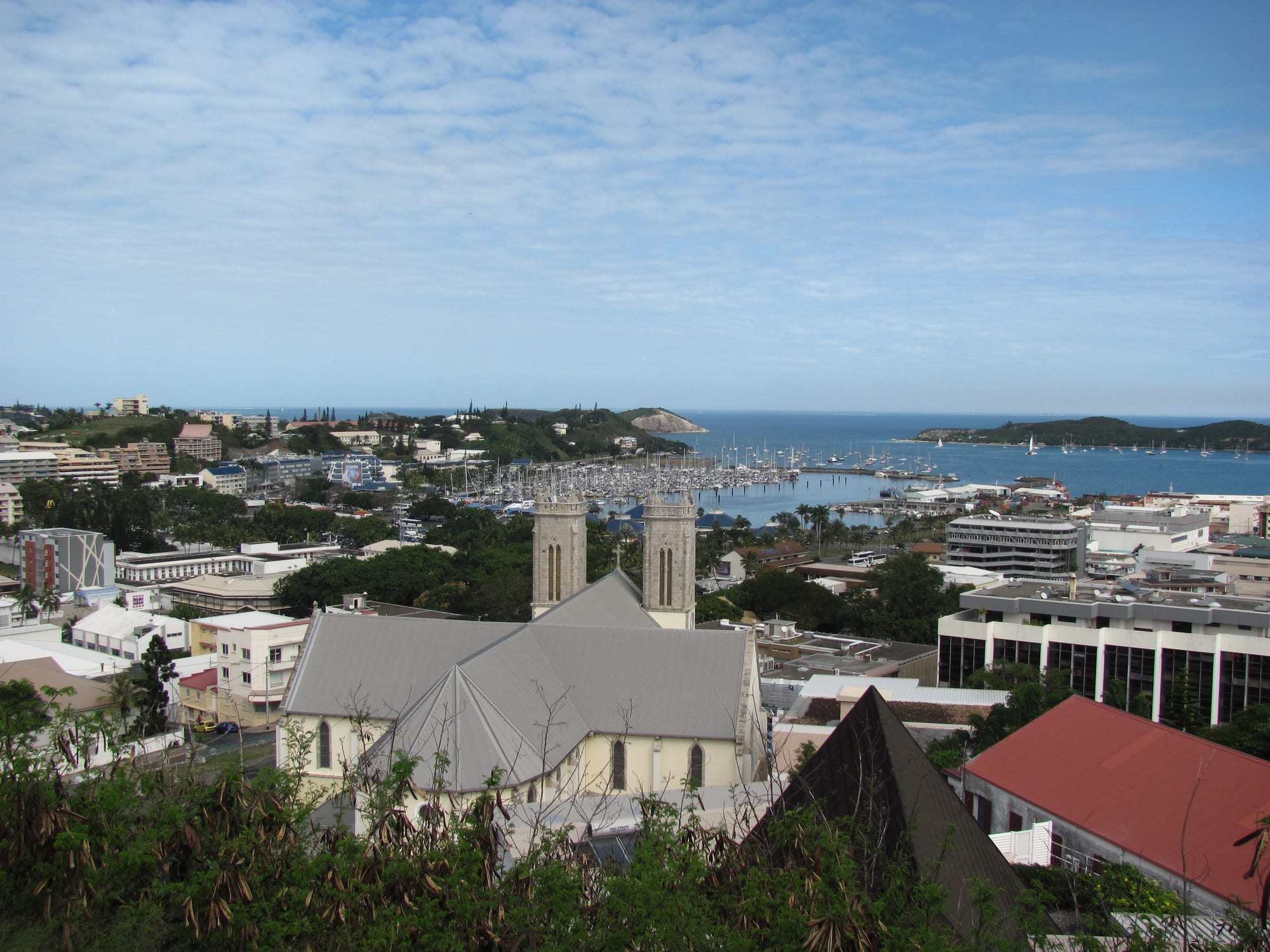
General view over the centre of Nouméa from a hillside, with the town below and the blue bay beyond

New Caledonia

Nouméa

A general view over central Nouméa from the hills above, with the bay and the lagoon behind. (Torbenbrinker / Wikimedia Commons · CC BY-SA 3.0)

The capital of New Caledonia, on a hilly peninsula at the southern end of the main island, inside the world's largest enclosed lagoon. Founded by France in 1854 and grown on nickel, it holds most of the territory's shops, offices and services, French cafés and bakeries beside Kanak and Pacific communities, and Renzo Piano's Tjibaou Cultural Centre.

Neighbourhoods

  • Centre-ville and Place des Cocotiers
    • First-time visitors
    • Shops and services
    • Historic district

    The grid of streets between the square and the harbour, with colonial-era buildings, the cathedral on its hill, banks, offices and the Port Moselle marina and market. Most of the city's older hotels are here, and it empties in the evening once the shops close.

    Open in Maps
  • Quartier Latin
    • Best for food
    • Bars
    • Close to the centre

    A small grid of streets just south of the centre, one of the city's oldest quarters, named after the Quartier latin of Paris because marshes, since filled in, once cut it off from the centre; a dense concentration of restaurants, bistros and bars, busy in the evening and within walking distance of the harbour.

    Open in Maps
  • Anse Vata
    • Beaches
    • First-time visitors
    • Water sports

    The main resort strip on the southern shore, a long beach facing the lagoon with hotels, apartment blocks, restaurants and the aquarium behind it. Steady trade winds make it a centre for kitesurfing and windsurfing, and the islet ferries leave from nearby.

    Open in Maps
  • Baie des Citrons
    • Beaches
    • Nightlife

    A sheltered curve of sand around the headland from Anse Vata, with calm swimming close to the shore and a line of bars and restaurants along the road behind it — the city's liveliest area after dark.

    Open in Maps
  • Nouville
    • History
    • Quiet and residential

    A former island, joined to the city by embankments and a bridge in the 1970s, where buildings of the penal colony survive among a university campus, a theatre and small beaches. Quiet, green and a short drive from the centre.

    Open in Maps
  • Magenta and Tina
    • Parks and the waterfront
    • Local life

    The eastern bays, holding the domestic airport, sports grounds, the zoological and forest park nearby and the peninsula where the Tjibaou Cultural Centre stands above a mangrove lagoon. Largely residential, with beaches used mainly by locals.

    Open in Maps

Things to do

Landmarks and viewpoints

  • Tjibaou Cultural Centremuseum

    Renzo Piano's centre for Kanak culture, opened in 1998 on the Tina peninsula, whose curved timber cases rise above the trees around exhibition halls, a Kanak garden and a performance space.

    Open in Maps
  • Place des Cocotierslandmark

    The central square of the colonial town, laid out on reclaimed swamp, with a bandstand inaugurated in 1883, the Céleste fountain of 1893 and rows of coconut palms.

    Open in Maps
  • Ouen Toroviewpoint

    A wooded hill above Anse Vata, a provincial park since 1989, with walking tracks, the coastal guns installed at its summit by the Australian army in 1941 and a view over the bays, the lagoon and the reef.

    Open in Maps
  • Nouville penal colony buildingslandmark

    Buildings of the convict establishment that ran on the former Île Nou from 1864, among them the old workshops now used as the Théâtre de l'île, a museum of the penal colony and part of the university.

    Open in Maps

Museums and the aquarium

  • Museum of New Caledoniamuseum

    The territory's museum of Kanak and Pacific cultures, with carvings, roof spires, masks and everyday objects from the archipelago and the wider region.

    Open in Maps
  • Nouméa City Museummuseum

    A museum of the city's own history, opened in 1996 in the building that served as the town hall from 1880 to 1975, beside Place des Cocotiers.

    Open in Maps
  • Aquarium des Lagonsattraction

    An aquarium between Anse Vata and Baie des Citrons devoted to the lagoon and reef of New Caledonia, with a nautilus tank and displays fed by sea water pumped from the bay and lit by daylight.

    Open in Maps

Beaches and the lagoon

  • Anse Vatabeach

    The city's main beach, a long stretch of sand facing the lagoon, with wind reliable enough to have made it a kitesurfing and windsurfing centre.

    Open in Maps
  • Baie des Citronsbeach

    A sheltered bay with shallow, calm water, popular for swimming and for snorkelling over the rocks at either end.

    Open in Maps
  • Île aux Canardsbeach

    A small islet a few minutes by shuttle boat from Anse Vata, with a marked snorkelling trail over the coral around it.

    Open in Maps
  • Îlot Maîtrebeach

    A low sand islet in the lagoon off Nouméa, reached by boat, surrounded by clear shallow water and a marine reserve.

    Open in Maps

Parks and markets

  • Port Moselle marketmarket

    The city's covered market beside the marina, selling fish, vegetables, fruit, flowers and prepared food in the mornings.

    Open in Maps
  • Parc Zoologique et Forestierpark

    A hillside park of dry forest above the city where the flightless cagou, New Caledonia's emblematic bird, and other endemic species are kept and bred.

    Open in Maps

Short trips from the city

  • Amédée Lighthouselandmark

    A slender iron lighthouse of 1865, prefabricated in France and erected on a sand islet near a pass in the barrier reef, visited on day trips from the city.

    Open in Maps
  • Mont-Doreattraction

    The commune east of Nouméa, named after the mountain behind it, with bays, walking tracks and the road south into the red-earth country of the Grand Sud.

    Open in Maps
  • Dumbéaattraction

    A neighbouring commune north of the city, where the Dumbéa river runs through a gorge with pools used for swimming.

    Open in Maps

Seasonal events

  • Fête de la CitoyennetéSeptember

    New Caledonia's Citizenship Day on 24 September, marking the date of French annexation in 1853 and now framed as a day of shared citizenship, with ceremonies, concerts and customary exchanges.

  • Bastille DayJuly

    The French national day on 14 July, marked in Nouméa with an official parade, music and fireworks over the bay.

  • Giant Omelette FestivalMarch or April

    A festival held at neighbouring Dumbéa on the first weekend after Easter since 1984, at which members of the Confrérie Mondiale de l'Omelette Géante cook a giant omelette in the open air and hand it out free to the public.

Eat and drink

Long-standing places and food districts in Nouméa. Hours, ratings and directions come from your maps app, always current.

Nouméa classics

  • Bougnarestaurant

    The Kanak earth-oven dish of yam, taro and sweet potato with chicken, fish or crab and coconut milk, wrapped in banana leaves; a few restaurants and market stalls in and near the city prepare it, usually to order.

    Open in Maps
  • Vietnamese and Indonesian kitchensneighborhood

    Phở, bò bún and spring rolls, and Indonesian dishes such as bami, are everyday food in Nouméa thanks to communities that arrived as indentured labourers; they are found around the centre, the Quartier Latin and the markets.

    Open in Maps

Food districts and markets

  • Port Moselle marketmarket

    Fish and prawns from the lagoon, tropical fruit and vegetables, French cheese and charcuterie, and stalls selling coffee, pastries and cooked breakfasts beside the marina.

    Open in Maps
  • Quartier Latinneighborhood

    A run of bistros, brasseries and cafés with terraces, where French cooking meets lagoon fish and venison.

    Open in Maps
  • Baie des Citronsneighborhood

    Bars, pizzerias and seafood restaurants along the road behind the beach, with tables facing the water.

    Open in Maps

Experience Nouméa

History

Nouméa was founded in 1854, a year after France annexed New Caledonia, as Port-de-France, a garrison and harbour at the southern end of the main island. The swamps behind the town had to be drained before the centre could be laid out. The settlement was renamed Nouméa, a Kanak name of uncertain meaning, in June 1866.

From 1864 the town's growth was tied to the penal colony: about 22,000 convicts and political prisoners, including Communards deported after 1871 and Algerians exiled after the Mokrani revolt, were transported until 1897, and much of Nouméa's early infrastructure was built with convict labour. On the former island of Nouville the prison establishment left workshops and cell blocks that still stand. At the same time nickel, discovered in the 1860s, made the port a mining and smelting town, with a works at Doniambo and indentured labourers brought from Japan, Java and Vietnam.

The Second World War transformed the place. From March 1942 Nouméa was the main American rear base for the war in the Pacific: the first 17,000 troops landing in a town of about 10,000 people and leaving new roads, wharves, airfields and a lasting imprint. Post-war nickel booms brought migrants from France, Wallis and Futuna and elsewhere in the Pacific. It was the seat of government through the conflict of the 1980s known as les Événements and the Matignon and Nouméa Accords that followed, and in May 2024 its suburbs and commercial districts were the centre of the worst rioting in decades, set off by a proposed change to the electoral roll.

Culture & Customs

Nouméa is often described as a Mediterranean town transplanted to the Pacific: bakeries and butchers, pavement cafés, pétanque under the palms, the July parade and a French rhythm of long lunches and August holidays. It is also the most mixed place in the territory, where Kanak from the mainland and the Loyalty Islands live alongside Caldoche families descended from settlers and convicts, metropolitan French on postings, and large Wallisian, Futunan, Tahitian, Vietnamese and Indonesian communities, each with its own associations, churches and food.

The city is the showcase for Kanak culture as well as the seat of French institutions. The Tjibaou Cultural Centre, named after the independence leader assassinated in 1989, commissions and exhibits contemporary Pacific art and hosts dance, film and music, while the Museum of New Caledonia holds older carving and material culture. Customary practice continues in the city among Kanak families — the offering of la coutume, obligations to clan and village, the yam calendar — and the Customary Senate sits here alongside the elected Congress.

Life is outdoors and water-centred: outrigger canoe paddling, sailing, diving, kitesurfing off Anse Vata, rugby, football and cricket played in the Melanesian women's version of the game. The unresolved question of independence, three referendums, the accords and the 2024 unrest sit behind much of public life; opinions divide sharply along community lines, and visitors are expected to listen rather than to take positions.

Daily Life

The April 2025 census counted 85,976 people in the commune of Nouméa and 173,814 in Greater Nouméa, which takes in Dumbéa, Le Mont-Dore and Païta — about two-thirds of the territory's population, and the first decline recorded for the urban area. The city holds the hospital, the university, the administration, the port and most private employment, and people commute into it along a few congested roads from suburbs that have spread far to the north and east.

The economy has rested on nickel — mining, and smelting at Doniambo — together with the French public sector, transfers from Paris, port trade and tourism. Nickel has been in deep difficulty in recent years, with plants idled and jobs lost, and the destruction of 2024 added business closures, insurance withdrawal and a sharp downturn. Inequality is visible in the geography of the city: prosperous neighbourhoods on the southern bays, and poorer, largely Kanak and Pacific Islander districts on the northern and eastern edges, where much of the rioting took place and where housing pressure is greatest.

The daily rhythm is early — offices and schools start soon after dawn and much of the city closes for a long lunch — with evenings on the beaches, the seafront paths and the terraces of Baie des Citrons. Rebuilding burnt-out shops and premises, the future of the nickel industry, the cost of living and the political negotiations — the agreement signed at Bougival in July 2025 has still to be approved — are the recurring subjects of conversation and of local news.

Food

Nouméa eats French and Pacific at once. Bakeries sell baguettes and croissants early, charcuterie and cheese come in from France, and bistros serve steak, duck and tarts alongside lagoon fish, prawns and the locally farmed prawn known as la crevette calédonienne. Venison from introduced deer and beef from the cattle stations of the west coast appear on menus as well, and coconut, yam and sweet potato give many dishes a Pacific base.

Kanak cooking centres on bougna, in which yam, taro and sweet potato are layered with chicken, fish or crab and coconut milk, wrapped in banana leaves and baked in an earth oven over hot stones. It is food for occasions rather than everyday restaurant fare, though some places in and around the city prepare it to order and it appears at markets and festivals. Reef fish, mangrove crab, lobster and sea snails are the other staples of the coast.

Asian food is thoroughly local. Vietnamese phở and bò bún, Indonesian bami and nasi, and Chinese dishes are all sold from small restaurants and market stalls, the legacy of indentured labour brought for the mines. Port Moselle market is the best single place to see the range: prawns and lagoon fish, tropical fruit, market gardens' vegetables, French cheeses and stalls where breakfast is taken beside the boats. Imported French wine is standard on tables, and the local beer, Number One, is brewed in the city.

Planning tools

Budget

Nouméa is expensive, on French-territory prices with almost everything imported. Hotels along Anse Vata and in the centre, restaurant meals and car hire are the main costs, while the beaches, the markets and the Tjibaou Centre's grounds cost little or nothing. Self-catering from supermarkets and the market cuts the bill substantially.

Daily Budget Midrange
USD 210–480 (city or beachfront hotel, restaurants, car hire, a lagoon boat trip)
Daily Budget Shoestring
USD 80–140 (guesthouse or studio, self-catering, buses and shared transport)

Tourism has been well below normal levels since the unrest of 2024, so it is worth confirming what is open and operating before booking.

Best Time to Visit

August to November is the most reliable window: warm, dry and breezy, with good visibility for diving and snorkelling over the lagoon reefs. December to April is hotter and more humid, with the cyclone risk concentrated between January and March. May to July is cooler, with fresh evenings.

Suggested Number of Days

Two or three days suits the city itself. Five to seven allow for the lagoon islets and trips out to the neighbouring communes or an island flight. Weather, ferry and flight schedules, and current conditions all affect the total.

First Visit
2–3 days
With Surroundings
5–7 days

Transportation

City buses run across Nouméa and to the neighbouring communes, and a network of routes connects the centre with Anse Vata and Baie des Citrons. Taxis exist but are not plentiful and are usually booked by telephone. A hire car is the normal way to reach the rest of the main island; driving is on the right, and roads are good by regional standards. Shuttle boats serve the nearby islets from Anse Vata.

Roads and services were disrupted by the unrest of 2024, so checking current conditions and routes before setting out is sensible.

Airport & Station Connections

La Tontouta International Airport lies about 50 kilometres north-west of the city, roughly an hour by road, with flights from Australia, New Zealand, Japan and other Pacific destinations, and connections to France. Magenta airport, inside the city, handles domestic flights to the Isle of Pines and the Loyalty Islands, and a fast passenger ferry serves them from the port. Cruise ships tie up beside the city centre.

Airport shuttles and taxis meet international flights; car hire desks are at Tontouta as well as in the city.

Walkability

The centre is flat, compact and easy on foot: Place des Cocotiers to the market and the waterfront takes a few minutes, and the Quartier Latin adjoins it. Beyond that the city is spread over hills and bays, and the walk from the centre to Anse Vata is about four kilometres, with some climbs and limited shade, so buses, taxis or a car are the practical way to move between districts.

Safety

New Caledonia was normally a low-crime destination, but this changed sharply in May 2024, when a French move to change the electoral rules set off rioting, arson, looting and roadblocks that killed more than a dozen people and destroyed hundreds of businesses, mostly in and around Nouméa. A state of emergency ran from 16 to 28 May 2024 and the last curfew was lifted on 2 December 2024. The political question behind the unrest is not settled: an agreement on the territory's institutional future was signed at Bougival in July 2025 and has still to be approved, and the French National Assembly voted a partial change to the electoral roll in May 2026 ahead of provincial elections; demonstrations can recur. Ordinary risks are otherwise petty theft, strong sun, currents in the lagoon passes and stonefish and cone shells on the reef.

Avoid demonstrations, roadblocks and crowds entirely, keep valuables out of sight on the beaches, and ask locally before driving outside the city during any period of tension. Check current official travel advice before travelling.

Climate

A tropical climate tempered by the south-east trade winds and cooler than most of the Pacific. In the southern hemisphere summer runs from December to February; the warm, humid wet season lasts from November to April, with cyclones possible between January and March, while May to September is drier and more comfortable.

Summer
warm and humid from December to February, with daytime temperatures around 29°C, heavy showers and the cyclone season
Winter
mild and drier from June to August, around 23°C by day and cooler at night, with steady trade winds

Local Customs

Daily manners are French: a greeting on entering a shop, 'bonjour' before any question, and a handshake or cheek kisses among friends. Tipping is not expected, as service is included. Kanak custom also matters, above all outside the city: la coutume, the ceremonial offering of cloth, money and words, opens any serious visit, land and sites are often customary property, and permission should be asked before entering tribal land or photographing people and ceremonies. Beachwear stays at the beach.

Ask before photographing people, and treat any discussion of independence, the referendums and the 2024 unrest as sensitive ground where opinions differ strongly.

Common Payment Methods

The currency is the CFP franc, pegged to the euro. Cards are widely accepted in the city's shops, hotels and restaurants, and ATMs are common. Cash is more useful at markets, small snack bars and anywhere outside Greater Nouméa, especially on the islands and in tribal areas.