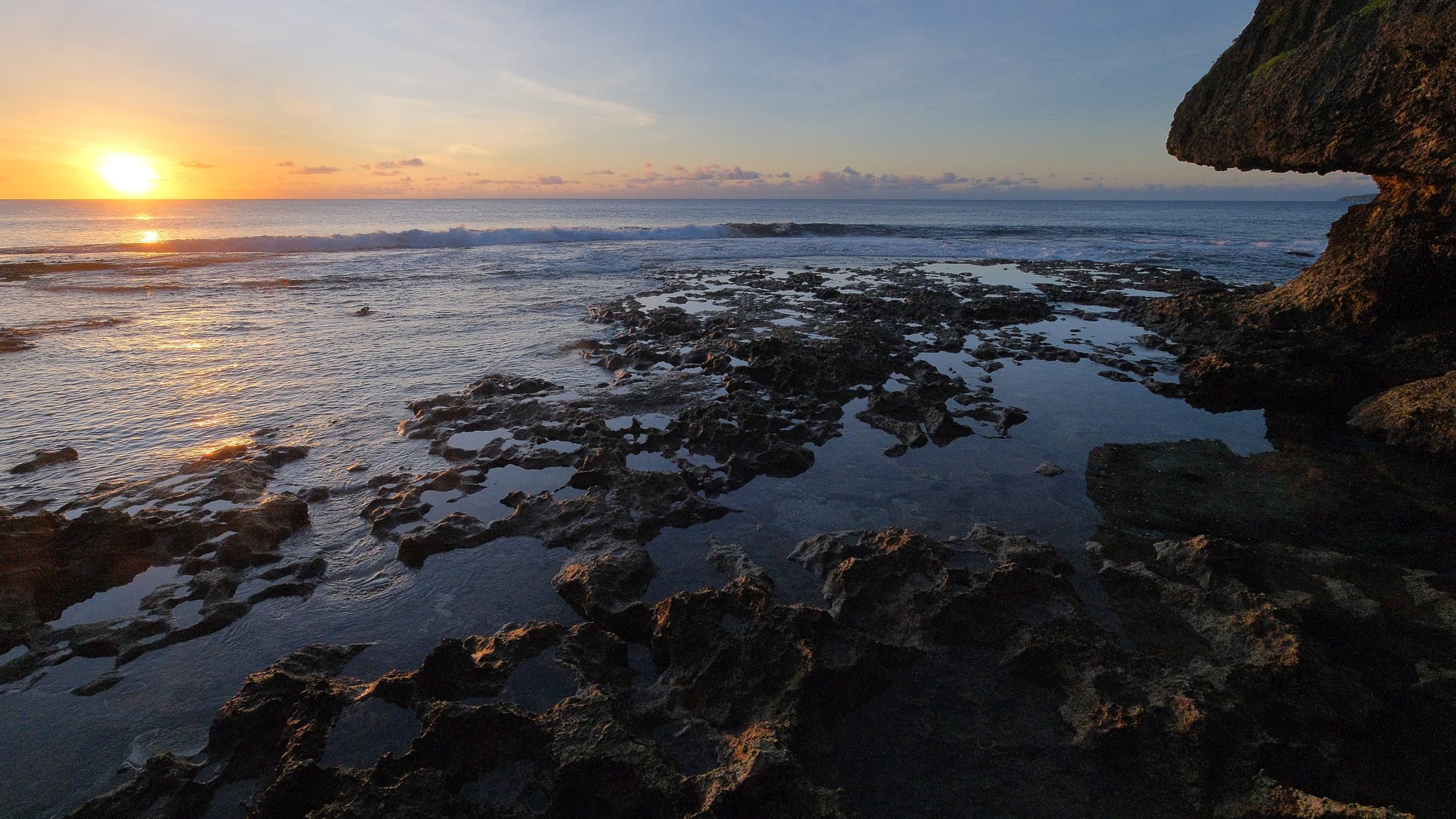
Dark pitted coral rock and shallow tidal pools at the foot of a low cliff, with breaking surf and the sun setting over the ocean

Niue

Alofi

The reef flat at the bottom of the Amanau sea track in Alofi, on Niue's west coast, at sunset. (Pseudopanax at English Wikipedia / Wikimedia Commons · Public domain)

The capital of Niue, a raised coral island in the South Pacific, strung for several kilometres along the sheltered west coast. Its two villages, Alofi North and Alofi South, held 610 people at the 2022 census, making it the second-smallest national capital by population after Ngerulmud in Palau; they hold the government offices, the island's wharf, its hospital and airport, with sea tracks leading from the road down through limestone cliffs to reef pools and caves.

Neighbourhoods

  • Alofi South
    • First-time visitors
    • Historic district
    • Close to the wharf

    The older part of the settlement, near the wharf, the main church and the shoreline road, with shops, the market building, small businesses and accommodation; the government quarter at Fonuakula, built three kilometres inland after Cyclone Heta, lies inside its village boundary. The coast here is rock and reef rather than sand, and sea tracks drop to the water between the buildings.

    Open in Maps
  • Alofi North
    • Close to the airport
    • Shops and services
    • Quiet and residential

    The northern of the capital's two villages, strung along the coast road with houses, commercial buildings and accommodation set back from the cliff edge. The airport and the island's main supermarket are close by.

    Open in Maps
  • Makefu and Tuapa
    • Quiet and residential
    • Walks and viewpoints

    Small villages a few kilometres north along the ring road, with houses among coconut and banana plots, reef flats below and the sea track down to Avaiki Cave within easy reach. Residential and very quiet.

    Open in Maps
  • Avatele and Tamakautoga
    • Beaches
    • Quiet and residential

    Villages on the south-west coast, where Avatele Beach, on Avatele Bay, is the island's largest and best-known beach — coarse sand rather than fine, and the usual place islanders and visitors go to swim and picnic. A short drive from the capital.

    Open in Maps

Things to do

In and around Alofi

  • Alofi wharflandmark

    The island's only landing place, a small wharf that can take shallow boats alone, so cargo vessels moor off the reef and barges bring goods ashore; a working spot that doubles as a swimming and fishing place in calm weather.

    Open in Maps
  • Alofi Baylandmark

    The wide bay the capital stands above, one of the two large indentations in Niue's western coast, with sea tracks dropping through the limestone cliffs to the reef flat.

    Open in Maps

Sea tracks, chasms and caves

  • Avaiki Caveattraction

    A cave in the limestone of the west coast north of the capital, reached by a sea track down the cliff, with reef pools at its mouth that can be swum at low tide.

    Open in Maps
  • Talava Archesattraction

    Three natural sea arches on the northern coast, reached by a trail across the makatea, framing the sea beyond the reef.

    Open in Maps
  • Togo Chasmattraction

    One of the coastal caverns that pit Niue's raised coral rim, reached by a long track across jagged limestone and a descent into the chasm.

    Open in Maps

Short trips around the island

  • Huvalu Forest Conservation Areapark

    A conservation area of 5,400 hectares on the eastern side of the island, where tall hardwood forest, forest birds and the coconut crab, uga, are protected.

    Open in Maps
  • Avatele Beachbeach

    The island's largest and best-known beach, on Avatele Bay in the south-west, with coarse sand and shallow water; before the wharf and the airport were built it was the main landing place for visitors.

    Open in Maps
  • Hakupuneighborhood

    Niue's second-largest village after Alofi, twelve kilometres south-east of the capital, with a heritage park established in 1998 and the Anapala chasm nearby, a freshwater pool at the bottom of 155 steps.

    Open in Maps

Seasonal events

  • Constitution DayOctober

    Niue's national day on 19 October, marking the Niue Constitution Act of 1974 and self-government in free association with New Zealand, with church services, sport and feasting.

  • Whale seasonSouthern winter

    Humpback whales migrate from Antarctic waters to breed around Niue and can often be seen from the cliff tops near the capital; whale watching is permitted in the island's marine park, and so is swimming with them.

Eat and drink

Long-standing places and food districts in Alofi. Hours, ratings and directions come from your maps app, always current.

Niuean classics

  • Takihirestaurant

    The island's signature dish, alternating layers of taro and pawpaw baked in coconut cream, served at feasts and at some of the capital's eating places.

    Open in Maps
  • Uga, the coconut crabrestaurant

    A prized delicacy on Niue and also a conservation concern, so it appears on menus and at festivals only when available.

    Open in Maps

Markets and food streets

  • Alofi marketmarket

    The Niue Makete in the centre of the capital, held twice a week, where families sell surplus taro, yams, uga, cassava, breadfruit and fruit as well as cooked food; one of the social gatherings of the week.

    Open in Maps
  • Alofi's cafés and takeawaysneighborhood

    A small number of cafés, takeaways and bars are spread along the coast road, serving fish, burgers, curries and coffee; opening days vary, and the island's supermarket supplies most self-caterers.

    Open in Maps

Experience Alofi

History

Alofi sits on the sheltered western side of a raised coral island settled around 900 CE by Polynesian voyagers from Samoa. Until the 18th century the island had no single leader, authority resting with chiefs and heads of families; the west coast, with the only practicable landing places in the cliffs, was where canoes came and went. Captain Cook made three attempts to land in 1774, the last at Avatele, and named the island Savage Island, a name that fell out of use as Niue regained its own.

Christianity arrived through Niueans themselves: Nukai Peniamina, taken away and trained as a pastor at the Malua Theological College in Samoa, came home in 1846, and mission stations followed in the villages. Traders and whalers called at the roadstead, and the settlement grew around the landing, the mission and the store. Niue became a British protectorate in 1900 and was brought within the boundaries of New Zealand in 1901, and Alofi became the administrative centre.

In 1974 Niueans voted for self-government in free association with New Zealand, and the capital acquired the assembly and government departments. The defining event of recent decades was Cyclone Heta, a category 5 storm that passed close on 6 January 2004: it devastated Alofi, destroyed the island's only hospital and the Huanaki Cultural Centre with most of its collections, and caused damage worth about five times the island's annual output. Rebuilding moved government offices and much new construction three kilometres inland to Fonuakula, away from the cliff edge, which is why the present capital feels dispersed and set back from the sea.

Culture & Customs

Alofi is really two villages, Alofi North and Alofi South, and village identity matters as much here as anywhere on the island. The Ekalesia Niue, the church descended from the mission and the affiliation of about three-fifths of residents, dominates religious life, with Latter-day Saint, Catholic and other congregations alongside it, and Sunday is quiet by custom as well as by preference, given to services, choirs and family meals.

Family ceremonies are the great occasions: weddings, funerals and church gatherings bring relatives back from New Zealand, where the great majority of Niueans live. Constitution Day on 19 October is the national celebration, kept with services, feasting and sport.

The island's cultural life is shaped by its diaspora: between 90 and 95 per cent of Niueans live in New Zealand, and people move back and forth for school, work, funerals and festivals. Vagahau Niue, the Niuean language, is official alongside English and was spoken by about seventy per cent of residents at the 2022 census, a share that has been falling since 2006. Niueans have also taken a collective approach to their environment, from becoming in March 2020 the first whole country designated an International Dark Sky Sanctuary to the declaration of the whole exclusive economic zone as a marine park in 2022, and this conservation identity is visible in the capital's signage, tourism and school programmes.

Daily Life

About 610 people lived in Alofi at the 2022 census, out of an island population of 1,681, which makes it the largest settlement by some distance and the place where almost all services are concentrated: the assembly and government departments, the hospital, the high school, the bank, the supermarket, the wharf and the airport. Government is by far the largest employer, funded largely by New Zealand budget support, with tourism, fishing licences and small-scale exports — vanilla, noni and taro — behind it.

Households combine salaried work with plantations inland, where taro, yams, bananas and cassava are grown on family land, and with fishing from small boats off the reef. Almost all manufactured goods and much of the food arrive on the twice-weekly flight or by ship, so the supermarket's stock and prices depend on freight, and everyone knows when a shipment is due.

The rhythm of the week is distinctive: the Niue Makete draws people to the capital twice a week, Sunday belongs to church, and the arrival and departure of the Auckland flight shape the days around them. There are no traffic lights and no public transport, and people wave to every passing car. Depopulation is the island's central concern — the resident population fell by about 2.2 per cent between the 2017 and 2022 censuses, and the great majority of Niueans now live in New Zealand — and governments have long tried to draw returnees back.

Food

Niuean cooking is Polynesian and coconut-rich. The signature dish is takihi, alternating layers of taro and pawpaw baked in coconut cream, served at feasts and family meals. Taro is the central starch, with yam, kumara, green banana, breadfruit and cassava beside it, and taro leaves cooked in coconut cream accompany fish and meat. An umu, the earth oven of hot stones, is fired for Sundays, weddings, funerals and show days, and its contents — taro, whole fish, chicken, pork and parcels of leaves — define celebration food.

The sea provides tuna, wahoo, mahi-mahi and reef fish, eaten grilled, raw in coconut cream and lime, or curried, and the coconut crab, uga, is the island's most prized catch as well as a species under conservation pressure. Eating it is a matter of local judgement rather than routine, and it features mainly at festivals. Pawpaw, bananas, passionfruit and limes are the fresh produce that visitors notice most.

Everyday food in the capital leans on imported New Zealand groceries: corned beef, tinned fish, rice, flour, frozen chicken and cordial. A handful of cafés, takeaways and bars serve fish and chips, burgers, curries and coffee, and the Niue Makete, held twice a week, is where local cooking is most easily found. Most visitors self-cater at least part of the time, buying fish directly from fishermen and vegetables at the market.

Planning tools

Budget

Niue is moderately expensive because almost everything is imported and the island is reached by a couple of flights a week. Accommodation, a hire car and food are the main costs; the sea tracks, chasms and pools are free, with a guided cave trip or whale trip the main paid activities. Self-catering from the supermarket and the Friday market cuts the bill.

Daily Budget Midrange
USD 170–300 (resort or better unit, restaurant meals, hire car, a whale or guided cave trip)
Daily Budget Shoestring
USD 75–125 (guesthouse or self-catering unit, supermarket and market food, a small hire car)

Accommodation and a hire car should be booked at the same time as the flight, since both are limited on an island of this size.

Best Time to Visit

May to October, the drier season, brings the best weather and the calmest sea for the chasms, caves and reef pools, and humpback whales breed in Niuean waters through the southern winter. November to April is hotter, wetter and carries the cyclone risk, which peaks between January and March. Constitution Day in October is the busiest time of year.

Suggested Number of Days

Four or five days suits the capital and the coast at an unhurried pace, and a week is common because the flight schedule works in weekly blocks. Sea conditions, which decide what can be entered safely, matter more than the number of days.

First Visit
4–5 days
With Surroundings
7 days

Transportation

There is no public transport. A hire car is effectively essential, and scooters and bicycles are alternatives for short distances; a ring road circles the island, with unsealed tracks branching to the plantations and the coast. Distances are short — the island is about 18 kilometres across — and traffic is very light. Driving is on the left.

Livestock, dogs and crabs are common on the road, sea tracks need care in a low car, and drivers wave to each other as a matter of course.

Airport & Station Connections

Niue International Airport, also known as Hanan, is a few minutes from the capital and receives about two flights a week from Auckland on Air New Zealand, the only scheduled airline. That schedule largely determines the length of a visit. There is no scheduled passenger shipping: cargo vessels moor off the reef and barges bring goods ashore.

Flights, accommodation and a hire car are best arranged together, and an onward ticket and confirmed accommodation are checked on arrival.

Walkability

The centre of the capital, with the market, shops, government offices and the wharf, can be walked in twenty minutes or so, and several sea tracks begin within the settlement. The town is spread thinly along a few kilometres of coast road, however, with little shade and no pavements in places, and anything beyond it needs a vehicle.

Safety

Niue is one of the safest places to travel, with almost no crime and a strong community. The hazards are natural: sharp, uneven coral rock on the sea tracks, ocean swell and surge at the arches and blowholes, slippery cave descents, strong sun, and isolation — the small hospital handles basics only, and serious cases are flown to New Zealand.

Wear reef shoes on the sea tracks, check conditions before entering chasms and pools, stay away from the arches and blowholes in swell, leave word with someone before setting out, and carry insurance that covers evacuation to New Zealand. Check current official travel advice before travelling.

Climate

Tropical, warm and humid, typically between 24 and 30°C. In the southern hemisphere summer runs from December to February; the wetter, hotter season lasts from November to April and carries the cyclone risk, while May to October is drier and a little cooler. Cyclone Heta struck the island in January 2004.

Summer
hot and humid from December to February, around 29°C by day, with heavy rain and the cyclone season
Winter
warm and drier from June to August, around 25°C by day and cooler at night, with the whales offshore

Local Customs

Life is village-based and church-centred, and Sunday is kept for worship and rest: shops close, and fishing, swimming and noisy activity are traditionally avoided. Land is held under customary title and rarely sold, so permission matters before crossing plantations or using a track that leads through family ground. Dress is modest away from the water, and greetings on the road, including waving from a car, are universal.

Tipping is not customary. Ask before photographing people, churches or houses, keep Sunday quiet, and remember that coconut crabs are under pressure — buying or eating them is a local decision, not a routine one.

Common Payment Methods

The currency is the New Zealand dollar. Card acceptance is limited to the main resort and a few businesses, so cash is needed for most purchases; the bank in the capital has an ATM, which can be unreliable, and there is no other banking on the island.