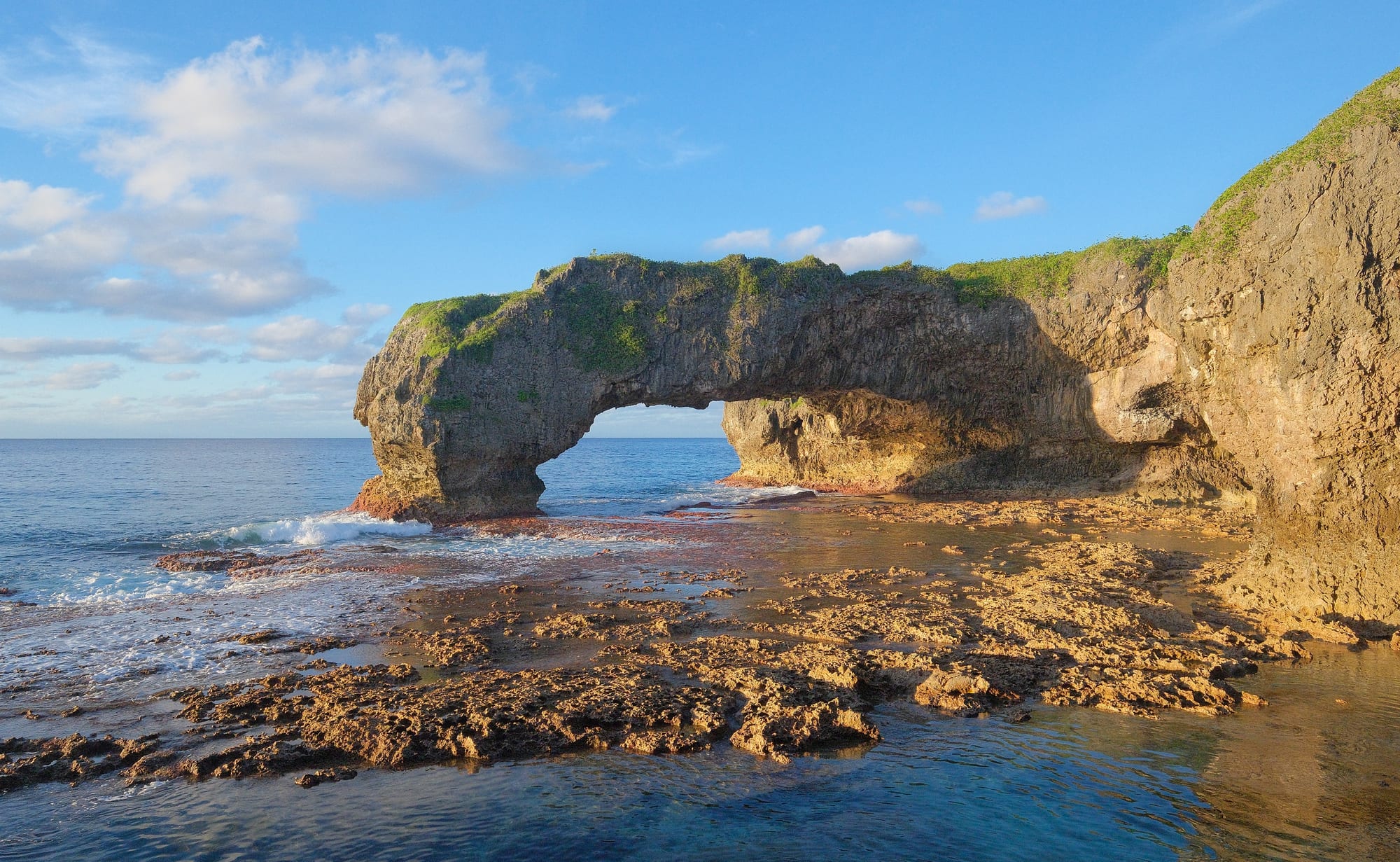
A jagged shelf of dark coral rock reaching toward a natural stone arch above a calm sea, warm light low on the horizon

Niue

The reef flat leading to the Talava Arches on Niue's north coast, reached by a trail through the raised-coral cliffs. (vuorikari / Wikimedia Commons · CC BY-SA 2.0)

One of the world's smallest self-governing states — a single raised coral island in the South Pacific, in free association with New Zealand, with fewer than 2,000 residents and vastly more Niueans living abroad, ringed by limestone chasms, caves, and some of the clearest water on Earth.

Explore Niue

History

Niue was settled more than a thousand years ago by Polynesian voyagers from Samoa, with later arrivals from Tonga, and developed as a single island society with a patu-iki (paramount chief) at times and warring districts at others. Captain Cook tried to land in 1774 and was driven off, and named it "Savage Island". Christianity took hold from 1846, when Nukai Peniamina, a Niuean trained at the London Missionary Society's college in Samoa, came home as a pastor; the church has been central ever since.

Niue became a British protectorate in 1900 and was annexed to New Zealand in 1901, under the same order as the Cook Islands. In 1974 Niueans voted for self-government in free association with New Zealand: Niue runs its own internal and external affairs, but its people are New Zealand citizens, New Zealand provides defence and much of the budget and has a standing duty to assist, and New Zealand law applies where Niue has not made its own.

The island's defining challenge is depopulation. From several times its present size in the 1960s the resident population has fallen below 2,000 — 1,689 at the 2022 census — while tens of thousands of Niueans and their descendants live in New Zealand, chiefly in Auckland. Cyclone Heta in January 2004 flattened much of the capital, Alofi, destroyed the hospital, and spurred more emigration, though the island was rebuilt with New Zealand aid. Niue is not a UN member but is treated as a state by many countries, and recognition has widened: the United States announced in 2022 that it would recognise Niue as a sovereign state, and Germany did so formally in January 2026.

  • Niue: The Rock of Polynesia — One of the world's largest raised coral atolls and one of its smallest self-governing states — a Polynesian society that kept missionaries and traders at bay for decades, then chose free association with New Zealand and a life shaped by emigration

Culture & Customs

Niuean life is village-based, church-centred, and organised around the extended family and land, which is held under customary title and rarely sold. The Ekalesia Niue (a Congregational church) dominates religious life, Sunday is for worship and rest, and — in principle — fishing, swimming, and noisy activity are avoided that day.

Key ceremonies mark the life cycle: the hifiulu, a boy's first haircut, and the huki teliga, a girl's ear-piercing, are large family gatherings involving the giving of money and goods, as are weddings and funerals. Annual village "show days" display crops, crafts, weaving, and food in friendly competition between the island's fourteen villages.

Uga, the coconut crab, is both a prized delicacy and a conservation concern, and Niueans have taken a strong collective approach to protecting their environment — in 2020 Niue became the first whole country certified as an International Dark Sky Sanctuary, and in 2022 it declared its entire exclusive economic zone a marine park.

  • Niue: A Lock of Hair and a Gift Returned — A boy's first haircut and a girl's ear-piercing celebrated with cash, quilts and feasts, a Sunday kept for church and rest, and a small island whose customs are sustained as much in New Zealand as at home

Daily Life

Fewer than 2,000 people live on Niue, spread among fourteen small villages around the ring road, with the largest cluster at and around Alofi, the capital. The population is elderly on average, and the government offers housing and other incentives to attract residents and returnees, with limited success against the pull of New Zealand.

The economy runs on New Zealand budget support and aid, which fund most of government, plus a small tourism sector tied to the flight schedule, remittances, fishing licences, and niche exports — vanilla, noni, taro, and honey. Revenue also comes from issuing collectible legal-tender coins through a New Zealand mint. Niue's ".nu" internet domain, most of it registered to users in Sweden, has been run by the Internet Foundation in Sweden since 2013; the government's court case there to win back control of it was finally dismissed in 2025.

Daily life is quiet and close-knit: everyone knows everyone, there are no traffic lights or public transport, and the rhythm follows the plantation, the reef, the church, and the arrival of the plane.

  • Niue: A Four-Day Week for Fourteen Villages — A resident population under two thousand, spread across fourteen villages on customary land that is rarely sold, where the government working week ends on Thursday and Sunday is still kept as a day of near-total rest

Food

Niuean cooking is Polynesian and coconut-rich. The signature dish is takihi — alternating layers of taro and pawpaw baked in coconut cream. Taro, yam, kumara, green banana, and breadfruit are the starches, eaten with taro leaves cooked in coconut cream, reef and deep-water fish, and — on special occasions — the coconut crab, uga.

An umu (earth oven) is fired for feasts and Sundays, and salted beef, corned beef, and other tinned meats fill out an everyday diet that leans heavily on imported New Zealand groceries. Pawpaw, bananas, passionfruit, and limes are the fresh produce, and Niue honey is a point of pride.

There is only a small handful of eateries, mostly in Alofi, plus the Friday morning market; most visitors self-cater. Beer and drinks are imported; fresh coconut is everywhere.

  • Niue: Food and the National Dish — A prized coconut crab hunted in the forest, on a raised coral island with no lagoon and a food culture rooted in taro, coconut and the reef

Attractions & Natural Wonders

Niue has no rivers and almost no beaches; instead, short "sea tracks" lead from the ring road down through the jagged makatea (raised coral) to an extraordinary coast. The Talava Arches, on the north coast and reached by a trail, frame the sea with natural stone spans. Matapa Chasm is a sheltered cleft of calm water between high walls, and the Limu Pools are a set of clear, interlinked rock pools good for snorkelling.

Avaiki Cave, on the west coast, is a tidal grotto reached by steps from the ring road, other coastal caverns are hung with stalactites, and Togo Chasm is the most dramatic of all — a hidden pocket of sand and coconut palms at the foot of a pit amid a lunar field of black coral pinnacles, reached by a long boardwalk and a ladder.

The surrounding water is famous for its clarity, because the island has no rivers and so no runoff to cloud it. Divers and snorkellers see sheer drop -offs, sea caves, and the katuali, a venomous sea snake found only in Niue's waters, and from about July to October humpback whales come close inshore, watched from small boats. Inland, the Huvalu Forest Conservation Area protects the island's largest remaining tract of rainforest.

  • Niue: Five Attractions and Natural Wonders — Known as the Rock of Polynesia — a raised coral island with no rivers or lagoons, its coast riddled with limestone sea caves and chasms of impossibly clear water

Planning basics

Budget

Niue is moderately expensive because almost everything is imported and the island is reached by a couple of flights a week. Accommodation is a handful of guesthouses, self-catering units, and one resort; a hire car is essential; and the main "costs" beyond that are fuel, food, and the odd guided trip.

Daily Budget Midrange
NZD 280–500 / USD 170–300 (resort or better unit, restaurant meals, hire car, a whale trip or guided cave trip)
Daily Budget Shoestring
NZD 120–200 / USD 75–125 (guesthouse or self-catering unit, supermarket and market food, small hire car)

Book accommodation and a hire car well before you fly, since both are limited, and self-cater from the Alofi supermarket and the Friday-morning market.

Visa Requirements

Niue is self-governing in free association with New Zealand, and Niueans are New Zealand citizens. Visitors of most nationalities do not need a visa for a short stay; a valid passport, an onward ticket, and confirmed accommodation are required. Entry is almost entirely via the flight from Auckland.

Typical Stay
A short visa-free stay for most visitors; check with Niue Immigration before booking

Have accommodation booked and an onward ticket ready — both are checked — and note that the whole trip is shaped by the Auckland flight schedule.

Safety

Niue is one of the safest places to travel, with almost no crime and a strong community. The hazards are all natural: sharp, uneven coral rock on the coastal tracks, big ocean swell and surge at the arches and blowholes, slippery cave descents, sun, and the isolation — the small hospital handles basics only, and serious cases are flown to New Zealand.

Health
Dengue can occur; tap water (rainwater-fed) is generally safe; reef stonefish, sea urchins, and the katuali, a venomous sea snake found only in Niue's waters, is present; the main risks are falls on coral and rough water

Wear reef shoes on the sea tracks, check conditions before entering chasms and pools, don't swim near the arches or blowholes in swell, and carry insurance covering evacuation to New Zealand.

Climate

Tropical, warm and humid, around 24–30°C. A wetter, hotter season with cyclone risk runs November to April; May to October is drier, a little cooler, and the main travel season. Cyclone Heta devastated the island in January 2004.

Dry Season
May–October
Wet Season
November–April (cyclone risk)

Transportation

Niue International Airport at Alofi receives about two flights a week from Auckland on Air New Zealand, the only airline serving the island — the schedule largely determines when and how long you can visit. There is no public transport; a hire car (or scooter or bike) is essential, and the island has one sealed ring road with unsealed "sea tracks" branching to the coast.

Reserve a hire car at the same time as your flight; drive carefully on the ring road (pigs, dogs, and free-roaming livestock are common) and wave at oncoming vehicles, as everyone does.

Best Time to Visit

May to October, the drier season, has the best weather and sea conditions for the chasms, caves, and reef pools. Humpback whales are present from about July to October and come close to the shore, and local operators run trips out to them. Avoid the January–March cyclone peak.

Events
Constitution Day (19 October); the annual village 'show days'; the Friday-morning Alofi market

Currency

The currency is the New Zealand dollar. Card acceptance is limited outside the main resort and a few businesses, so bring enough cash; ATMs are few and can be unreliable.

Symbol
$
Currency Code
NZD — New Zealand dollar

Language

Niuean (Vagahau Niue), a Polynesian language closely related to Tongan, is the everyday language and, with English, official. English is spoken by virtually everyone, and many residents have spent time in New Zealand.

Official Languages
Niuean and English