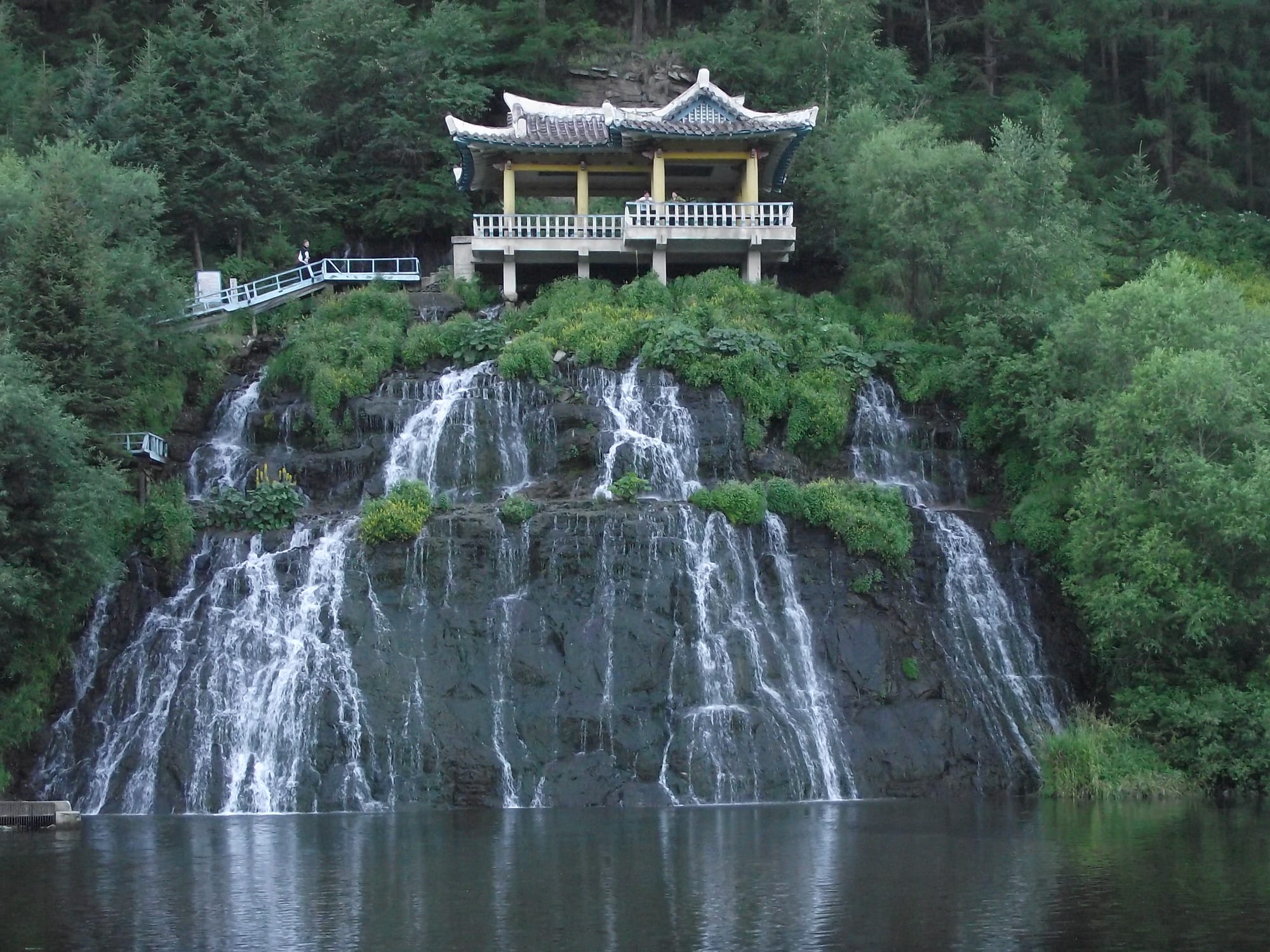
Curtains of water spreading down a mossy rock face into a dark pool, with a tiled Korean pavilion on the wooded slope above

The North, North Korea

Samjiyon

Rimyongsu Falls, on the Paektu plateau in Samjiyon county. (Mark Fahey from Sydney, Australia / Wikimedia Commons · CC BY 2.0)

A high plateau town in Ryanggang province, in the far north of North Korea, laid out among larch forest and potato fields below Mount Paektu. It serves as the base for visits to the mountain and its crater lake, and to the guerrilla sites central to the state's founding story, and was rebuilt as a model settlement at the end of the 2010s. This page is written to explain the city, not to encourage travel.

Neighbourhoods

  • The rebuilt town centre
    • First-time visitors
    • Architecture

    Ranks of new low-rise flats, a cultural hall, a school and a hotel laid out around wide streets and open squares, finished at the end of the 2010s as a showcase settlement. It is the part of the town shown to every visiting group.

    Open in Maps
  • The monument area
    • Monuments
    • Historic district

    The ceremonial quarter around the grand monument to the anti-Japanese guerrilla campaign, with statues, a museum and open ground used for group visits and ceremonies, set against the forest and the distant cone of Paektu.

    Open in Maps
  • The plateau villages
    • Local life
    • Quiet and residential

    Rows of single-storey houses among potato fields and larch woods outside the town, where most of the county's farming and forestry families live. Winters here are long and the settlements are widely spaced.

    Open in Maps

Things to do

Mount Paektu

  • Paektu Mountainlandmark

    The volcano on the Chinese border, at about 2,750 metres the highest peak in Korea, sacred in Korean tradition and central to the North Korean state's account of itself.

    Open in Maps
  • Heaven Lakeattraction

    The deep crater lake filling the summit caldera, shared with China and frozen for much of the year; a road and funicular climb towards the rim on the Korean side.

    Open in Maps
  • The Paektu plateau forestsviewpoint

    Larch and birch forest, volcanic ash soils and open moorland spread for tens of kilometres around the mountain, with the high ground snowbound from autumn to late spring.

    Open in Maps

In and around the town

  • Samjiyon Grand Monumentlandmark

    A monument complex completed in 1979 beside Lake Samji, built around a 15-metre statue of Kim Il-sung with sculpture groups and a square for rallies, commemorating the anti-Japanese guerrilla campaign of the 1930s.

    Open in Maps
  • Lake Samjiattraction

    The group of shallow lakes that give the town its name — 'three lakes' — set among birch and larch woods on the edge of the settlement.

    Open in Maps
  • Samjiyon Airporttransit hub

    The plateau airfield served only by flights from Pyongyang's Sunan airport on the state airline, the usual way visitors have reached the far north.

    Open in Maps

The plateau

  • Rimyongsu Fallsattraction

    Water emerging straight from the porous volcanic rock and falling in sheets into a pool below a hillside pavilion, about twenty kilometres from the town and fed by springs rather than a surface stream.

    Open in Maps
  • The secret camp sitelandmark

    A log cabin and barracks in the forest below Paektu presented by the state as Kim Jong-il's birthplace, although records outside North Korea place his birth in the Soviet Far East; it is a standard stop on visits to the mountain.

    Open in Maps
  • The potato countryviewpoint

    Wide fields of potatoes on the volcanic plateau, promoted since the late 1990s as the answer to the region's inability to grow rice, with the county of Taehongdan to the north the best known of them.

    Open in Maps

Seasonal events

  • Day of the Shining StarFebruary

    The 16 February anniversary of Kim Jong-il's birth, marked especially strongly here because of the claimed birthplace on the mountain, with pilgrimages made in deep snow; since 2024 state media have mostly called it simply the February holiday.

  • Day of the SunApril

    The 15 April anniversary of Kim Il-sung's birth, marked with flower-laying at the grand monument and organised visits by school and work groups; since 2024 state media have mostly called it simply the April holiday.

  • The Paektu climbing seasonJune to September

    The months when snow clears from the summit road and the crater lake thaws, and the only realistic window for reaching the rim.

Eat and drink

Long-standing places and food districts in Samjiyon. Hours, ratings and directions come from your maps app, always current.

Plateau food

  • Tour and hotel restaurantsrestaurant

    Meals are arranged by the tour at the town's hotel and a small number of state restaurants rather than chosen, and potato dishes feature heavily on the menus here.

    Open in Maps
  • Potato dishes of Ryanggangrestaurant

    The plateau's staple appears boiled, in noodles, in dumplings and as kamja-tteok, chewy cakes made from ground potato starch, in the province whose Taehongdan county leads the country in potato production.

    Open in Maps
  • Wild mountain foodsmarket

    Mushrooms, bracken, wild greens and berries gathered in the surrounding forests are a real part of the local diet and of the region's trade.

    Open in Maps

Experience Samjiyon

History

The plateau around Mount Paektu lay at the edge of Korean settlement for most of recorded history: high, cold, forested country held at different times by Koguryo, by the kingdom of Balhae and by Jurchen tribes, before the early Joseon kings pushed the frontier north to the Yalu and Tumen and planted garrisons along it. The mountain itself erupted catastrophically around the year 946, one of the largest eruptions of the last few thousand years, scattering ash as far as Japan and leaving the caldera that now holds the crater lake.

Modern Samjiyon grew from a scattering of forest and farming hamlets by the three small lakes that give the place its name. The forests around it were the ground of the anti-Japanese guerrilla campaigns of the 1930s, and the state's official history places Kim Il-sung's operations here, including the 1937 raid on nearby Pochonbo; a secret camp on the slopes of Paektu is presented as Kim Jong-il's birthplace, although records outside North Korea place his birth in the Soviet Far East. From the 1970s onwards monuments, museums and a grand statue were raised around the town to mark those claims, and school and work groups were sent on pilgrimages to them.

From the late 2010s the town was rebuilt on a large scale, with new housing, a hotel, a cultural hall, a ski slope and public buildings; Kim Jong-un opened the completed expansion in December 2019, and in the same month the status of Samjiyon was raised from county to city. The work was carried out with mobilised labour and presented as a model for the reconstruction of provincial towns. What has emerged is a small, orderly settlement whose purpose is at once political, agricultural and, when tours run, touristic.

Culture & Customs

Nothing here is separable from the mountain. Paektu appears on the state emblem and in the national anthem, the ruling family is described as the "Paektu bloodline", and organised pilgrimages bring students, soldiers and workers to the guerrilla sites around the town, often deliberately in deep winter to demonstrate endurance. Visitors are expected to treat the monuments and the mountain with the same formality shown in Pyongyang.

Beneath that, this is a Ryanggang highland community with its own character: a frontier region of foresters, potato farmers and border villages, speaking the north-eastern dialect, where houses are built against very long winters and wild foods gathered in the forest are a serious part of the household economy. Korean seasonal customs survive in domestic form, with graves visited at the lunar new year and at Chuseok.

The border is close, and the whole of the far north is the least sealed part of the country, with Chinese goods, phone signals and smuggled media reaching the Yalu towns first and heavy penalties attached to all of it. The UN Commission of Inquiry of 2014 documented systematic human-rights abuses across the country, and songbun, the ranking of families by political background, governs who may live in a place of this symbolic importance.

Daily Life

The city's population runs to the tens of thousands, spread between the rebuilt town and villages scattered across the plateau; this is one of the most thinly settled parts of Korea. New flats, a school, a hospital and a hotel give the centre a finished, uniform look that contrasts sharply with the older settlements in the woods around it.

Work is farming, forestry and services. Potatoes are the plateau's crop, grown at altitudes where rice will not ripen, and the state has promoted them heavily since the famine years of the 1990s; timber from the larch forests, blueberries and other wild harvests, and the processing plants built alongside the new town make up much of the rest. Tourism, both domestic pilgrimage and the foreign tours that have run in some years, is part of the town's declared purpose.

Life is shaped by the cold. Heating through a winter of five months or more depends on wood and coal, the growing season is short, roads can be blocked by snow, and supplies come a long way. Electricity is uneven outside priority buildings. The border closure of 2020 cut the cross-border trade that had helped sustain households across the far north, and the region's remoteness makes shortages harder to cushion than in the capital.

Food

Ryanggang is potato country, and Samjiyon eats accordingly. Potatoes are boiled and eaten plain, mashed into dough for dumplings, pressed into chewy noodles, and made into kamja-tteok, cakes of ground potato starch that are a speciality of the northern highlands. Maize and millet were long the staples of the northern countryside, with rice a luxury brought up from the plains, and that pattern has only partly changed.

The forest supplies the rest. Mushrooms, bracken, wild garlic and mountain greens are gathered and dried, blueberries and other berries are picked on the plateau in late summer, and pine nuts and honey come from the same woods. Freshwater fish from the lakes and streams appear on local tables, and meat is scarce enough to be an occasion rather than a habit.

Kimchi is essential to surviving the winter, made in bulk at kimjang in autumn from cabbage and radish with chilli, garlic and salt; in a province this cold the pots are buried and keep well into spring. Soups of soybean paste, potato and greens are everyday food. Soju and other grain spirits are drunk, often flavoured with local berries or roots, and hot maize or barley tea is served against the cold.

Planning tools

Budget

There is no independent budget for Samjiyon. When tourism has operated, the town has been reached only on specialist tours from Pyongyang, usually involving a charter flight, and these have cost more per day than capital tours because of the flight and the small group sizes. Everything is paid in advance to a state-approved agency.

Daily Budget Midrange
USD 230–460 (a specialist tour, when tours run: charter flight, hotel, meals, guides and transport)
Daily Budget Shoestring
USD 230–460 (no cheaper option exists — independent travel is not permitted, so the tour price is the floor)

Tourist access has been almost entirely suspended since the border closed in 2020; if a tour ever runs, carry euros or Chinese yuan in small notes and warm clothing in any season.

Best Time to Visit

June to September is realistically the only window for the mountain, when snow has cleared from the summit road and the crater lake has thawed. Even then the summit is often cloud-bound and windy. Winter here is long, deep and severe, though it is the season of the political pilgrimages that fill the town.

Suggested Number of Days

Visits have normally run to a night or two, enough for the mountain and the sites around the town, with the weather rather than the visitor deciding how much is seen. The programme is fixed by the operator and cannot be changed once under way.

First Visit
1–2 days
With Surroundings
2–3 days

Transportation

Movement is by chartered bus or car with guides on approved roads. The plateau is remote: roads are poor and long, a railway reaches the region slowly from the coast, and the practical link to Pyongyang has been a charter flight to the local airfield. Residents need permits to travel, and this is a guarded border area.

No independent movement is allowed, and the border zone along the Yalu and the approaches to the mountain are closely policed.

Airport & Station Connections

Samjiyon lies on the plateau roughly 380 km north-east of Pyongyang. Tours have used charter flights to the airfield beside the town, a little over an hour from the capital, because the overland journey takes days over difficult roads. From the town, the summit of Paektu is about 40 km by road. Access depends entirely on an approved tour arranged in advance.

Walkability

The rebuilt town is small, flat and easily crossed on foot, but visitors walk only where and when guides allow, and everything of interest — the mountain, the falls, the camp sites — is a drive away. At well over a thousand metres the air is thin and cold, and snow lies on the ground for much of the year.

Safety

The risks are political and environmental rather than criminal. This is a heavily policed border region where photographing the border, soldiers, military sites or anything that reads as poverty can lead to arrest, and Paektu is treated as a sacred site of the state, so any perceived disrespect there is taken seriously. Medical care is minimal and evacuation slow; cold, altitude and sudden weather on the mountain are real hazards.

Most governments advise against all travel to North Korea and the US bans its citizens from going without special permission. Dress for severe cold even in summer on the summit, and follow the guides' instructions on photography and conduct exactly. Check current official travel advice before travelling.

Climate

The coldest inhabited part of the Korean peninsula. The plateau sits high enough that summers are short and cool and winters are long, snowbound and severe, with far more snow than the lowlands and strong wind on the open ground.

Summer
short and mild — usually 15–22°C in the town, considerably colder and often cloud-bound on the summit
Winter
severe — regularly below −20°C with heavy snow lying for months

Local Customs

Conduct at the monuments is formal, and more so here than elsewhere because of the mountain's place in the state's account of its origins: groups bow where asked, flowers are laid, and images of the leaders are never cropped, folded or creased. Neat dress is expected. Korean courtesies — two-handed giving and receiving, shoes off indoors, deference to age — apply as everywhere in the country.

Ask the guides before taking any photograph, do not photograph soldiers, the border or military sites, and treat Paektu and the guerrilla sites with the seriousness locals give them.

Common Payment Methods

The North Korean won is not available to visitors, who pay in euros, Chinese yuan or US dollars in cash at the handful of counters open to foreigners. Foreign cards do not work, there are no international ATMs, and there is very little to buy outside the hotel, so only small amounts of cash are needed.