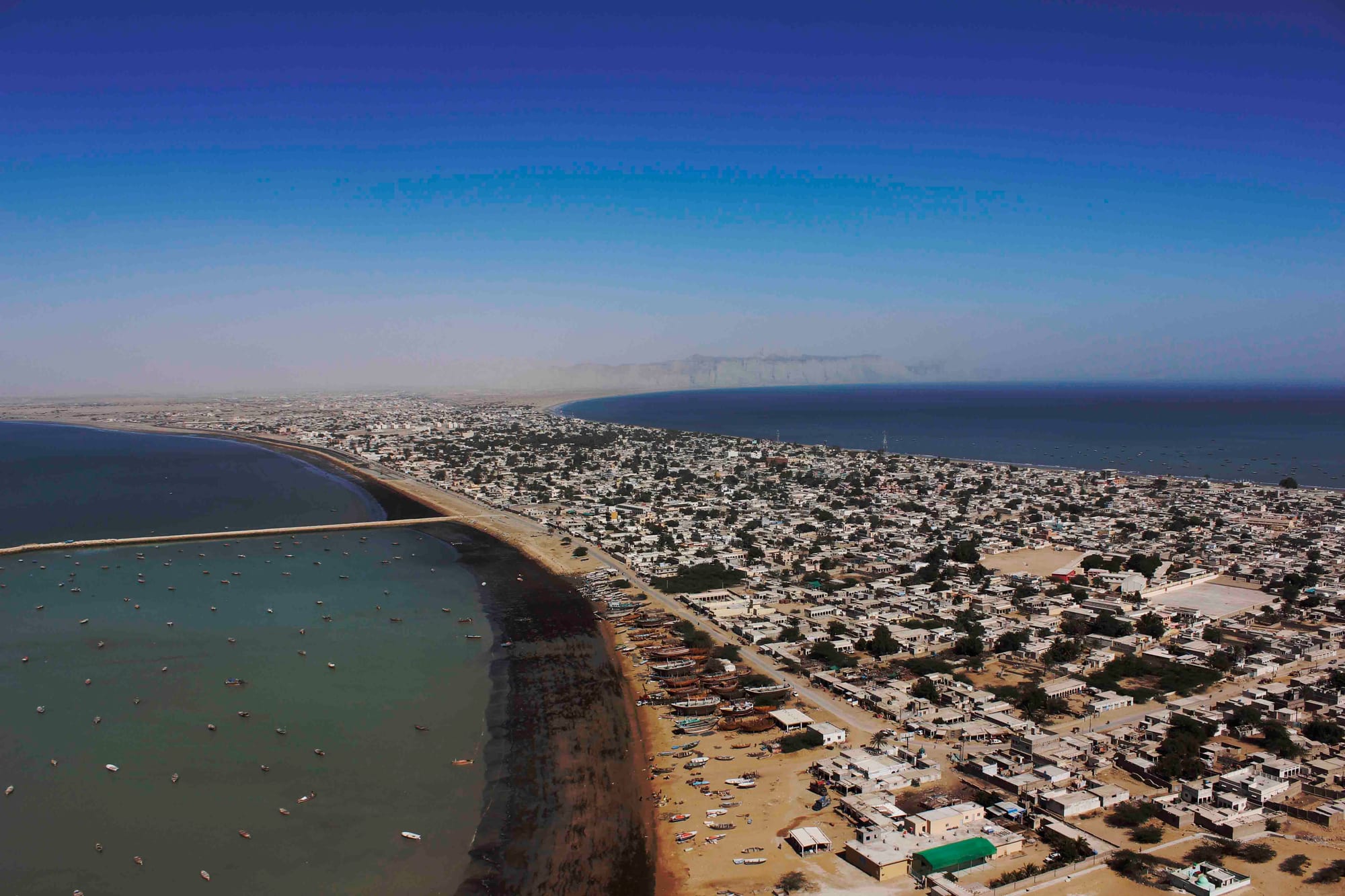
Aerial view of a low town filling a sandy isthmus with calm sea and moored fishing boats on both sides

Balochistan, Pakistan

Gwadar

Gwadar spread across the isthmus between its two bays, with the Makran coast beyond. (Shayhaq Baloch / Wikimedia Commons · CC BY-SA 4.0)

A fishing port on the Makran coast of Balochistan, built on a sandy isthmus that runs out to the flat-topped headland of Koh-e-Batil, with a long crescent bay on either side. Held by Oman until Pakistan bought it in 1958, it has since been remade around a deep-water port developed with Chinese investment. This page is written to explain the town, not to encourage travel.

Neighbourhoods

  • The old town and fish harbour
    • First-time visitors
    • Local life
    • Waterfront

    The original settlement on the isthmus, a dense grid of low houses, mosques and small shops running down to the west bay, where wooden fishing boats are drawn up and unloaded. The bazaar streets here are the busiest part of Gwadar and its working heart.

    Open in Maps
  • The new town and Marine Drive
    • Quiet and residential
    • Waterfront

    The planned districts spreading north and east from the isthmus along the east bay, laid out in wide blocks with government buildings, hotels and housing schemes, and a seafront road along the sand. Much of the ground here is still empty or under construction.

    Open in Maps
  • The port and free zone area
    • Industry
    • Close to transport

    The deep-water port and its adjoining free zone occupy the eastern shore beneath the headland. Access is restricted and the area is heavily secured, but it dominates the town's economy and the shape of its recent growth.

    Open in Maps

Things to do

Landmarks

  • Gwadar Portlandmark

    The deep-water port on the east bay, developed with Chinese investment as the maritime end of the China–Pakistan Economic Corridor.

    Open in Maps
  • New Gwadar International Airporttransit hub

    Built with Chinese funding on the plain north-east of the town as part of the port scheme, the largest airport in Pakistan by area; it took over from the old Gwadar airport in January 2025.

    Open in Maps

Beaches and the shore

  • Gwadar West Baybeach

    The wide crescent of sand on the western side of the isthmus, where the fishing fleet moors and the sun sets over the water.

    Open in Maps

Along the Makran coast

  • Jiwaniattraction

    A small port and airstrip town west of Gwadar near the Iranian border, with turtle-nesting beaches and the remains of wartime installations.

    Open in Maps
  • Pishukanattraction

    A fishing town on the western shore of Gwadar's west bay, whose economy has rested on the sea since at least the early 20th century.

    Open in Maps

Seasonal events

  • Fishing seasonroughly September to May

    The months when the fleet works hardest and the harbour and fish market are at their busiest, before the summer monsoon winds close much of the season.

  • Date harvestJune to August

    The weeks when the Makran date palms are picked and dates are dried and packed, a mainstay of the district's farming economy.

  • Baloch Culture Day2 March

    A day marked across Balochistan with Baloch dress, embroidery, music and dancing.

Eat and drink

Long-standing places and food districts in Gwadar. Hours, ratings and directions come from your maps app, always current.

Gwadar classics

  • Fish grills by the harbourrestaurant

    Fish from the day's catch, grilled whole or fried and eaten with flatbread, is the local staple, cooked at small places near the fish harbour and along the seafront.

    Open in Maps
  • Sajji and roast-meat housesrestaurant

    The Balochi tradition of salted lamb or chicken roasted slowly beside an open fire, served with rice or with kaak bread.

    Open in Maps

Markets

  • Gwadar fish marketmarket

    Where the boats land their catch and traders buy kingfish, mackerel, prawns, crab and lobster for the town and for shipment inland.

    Open in Maps
  • The old town bazaarmarket

    Streets of small shops selling dates, dried fish, cloth, Baloch embroidery and household goods.

    Open in Maps

Experience Gwadar

History

Gwadar's position on the Makran coast put it on an ancient sea route between Mesopotamia, Persia and the Indus. Alexander the Great's admiral Nearchus sailed this shore in the 4th century BC while the army marched back through the Gedrosian desert, and Arab fleets passed along it on the way to Sindh. For most of its recorded history it was a small fishing settlement living off the sea and the date palms behind the coast, changing hands between Persian, Portuguese and local powers.

In the late 18th century the ruler of Kalat granted Gwadar to a prince of Muscat, and the town remained an Omani possession, administered from across the Gulf of Oman, for close to two centuries. Oman built a fort and collected customs, and dhows carried dates, dried fish and passengers between the Makran and the Arabian peninsula — a link still visible in family ties between Gwadar and Muscat. Oman handed the enclave over to Pakistan on 8 September 1958, after a contribution of about three million US dollars from Prince Karim Aga Khan IV, and it was merged into Balochistan.

Plans to turn the natural harbour into a major port were discussed for decades before construction of a deep-water port began in 2002 with Chinese assistance. The first phase was inaugurated in 2007, the port became formally operational in 2016, and it is run by a Chinese state company as the maritime terminal of the China–Pakistan Economic Corridor. The scheme brought a free zone, a new airport, roads and a great deal of land speculation, but much less local employment than promised, and Gwadar has since seen large protests over water, electricity and the rights of its fishermen.

Culture & Customs

Gwadar is a Baloch town whose culture faces the sea and the Gulf as much as it does the interior of Pakistan. Balochi is the language of the streets; many families have relatives in Oman and the United Arab Emirates, and returning migrants have shaped the town's houses, tastes and money for generations. The Omani centuries left mosques, wind-catching house design and a shared repertoire of music along both sides of the water.

Baloch custom stresses hospitality, the protection of guests and loyalty to family and tribe, and disputes are often settled by elders. Dress is distinctive: men in very loose shalwar and long shirts, often with a turban, and women in long dresses with dense mirrored embroidery across the front pocket and cuffs, a craft that is also made for sale. Music is carried by the suroz, a bowed string instrument, and by the benju, a keyed zither that is one of the characteristic sounds of Balochi music; sung epics of tribal heroes and Sufi poetry are the traditional repertoire.

Religious life is Muslim and largely Sunni, with Sufi shrines respected along the coast, and Zikri communities present in the Makran. Fishing gives the town its calendar and much of its vocabulary, and boatbuilding by hand continues in nearby villages. Political feeling runs strong: the town's public life is dominated by argument over who benefits from the port, and local movements over fishing rights and water have drawn very large crowds.

Daily Life

The 2023 census counted about 71,000 people in Gwadar, fewer than the 90,000 recorded in 2017 and far short of the projections that accompanied the port. Fishing remains the base of daily life: boats work the Arabian Sea for kingfish, mackerel, tuna, prawns, crab and lobster, and the catch is sold at the harbour, dried on racks or trucked inland. Dates from the palm groves of the Makran, small trade with Iran across the border, government employment and remittances from the Gulf make up most of the rest.

Water is the constant preoccupation. The district depends on small dams that fail in drought years and on tankered supply, and shortages are routine. Electricity has historically come across the border from Iran and is interrupted often. Schools and hospitals are stretched, and serious medical cases go to Karachi.

Two towns exist side by side: the crowded old settlement on the isthmus, where life runs between the mosque, the bazaar and the boats, and the wide, half-built new districts laid out for a future population that has not yet arrived. Land prices rose sharply with each announcement about the port and fell back again. Security dominates movement, with checkpoints on the approach roads and fenced zones around the port, and protests and shutdowns interrupt ordinary business several times a year.

Food

Gwadar eats fish. The day's catch — kingfish, mackerel, pomfret, tuna, prawns, crab and lobster — is grilled whole over coals, fried in a light batter or cooked in a thin tomato and chilli curry, and eaten with flatbread or rice. Dried and salted fish, hung on racks along the shore, has been a trade good on this coast for centuries and still flavours cooking inland. Fish biryani and rice cooked with prawns appear at family meals and celebrations.

The Balochi meat tradition is here too. Sajji, a whole lamb or chicken lightly salted, skewered and roasted slowly beside an open fire, is the dish of hospitality across the province, served with kaak, a thick bread baked around a hot stone. Meat and rice cooked together in a covered pit, a method known along the Makran, appears at weddings and large gatherings.

Dates are the other local product: the palm groves behind the coast supply fresh dates in summer and dried dates all year, eaten with tea and pressed into sweets. Gulf and Omani influence shows in the town's sweet, cardamom-scented tea, in halwa, and in the use of dried limes and strong spice mixtures in some fish dishes. Bread comes from tandoor ovens in the bazaar, and green tea is offered to every visitor and every customer.

Planning tools

Budget

Food and simple lodging in Gwadar cost little, but the security arrangements expected of foreign visitors — permission, an approved hotel and usually a hired vehicle with a driver or an escort — set the real cost of a visit. Hotel choice in the town is limited, and prices at the few larger hotels are high for what they are.

Daily Budget Midrange
USD 70–160 (approved hotel, private vehicle and driver, meals)
Daily Budget Shoestring
USD 20–40 (basic hotel, fish and bread, local transport) — though independent budget travel is not realistic for foreign visitors under current security rules

Arrange any visit in advance through the authorities and a reputable local operator, and carry cash, as cards are rarely accepted.

Best Time to Visit

November to March, when the coast is mild, dry and clear and the sea is calm. From May to September the Makran is hot and humid, with strong monsoon winds that keep boats in harbour. Security, rather than the season, generally decides whether a visit is possible.

Suggested Number of Days

The town and its two bays are small enough to see in a day or two. Three or four days allow the coast on either side, though every journey outside the town needs clearance and an escort, which lengthens the time needed.

First Visit
1–2 days
With Surroundings
3–4 days

Transportation

Gwadar is small, and taxis, rickshaws and shared vans cover the isthmus and the new town. The Makran Coastal Highway is the road link east to Karachi, six to seven hours' driving, and west towards Jiwani and the Iranian border. Movement outside the town by foreigners usually requires permission and a security escort.

Do not travel by road without the required permission and escort, and avoid all night travel.

Airport & Station Connections

New Gwadar International Airport, on the plain north-east of the town, replaced the old Gwadar airport in January 2025 and handles the domestic flights, chiefly from Karachi, by which most visitors arrive. By road, the Makran Coastal Highway runs 653 kilometres from Karachi through Ormara and Pasni, six to seven hours' driving that is subject to checkpoints and closures.

Walkability

The old town on the isthmus is compact and flat and can be walked in an hour, with the harbour and both bays close together. The new districts are spread out, with long empty blocks and little shade, so they are driven rather than walked. Heat and humidity make walking hard from late spring to early autumn, and foreign visitors are normally advised against walking about freely.

Safety

Governments advise against all travel to Balochistan. A separatist insurgency has escalated in recent years, with attacks on security forces, transport, workers from other provinces and Chinese nationals and projects linked to Gwadar itself. The town is heavily secured, with checkpoints, walls and restricted zones, and protests over water, electricity and fishing rights have brought long shutdowns. Kidnapping is a risk, and the Iranian border area is especially dangerous.

Governments advise against all travel to Balochistan. Travel only if essential, with official permission, a security escort and a trusted local contact, keep away from the port and any restricted area, and avoid the Iranian border entirely. Check current official travel advice before travelling.

Climate

Hot desert climate tempered by the sea. Summers are hot and humid with strong south-west winds; winters are mild and dry and are the pleasant season. Rainfall is very low and irregular, falling mostly in winter, and cyclones from the Arabian Sea occasionally brush the coast.

Summer
hot and humid, roughly 30–38°C by day, with high humidity and strong sea winds
Winter
mild and dry, roughly 12–26°C, with clear skies and calm seas

Local Customs

Gwadar is a Baloch town and a conservative one. Balochi is the everyday language, with Urdu used in offices and schools. Hospitality and the protection of guests are central to Baloch custom, and tribal ties matter in daily affairs. Men wear very loose shalwar with long shirts, and women's dresses carry dense mirrored embroidery on the front pocket and cuffs. Women are little seen in public spaces such as the bazaar.

Dress modestly, never photograph the port, checkpoints or security forces, ask before photographing anyone and do not photograph women, and remember that alcohol is prohibited.

Common Payment Methods

The currency is the Pakistani rupee, and the town runs on cash. There are banks and ATMs in Gwadar, but they can be out of service during network or power interruptions, and cards are taken only at the larger hotels. Nothing along the coast road should be assumed to take cards.