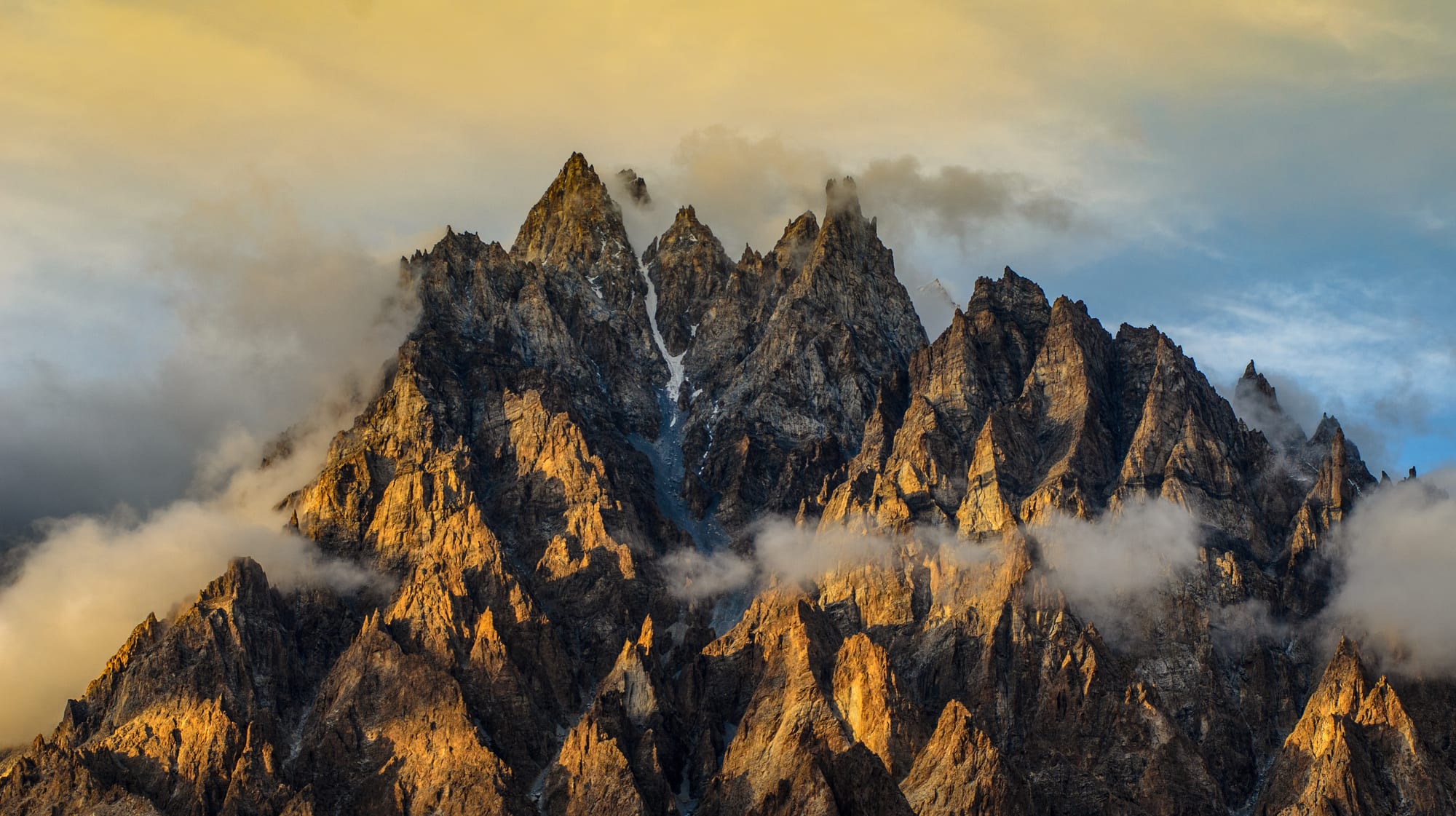
A row of steep, jagged snow-dusted granite spires rising above a broad grey river valley, with autumn trees in the foreground

Pakistan

The Passu Cones above the Hunza valley in Gilgit-Baltistan, where the Karakoram, Himalaya, and Hindu Kush ranges meet. (Shahbazaslam1 / Wikimedia Commons · CC BY-SA 4.0)

The fifth-most-populous country in the world — carved out of British India in 1947 as a Muslim homeland — running from the Arabian Sea up the Indus plains to the meeting point of the Karakoram, Himalaya, and Hindu Kush, and ruled in practice by a powerful army.

Explore Pakistan

History

The Indus Valley Civilisation, with planned cities such as Mohenjo-daro and Harappa, flourished here more than four thousand years ago, one of the world's first urban cultures. Later came the Buddhist Gandhara civilisation and its Greco-Buddhist art around Taxila, then a long succession of empires — Persian, Greek, Mauryan, Kushan — before Islam arrived, first with the Arab conquest of Sindh in 711 and then with the Ghaznavids, the Delhi Sultanate, and the Mughals, whose monuments crown Lahore. The British annexed Punjab from the Sikh Empire in 1849, completing their control of the region.

The Pakistan Movement — the Muslim League, Muhammad Ali Jinnah, and the demand for a separate Muslim homeland — culminated in the 1947 Partition of British India, which created Pakistan in two wings separated by the breadth of India and triggered one of history's largest and most violent mass migrations, with 12 to 20 million people displaced and death-toll estimates ranging from a few hundred thousand to two million. The eastern wing seceded in 1971, after a military crackdown and an Indian intervention, to become Bangladesh.

Since then, military coups and army rule have alternated with civilian governments that the military has repeatedly undermined. The anti-Soviet jihad of the 1980s left weapons and militancy behind; Pakistan tested nuclear weapons in 1998; and Benazir Bhutto, twice prime minister, was assassinated in 2007. After 2001, Pakistan was a US ally that also sheltered the Afghan Taliban leadership, and a domestic Taliban insurgency killed tens of thousands. More recently, the cricketer turned politician Imran Khan rose, widely believed to have had army backing, was ousted in 2022 and jailed, and army-managed politics and a grinding economic crisis have followed.

Relations with both large neighbours have since deteriorated. India suspended the Indus Waters Treaty in April 2025 and the two countries fought a short conflict that May, after which Pakistan closed its airspace to Indian aircraft and halted trade; on the western side, Pakistani airstrikes on militant camps in Afghanistan in February 2026 escalated into open fighting with the Taliban that has continued through 2026. In the war that began in February 2026 between the United States and Israel on one side and Iran and its allies on the other, Pakistan has acted as a mediator — US–Iran talks were held in Islamabad and the memorandum signed in June 2026 to end that fighting carries the city's name, though hostilities resumed in July — while also deploying troops and aircraft to Saudi Arabia under a mutual defence agreement signed in 2025.

  • Pakistan: The Land of the Indus — One of the world's oldest urban civilisations and one of its youngest large states — a country carved from British India in 1947 as a homeland for Muslims, split in two by the loss of Bangladesh, and shaped ever since by the contest between elected governments and the army

Culture & Customs

Pakistan is bound together by Islam and by Urdu, but it is a patchwork of strong regional cultures — Punjabi, Sindhi, Pashtun, Baloch, Muhajir, and the peoples of the north — each with its own language, dress, food, and music. Sufism runs deep: shrines of saints across the country draw huge crowds to urs festivals and to the ecstatic devotional singing of qawwali, carried to the world by Nusrat Fateh Ali Khan.

The shalwar kameez is near-universal national dress, and hospitality toward guests — especially in Pashtun and Baloch codes of honour — is a point of pride, as are family and clan ties. Poetry is a mass passion, from the national poet Iqbal to Faiz Ahmed Faiz and the mushaira recital.

Cricket is the national obsession, and the country produces world-class players. Trucks turned into rolling folk-art canvases of poetry and colour are a distinctive popular art, and a lively drama and music scene runs from the Lahore film industry to Coke Studio.

  • Pakistan: Honour, Tea and the Sufi Shrine — A deep-rooted sense of family honour, a hospitality that will not take no for an answer, and a Sufi devotional tradition whose music has carried far beyond the shrines where it began

Daily Life

Pakistan is young and rapidly urbanising. Karachi, the sprawling port megacity of Sindh, is the commercial hub; Lahore is the cultural heart of Punjab; and Islamabad is the planned capital beside the garrison city of Rawalpindi. Punjab holds around half the population and dominates politics, the army, and the economy; Sindh has Karachi and a feudal rural interior; Khyber Pakhtunkhwa borders Afghanistan; and vast, arid Balochistan is resource-rich, thinly peopled, and restive.

The economy lurches from one balance-of-payments crisis and IMF programme to the next, with energy shortages, very low tax collection, widespread poverty, and close to 23 million children out of school, offset by a large farming base, a big textiles export sector, IT growth, and remittances of more than 38 billion dollars in 2024–25 from a diaspora of around 10 million. Consumer price inflation, which spiked painfully after 2022, had fallen back to about 4.5 per cent by 2025.

Climate change bears down hard: record heat, the 2022 floods, which submerged huge tracts of the country and affected 33 million people, and the 2025 monsoon floods, which killed more than a thousand people and affected millions more in Khyber Pakhtunkhwa, Punjab and Sindh, are a warning of what a warming, water-stressed future holds.

  • Pakistan: A Week Bent Around Friday — Multigenerational households where the eldest still holds authority, a working week that pauses for Friday prayers, and a nation of well over two hundred million held together as much by family obligation as by anything else

Food

Pakistani cooking is rich, meat-forward, and heavily spiced, sharing much with north Indian Mughlai food but with its own regional traditions. Punjab and the cities give the best-known dishes: slow-cooked nihari eaten for breakfast, haleem, karahi fried with tomato and green chilli, and tandoori and seekh kebabs with biryani, daal, and hot naan.

Chapli kebab and slow-cooked lamb are Pashtun specialities; Sindhi food is fierier, with its own biryani and Indus palla fish; and Balochi sajji is a whole lamb or chicken roasted slowly by an open fire. Street food runs from gol gappay and dahi bhalla to samosas, pakoras, and bun kebab.

Sweets such as gulab jamun, jalebi, and ras malai, and drinks of lassi, sugarcane juice, and endless milky, cardamom-spiced chai complete the picture. In Hunza and Gilgit-Baltistan the food is plainer — apricots, mulberries, walnuts, buckwheat bread, and local dishes such as chapshuro.

Attractions & Natural Wonders

The mountainous north is the heartland of Pakistan's growing tourism. Gilgit- Baltistan holds the Hunza valley, with its stone villages, apricot blossom, and old forts above Attabad Lake; Skardu and the Baltoro glacier trek to K2 base camp and Concordia, the glacier junction used as a base for K2 and its neighbours; the meadows of Fairy Meadows below Nanga Parbat; the high plateau of Deosai; and the Khunjerab Pass on the Karakoram Highway at the Chinese border. Chitral and the isolated Kalash valleys shelter the small non-Muslim Kalasha people.

In Punjab, Lahore is the Mughal showpiece — the Fort and Badshahi Mosque, the Shalimar Gardens, the tiled Wazir Khan Mosque, and the theatrical flag ceremony at the Wagah border. Taxila's Buddhist ruins lie near Islamabad and its vast Faisal Mosque.

In Sindh, Mohenjo-daro speaks for the Indus Civilisation, and Thatta's Makli necropolis is a World Heritage Site, beside the tiled Shah Jahan Mosque; Sehwan Sharif draws huge crowds to the shrine of the Sufi saint Lal Shahbaz Qalandar. Multan, "the city of saints", is a dense cluster of Sufi tombs, and the Karakoram Highway itself is one of the world's great road journeys.

  • Pakistan: Eight Attractions and Natural Wonders — A red sandstone mosque built for 100,000 worshippers, a 4,500-year-old lost city on the Indus, alpine valleys ringed by some of the highest peaks on earth, and a plateau where brown bears roam an empty summer plain

Planning basics

Budget

Pakistan is inexpensive. Guesthouses, local restaurants (dhabas), buses, and trains cost little; the north has grown a range of hotels and guesthouses for the tourism boom, with prices rising in Hunza and Skardu in peak summer. Domestic flights to the mountains and 4x4 hire are the main costs.

Daily Budget Midrange
PKR 12,000–30,000 / USD 45–110 (comfortable hotel, restaurants, a hired car or 4x4 with driver, domestic flights)
Daily Budget Shoestring
PKR 3,000–6,000 / USD 10–22 (guesthouse, dhaba food, buses and trains)

In the northern mountains, book jeeps and popular guesthouses ahead in July and August, and carry cash — cards and ATMs are scarce beyond Gilgit and Skardu.

Visa Requirements

Most nationalities need a visa and apply for it online; citizens of a list of countries are visa-exempt for up to 90 days. The free "visa prior to arrival" scheme was suspended on 1 January 2026, so online applications now carry a fee and are expected to take about 7 to 10 working days. Access to some border and military areas is restricted, so check the rules for anywhere close to the Afghan or Indian frontier before setting out.

Typical Validity
Commonly up to 90 days; single or multiple entry depending on the visa

Apply through the official government visa portal well ahead of the trip, allow for processing time, and carry proof of onward travel and hotel bookings.

Safety

Security is serious and region-specific, and has worsened since 2021. Governments advise against all travel to Balochistan, to the districts of Khyber Pakhtunkhwa near the Afghan border, and to areas near the Line of Control in Kashmir, citing insurgency, terrorism, and cross-border shelling. Elevated caution applies elsewhere: attacks can strike mosques, markets, and transport in the cities; blasphemy accusations can trigger mob violence; and armed street robbery is common in Karachi. Fighting along the Afghan border has also escalated since 2025, with Pakistani airstrikes inside Afghanistan in February 2026 followed by open fighting with Taliban forces that has continued through 2026, with brief Eid ceasefires and a fresh flare-up in September; crossings such as Torkham have closed at short notice during clashes.

North
Gilgit-Baltistan and Hunza are far safer and see growing tourism, but mountain hazards, landslides on the Karakoram Highway, and altitude are real risks

Read your government's advisory in full, never discuss or appear to disrespect religion, dress locally, avoid political demonstrations, and accept any assigned security escort.

Climate

Highly varied. The Indus plains of Punjab and Sindh are hot and arid, with an erratic, flood-prone monsoon from July to September and some of the hottest temperatures on Earth in the south. Karachi is hot and humid. Balochistan is desert and dry mountains. The far north holds the Karakoram, Himalaya, and Hindu Kush, with deep snow, huge glaciers, and short, pleasant summers.

Plains
Summer 40–50°C; mild winters with fog and Lahore smog
Mountains
Alpine; trekking season roughly May–October

Transportation

Islamabad, Karachi, and Lahore have the main international airports. Domestic flights link the cities and, weather permitting, the mountain strips at Skardu, Gilgit, and Chitral. The British-era railway runs Karachi–Lahore–Rawalpindi–Peshawar, slow but cheap. Motorways are excellent between the big Punjab cities; the Karakoram Highway climbs the Indus and Hunza valleys to the Chinese border.

Take the motorway coaches (Daewoo, Faisal Movers) between cities, fly to the north if you can, and hire a 4x4 with a local driver for mountain roads.

Best Time to Visit

October to March for the plains, the cities, and the Mughal sites — avoiding the summer heat, the monsoon, and Lahore's worst smog (November–January). May to October for the northern mountains, with July to September the main trekking and climbing season; the Karakoram Highway can be blocked by landslides in the monsoon.

Events
Independence Day (14 August); the Basant kite festival in Lahore in spring, after Punjab lifted its long-standing kite-flying ban in February 2026; the Kalash festivals in Chitral; Eid celebrations

Currency

The currency is the Pakistani rupee (PKR), which has lost much of its value in recent years. It is largely a cash economy; ATMs work in cities and the main northern towns but often limit foreign-card withdrawals. Bring US dollars to change.

Symbol
₨ / Rs
Currency Code
PKR — Pakistani rupee

Language

Urdu is the national language and the country's lingua franca, though the first language of only a small minority; it is the language of education, media, and popular culture. English is co-official, used in the higher courts, government, and elite education, and widely understood in cities. Punjabi is the most spoken mother tongue, followed by Pashto, Sindhi, Saraiki, Urdu, and Balochi.

Co Official
English; plus Punjabi, Pashto, Sindhi and others regionally
National Language
Urdu