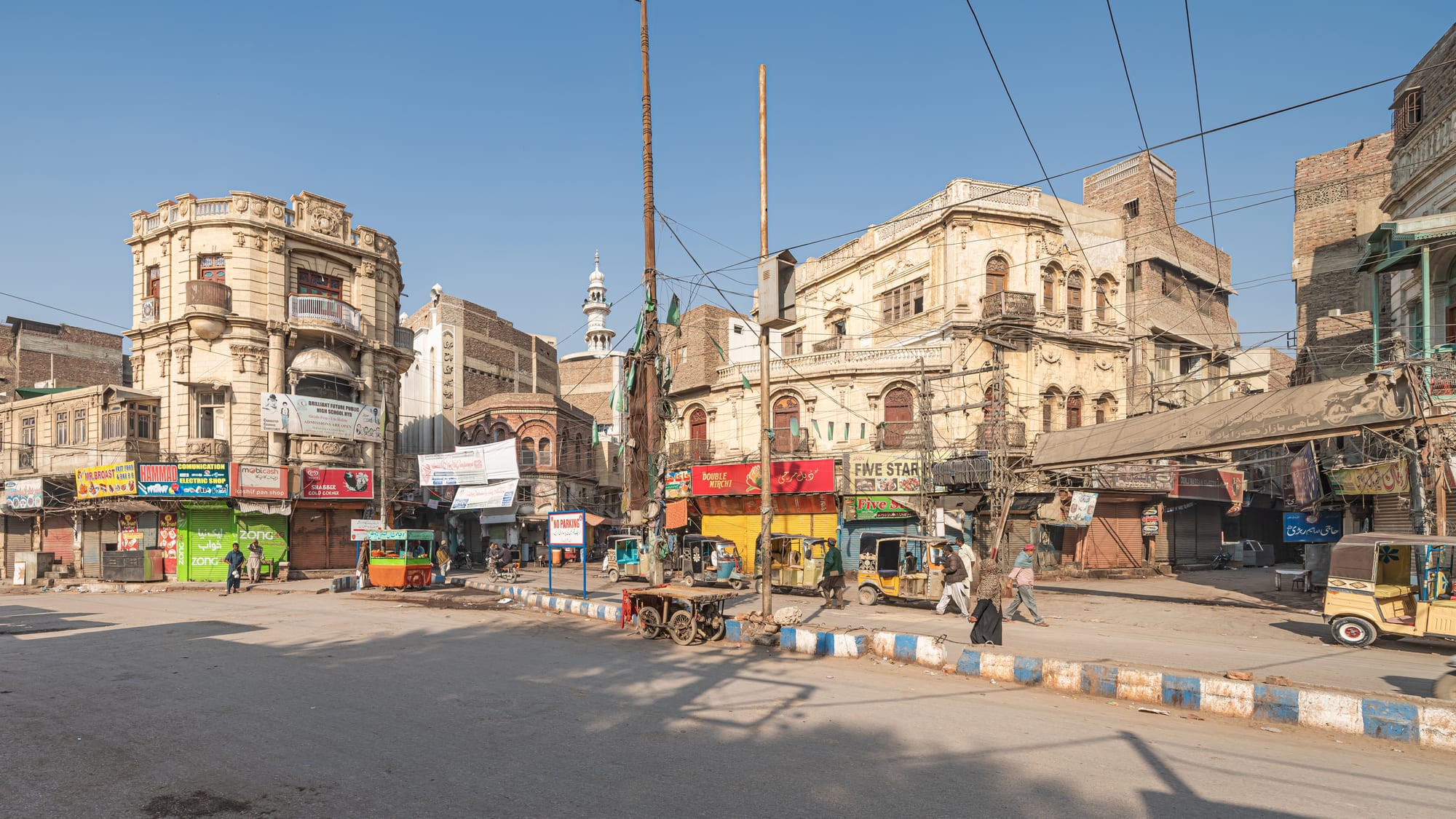
A wide city street with ornate pale stone colonial buildings, shopfronts, rickshaws and a minaret rising behind under a clear sky

Karachi & Sindh, Pakistan

Hyderabad

Colonial-era buildings and shopfronts on the road beside the old fort in Hyderabad, Sindh. (A.Savin / Wikimedia Commons · FAL)

Sindh's second city, built on a limestone ridge above the east bank of the Indus about 150 kilometres from the sea. Founded in 1768 and the capital of the Talpur Mirs until the British took the province in 1843, it keeps their tiled tombs, a great brick fort, one of the longest bazaars in Asia, rooftop wind catchers and a bangle industry that supplies the country.

Neighbourhoods

  • The old city and Pacco Qillo
    • Historic district
    • Markets
    • First-time visitors

    The original walled town on the ridge, around the mud-brick fort, where the bazaars run for kilometres in narrow covered lanes. Bangle workshops, cloth merchants and sweet shops trade among old timber-balconied houses, many of them topped by the wind catchers that give the skyline its shape.

    Open in Maps
  • Saddar and the cantonment
    • Colonial architecture
    • Restaurants
    • Close to public transport

    The district the British laid out south-west of the old town, with straight roads, churches, clubs and stone civic buildings. It holds most of the city's hotels, banks and larger restaurants and sits near the railway station.

    Open in Maps
  • Latifabad
    • Local life
    • Quiet and residential

    A large planned district south of the centre, laid out after Partition for Urdu-speaking migrants and named after the Sindhi poet Shah Abdul Latif. It is numbered by units rather than street names, with its own markets, schools and food streets.

    Open in Maps
  • Qasimabad
    • Local life
    • Quiet and residential

    The newer district spreading north-west towards the bypass, predominantly Sindhi-speaking and one of the fastest-growing parts of the city, with modern housing schemes and shopping streets.

    Open in Maps
  • Hirabad and the Tando quarters
    • Local life
    • Best for food

    Older residential quarters east and south of the centre, built up in the 20th century around markets and mosques. The streets are dense and busy, with tea stalls and small restaurants where much of the city actually eats.

    Open in Maps

Things to do

Famous landmarks

  • Pacco Qillolandmark

    The Kalhora fort of the 1760s on the ridge above the old city, a huge enclosure of fired brick whose walls and gateway still stand over a crowded quarter built inside them.

    Open in Maps
  • Tombs of the Talpur Mirslandmark

    Domed brick and stone tombs of the Talpur rulers of Sindh, who reigned from the 1780s to 1843, decorated with blue and white tilework and painted panels, with smaller mausoleums for their families around them.

    Open in Maps

Museums

  • Sindh Museummuseum

    The provincial museum, established in 1971 to collect and exhibit the cultural history of Sindh, from archaeological finds to crafts and everyday objects.

    Open in Maps
  • Institute of Sindhology Museummuseum

    At the University of Sindh campus in Jamshoro across the river, a research institute and museum devoted to Sindhi history, manuscripts, folklore and crafts.

    Open in Maps

Markets and crafts

  • Shahi Bazaarmarket

    A market street running from the fort through the old city to the Market Tower, one of the longest bazaars in Asia, selling cloth, jewellery, spices and household goods.

    Open in Maps

Parks and the river

  • Rani Baghpark

    The city's largest public garden, laid out in 1861 as a botanical garden and later given a zoo, 22 hectares of old trees, lawns, enclosures and a boating lake.

    Open in Maps
  • Kotri Barragelandmark

    The barrage on the Indus between Jamshoro and Hyderabad, completed in 1955, which feeds the Fulleli, Pinyari and Kalri Baghar canals of the delta region.

    Open in Maps

Short trips from the city

  • Shrine of Shah Abdul Latif Bhittailandmark

    The tiled shrine at Bhit Shah where the 18th-century poet Shah Abdul Latif is buried and his verses are sung nightly by resident musicians.

    Open in Maps
  • Ranikot Fortlandmark

    A vast fort in the Kirthar hills west of the river, sometimes called the Great Wall of Sindh, its ramparts running some 31 kilometres over ridges and streambeds.

    Open in Maps
  • Makli Necropolislandmark

    A UNESCO World Heritage Site above Thatta, where hundreds of thousands of graves and monumental carved tombs of Sindh's rulers cover a long ridge.

    Open in Maps
  • Shah Jahan Mosquelandmark

    A Mughal mosque at Thatta built between 1644 and 1647, lined with blue and white tilework beneath 93 small domes.

    Open in Maps
  • Keenjhar Lakepark

    A large freshwater lake south-west of the city that supplies much of Karachi's water and draws day trippers to its shore.

    Open in Maps
  • University of Sindhattraction

    One of Pakistan's oldest universities, founded in 1947 and since moved to a large campus at Jamshoro across the river, with gardens, bookshops and the Sindhology institute.

    Open in Maps
  • Sehwan Sharifattraction

    The town on the Indus around the shrine of Lal Shahbaz Qalandar, where drumming and the dhamaal dance fill the courtyard in the evenings.

    Open in Maps

Seasonal events

  • Urs of Shah Abdul LatifSafar, varies with the Islamic calendar

    Three days of music, poetry recitals and enormous crowds at Bhit Shah, an hour north of the city, marking the death anniversary of Sindh's best-loved poet.

  • Sindhi Cultural Daythe first Sunday in December

    Ajrak shawls and Sindhi caps worn across the city, with rallies, music and processions through the bazaars.

  • Mango seasonMay to August

    The orchards of the surrounding districts send Sindhri and Anwar Ratol mangoes to roadside stalls and markets, the high point of the local food year.

  • Muharram processionsvaries with the Islamic calendar

    Mourning processions move through the old city in the first ten days of the Islamic year, with roads closed along the route.

Eat and drink

Long-standing places and food districts in Hyderabad. Hours, ratings and directions come from your maps app, always current.

Hyderabad classics

  • Bombay Bakerycafe

    A long-established Hyderabad institution near Saddar, known across Pakistan for its coffee, macaroon and chocolate cakes, sold plainly boxed and often taken away by the armful.

    Open in Maps
  • Sindhi biryani and Sindhi kadhirestaurant

    The local versions of the province's staples — rice layered with potato, dried plums and green chillies, and a tangy gram-flour gravy with vegetables eaten over rice.

    Open in Maps
  • Rabri and sweet shopsrestaurant

    The city is known throughout Sindh for its mithai, above all rabri, milk cooked down slowly with sugar and served cold in earthenware.

    Open in Maps

Food streets and markets

  • The old city bazaarsneighborhood

    Stalls in the lanes off the main bazaar sell bun kebab, samosas, pakoras, dahi bhalla and sugarcane juice through the day.

    Open in Maps
  • Latifabad food streetsneighborhood

    Barbecue, karahi and fast-food places along the main roads of the southern districts, busiest after dark.

    Open in Maps
  • Hyderabad's tea stallscafe

    Doodh patti, boiled thick with milk and sugar, poured all day at pavement dhabas that double as the city's meeting rooms.

    Open in Maps

Experience Hyderabad

History

The ridge above the Indus where Hyderabad stands was occupied long before the city: Neroon Kot, the settlement said to have given Sindh's Arab conquerors their foothold on this stretch of the river in the early eighth century, stood on or near the same rise. The modern city dates from 1768, when the Kalhora ruler Mian Ghulam Shah moved his capital here from Khudabad and built the great brick fort, Pacco Qillo, on the ridge, with the town spreading below its walls.

The Baloch Talpur Mirs took power from the Kalhoras in the 1780s and made Hyderabad their capital in 1789, ruling Sindh from it until 1843 and dividing authority between branches of the family and building the tiled tombs that are still the city's finest monuments. Their rule ended at the battle of Miani in February 1843, a few kilometres north of the city, where Charles Napier's British force defeated the Mirs' army; Sindh was annexed and administered from Bombay, and the British soon moved the provincial centre of gravity to the new port of Karachi.

Hyderabad remained the commercial and cultural capital of Sindhi life, its merchant families — many of them Hindu — trading across the Indian Ocean. In 1947 most of its Hindu population left for India and Urdu-speaking Muhajirs arrived in large numbers, filling the new district of Latifabad. The ethnic divide that followed made the city a centre of Sindhi nationalist politics and of the Muhajir movement, with violent years in the 1970s, 1980s and 1990s before an uneasier calm returned.

Culture & Customs

Hyderabad is the cultural capital of Sindhi language and letters. The provincial literary bodies, publishers and Sindhi newspapers are concentrated here, the University of Sindh sits across the river at Jamshoro with its Institute of Sindhology, and the city has produced a long line of poets, singers and scholars. Sindhi and Urdu are both heard everywhere, and which is spoken where still carries political weight.

The crafts are what the city is best known for. Its workshops produce almost all of Pakistan's ornamental glass bangles, made in small, intensely hot furnaces in the lanes around the old town and sold by the dozen in the bazaars; ajrak block printing, embroidery, lacquered woodwork and the mirrored Sindhi cap are made and traded here too. On Sindhi Cultural Day, the first Sunday in December, the streets fill with ajrak shawls and caps.

Devotional life is strongly Sufi. The shrine of Shah Abdul Latif at Bhit Shah draws the city's musicians and pilgrims, and his poetry, sung to the dambura and the yaktaro, is the shared inheritance of educated and rural Sindhis alike. Manners are formal and unhurried: elders are greeted first, hospitality is insistent, and business in the bazaar is conducted over tea. Weddings are large and noisy, and the wedding market is one of the engines of the local economy.

Daily Life

About 1.7 million people live in the city proper, making it Sindh's second largest after Karachi and one of the largest in Pakistan. The population divides roughly between Sindhi speakers, concentrated in Qasimabad and the surrounding districts, and Urdu-speaking Muhajirs, concentrated in Latifabad, with Punjabi, Pashtun and Baloch communities alongside them.

The economy rests on trade and small industry: glass bangles, textiles, hosiery, soap, cement, leather and food processing, along with the wholesale markets that serve farming districts producing wheat, sugarcane, cotton, bananas and mangoes. Government offices, the university across the river and hospitals employ a large share of the middle class, and the motorway to Karachi has pulled the two cities closer together.

The day begins early and pauses through the worst of the afternoon heat, with shops reopening in the late afternoon and the bazaars busiest after dark. Power cuts are a routine feature of summer, water supply is unreliable in parts of the city, and drainage cannot cope with heavy monsoon rain, which has flooded whole districts in recent years. Much of the old city's historic housing is deteriorating, while new building spreads outwards along the bypass roads.

Food

Hyderabad eats Sindhi food in its fullest form. Sindhi biryani, layered with potatoes, dried plums and green chillies, is the dish of celebration; Sindhi kadhi, a tangy gram-flour gravy cooked with vegetables and poured over rice, is the everyday counterpart, often followed by rice pudding. Sai bhaji, spinach stewed down with lentils and greens, and koki, a thick wheat flatbread studded with onion and chilli and eaten with tea or yoghurt, belong to the same tradition.

Meat comes grilled or in a karahi — mutton or chicken fried with tomato, chilli and ginger in a wide iron pan — and street food means bun kebab, samosas, pakoras, dahi bhalla and chaat sold from carts in the bazaar lanes. Palla, the oily hilsa of the Indus, is a seasonal delicacy taken from the river nearby and usually fried or cooked with tamarind.

The city has an outsized reputation for sweets. Rabri, milk reduced for hours and served chilled, is the classic, along with halwa, gulab jamun and seasonal sohan. Bombay Bakery, near Saddar, is the one Hyderabad name known across Pakistan; its boxes are a standard gift for anyone travelling on to Karachi. Drinks are tea — doodh patti at every corner — sugarcane juice pressed at roadside stalls, lassi, and, from May to August, the mangoes of the surrounding districts, eaten out of hand or blended into milkshakes.

Planning tools

Budget

Hyderabad is inexpensive, and cheaper than Karachi for both rooms and meals, though the choice of good hotels is limited and most are in Saddar or along the bypass. The largest cost for a visitor is usually a car with a driver for the shrines, Ranikot or the archaeological sites, none of which are easy to reach by public transport.

Daily Budget Midrange
USD 45–100 (the better hotels, restaurants, a car with driver for day trips)
Daily Budget Shoestring
USD 12–22 (simple hotel, bazaar food and dhabas, buses and rickshaws)

Carry cash: cards are accepted in hotels and larger shops but not in the bazaar, and change money in Karachi or at a licensed exchange rather than at a market stall.

Best Time to Visit

November to February, when days are warm and dry and the nights cool. March is already hot, and mid-April to late June, before the monsoon, is the hottest part of the year, with daytime highs regularly above 40°C and dust carried on the wind. July to September brings humidity and occasional heavy monsoon downpours that flood low-lying streets; mango season from May to August is a compensation for the heat.

Suggested Number of Days

A day or two is enough for the fort, the tombs, the museum and the bazaars. Three or four allows the shrines, the Kirthar hills and the riverside sites nearby. Heat is the main limit in the warmer months, when most people keep to mornings and evenings.

First Visit
1–2 days
With Surroundings
3–4 days

Transportation

Auto-rickshaws and shared chingchi rickshaws are the standard way to move around, with ride-hailing apps working in the main districts and buses on the longer routes to Latifabad and Qasimabad. The old city is closed to cars in its narrowest lanes, and the bypass carries through traffic towards Karachi and Sukkur.

Agree a rickshaw fare before setting off, and hire a car with a driver for anything outside the city, as rural roads are poorly signed and best travelled by day.

Airport & Station Connections

Most visitors arrive from Karachi, about 160 kilometres south-west and roughly two to two and a half hours by motorway, by intercity coach, shared car or train. Hyderabad Junction is a main stop on the railway line north towards Sukkur, Lahore and Rawalpindi, and Karachi's Jinnah International Airport is the nearest airport with regular flights.

Walkability

The old city and its bazaars can only be seen on foot, and walking there is the point of a visit — though the lanes are crowded, uneven and shared with motorbikes and handcarts. Saddar's colonial streets are walkable too. Beyond those two areas, distances are long, pavements are broken and the heat makes walking hard for most of the year.

Safety

Hyderabad is calmer than Karachi, and the usual risks are petty theft and pickpocketing in crowded bazaars, along with heavy and disorderly traffic. Political rallies, strikes and religious processions can close roads at short notice, and rural areas of upper Sindh have a longstanding problem with banditry that does not affect the city itself.

Keep valuables out of sight in the bazaar, travel between cities by day, allow for police checkpoints on rural roads, and dress conservatively, particularly at shrines. Check current official travel advice before travelling.

Climate

Hot and dry, with a short, unreliable monsoon. Summer heat inland is far more severe than on the coast, though an evening breeze off the river is a local point of pride and once powered the wind catchers on the old rooftops. Winter is warm by day and can be cold at night.

Summer
very hot and largely dry, typically 38–44°C by day in May and June, with humid spells during the monsoon
Winter
warm, sunny days of about 25°C with nights that can fall near 8°C

Local Customs

This is a conservative provincial city. Men and women both dress modestly in shalwar kameez, and women visitors are expected to cover their arms and legs and to carry a scarf for shrines and mosques. Shoes are removed at religious sites, greetings begin with 'salaam alaikum', and hospitality — tea pressed on visitors, invitations to eat — is offered readily and should be accepted graciously where possible.

Ask before photographing people, especially women, and never photograph inside shrines during prayers. Alcohol is not available publicly, and eating in public during daylight in Ramadan is avoided.

Common Payment Methods

The currency is the Pakistani rupee, and cash is essential outside hotels and a few larger shops. ATMs are common in Saddar and Latifabad, though some do not accept foreign cards, and it is worth arriving with rupees and keeping small notes for rickshaws and market stalls.