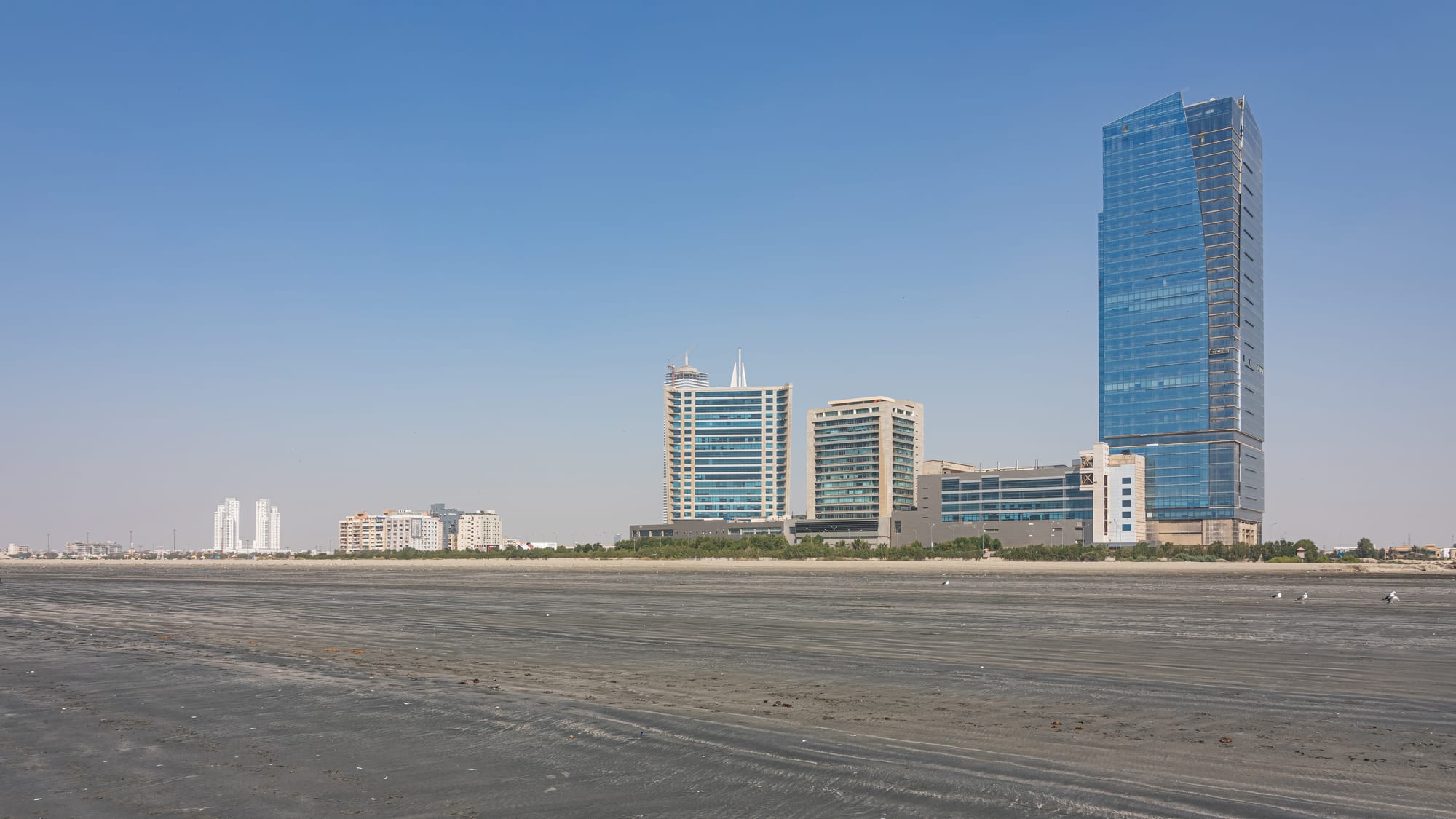
Wide grey sand at low tide with glass and concrete office towers and apartment blocks lining the shore under a clear blue sky

Karachi & Sindh, Pakistan

Karachi

Clifton Beach in Karachi, with the towers of the Clifton seafront behind it. (A.Savin / Wikimedia Commons · FAL)

Pakistan's largest city and its main port, spread along the Arabian Sea at the western edge of the Indus delta. A fishing settlement that the British turned into a harbour town, it became the country's first capital after 1947 and grew into a megacity of perhaps twenty million, with colonial-era Saddar, the marble mausoleum of Jinnah, long beaches and the most varied food in the country.

Neighbourhoods

  • Saddar
    • First-time visitors
    • Historic district
    • Best for food

    The commercial heart laid out by the British, with Empress Market at its centre and colonial stone buildings, churches and cinemas on the surrounding streets. Bookshops, electronics bazaars and cheap hotels crowd the blocks between them, and Burns Road and the old city are a short ride away.

    Open in Maps
  • Clifton
    • Beaches
    • Seafront walks
    • Cafés

    The seaside quarter south of the centre, where the shoreline drive runs past a long grey beach, shopping malls, the shrine of Abdullah Shah Ghazi and Mohatta Palace. Families gather along the sand in the evenings, and the Boat Basin area behind it is lined with restaurants.

    Open in Maps
  • Defence Housing Authority
    • Restaurants
    • Quiet and residential
    • Nightlife without alcohol

    A large planned district of walled houses, wide avenues and commercial strips running inland from the sea south-east of Clifton. Much of the city's restaurant, café and boutique scene is here, and the coastal road continues past it towards the open beaches.

    Open in Maps
  • Kharadar and Mithadar
    • Historic district
    • Markets
    • Local life

    The oldest part of the city, beside the harbour, where Karachi began as a walled trading settlement with a sweet-water and a brackish-water gate. Narrow lanes hold wholesale bazaars, carved balconies, old Gujarati and Parsi merchant houses and Wazir Mansion, the house where Jinnah was born.

    Open in Maps
  • Gulshan-e-Iqbal
    • Local life
    • Museums
    • Close to the airport

    A large middle-class district in the east of the city, built from the 1970s on a grid of blocks. It holds universities, the National Stadium, parks and the safari park, and it sits between the centre and the airport.

    Open in Maps
  • Malir and the eastern suburbs
    • Local life
    • Quiet and residential

    Older village settlements and army cantonment land along the Malir river east of the centre, with market gardens, dairy farms and the road out towards Thatta. It is residential rather than a visitor district, but it shows the Karachi that existed before the megacity.

    Open in Maps

Things to do

Famous landmarks

  • Mazar-e-Quaidlandmark

    The white marble mausoleum of Muhammad Ali Jinnah, Pakistan's founder, completed in 1971 on a raised platform above gardens, with a changing guard.

    Open in Maps
  • Frere Halllandmark

    A Venetian Gothic hall of 1865 in yellow limestone, set in gardens in Saddar, with a ceiling mural by Sadequain in its upper library.

    Open in Maps
  • Merewether Clock Towerlandmark

    A Gothic Revival stone clock tower at a busy junction near the old city, begun in 1884 and opened in 1892 in memory of William Merewether, commissioner of Sindh in the 1870s.

    Open in Maps
  • Masjid e Toobalandmark

    A mosque of 1969 in the Defence district covered by a single low white dome about 65 metres across, its prayer hall built without central pillars.

    Open in Maps
  • Wazir Mansionlandmark

    The three-storey merchant house in the old city where Muhammad Ali Jinnah was born in 1876, now a national monument and small museum.

    Open in Maps
  • Empress Marketmarket

    A long Gothic market hall of 1889 in Saddar with a tall clock tower, still trading in fruit, spices, meat and household goods.

    Open in Maps

Museums and palaces

  • Mohatta Palacemuseum

    A mansion of 1927 in Clifton in pink Jodhpur and local yellow stone, built as the summer home of a Hindu Marwari businessman and later used by Jinnah's sister Fatima; it is now a museum, officially renamed Qasr-e-Fatima.

    Open in Maps
  • National Museum of Pakistanmuseum

    The country's principal museum, holding Indus Valley material, Gandharan sculpture, Islamic manuscripts and coins, in a purpose-built hall near Burns Garden.

    Open in Maps
  • Quaid-e-Azam Housemuseum

    Flagstaff House, the stone bungalow Jinnah bought in 1943 and lived in during his last years, preserved with his furniture and belongings.

    Open in Maps
  • Pakistan Maritime Museummuseum

    A naval museum in Karsaz with a decommissioned submarine, aircraft and ship models in a park with a lake.

    Open in Maps

Beaches and the seafront

  • Clifton Beachbeach

    The city's closest beach, a broad strip of grey sand backed by a promenade, busiest at sunset and on public holidays; the sea here has strong currents.

    Open in Maps
  • Hawke's Bay Beachbeach

    A quieter sandy bay west of the city lined with beach huts, where green turtles come ashore to nest in the cooler months.

    Open in Maps
  • Manoraneighborhood

    A naval settlement at the mouth of the harbour, once an island and now joined to the shore by the Sandspit, reached by boat from Keamari, with a lighthouse of 1889, a colonial church of 1865 and long sandy beaches.

    Open in Maps
  • Port Grand and the Native Jettyattraction

    The bridge and waterfront strip between the old city and Keamari, looking out over fishing boats and the harbour channel.

    Open in Maps

Parks and viewpoints

  • Karachi Zoopark

    Pakistan's largest zoo and its second oldest after Lahore's, established in 1899 in Garden East, with mature trees, botanical gardens and a Mughal-style garden added in 1970.

    Open in Maps
  • Safari Parkpark

    A park of about 60 hectares in Gulshan-e-Iqbal, opened in 1970, with two natural lakes, a chairlift and safari tracks, popular with families at weekends.

    Open in Maps

Short trips from the city

  • Chaukhandi tombslandmark

    A field of carved yellow sandstone graves on stone plinths east of the city, cut with geometric and jewellery-like patterns, mainly between the 16th and 18th centuries.

    Open in Maps
  • Makli Necropolislandmark

    A UNESCO World Heritage Site on a ridge above Thatta, where hundreds of thousands of graves and monumental stone and tiled tombs of Sindh's rulers cover several square kilometres.

    Open in Maps
  • Shah Jahan Mosquelandmark

    A Mughal mosque at Thatta built between 1644 and 1647, faced with blue and white tilework under a canopy of 93 domes, the most of any building in Pakistan.

    Open in Maps
  • Haleji Lakepark

    A freshwater lake east of Karachi, a saline lagoon turned into a reservoir in the 1930s, known for wintering and migratory waterfowl such as teal, ducks, moorhens and jacanas.

    Open in Maps
  • Keenjhar Lakepark

    A large freshwater lake beyond Thatta that supplies much of Karachi's drinking water and draws day trippers to its shore.

    Open in Maps

Seasonal events

  • Karachi Literature FestivalFebruary

    A large English and Urdu literary festival held over a weekend, with readings, debates and book launches drawing writers from across South Asia.

  • Urs of Abdullah Shah Ghazivaries with the Islamic calendar

    The annual commemoration at the hilltop shrine above Clifton, with devotional music, crowds and food stalls over several days.

  • Muharram processionsvaries with the Islamic calendar

    Mourning processions for the first ten days of the Islamic year move through the old city and Saddar; roads and mobile networks in the area are often restricted.

  • Independence Day14 August

    Flags, lights and crowds at Mazar-e-Quaid, where the national ceremony in Karachi is centred on Jinnah's tomb.

  • Sindhi Cultural Daythe first Sunday in December

    A day of ajrak shawls, Sindhi caps and music marked with rallies and concerts across the city.

Eat and drink

Long-standing places and food districts in Karachi. Hours, ratings and directions come from your maps app, always current.

Karachi classics

  • Bun kebab stallsrestaurant

    The city's own street burger — a spiced patty of minced meat or lentils fried with egg and served in a soft bun with chutney and onion, sold from carts across the city.

    Open in Maps
  • Nihari and haleem housesrestaurant

    Slow-cooked beef shank stew eaten with naan, traditionally at breakfast, alongside haleem, a thick porridge of wheat, lentils and meat.

    Open in Maps
  • Seafood grills at the seafrontrestaurant

    Prawns, crab and Arabian Sea fish grilled or fried, a Karachi speciality tied to the fishing harbour at Keamari.

    Open in Maps

Food districts and markets

  • Burns Roadneighborhood

    The oldest food street in the city, near the old town, known for nihari, biryani, kebabs and sweet dishes such as rabri and falooda.

    Open in Maps
  • Boat Basinneighborhood

    A strip of open-air grills, tea stalls and restaurants behind the Clifton seafront that fills up late into the night.

    Open in Maps
  • Empress Marketmarket

    Spices, dried fruit, fish and produce under a Victorian hall, with tea and snack stalls in the surrounding lanes.

    Open in Maps
  • Zaibunnisa Street and Saddar's tea housesneighborhood

    Doodh patti and sweet chai poured at pavement stalls among the bookshops and colonial buildings of the old commercial centre.

    Open in Maps

Experience Karachi

History

Karachi began as Kolachi, a fortified fishing and trading settlement beside a creek at the western edge of the Indus delta, defended by two gates named for sweet and brackish water — Mithadar and Kharadar — which still name the oldest quarters. Traders shipped goods to Muscat and the Gulf, and the Talpur rulers of Sindh built a small fort at Manora to guard the harbour. British forces took the town in 1839, four years before they annexed Sindh.

Under British rule the harbour was dredged, a railway pushed inland and Karachi became the port for the wheat and cotton of the Punjab, growing into a planned colonial city of stone civic buildings, churches, gymkhanas and the Saddar bazaar. Municipal works came early, and by 1900 it was one of the busiest grain ports in the British Empire. Its population was strikingly mixed: Sindhi Hindus, Gujarati and Parsi merchants, Goans, Jews, Baloch and Memons all built quarters and institutions that survive in the street names.

Partition in 1947 remade the city. Most Hindu Sindhis left, and hundreds of thousands of Urdu-speaking Muhajirs arrived from India; Karachi served as the capital of the new state until the government moved to Rawalpindi and then Islamabad in the late 1950s. Industry, Pashtun and Punjabi migration and Afghan refugees after 1979 pushed growth further. Ethnic and political violence, arms and sectarian killings made the 1980s and 1990s bitter decades, and a long security operation from 2013 brought murder rates down sharply, leaving a city that is calmer than its reputation but still under strain.

Culture & Customs

Karachi is the most cosmopolitan city in Pakistan, and the least defined by any one group. Urdu is the common language of the street, but Sindhi, Pashto, Punjabi, Balochi, Gujarati and Memoni are all spoken at home, and the city contains large Christian, Hindu, Parsi, Ismaili and Bohra communities alongside the Sunni and Shia majority. That mixture is the source of both its energy and its politics.

It is the country's media and creative capital. Television drama, advertising, publishing and the fashion industry are based here, and the Karachi Literature Festival, art galleries, the National Academy of Performing Arts and a long line of musicians and painters — Sadequain's murals are on public walls — give the city a cultural weight the rest of Pakistan acknowledges. Truck art, painted in workshops on the city's edges, has become a national emblem.

Religious life runs from the formal mosque to the Sufi shrine: the hilltop darbar of Abdullah Shah Ghazi above Clifton draws crowds with its drumming and offerings, and Muharram processions are among the largest anywhere. Social custom is conservative by international standards and liberal by Pakistani ones — women work throughout the city, cafés are mixed, and dress in Clifton and Defence is freer than in the old city. Hospitality is emphatic: guests are fed, refusals are negotiated, and meeting times are treated generously.

Daily Life

Around twenty million people live in Karachi, making it one of the largest cities in the world and by far the largest in Pakistan; nobody knows the true figure, and census counts are politically contested. The city generates a large share of national tax revenue and hosts the central bank, the stock exchange, the two seaports, textile mills, car assembly and much of the country's manufacturing, while more than half the population lives in unplanned settlements known as katchi abadis.

Days start late and end later. Offices open mid-morning, shops stay open until late evening, and restaurants fill after ten at night; Sunday is the weekly holiday, with Friday afternoons broken by prayers. Commuting means long journeys by minibus, rickshaw or motorbike, and the school run and the evening rush choke the main arteries. Middle-class life centres on Clifton, Defence, Gulshan-e-Iqbal and North Nazimabad; working-class districts such as Lyari, Orangi and Korangi are dense, industrious and poorly served.

The standing grievances are water, which is delivered unevenly and often bought from tankers, power cuts in summer, drainage that fails in monsoon rain, solid waste, and transport. Heat is a serious public-health issue after a deadly heat wave in 2015. Set against this is a tenacious commercial optimism: the city absorbs migrants from everywhere in Pakistan and keeps growing.

Food

Karachi eats better than anywhere else in the country because it eats from everywhere in it. The Muhajir kitchens of the old city gave the city nihari, beef shank stewed overnight and eaten with naan at breakfast; haleem, a thick mash of wheat, lentils and meat; and biryani in the Karachi style, layered with potato and heavily spiced. Sindhi biryani with dried plums, Pashtun karahi and grilled tikka, Punjabi paya and Balochi sajji all have their own restaurants.

The street classic is the bun kebab, a fried patty of spiced mince or lentils with egg, chutney and onion in a soft bun, sold from carts everywhere. Other staples of the pavement are gol gappay, crisp hollow shells filled with spiced water; chaat; anda shami; and, near the fish harbour, fried and grilled seafood — prawns, crab and Arabian Sea fish, which are cheaper and more central to eating here than anywhere inland.

Burns Road, near the old city, is the oldest food street, known as much for its sweets as its meat: rabri, thickened milk cooked down slowly; falooda, a cold drink of milk, vermicelli and ice cream; and kulfi. Tea is constant — doodh patti, boiled thick with milk and sugar, and sweet chai from roadside stalls — alongside sugarcane juice, fresh lime and, in summer, Sindhi mangoes, which arrive from the interior between May and August.

Planning tools

Budget

Karachi is the most expensive city in Pakistan, and hotels with proper security are the main cost; food, taxis and entry tickets are cheap by international standards. Ride-hailing keeps transport costs low, while hiring a car with a driver for trips to Thatta or the beaches is the biggest single expense for most visitors.

Daily Budget Midrange
USD 55–130 (secure hotel, restaurants, a car with driver for day trips)
Daily Budget Shoestring
USD 20–35 (simple hotel or guesthouse, street food and dhabas, buses and ride-hailing bikes)

Agree fares in advance if using a rickshaw rather than an app, and expect hotel rates to be quoted in rupees but sometimes settled in dollars at international chains.

Best Time to Visit

November to February, when days are warm and dry and the evenings by the sea are comfortable. March and October are hot but manageable. From April to September the combination of heat and humidity is draining, and heat waves in May and June have been severe; the light monsoon rains of July and August can flood streets for days.

Suggested Number of Days

Two or three days cover the museums, the old city, Saddar and the seafront. Four or five allow the sites out towards Thatta and a slower pace. Traffic is the main constraint: the city is very large, and distances that look short can take an hour.

First Visit
2–3 days
With Surroundings
4–5 days

Transportation

Ride-hailing apps are how most visitors move around, and motorbike ride-hailing is the cheapest and quickest option in heavy traffic. Auto-rickshaws and chingchis serve short trips, minibuses cover the whole city cheaply but are crowded and hard to use without Urdu, and the Karachi Breeze bus rapid transit, whose Green Line opened in 2021, runs on dedicated corridors from the north of the city towards the centre.

Allow far more time than the distance suggests, particularly in the evening rush, and avoid travelling during processions or protests, when roads are closed at short notice.

Airport & Station Connections

Jinnah International Airport, Pakistan's second busiest after Islamabad's, is about 15 kilometres east of the centre and roughly 30 to 60 minutes by road depending on traffic, with flights across Pakistan, the Gulf and beyond. Trains from Lahore and Rawalpindi arrive at Karachi Cantonment station, and a motorway links the city with Hyderabad in about two hours.

Walkability

Saddar, the old city around Kharadar and the Clifton promenade are all walkable, and the colonial centre is best seen on foot. Everywhere else the city is built for vehicles: distances are long, pavements are broken or occupied by parked cars and stalls, crossings are rare and traffic is relentless. Heat and humidity limit walking for much of the year.

Safety

Karachi has high levels of street crime, including armed mobile-phone and bag snatching from pedestrians and from cars stopped in traffic, and the city has seen terrorist attacks. Large crowds, religious processions and political rallies are the main occasions to avoid. Most visitors have no trouble in the central and seafront districts, but the risk of robbery is real and resisting is dangerous.

Carry little of value, keep phones out of sight on the street and in stationary traffic, use ride-hailing rather than street taxis, hand over belongings without resistance if confronted, and avoid rallies and processions. Check current official travel advice before travelling.

Climate

Hot and arid, with a strong sea breeze that makes the coast humid but keeps it cooler than the interior of Sindh. Rain is scarce and comes mostly in brief monsoon spells between July and September, when drainage fails and streets flood. Cyclones in the Arabian Sea occasionally threaten the coast.

Summer
hot and humid, typically 32–36°C by day with high humidity, and heat waves that push higher inland from the shore
Winter
warm, dry and sunny, roughly 13–27°C, with cool evenings and the clearest air of the year

Local Customs

Karachi is Pakistan's most mixed city and more relaxed than the interior, but dress is still conservative: covered shoulders and knees for everyone, and a scarf for women to use at shrines and mosques. Greetings are 'salaam alaikum'; handshakes between men are normal, while many women prefer not to shake hands with men. Shoes come off at mosques and shrines, and Friday midday prayers empty offices for an hour or two.

Ask before photographing people, and avoid photographing military and port installations, checkpoints and the airport. Alcohol is not served in public, and eating and drinking in public during daylight in Ramadan is avoided.

Common Payment Methods

The currency is the Pakistani rupee. Cash rules for taxis, markets and small restaurants; cards work in hotels, malls, chain restaurants and supermarkets. ATMs are widespread in Clifton, Defence and Saddar, though some reject foreign cards, so it is worth carrying a backup card and changing money at a licensed exchange rather than on the street.