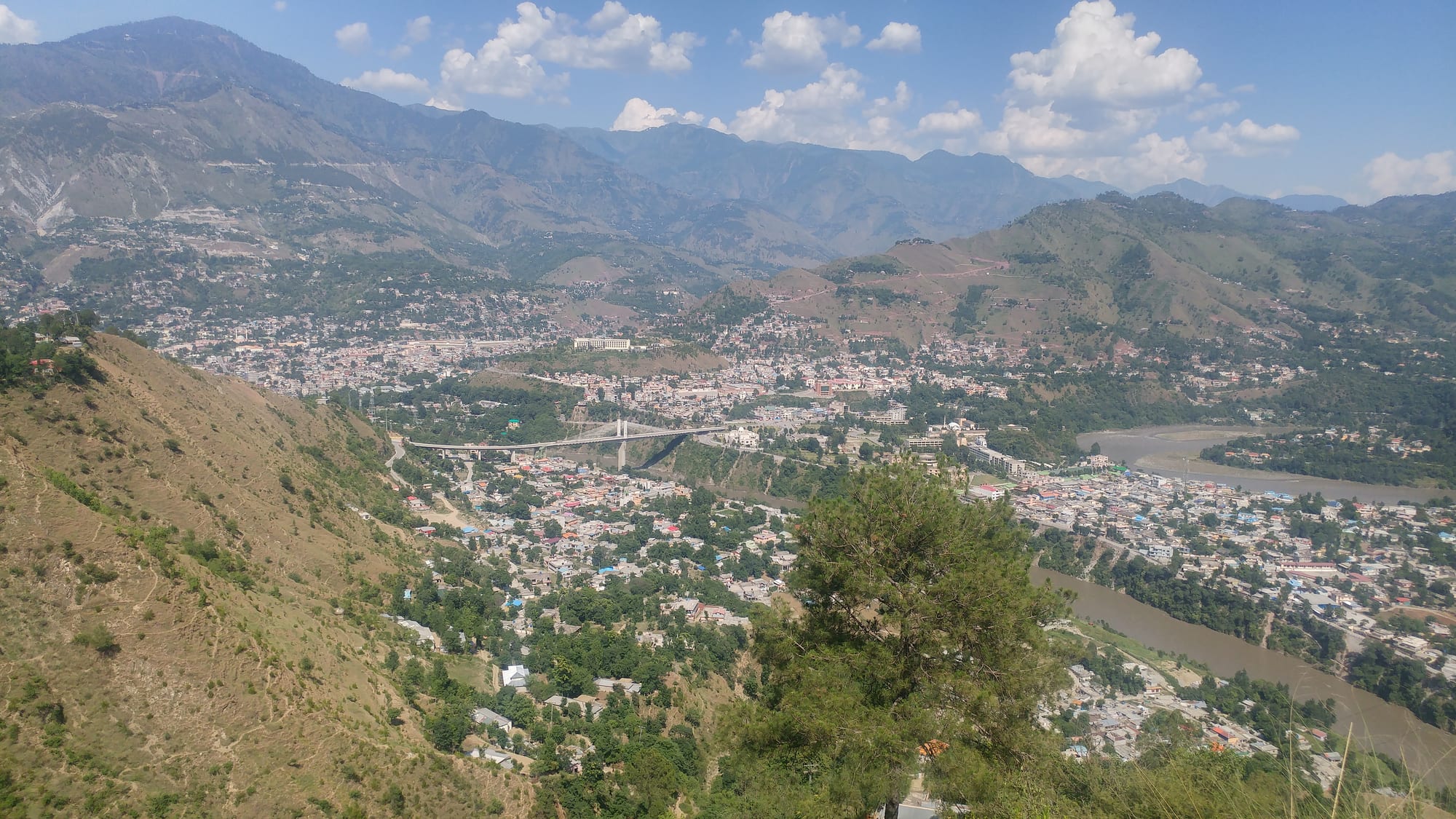
A town of low buildings filling a green river valley, with a suspension bridge over a brown river and forested ridges behind

Gilgit-Baltistan & Azad Kashmir, Pakistan

Muzaffarabad

Muzaffarabad spread along its rivers, seen from the hills above the city. (Mariaivon / Wikimedia Commons · CC BY-SA 4.0)

The capital of Azad Kashmir, built where the Neelum river joins the Jhelum among steep green hills. The old Red Fort stands above the Neelum in a city that was largely destroyed by the 2005 Kashmir earthquake and rebuilt since, and that serves as the gateway to the long Neelum valley. This page is written to explain the city, not to encourage travel.

Neighbourhoods

  • City centre and the main bazaar
    • First-time visitors
    • Local life
    • Best for food

    The commercial core on the western bank, with shops, banks, bakeries and small restaurants along a few busy streets. Much of it was rebuilt after 2005, so the buildings are newer than the street plan.

    Open in Maps
  • Domel and the river junction
    • Views
    • Walks

    The point where the Neelum meets the Jhelum, with bridges, embankments and the clearest view of the two rivers running side by side in different colours before they mix.

    Open in Maps
  • Chattar and the Neelum bank
    • Quiet and residential
    • Close to the Neelum road

    The northern side of the city along the Neelum river, where hotels and guesthouses stand near the road that leads up into the Neelum valley. Quieter than the bazaar and convenient for early departures.

    Open in Maps
  • Upper Adda and the government quarter
    • Practical base
    • Close to public transport

    The area of offices, the assembly and secretariat buildings, and the transport stands for Islamabad and the valleys. Functional rather than attractive, but where most practical business in the city is done.

    Open in Maps
  • Chella Bandi and the university side
    • Quiet and residential
    • Students

    The outer districts north of the centre, with the university campus, newer housing built after the earthquake and views back down over the valley. Life here is slower and more residential than in the bazaar.

    Open in Maps

Things to do

Forts and landmarks

  • Muzaffarabad Fortlandmark

    The Red Fort west of the centre, begun by the Chak rulers of Kashmir in 1559 and completed in 1646 under Sultan Muzaffar Khan, with the Neelum river running round three sides of it and terraces stepping down to the water.

    Open in Maps
  • University of Azad Jammu and Kashmirattraction

    The territory's main university, founded in 1980, with campuses in and around the city and a large share of its student population.

    Open in Maps

Rivers and viewpoints

  • Pir Chinasiviewpoint

    A hilltop shrine and viewpoint about 30 kilometres east of the city at 2,900 metres, reached by a winding road, with pine slopes and long views over the surrounding ranges.

    Open in Maps
  • Domel river junctionviewpoint

    The confluence where the Neelum meets the Jhelum below the city, best seen from the bridges and embankments, with the two rivers running in visibly different colours before they mix.

    Open in Maps

Short trips from the city

  • Neelum Valleyattraction

    The long forested valley running north-east from the city past villages such as Athmuqam and Sharda; parts of it lie close to the Line of Control and permits and official advice apply.

    Open in Maps
  • Leepa Valleyattraction

    A high, terraced valley of wooden houses and rice fields about 83 kilometres south-east of the city, reached over a pass; access is controlled and permission is required.

    Open in Maps
  • Neelum-Jhelum Hydropower Plantlandmark

    A 969 MW scheme that takes water from the Neelum above the city through long tunnels to a powerhouse on the Jhelum some 42 kilometres to the south; generation stopped after damage to the tunnels and the plant has been shut down.

    Open in Maps
  • Ayubia National Parkpark

    A protected area of moist temperate forest on the ridges south-west of the city, with pine and fir woods, a chairlift and walking tracks along the hillsides.

    Open in Maps
  • Nathia Galiattraction

    A small hill resort among conifer forests on the road towards Abbottabad, long used as a summer retreat and the starting point for walks up Miranjani.

    Open in Maps
  • Murreeattraction

    The best-known hill station of the region, on a ridge south-west of Muzaffarabad, developed in British times and crowded with Pakistani holidaymakers in summer and at snowfall.

    Open in Maps

Seasonal events

  • Eid al-Fitrend of Ramadan, month varies with the Islamic calendar

    The festival closing Ramadan, when the bazaars fill beforehand and families gather for large meals and visits over several days.

  • Eid al-Adhavaries with the Islamic calendar

    The festival of sacrifice, marked with prayers, the distribution of meat to neighbours and relatives, and travel back to home villages.

  • Kashmir Solidarity Day5 February

    A public holiday in Pakistan and Azad Kashmir, marked in the capital with official ceremonies, processions and speeches about the Kashmir dispute.

  • Summer season in the valleysMay to September

    The months when domestic visitors pass through the city on their way to the Neelum valley, filling hotels and transport stands, particularly at weekends.

Eat and drink

Long-standing places and food districts in Muzaffarabad. Hours, ratings and directions come from your maps app, always current.

Kashmiri classics

  • Kashmiri meat dishesrestaurant

    Restaurants in the centre serve slow-cooked mutton and chicken curries in the Kashmiri manner, with rice, and the heavily spiced dishes associated with wedding cooking.

    Open in Maps
  • Noon chaicafe

    The salted pink tea of Kashmir, made with green tea leaves and milk and drunk with bread, is a fixture of mornings and of guests arriving in a house.

    Open in Maps
  • Trout from the valleysrestaurant

    Trout farmed and fished in the Neelum and its tributaries is a speciality of the area, usually fried whole and served plainly.

    Open in Maps

Markets and food streets

  • Muzaffarabad main bazaarmarket

    The central market streets, with bakeries, sweet shops, dried fruit, honey from the valleys, spices and cheap kitchens serving rice and curry.

    Open in Maps

Experience Muzaffarabad

History

The city takes its name from Sultan Muzaffar Khan of the Bomba dynasty, who founded it in 1646 at the meeting of the Neelum and Jhelum rivers, a crossing point on the routes between the Kashmir valley and the plains. The Red Fort on the Neelum bank was begun earlier, by the Chak rulers of Kashmir in 1559, and completed in 1646 in the reign of Muzaffar Khan, with the river running round three sides of it. Mughal, Afghan and then Sikh authority reached the area in turn, and the Bombas held a semi-independent position between them.

In 1846 the British sold Kashmir to Gulab Singh of Jammu, and Muzaffarabad became a district town of the new princely state of Jammu and Kashmir, ruled by the Dogra dynasty for a century. When the Maharaja acceded to India in October 1947, rebellion in the western districts and fighting in the first Indian-Pakistani war left the town on the Pakistani side of the ceasefire line drawn in 1949, later renamed the Line of Control. It became the capital of Azad Kashmir, with its own president, prime minister and assembly, while India claims the territory as part of Jammu and Kashmir.

On 8 October 2005 an earthquake of magnitude 7.6 struck with its epicentre a short distance from the city. Muzaffarabad was devastated: schools, hospitals, government buildings and much of the housing collapsed, and tens of thousands of people died in Azad Kashmir and the neighbouring districts. Reconstruction, with international assistance, rebuilt the city over the following decade, including new campuses, hospitals and housing on the slopes above the old centre. A bus service across the Line of Control to Srinagar had been launched in April 2005, six months before the earthquake.

Culture & Customs

Muzaffarabad is a Pahari-speaking city. The local language, Pahari-Pothwari, is close to the speech of northern Punjab and the Kashmir valley's Pahari districts, with Gojri and Kashmiri also heard and Urdu used for schooling, government and the press. English is common among the educated, and the university gives the city a large student population and a livelier public life than its size suggests.

The population is almost entirely Muslim, mostly Sunni, and the rhythm of the year runs on the Islamic calendar: Ramadan, the two Eids, and the mawlid processions. Shrines on the hills, above all Pir Chinasi, attract pilgrims and weekend visitors alike, and the Sufi tradition they belong to is part of everyday religious life. Kashmir's political status is present in public life — in street names, monuments, official ceremonies and the flow of families displaced across the Line of Control in earlier decades — and visitors are usually best served by listening rather than offering opinions.

Family and biradari ties are strong, weddings are large and elaborate, and much of the city has relatives in Britain and the Gulf whose remittances and summer visits shape the social calendar. Crafts associated with Kashmir — embroidered shawls, woodwork, woollen cloth — are sold in the bazaar, though most are made elsewhere. Manners are formal: greetings first, tea offered immediately, and modest dress taken as a sign of respect.

Daily Life

Muzaffarabad is the largest city of Azad Kashmir and the capital of a territory of 4.33 million people at the 2023 census, and is therefore full of government offices, courts, the assembly, hospitals and the university. It is also the market and service town for the Neelum, Jhelum and Leepa valleys, and people come down from the hills for shopping, schooling and medical care.

Work is mainly in government service, education, trade, transport and construction, with farming and forestry in the surrounding hills and a growing seasonal trade in domestic tourism heading for the Neelum valley. Remittances from relatives in Britain, where many Azad Kashmiri families settled from the 1960s, and in the Gulf support a great many households and are visible in the large houses on the outskirts. Reconstruction after 2005 remains the largest single event in living memory, and new building is still going on.

Days start early, the bazaar is busiest in the morning and again after the afternoon heat, and summer evenings are spent outside along the rivers. Current concerns include earthquake and landslide risk, the reliability of electricity and water, hospital capacity, the cost of living, the effect of dams and water projects on the rivers, and the tension that periodically affects areas near the Line of Control.

Food

The food is Kashmiri and Pahari rather than northern-mountain. Slow-cooked mutton dishes with yogurt and red chilli, roasted and minced-meat preparations, and rice served with thick gravies are what a household cooks for guests, and the elaborate multi-course wedding feast of Kashmiri tradition is the model for celebration cooking. Maize and wheat breads, dal, seasonal greens known locally as saag, and pickles are the everyday staples, with beans and rajma common.

Noon chai, the pink salted tea of Kashmir made from green tea leaves, milk and a pinch of soda, is drunk in the morning and whenever a guest arrives, usually with a plain baked bread from the bakery. Sweet milk tea and green tea, sometimes with cardamom, are the alternatives, and bakeries sell biscuits, cakes and sweets such as halwa and barfi in the bazaar.

The rivers and hills supply the local specialities: trout from the Neelum and its tributaries, fried simply; honey from the valleys; walnuts, apples and apricots in season; and maize dishes from the upland villages. Along the road into the Neelum valley, small restaurants serve trout, chicken karahi and bread to travellers, and that is where most visitors to Muzaffarabad eat their best meal.

Planning tools

Budget

Muzaffarabad is inexpensive by Pakistani standards, cheaper than the northern mountain towns because it is close to the plains and served by good roads. Simple hotels and bazaar food cost very little; the main variable is car hire for the Neelum valley, and rooms fill and rise in price during the summer domestic tourist season.

Daily Budget Midrange
USD 55–130 (good hotel, restaurant meals, a car with driver for the valleys)
Daily Budget Shoestring
USD 10–25 (simple hotel, bazaar food, minibuses)

Carry cash for anything outside the city, and agree the fare or hire charge before setting off for the valleys.

Best Time to Visit

March to June and September to October. Spring is green and mild, summer is hot in the valley bottom though cooler in the hills above, and the monsoon from July to September brings heavy rain and the risk of landslides on mountain roads. Winter is cool and damp in the city, with snow higher up.

Suggested Number of Days

A day or two covers the city, its forts and the river junction. Three to five allow the hills above it and a trip up the valleys, subject to permits and official advice. Rain and road closures can add time in the monsoon months.

First Visit
1–2 days
With Surroundings
3–5 days

Transportation

Taxis, shared Suzuki pick-ups and minibuses cover the city cheaply, and the bazaar area is walkable. Vans and jeeps for the Neelum valley and for other towns of Azad Kashmir leave from stands near the centre, and coaches run to Rawalpindi and Islamabad. A hired car with a driver is the usual way to reach the valleys and Pir Chinasi.

Mountain roads are narrow, and landslides are common after heavy rain; travel in daylight and check conditions before setting out.

Airport & Station Connections

Most people arrive by road from Islamabad and Rawalpindi, a drive of several hours by way of Murree or the Hazara route, depending on traffic and road works. Abbottabad and the Karakoram Highway lie to the north-west. The city's own airport is not in use, so the nearest airport with scheduled flights is Islamabad.

Walkability

The bazaar and the riverfront are walkable, and the fort can be reached on foot from the centre. The city is strung along the valley between steep slopes, so distances between districts are longer than they look, pavements are uneven, and anything on the hillsides means a climb or a taxi.

Safety

Governments advise against travel near the Line of Control, which runs close to the north and east of the city and includes much of the Neelum valley, because of cross-border firing, which flared again in 2025, and some areas require a permit. The city itself is generally calm, and the other risks are natural: the region is seismically active, and monsoon rain brings landslides and flash floods.

Follow official advice on the Line of Control, carry a passport and permits for checkposts, avoid political gatherings, and take local guidance on roads during the monsoon. Check current official travel advice before travelling.

Climate

A humid subtropical climate in a low valley, wetter than the northern mountains because the monsoon reaches it. Summers are hot in the valley, the monsoon falls heavily from July to September, and winters are cool and damp with snow on the ridges rather than in the city.

Summer
hot and humid — daytime temperatures often in the mid 30s °C, with monsoon downpours from July
Winter
cool and damp — daytime highs usually around 10 to 15°C, with cold nights and snow on the surrounding hills

Local Customs

Azad Kashmir is conservative and almost entirely Muslim, and dress is expected to be modest: long sleeves and trousers for men, loose clothing and a headscarf for women. Pahari is the main everyday language, with Gojri and Kashmiri also spoken and Urdu used in offices and schools. Hospitality is emphatic, and a guest will be pressed to eat and drink more than once.

Ask before photographing people or military and bridge installations, dress conservatively, avoid taking sides in conversations about Kashmir, and note that alcohol is not available.

Common Payment Methods

The currency is the Pakistani rupee. Cash is used for nearly everything, and cards are accepted only in a few larger hotels. Banks and ATMs in the city are reliable by regional standards, but there is little in the Neelum valley beyond it, so travellers draw what they need before leaving.