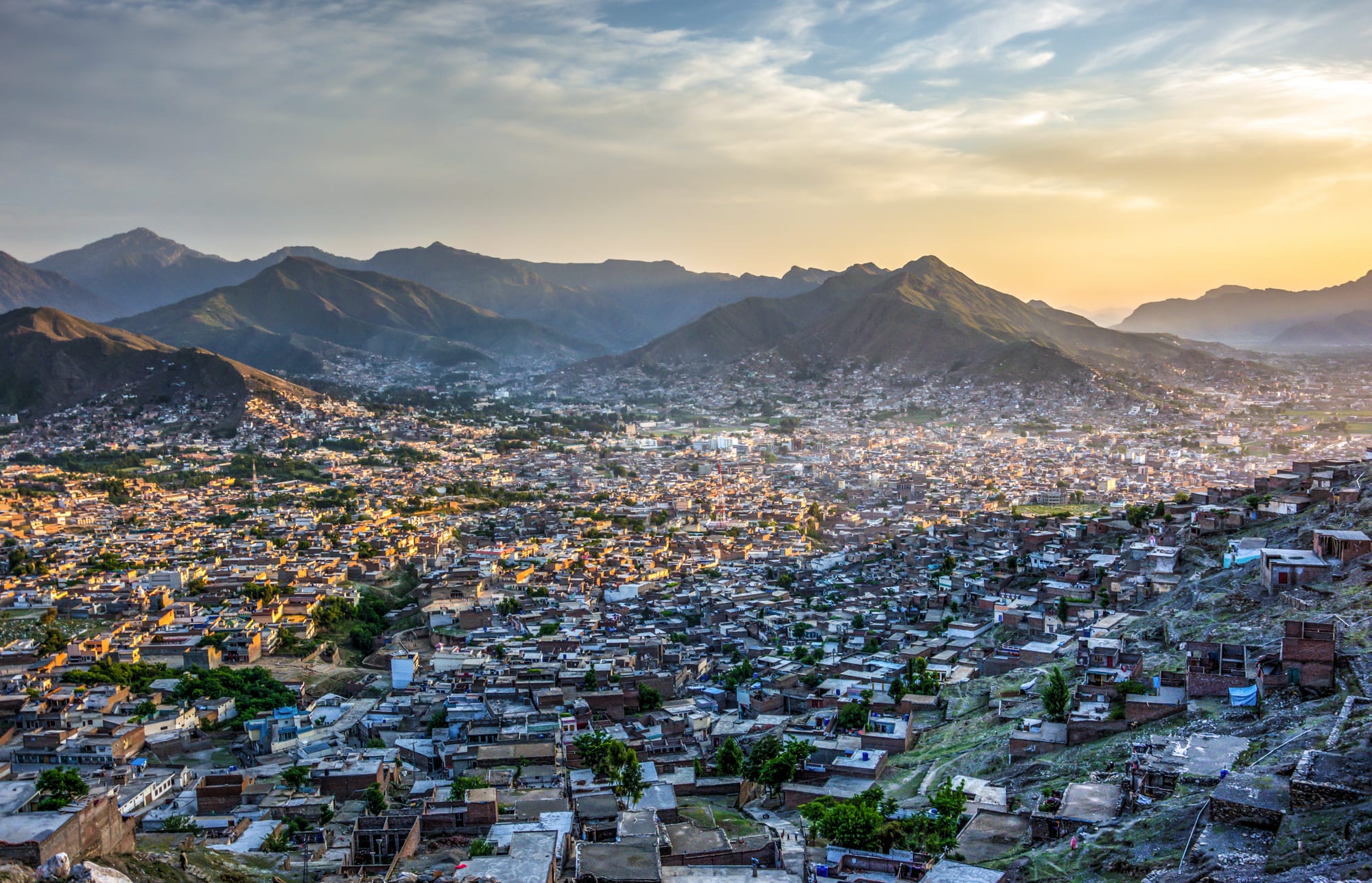
A dense town of flat-roofed houses filling a valley floor at sunset, with bare ridges rising behind it

Peshawar & Khyber Pakhtunkhwa, Pakistan

Mingora

Mingora spread across the floor of the Swat valley at sunset. (Imranrashid26 / Wikimedia Commons · CC BY-SA 3.0)

The main town of the Swat valley in northern Khyber Pakhtunkhwa, set on the Swat River where the valley opens out below the Hindu Kush foothills. Grown out of the Buddhist land of Uddiyana and the former princely state of Swat, it is the trading centre for the valley's orchards and the gateway to the road north to Kalam. This page is written to explain the city, not to encourage travel.

Neighbourhoods

  • The Main Bazaar and Green Chowk
    • First-time visitors
    • Markets
    • Local life

    The commercial heart of the town, a grid of narrow shopping streets around the central junction where cloth, gemstone, dried-fruit and hardware traders sit side by side. It is crowded and loud from mid-morning until late evening, and most of the town's hotels and restaurants are within a few minutes of it.

    Open in Maps
  • Saidu Sharif
    • Historic district
    • Museums
    • Quiet and residential

    The administrative twin of Mingora, immediately south and now joined to it, built as the seat of the walis who ruled the princely state of Swat. Government offices, the Swat Museum, the shrine of the Akhund of Swat and the airport road are here, and the streets are calmer than in the bazaar.

    Open in Maps
  • Fizagat
    • Riverside
    • Families
    • Quiet and residential

    The riverside strip north of the centre where the Swat River runs beside a public park and a line of hotels and tea gardens. Local families come in the evenings and in the hot months, and the road onwards leads up the valley towards Bahrain and Kalam.

    Open in Maps
  • Makan Bagh and Rahimabad
    • Quiet and residential
    • Close to transport

    Residential districts on the northern and western edges of the town, a mix of older orchard plots and newer concrete housing. The main bus and van stands for the valley and for Peshawar and Islamabad are in this part of Mingora.

    Open in Maps

Things to do

Buddhist Swat

  • Butkara Stupalandmark

    A large stupa complex on the edge of Mingora, excavated by an Italian mission, rebuilt in several phases from around the 2nd century BC and one of the most important Buddhist sites of ancient Uddiyana.

    Open in Maps
  • Saidu Sharif Stupalandmark

    The remains of a stupa on a lower terrace with a monastery above it, near Saidu Sharif, excavated by the Italian Archaeological Mission between 1963 and 1982.

    Open in Maps
  • Shingardar Stupalandmark

    A tall stupa of large stones and thin slate courses standing beside the road at Shingardar village, between Ghalegay and Barikot south of Mingora, among the most conspicuous Buddhist remains in the valley.

    Open in Maps
  • Udegramlandmark

    A hillside site south-west of the town with the ruins of a fortified settlement identified with the Ora of the Greek accounts of Alexander's campaign; finds from it fill part of the Swat Museum.

    Open in Maps

Museums

  • Swat Museummuseum

    The valley's museum on the road between Mingora and Saidu Sharif, holding Gandharan statuettes and friezes of the Buddha's life, seals and reliquaries mostly from Butkara and Odigram, alongside an ethnographic gallery of carved Swati furniture, jewellery and embroidery.

    Open in Maps

Markets and the river

  • Fizagat Parkpark

    A riverside park on the Swat River at the northern edge of the town, with lawns, tea stalls and views of the water.

    Open in Maps
  • Mingora bazaarmarket

    The dense trading streets at the centre of town, where the valley's fruit, honey, gemstones, shawls and everyday goods change hands.

    Open in Maps

Short trips from the town

  • Malam Jabbaattraction

    A mountain resort about 40 kilometres north-east, one of Pakistan's two ski resorts, with an 800-metre chairlift opened in 2016 after the older resort was destroyed in 2008, and pine forest walks.

    Open in Maps
  • Marghuzarattraction

    A wooded side valley about 13 kilometres from Saidu Sharif below Mount Ilam, with the White Palace built in 1940 as the wali of Swat's summer residence and since converted into a hotel.

    Open in Maps
  • Mount Ilamviewpoint

    The peak rising above the southern side of the valley, long held sacred by Buddhists and Hindus and still climbed by walkers.

    Open in Maps
  • Bahrainattraction

    A bazaar town up the valley where two rivers meet, known for carved woodwork and as a stop on the road to Kalam.

    Open in Maps
  • Kalamattraction

    The forested head of the Swat valley, about 90 kilometres north, a summer resort surrounded by alpine meadows and glacier-fed streams.

    Open in Maps

Eat and drink

Long-standing places and food districts in Mingora. Hours, ratings and directions come from your maps app, always current.

Swat classics

  • Trout from the Swat Riverrestaurant

    Farmed and river trout, grilled or fried whole and eaten with naan, is the dish the valley is known for, served at riverside restaurants in and above the town.

    Open in Maps
  • Chapli kebab grillsrestaurant

    The wide, flat minced-beef patty of the Pashtun north, fried in a shallow pan and eaten straight from it with bread, sold at open-fronted grills around the bazaar.

    Open in Maps

Bazaars and tea houses

  • Mingora Main Bazaarmarket

    The main shopping streets, with dried-fruit and honey sellers, sweet shops and small kebab and karahi houses tucked between them.

    Open in Maps
  • Fizagat riverside tea gardensneighborhood

    Tea gardens and family restaurants along the Swat River at the north end of town, where green tea and grilled fish are the usual order.

    Open in Maps

Experience Mingora

History

The Swat valley was the land the Buddhist texts call Uddiyana, an early centre of Buddhism whose monasteries and stupas covered the hillsides from the time of the Mauryan and Kushan empires onwards. Butkara, on the edge of modern Mingora, was rebuilt over several centuries and stood among hundreds of religious sites in the valley; Udegram to the south-west is the Ora of the Greek accounts, one of the towns stormed by Alexander the Great's army in 327 BC, as Barikot down the valley was Bazira. Buddhism faded after the first millennium, and by the 11th century Mahmud of Ghazni's campaigns had brought Islam to the valley.

Yusufzai Pashtuns settled Swat in the 16th century, dividing the land among clans. In 1849 a religious leader was elected king of the valley, and the descendants of the Akhund of Swat went on to build a state that the British recognised in 1926, giving its ruler the title of Wali. The walis of Swat ruled from Saidu Sharif until the state was merged into Pakistan in 1969, building roads, schools and hospitals that made the valley unusually well provided for; Mingora grew as its bazaar and trading town while Saidu Sharif held the offices.

Italian archaeologists began work at Butkara in the 1950s and have excavated in the valley ever since. From 2007 the Pakistani Taliban took control of Swat, destroying schools and damaging Buddhist carvings, until an army offensive in 2009 drove them out and displaced much of the population for months. In 2012 the schoolgirl Malala Yousafzai, who is from Mingora, was shot on her way home from school. Floods in 2010 and again in 2022 swept away riverside buildings, bridges and roads.

Culture & Customs

Mingora is a Pashto-speaking town, and Pashtunwali — the code of hospitality, refuge, honour and settlement of disputes by a jirga of elders — still governs much of social life. Families are large and closely bound, marriages are usually arranged within the clan, and the hujra, the men's guest house, remains the place where village matters are discussed. Women are less visible in public than in Pakistan's big cities, though schools and colleges in the town are full.

Swati craft is distinctive: deeply carved walnut and cedar woodwork on doors, columns and furniture, heavy embroidery on women's shawls and dresses, and the shawls and caps sold throughout the bazaar. The rabab, a short-necked lute, and the circle dance called attan accompany weddings, and Pashto poetry and song have a strong following. Gemstones from the valley's mines, emeralds above all, are traded in their own corner of the market.

The town takes evident pride in the valley's Buddhist past and in the Swat Museum, which local guides treat as a shared inheritance rather than something foreign. Malala Yousafzai's story is part of the recent identity of the place, discussed with mixed feelings locally. Everyday manners are formal and warm at once: greetings are long, tea is refused only with difficulty, and guests are treated as a responsibility.

Daily Life

About 360,000 people live in Mingora, which makes it one of the larger towns of Khyber Pakhtunkhwa and by far the biggest in the Swat valley. Its economy is built on trade: fruit from the valley's orchards — peaches, apples, persimmons, apricots and walnuts — passes through its markets, along with honey, timber, gemstones and the everyday supplies that the upper valleys buy. Tourism from other parts of Pakistan has become a mainstay, filling hotels in the summer months and supporting drivers, guides and restaurants.

The town runs on an early rhythm. Shops open in the middle of the morning and stay open late, prayer times punctuate the day, and Friday is the quiet afternoon. Households are often supported in part by remittances from relatives working in Karachi or the Gulf. Newer concrete housing has spread over orchard land on the edges, while the old centre remains cramped.

Persistent problems are plain to see: traffic and air pollution in the narrow central streets, waste and sewage reaching the Swat River, and unplanned building on the flood plain, which the floods of 2010 and 2022 exposed with great cost. Electricity supply is uneven and water is short in summer. Security concerns have returned to public discussion since 2021, and they affect confidence in the valley's tourist season.

Food

Swati cooking belongs to the Pashtun tradition of meat, bread and rice with restrained spicing. The chapli kebab — a wide, flat patty of minced beef with tomato, onion, green chilli and coriander, fried in a shallow pan of hot fat — is the regional favourite, eaten fresh from the pan with naan. Karahi, mutton or chicken cooked quickly with tomato in a two-handled iron pan, and tikka grilled over charcoal are the other staples of the bazaar grills, while Kabuli pulao, rice cooked with lamb and topped with carrots and raisins, shows the Afghan influence that reaches across the province.

What sets the valley apart is trout. Farms along the Swat River and its tributaries supply restaurants in and above Mingora, where the fish is salted, floured and fried or grilled whole. Saag, mustard greens slow-cooked and eaten with maize bread, is the winter dish of village kitchens, and shorwa, a thin meat broth with bread broken into it, is common at home.

The orchards define the sweet side of the local diet: peaches, apples, persimmons, apricots, plums and walnuts, sold fresh in season and dried the rest of the year in the bazaar. Swat honey is a well-known local product. Meals end with qehwa, green tea with cardamom, poured from a pot into small cups, which is offered to every visitor and to every customer weighing up a purchase.

Planning tools

Budget

Mingora is inexpensive by any measure. Simple hotels and restaurants in the bazaar cost very little, and prices rise in June, July and August, when Pakistani holidaymakers fill the valley. The main variable costs are a car or jeep with a driver for the upper valley and Malam Jabba, and any guide or escort required of foreign visitors.

Daily Budget Midrange
USD 45–100 (good hotel, restaurants, a car or jeep with driver)
Daily Budget Shoestring
USD 12–25 (guesthouse, bazaar food, shared vans up the valley)

Carry cash, as cards are accepted only at a few larger hotels, and book rooms ahead for the summer holiday rush.

Best Time to Visit

March to early June and September to October are the most comfortable months, with warm days, blossom in spring and the fruit harvest in late summer and autumn. July and August are hot in the town itself and bring monsoon rain, landslides and the heaviest domestic tourist traffic. Winter is cold and grey, though it is the season for snow at Malam Jabba.

Suggested Number of Days

The town and its Buddhist sites and museum take a day or two. Allow four or five days for the upper valley and the side valleys as well, and more if road conditions or weather slow the journey north.

First Visit
1–2 days
With Surroundings
4–5 days

Transportation

Within Mingora, shared vans, rickshaws and taxis cover the short distances between the bazaar, Saidu Sharif and Fizagat. Vans and coaches leave from the town's stands for Peshawar, Islamabad and up the valley to Bahrain and Kalam, and jeeps are hired for the rougher side roads. Traffic in the central streets is heavy for much of the day.

Hire a car with a local driver for the upper valley, travel by daylight, and expect delays after monsoon rain or winter snow.

Airport & Station Connections

Most visitors arrive by road. The Swat Expressway links the valley to the motorway network, putting Islamabad roughly four to five hours away and Peshawar a little less. Saidu Sharif Airport, across the Swat River at Kanju, reopened to domestic flights in 2021 after being closed since 2007, but most visitors still arrive by road. Shared vans and long-distance coaches use stands on the edge of Mingora.

Walkability

The bazaar is walkable and best seen on foot, though pavements are crowded, uneven and often taken up by stalls and parked vehicles. Saidu Sharif is a walk or a short rickshaw ride from the centre, and the riverside at Fizagat is pleasant to stroll. Traffic is dense and pedestrian crossings are rare, so crossing main roads takes care.

Safety

Security varies more in Khyber Pakhtunkhwa than anywhere in Pakistan. Swat was taken over by the Pakistani Taliban in 2007–2009 until an army offensive drove them out, and militant activity in the province has increased again since 2021, though the main Swat valley is visited by very large numbers of Pakistani tourists. Foreigners may be required to register with police or to accept an escort, and checkpoints are common on the roads into and out of the valley.

Follow police and security instructions, keep away from crowds and political rallies, travel between towns by daylight, and dress and behave conservatively. Check current official travel advice before travelling.

Climate

Mingora lies below 1,000 metres, so it is warmer than the upper valley. Summers are hot and humid with monsoon storms from July to September; spring and autumn are mild; winters are cold but snow rarely lies long in the town, while the surrounding mountains hold snow for months.

Summer
hot, roughly 25–38°C by day, with monsoon rain and the risk of flash floods from July
Winter
cold, roughly 2–15°C, with frost at night and snow on the ridges above

Local Customs

Swat is conservative and Pashtun custom shapes daily life: hospitality is taken seriously, guests are pressed to eat, and the men's guest house, or hujra, remains a social centre in the villages. Modest dress covering arms and legs is expected of everyone, and women visitors are more comfortable with a headscarf to hand. Many restaurants keep a separate family section for women and family groups.

Ask before photographing people, and never photograph women or security installations; alcohol is prohibited; take off shoes at mosques and shrines, and avoid eating in public during daylight hours in Ramadan.

Common Payment Methods

The currency is the Pakistani rupee. Cash is used for nearly everything, and only larger hotels take cards. ATMs are available in Mingora and are the last reliable ones before the upper valley, so cash is worth drawing here for trips towards Bahrain, Kalam or Malam Jabba.