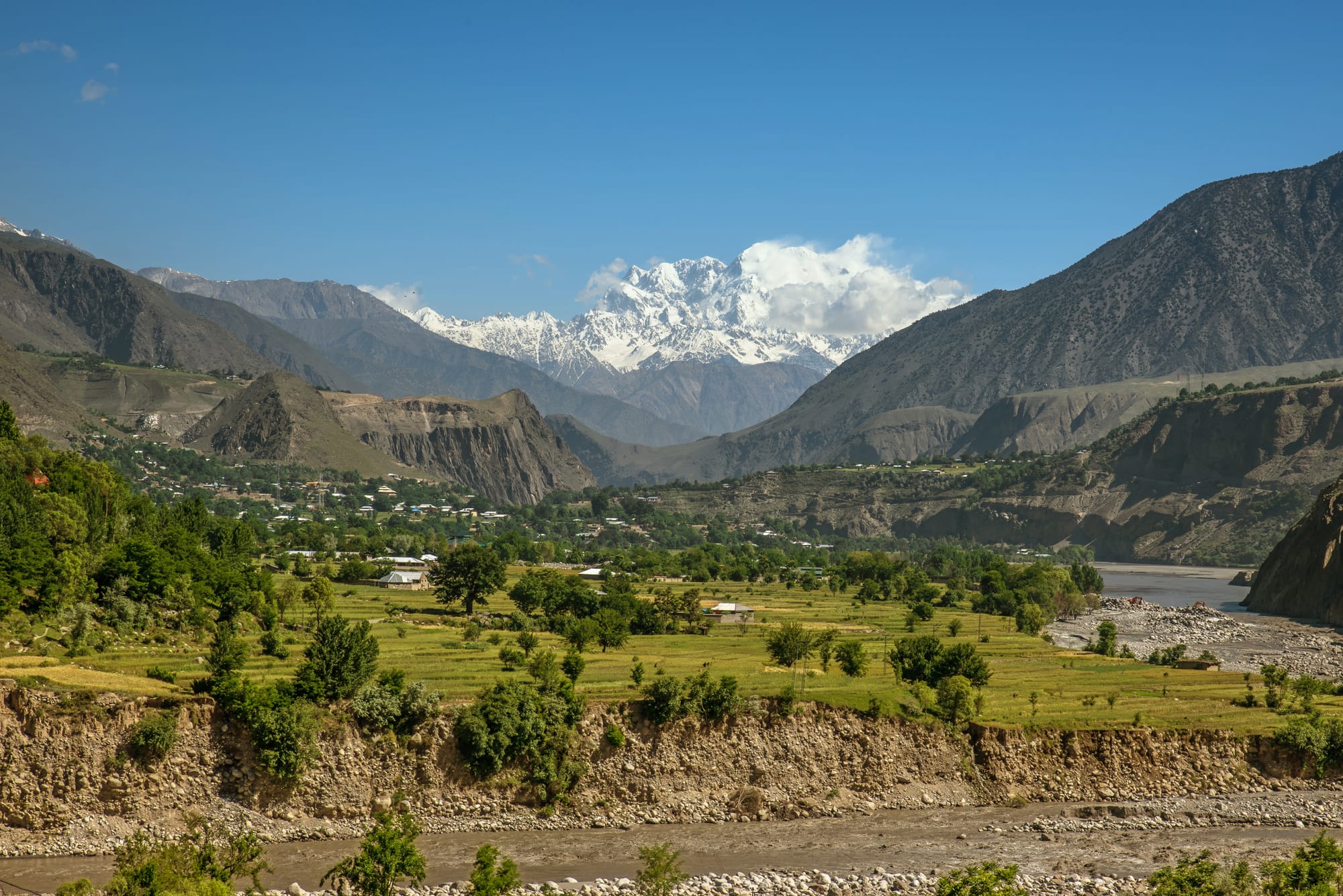
Green fields and trees along a braided river, with bare brown ridges and a snow-covered peak beyond

Pakistan

Peshawar & Khyber Pakhtunkhwa

The Chitral valley below Tirich Mir, the highest peak of the Hindu Kush. (Uzair189 / Wikimedia Commons · CC BY-SA 4.0)

Pakistan's north-western province, the Pashtun heartland along the Afghan border, running from the Peshawar valley and the Khyber Pass up to the Hindu Kush valleys of Swat and Chitral — the old land of Gandhara, now a mix of mountain resorts and insurgency-hit border districts. For those former tribal districts, this page is written to explain the region, not to encourage travel.

Explore Peshawar & Khyber Pakhtunkhwa

History

The Peshawar valley was the heart of ancient Gandhara. Its city, known as Purushapura, was a capital of the Kushan emperor Kanishka, whose great stupa stood outside it, and the monasteries of Takht-i-Bahi and the Swat valley produced the Greco-Buddhist sculpture that blended Hellenistic and Indian styles. The Khyber Pass made the valley a highway for invaders from Central Asia, from Mahmud of Ghazni to Babur, the founder of the Mughal dynasty.

The Pashtun tribes of the hills were never fully ruled by anyone. The Mughals held Peshawar, the Durrani Afghans took it in the 18th century, the Sikhs seized it in the 1830s, and the British annexed it in 1849. In 1901 they created the North-West Frontier Province, leaving the tribal agencies along the new Durand Line border with Afghanistan to their own customary law. Swat and Chitral remained princely states until 1969. In the 1930s Abdul Ghaffar Khan, known as Bacha Khan, led the non-violent Khudai Khidmatgar movement against British rule.

From 1979 the Soviet war in Afghanistan sent millions of refugees to Peshawar, which became a base for the mujahideen. After 2001 the tribal areas became a refuge for Afghan and Pakistani militants, and the Pakistani Taliban took control of Swat in 2007–2009 until an army offensive drove them out; in 2012 they shot the schoolgirl Malala Yousafzai in Swat. In 2014 militants attacked the Army Public School in Peshawar, killing more than 140 people, most of them children. The province was renamed Khyber Pakhtunkhwa in 2010, and the tribal areas were merged into it in 2018.

Culture & Customs

Pashto is the main language, with Hindko spoken in old Peshawar and the Hazara region and Khowar, among several smaller languages, in Chitral. Pashtun life is governed by Pashtunwali, the code of honour: hospitality to guests, the protection of those who seek refuge, the settling of disputes by a jirga, or council of elders, and the guarding of family honour, with women largely secluded in rural areas. The hujra, a men's guest house, is the social centre of the village.

Music is carried by the rabab, a short-necked lute, and the circle dance of attan is performed at weddings. The Sufi poet Rahman Baba and the warrior poet Khushal Khan Khattak are the classics of Pashto literature. Peshawari chappal sandals, woollen shawls and caps, and the carved woodwork of Swat are the famous crafts.

The Kalasha of the three Kalash valleys near Chitral, numbering a few thousand, keep a polytheistic religion distinct from the Muslim majority. Kalasha women wear black embroidered robes and beaded headdresses, and the community marks the seasons with festivals such as Chilam Joshi in spring and Chaumos at the winter solstice. Polo is the passion of Chitral.

Daily Life

The province has about 40 million people. Peshawar, with around 2 million, is by far the largest city; Mardan, Mingora, Abbottabad, Kohat, Dera Ismail Khan and Bannu follow. Abbottabad, a military town in the hills, became notorious in 2011 as the place where US forces killed Osama bin Laden.

The economy rests on farming — wheat, maize, tobacco, sugarcane and the fruit orchards of Swat — along with trade with Afghanistan, hydropower from dams such as Tarbela, marble and gemstones, and remittances from Pashtuns working in Karachi and the Gulf. Tourism to Swat, Naran and the Galiyat has boomed with domestic visitors.

Life is conservative and family-centred, with a slow rhythm set by prayer times and the bazaar. The main issues are the renewed militancy in the border districts, the future of the large Afghan refugee population, unemployment, and flash floods, which devastated Swat in 2010 and 2022.

Food

Pashtun food is centred on meat, bread and rice rather than heavy spice. The chapli kebab is the signature dish: a flat, wide patty of minced beef or mutton with tomato, onion, coriander and spices, fried in a large pan and eaten with naan. Peshawar is also known for karahi and for tikka grilled on skewers.

Kabuli pulao, rice cooked with lamb and topped with carrots and raisins, shows the Afghan influence, as does rosh, lamb or mutton cooked without spices. Meals end with qehwa, green tea with cardamom, offered to every guest.

In the mountains, trout from the rivers of Swat and Chitral, walnuts, apricots, apples and honey are local products.

Attractions & Natural Wonders

Peshawar's old city is a warren of bazaars around Qissa Khwani, the Storytellers' Bazaar, with the 17th-century Mahabat Khan Mosque, the carved wooden Sethi House and the Gor Khuttree archaeological complex; the Peshawar Museum holds an outstanding Gandharan collection. West of the city, the road towards the Khyber Pass passes Jamrud Fort and the Bab-e-Khyber gate and climbs to Landi Kotal and the Torkham border. North-east, Takht-i-Bahi's hilltop monastery, a UNESCO World Heritage Site, stands above the plain near Mardan.

The Swat valley holds Buddhist sites such as the Butkara stupa and the rock-carved Buddha of Jahanabad, restored after the Taliban damaged it. Beyond Mingora lie the Malam Jabba ski slopes, Bahrain, and Kalam, with the forests and lakes of the upper valley.

In the far north, Chitral town has its fort and Shahi Mosque beneath Tirich Mir, with the Kalash valleys of Bumburet, Rumbur and Birir to the south-west, the hot springs of Garam Chashma, and the high Shandur Pass on the border with Gilgit-Baltistan. In Hazara, the Galiyat hill stations of Nathia Gali and Ayubia sit among pine forests, and the Kaghan valley leads to Naran and the glacial Lake Saif-ul-Malook.

Cities in Peshawar & Khyber Pakhtunkhwa

Planning basics

Budget

Khyber Pakhtunkhwa is cheap. Peshawar's hotels and food are inexpensive, and the hill resorts of Swat, Naran and the Galiyat range from basic guesthouses to mid-range hotels whose prices jump in the summer holidays. Chitral and the Kalash valleys have simple guesthouses, and the main extra costs are jeep hire and, where required, a guide.

Daily Budget Midrange
USD 45–100 (good hotel, restaurants, a car or jeep with driver)
Daily Budget Shoestring
USD 10–20 (guesthouse, dhaba food, minibuses)

Carry cash beyond Peshawar, Mingora and Abbottabad, and book resort hotels ahead for the June–August holiday rush.

Safety

Security varies more here than anywhere in Pakistan. Governments advise against all travel to the former tribal districts along the Afghan border, including the Khyber district beyond Peshawar, where militant attacks have increased since 2021, and Peshawar itself has suffered repeated bombings. The Galiyat, Naran and the main Swat and Chitral valleys are visited by large numbers of Pakistani tourists, but foreigners may be required to register with police or accept an escort.

Follow police and security instructions, do not attempt the Khyber Pass without official permission, avoid crowds and rallies in Peshawar, and respect conservative dress and customs. Check current official travel advice before travelling.

Climate

The Peshawar valley has a hot, dry summer, regularly above 40°C, and cool winters. The hills are a different world: Swat, the Galiyat and Chitral have warm summer days and cold nights, and heavy winter snow closes high passes and roads, while the monsoon brings heavy rain and flash floods to the Hazara and Swat valleys from July to September.

Summer
Peshawar 38–45°C; 20–30°C in Swat, Nathia Gali and Chitral
Winter
cool on the plains, 4–18°C; freezing with deep snow in the mountains

Transportation

Peshawar has an international airport and is about two hours from Islamabad by motorway; the city has its own rapid bus line. A motorway shortens the drive to lower Swat, and the Karakoram Highway runs north through Abbottabad and Mansehra. Chitral is reached by road through the Lowari Tunnel or by weather-dependent flights from Islamabad, with jeeps to the Kalash valleys.

Mountain roads close in winter and after monsoon landslides; travel by day with an experienced local driver.

Best Time to Visit

October to March suits Peshawar and Takht-i-Bahi. The mountains are best from May to October, when the upper Swat valley and Chitral are fully open; the Kalash spring festival of Chilam Joshi falls in May and the polo tournament on the Shandur Pass is held in summer. Monsoon rain can bring landslides and floods in July and August.