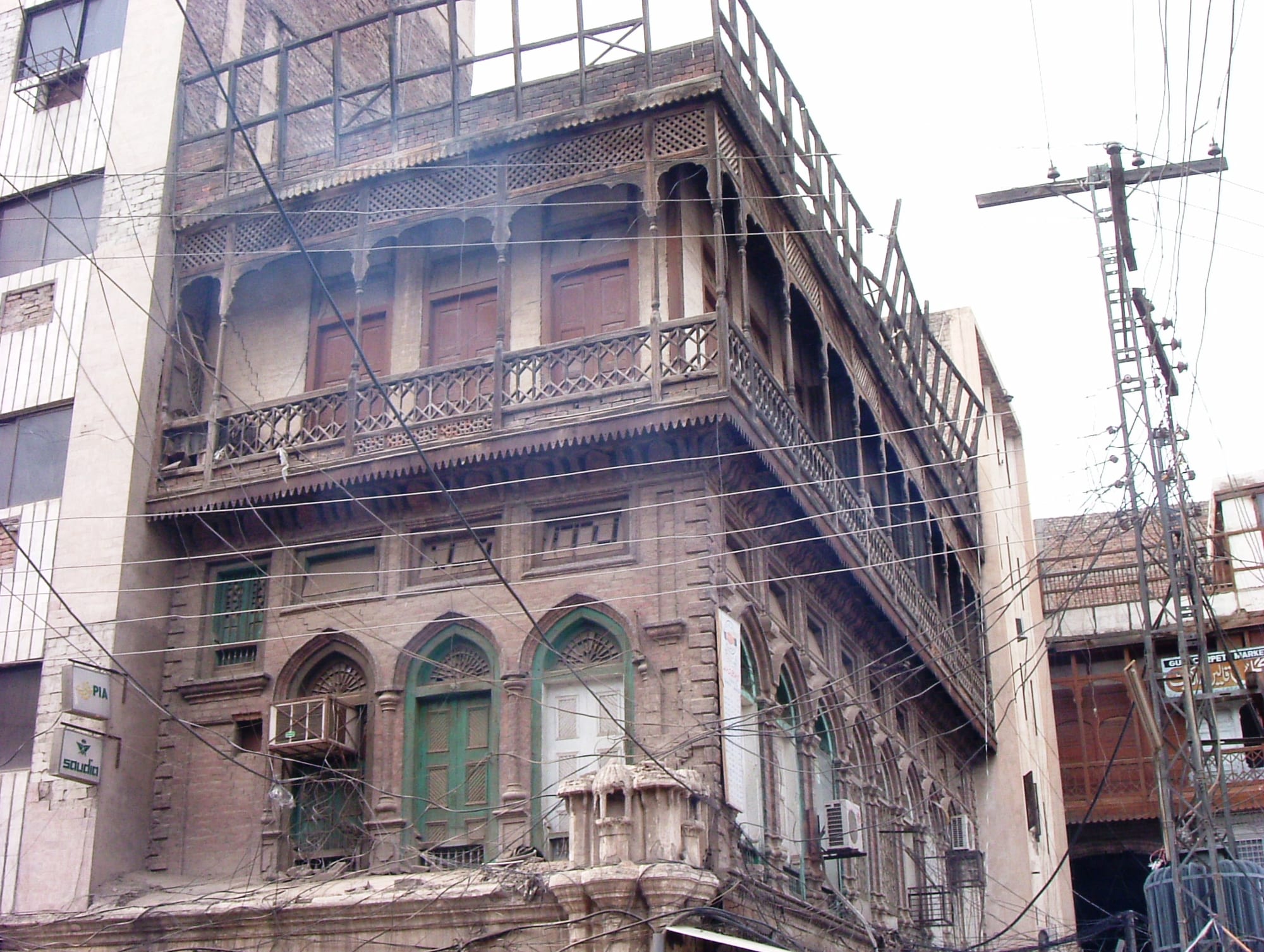
An old corner house in a bazaar street with carved wooden balconies, shuttered windows and tangled overhead wires

Peshawar & Khyber Pakhtunkhwa, Pakistan

Peshawar

A timber-balconied merchant house in the Qissa Khwani Bazaar quarter of old Peshawar. (franek2 / Wikimedia Commons · CC BY-SA 3.0)

The capital of Khyber Pakhtunkhwa, on the plain where the road from Central Asia comes down out of the Khyber Pass. Once the Kushan city of Purushapura and a centre of Gandharan Buddhism, it is now a Pashtun trading city of walled-city bazaars, Mughal mosques and a celebrated museum, and has been marked by decades of war across the nearby Afghan border. This page is written to explain the city, not to encourage travel.

Neighbourhoods

  • The walled city
    • Historic district
    • Markets
    • First-time visitors

    The old town inside the line of the demolished city walls, entered through gates whose names survive, such as Kabuli and Lahori. Lanes of specialised bazaars — copper, cloth, spices, dried fruit — run between tall brick houses with carved wooden balconies, and the Mahabat Khan Mosque and Gor Khatri stand among them.

    Open in Maps
  • Qissa Khwani and Chowk Yadgar
    • Markets
    • Best for food
    • Local life

    The Storytellers' Bazaar and the square beside it form the commercial centre of the old city, where caravans once halted and traders, tea houses and dried-fruit merchants still do business. It is the busiest and most atmospheric part of Peshawar.

    Open in Maps
  • Saddar and the cantonment
    • Colonial architecture
    • Restaurants
    • Close to public transport

    The district the British laid out south of the walled city, with wide tree-lined roads, churches, the railway station and army land. Most hotels, banks and airline offices are here, and the bus rapid transit line runs along its main avenue.

    Open in Maps
  • University Town
    • Quiet and residential
    • Cafés

    A leafy planned suburb west of the centre built around the university, with large bungalows, aid agency and consulate offices, private schools, clinics and a scattering of cafés and restaurants.

    Open in Maps
  • Hayatabad
    • Quiet and residential
    • Local life

    A large grid-planned township on the western edge of the city, laid out from the 1980s and now home to much of the middle class, with its own markets, hospitals and sports complex. The road towards the Khyber Pass begins just beyond it.

    Open in Maps

Things to do

The old city

  • Qissa Khwani Bazaarmarket

    The Storytellers' Bazaar, named for the tea houses where travelling traders and caravan men once exchanged news, and still a street of tea, dried fruit and general trade.

    Open in Maps
  • Mahabat Khan Mosquelandmark

    A 17th-century Mughal mosque in the heart of the bazaars, built on what was the highest point of the old city, with a white marble façade, two tall minarets and a painted prayer hall.

    Open in Maps
  • Sethi Houselandmark

    One of the havelis the Sethi merchant family built in the old city in the 19th century, designed with inspiration from the architecture of Bukhara, with carved woodwork, coloured glass and an underground summer basement.

    Open in Maps
  • Gor Khatriattraction

    A walled caravanserai built in the Mughal period by Jahanara Begum, daughter of Shah Jahan, on a mound in the old city occupied for millennia and now an archaeological complex with deep excavation trenches.

    Open in Maps
  • Cunningham Clock Towerlandmark

    A brick and stone clock tower of 1900 in the bazaar quarter, raised in commemoration of Queen Victoria and known locally as the Ghanta Ghar.

    Open in Maps
  • Bala Hissarlandmark

    The fort on a mound above the old city, on much older foundations, rebuilt by the Sikhs after they took Peshawar in 1823 and altered again by the British in 1849, and long the seat of whoever ruled the city.

    Open in Maps

Museums and learning

  • Peshawar Museummuseum

    A hall built in memory of Queen Victoria and opened as a museum in 1907, holding some 14,000 items and best known for its Gandharan Buddhist sculpture, including reliefs of the Buddha's life and standing Buddha figures, alongside Islamic and ethnographic galleries.

    Open in Maps
  • Islamia Collegelandmark

    A college founded in 1913 in a long, arcaded sandstone building that mixes Mughal and British styles, set in lawns on the western side of the city.

    Open in Maps
  • University of Peshawarattraction

    The province's main university, founded in 1950 on a spacious campus west of the centre, with departments of archaeology and Pashto that have shaped regional scholarship.

    Open in Maps

Parks and sport

  • Wazir Baghpark

    A garden of four walled enclosures laid out in 1810 under Durrani rule, with a pond and fountains, lawns, old trees and a pavilion.

    Open in Maps
  • Imran Khan Cricket Stadiumattraction

    The city's cricket ground, known for most of its life as Arbab Niaz Stadium and renamed after the former Pakistan captain and prime minister, long the home of Peshawar cricket in a province that has produced many of the country's fast bowlers.

    Open in Maps

Short trips from the city

  • Jamrud Fortlandmark

    A Sikh fort of 1836 at the eastern entrance to the Khyber Pass, guarding the point where the plain meets the hills; the surrounding district is subject to travel restrictions.

    Open in Maps
  • Bab-e-Khyberlandmark

    The ceremonial arched gateway at the entrance to the Khyber Pass west of the city, with Jamrud Fort standing beside it.

    Open in Maps
  • Khyber Passlandmark

    The historic route through the hills to the Afghan border at Torkham, used by armies and caravans for millennia; official permission is required and travel there is widely advised against.

    Open in Maps
  • Takht-i-Bahilandmark

    A UNESCO World Heritage Site near Mardan, where the courtyards, monks' cells and stupa bases of a Buddhist monastery of the first centuries AD stand on a ridge above the plain.

    Open in Maps
  • Shahbaz Garhilandmark

    Boulders near Mardan carved with the edicts of the emperor Ashoka in the Kharosthi script, among the oldest inscriptions in the subcontinent.

    Open in Maps
  • Pushkalavatilandmark

    The mounds of the ancient Gandharan capital near Charsadda, north-east of Peshawar, occupied long before the Kushan city on the Peshawar plain.

    Open in Maps

Seasonal events

  • Ramadanthe ninth month of the Islamic calendar

    Fasting from dawn to dusk changes the whole rhythm of the city, with restaurants closed by day and the bazaars alive from the iftar meal until the early hours.

  • Eid al-Fitrvaries with the Islamic calendar

    The festival ending Ramadan, marked by mass prayers, new clothes, sweets and days of visiting, with the bazaars packed in the week beforehand.

  • Eid al-Adhavaries with the Islamic calendar

    The feast of sacrifice, preceded by large livestock markets on the edge of the city and followed by days of meat dishes shared with neighbours.

  • Muharram processionsvaries with the Islamic calendar

    Mourning processions in the first ten days of the Islamic year follow set routes through the old city under heavy security, with roads closed along the way.

  • Independence Day14 August

    Flags, lights and decorated vehicles fill the main roads, with official ceremonies in the cantonment.

Eat and drink

Long-standing places and food districts in Peshawar. Hours, ratings and directions come from your maps app, always current.

Peshawar classics

  • Chapli kebabrestaurant

    The city's signature dish — a wide, flat patty of minced beef with tomato, onion, coriander, pomegranate seeds and spices, fried in a broad pan and eaten with naan.

    Open in Maps
  • Namak Mandineighborhood

    The old salt market, a street of meat cooks, where mutton karahi and tikka are cooked in heavy pans over wood and charcoal.

    Open in Maps
  • Kabuli pulaorestaurant

    Rice steamed with lamb and topped with sweet carrot and raisin, an Afghan dish long naturalised in Peshawar's kitchens.

    Open in Maps

Bazaar food and tea

  • Qissa Khwani tea housescafe

    Qehwa, green tea with cardamom, poured in small glasses in the bazaar where storytellers and caravan traders once gathered; the street also sells dried fruit and nuts by the sack.

    Open in Maps
  • Peshawari naan and bakeriesrestaurant

    Flatbread baked against the walls of a tandoor, sold hot from shopfront ovens across the old city, sometimes sweetened or stuffed.

    Open in Maps
  • Sweet shops of the old cityrestaurant

    Sohan halwa, jalebi and gulab jamun sold by weight, with sheer chai, the pink salted milk tea of the wider region, in winter.

    Open in Maps

Experience Peshawar

History

Peshawar sits on one of the oldest inhabited sites in South Asia. As Purushapura it became the capital of the Kushan emperor Kanishka in the second century AD, and the enormous stupa built after his death outside the city, described by Chinese pilgrims and excavated in the twentieth century, was one of the wonders of the Buddhist world. The surrounding plain was the heart of Gandhara, whose sculptors combined Hellenistic technique with Indian subject matter, and whose work fills the Peshawar Museum.

The city's later history was written by whoever held the road from the Khyber Pass. Mahmud of Ghazni, Babur and a succession of Central Asian armies came through it; the Mughals fortified and gardened it; the Durrani Afghans made it their winter capital in the eighteenth century; the Sikhs took it in 1834; and the British annexed it in 1849 and made it the headquarters of their frontier administration, adding a cantonment, a railway and Islamia College. In April 1930 the Qissa Khwani Bazaar was the scene of a mass shooting of unarmed protesters from Abdul Ghaffar Khan's non-violent movement.

After Partition the city became the provincial capital, and from 1979 the Soviet war in Afghanistan transformed it: millions of refugees arrived, arms and aid flowed through, and the city became a base for the mujahideen and later a listening post for journalists and agencies. The years after 2001 brought insurgency across the border districts and a long series of bombings in the city, including the attack on the Army Public School in December 2014 in which more than 140 people died, most of them children. Security improved from the mid-2010s, but militancy in the surrounding districts increased again after 2021.

Culture & Customs

Peshawar is a Pashtun city with a Hindko-speaking core: the old families of the walled city speak Hindko, while Pashto is the language of the wider province and of most of the population. Afghan communities, some of whom have lived here for more than forty years, add Dari to the mix, and the border with Afghanistan is social as much as political, with families and trade on both sides.

Pashtunwali, the customary code, governs much of daily conduct: melmastia, or hospitality to any guest; nanawatai, refuge for those who ask; and the settlement of disputes by jirga, a council of elders. The hujra, a men's guest house, remains the place where news is exchanged and disagreements resolved. Two Pashto literary traditions are constantly quoted, the devotional verse of Rahman Baba and the martial poetry of Khushal Khan Khattak, and music means the rabab and the tabla, with the attan danced in a circle at weddings.

The crafts are those of a caravan city: Peshawari chappal sandals, cut from heavy leather; woollen shawls, caps and the flat pakol; copper and brass work; and the carved woodwork seen on the balconies of the old houses. Cricket is the mass passion, and the province has produced a remarkable line of fast bowlers. Manners are formal — elders greeted first, right hand used for eating and giving, tea pressed on every visitor — and social life is strongly separated by gender in public.

Daily Life

Around two million people live in the city, with a much larger population in the district and the towns spreading along the roads to Charsadda and Nowshera. The population has grown fast for four decades, first with Afghan refugees and then with families displaced from the border districts, and unplanned building has filled much of the farmland that once surrounded the old city.

Trade is the engine: Peshawar is the exchange point for goods moving between Central Asia, Afghanistan and Pakistan, and the bazaars deal in cloth, dried fruit, tea, spices, electronics and transport. Marble, furniture and food processing are the main industries, government and the university are large employers, and remittances from Pashtuns working in Karachi and the Gulf support many households. The informal economy is very large.

Days begin early, pause for prayers, and end with long evenings in the bazaars, which stay open late. Most social life happens at home or in the hujra rather than in public venues, and weekends are for family visits and weddings. The standing problems are air pollution, which is severe in winter, traffic, electricity and water supply, the future of the Afghan refugee population as repatriation pressure grows, and the return of militant violence to the districts nearby, which keeps security visible on the streets.

Food

Peshawar's food is the food of the Pashtun hills: meat, bread and rice, cooked simply and served in quantity, with far less chilli and spice than in Punjab or Sindh. The chapli kebab is the city's own — minced beef mixed with tomato, onion, coriander seed and pomegranate seed, pressed into a wide flat patty and fried in a shallow pan of fat until the edges crisp — and it is eaten straight from the pan with naan.

Namak Mandi, the old salt market, is known across Pakistan for its mutton: karahi cooked with nothing more than tomato, salt and ginger in a heavy iron pan, and tikka grilled over wood, sold by weight and eaten with the hands from the pan. Kabuli pulao, rice steamed with lamb stock and topped with sweet carrot and raisin, and rosh, meat stewed with almost no spice, show the Afghan kitchen's long presence here. Fish fried in the winter months and lamb roasted whole for large gatherings complete the repertoire.

Bread is baked in tandoors on nearly every street, including the thick, chewy naan often labelled Peshawari elsewhere in the country. Meals are followed by qehwa, green tea scented with cardamom and drunk from small glasses, offered to every visitor and customer; sheer chai, the salted pink tea of the northern regions, appears in winter. Sweets mean sohan halwa, jalebi and mithai by weight, and the dried fruit and nuts of the bazaar — almonds, pistachios, apricots and raisins traded from Afghanistan and Central Asia — are as much a part of the city's food as any cooked dish.

Planning tools

Budget

Peshawar is inexpensive by any measure: food in the bazaars and at kebab houses costs very little, and rooms in the cantonment are cheap for what they are, with only a small number of higher-end hotels. Security arrangements, a driver and permits, where they are required, are what raise costs for foreign visitors rather than the everyday prices.

Daily Budget Midrange
USD 45–100 (good hotel, restaurants, a car or jeep with driver)
Daily Budget Shoestring
USD 10–20 (guesthouse, dhaba food, minibuses and rickshaws)

Carry cash in rupees, keep small notes for rickshaws and tea houses, and expect to pay for a driver by the day rather than by the trip.

Best Time to Visit

October to March, when the plain is cool and dry and the old city is comfortable to walk. February and March bring blossom and mild days. April warms quickly, and from May to August the valley is very hot, regularly above 40°C, with dusty air; the monsoon from July brings humid spells and occasional heavy rain.

Suggested Number of Days

One or two days are enough for the old city, the bazaars and the museum. Three or four allow the Gandharan sites on the surrounding plain at an easy pace. Security arrangements and checkpoints can slow movement, so it is worth allowing more time than the distances suggest.

First Visit
1–2 days
With Surroundings
3–4 days

Transportation

Auto-rickshaws and ride-hailing apps cover the city, and the bus rapid transit line running east to west along the main avenue is clean, cheap and useful for the cantonment and Hayatabad. The walled city is best entered on foot, as its lanes are too narrow for cars. Minibuses and shared vans serve the surrounding towns from the general bus stand.

Hire a car with a local driver for trips outside the city, travel by day, and expect police checkpoints where foreigners may be asked for passport details or given an escort.

Airport & Station Connections

Bacha Khan International Airport sits close to the city centre, with domestic flights and services to the Gulf. The motorway from Islamabad takes about two hours by car or coach, and intercity coaches run through the day from Rawalpindi and Lahore. Trains reach Peshawar Cantonment station from Punjab, though rail services are slow and schedules change.

Walkability

The walled city is compact and can only be seen on foot: its bazaars run into one another within a couple of kilometres, and the main sights are minutes apart. The lanes are crowded, uneven and shared with motorbikes and handcarts. Outside the old city, distances grow, pavements are patchy and traffic is heavy, so rickshaws or the bus line are the practical options.

Safety

Governments advise against all travel to the former tribal districts along the Afghan border, including the Khyber district immediately west of the city, and Peshawar itself has suffered repeated bombings, including an attack on a school in 2014 and later attacks on mosques and police. The city is heavily policed, foreign visitors are often required to register or accept an escort, and the practical risks are crowded public places, political rallies and travel after dark.

Register with police where asked and follow their instructions, do not attempt the Khyber Pass or the border districts without official permission, avoid crowds, rallies and religious gatherings, travel by day, and dress and behave conservatively. Check current official travel advice before travelling.

Climate

A hot semi-arid climate on a sheltered plain ringed by hills. Summers are long, hot and dusty, winters are cool with occasional frost at night, and rain falls mainly in late winter and during the monsoon, when storms can flood low-lying streets.

Summer
hot and dry, commonly 38–42°C by day in June, cooling a little at night
Winter
cool and often foggy, roughly 4–18°C, with cold nights and snow visible on the hills

Local Customs

Peshawar is socially conservative even by Pakistani standards, and Pashtun custom shapes everyday behaviour: hospitality is an obligation, guests are protected, and disputes are settled through elders. Men wear shalwar kameez, often with a waistcoat and a cap or pakol; women in public are usually veiled, and foreign women are expected to cover arms, legs and hair. Shoes come off in mosques.

Do not photograph women, checkpoints, military or police installations, ask before photographing anyone else, accept tea when it is offered, and keep public behaviour reserved — alcohol is not available and public affection is unacceptable.

Common Payment Methods

The currency is the Pakistani rupee and the city runs largely on cash. Cards are accepted at the better hotels and a few larger shops, ATMs are common in the cantonment, University Town and Hayatabad, and money is best changed at a licensed exchange rather than in the bazaar.