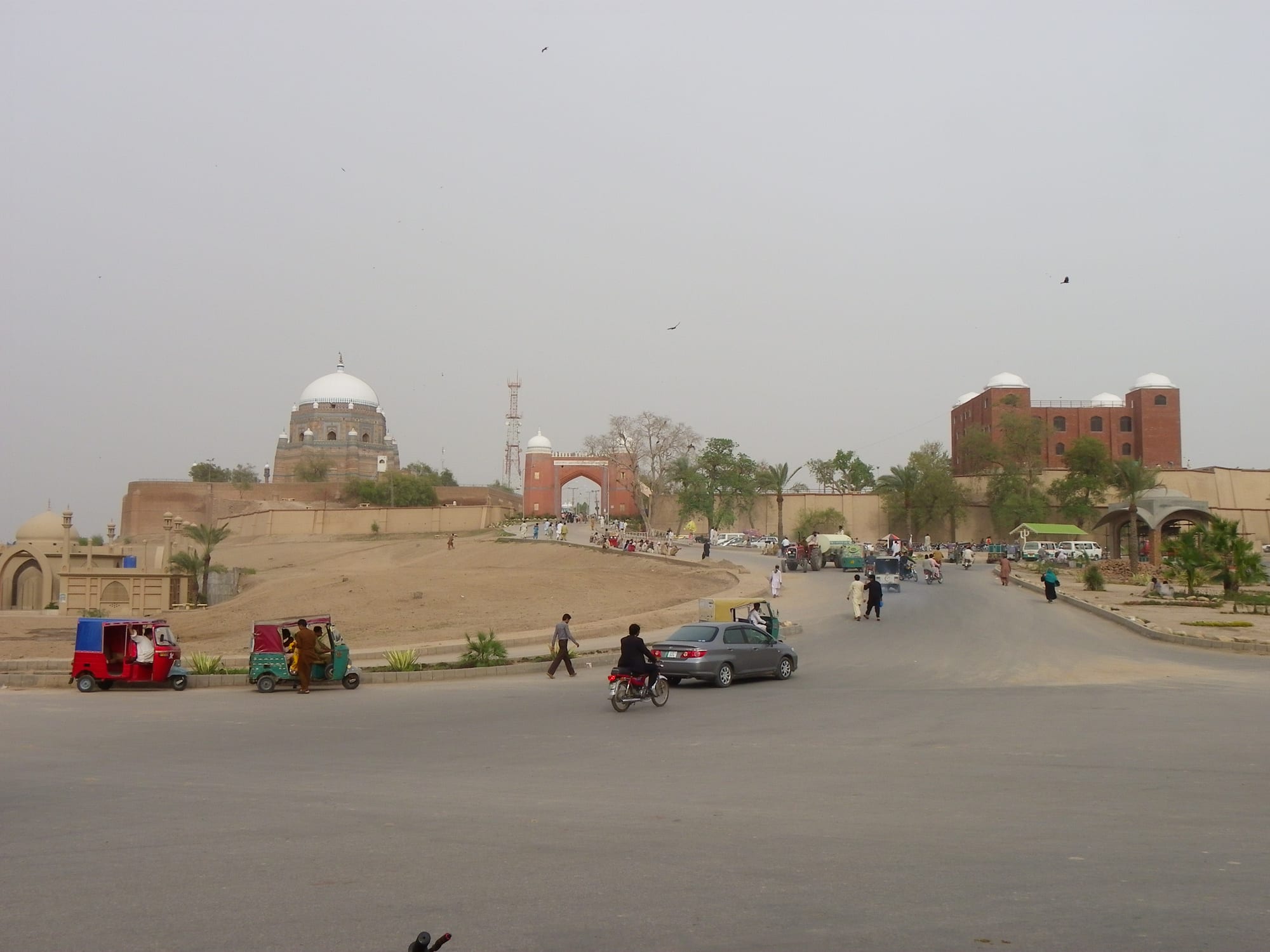
The domed tomb of Shah Rukn-e-Alam on the old fort mound above a road with rickshaws, motorbikes and a brick gateway

Lahore, Islamabad & Punjab, Pakistan

Multan

The fort mound in Multan, with the tomb of Shah Rukn-e-Alam on the left and the Qasim Gate in the centre. (Alhabib7 / Wikimedia Commons · CC BY-SA 3.0)

One of the oldest continuously inhabited cities in South Asia, standing on a mound above the Chenab plain in southern Punjab. Known as the city of saints for the Sufi shrines whose tiled brick domes rise over the old town, it is also the centre of Saraiki Punjab, of the mango trade and of blue-glazed pottery. This page is written to explain the city, not to encourage travel.

Neighbourhoods

  • The old city and the fort mound
    • First-time visitors
    • Historic district
    • Shrines

    The raised core of Multan, where the levelled fort mound carries the great shrines and the surviving gates mark the line of the old walls. Below it lie tight lanes of brick houses, bazaars and small mosques, best covered on foot or by rickshaw.

    Open in Maps
  • Hussain Agahi and the bazaars
    • Markets
    • Street food
    • Crafts

    The main commercial bazaar running through the old town, with separate lanes for cloth, shoes, spices and metalware, and the workshops that sell Multan's blue-glazed pottery, camel-skin lamps and khussa slippers.

    Open in Maps
  • Cantonment and the Mall
    • Quiet and residential
    • Hotels

    The army cantonment laid out by the British east of the old city, low-rise and greener than the centre, with the railway station, wide roads, some of the better hotels and the clubs and offices of colonial Multan.

    Open in Maps
  • Bosan Road and Gulgasht
    • Best for food
    • Shopping
    • Close to the university

    The modern northern corridor towards Bahauddin Zakariya University and the airport, lined with restaurants, bakeries, private hospitals and housing schemes. Most of the newer shopping and eating out in Multan happens along here.

    Open in Maps
  • Shah Rukn-e-Alam Colony and the southern suburbs
    • Quiet and residential
    • Local life

    Post-independence residential colonies spreading south and west from the old town, built for government employees and refugee families after 1947. Ordinary and largely residential, with local markets and tea shops rather than sights.

    Open in Maps

Things to do

Shrines and landmarks

  • Tomb of Shah Rukn-e-Alamlandmark

    The city's emblem — an octagonal brick mausoleum of the early 14th century on the fort mound, its sloping buttressed walls covered in blue and turquoise tilework under a white dome.

    Open in Maps
  • Shrine of Bahauddin Zakariyalandmark

    The tomb of the 13th-century Suhrawardi saint who established Multan as a centre of Sufism, a square brick chamber under a hemispherical dome, rebuilt after damage in the siege of 1848.

    Open in Maps
  • Multan Fortlandmark

    The levelled mound of the fortress destroyed by British bombardment in 1848, now a public open space carrying the shrines, the Qasim Gate and a park.

    Open in Maps
  • Ghanta Gharlandmark

    The colonial clock tower of the 1880s, built on the site of an earlier palace, standing in a busy square at the edge of the old city.

    Open in Maps
  • Multan Sun Templelandmark

    The site of the ancient temple of the sun god that made Multan famous in classical and early Islamic accounts, long destroyed and known mainly from those descriptions.

    Open in Maps
  • Bahauddin Zakariya Universityattraction

    The main university of southern Punjab, on a large campus north of the city, named after the saint buried on the fort mound.

    Open in Maps

Older sites

  • Prahladpuri Templelandmark

    The ruined Hindu temple on the fort mound, associated with the legend of Prahlad and long one of the city's oldest sacred sites.

    Open in Maps
  • Tomb of Shah Ali Akbarlandmark

    A tiled brick tomb of the Mughal period in the Suraj Miani area, west of the old city.

    Open in Maps

Museums and parks

  • Multan Museummuseum

    A small municipal collection of coins, manuscripts, tiles and archaeological finds from southern Punjab, near the old city.

    Open in Maps
  • Qasim Baghpark

    The park laid out over part of the old fort area beside the Qasim Gate, with lawns, a stadium and views up to the shrines.

    Open in Maps

Markets and crafts

  • Hussain Agahi Bazaarmarket

    The long central bazaar of the old city, where cloth, spices, dried fruit, household goods and sweets are sold from small shops in specialised lanes.

    Open in Maps

Sport

  • Multan Cricket Stadiumattraction

    The city's international cricket ground north of the centre, home matches of the Multan Sultans and the occasional Test.

    Open in Maps

Short trips from the city

  • Shujabadattraction

    A small walled town about 45 km south founded in the 18th century, with a surviving fort wall and gates, on the old road towards Bahawalpur.

    Open in Maps

Seasonal events

  • Urs of Shah Rukn-e-Alammonth of Jumada al-Awwal, moving through the year

    The saint's death anniversary, when the fort mound fills with pilgrims, dhamal drumming and stalls for several days.

  • Urs of Bahauddin Zakariyamonth of Safar, moving through the year

    A similar gathering at the older shrine beside it, with qawwali singing and free food distributed to pilgrims.

  • Mango seasonJune to August

    The southern Punjab harvest, when Chaunsa, Anwar Ratol and Sindhri mangoes fill the markets and are sent across the country and abroad.

  • Eid al-Fitr and Eid al-Adhadates move through the year with the Islamic calendar

    The two Muslim festivals, marked by prayers at the Eidgah, family visits and several days of closures.

Eat and drink

Long-standing places and food districts in Multan. Hours, ratings and directions come from your maps app, always current.

Multan classics

  • Sohan halwaneighborhood

    The city's famous sweet — a hard, brittle disc of reduced milk, sugar, ghee and nuts, sold in tins by long-established shops in and around the old bazaars.

    Open in Maps
  • Mangoesmarket

    Southern Punjab's orchards supply the Chaunsa and Anwar Ratol varieties that Pakistanis argue about every summer; the wholesale fruit market is the place to see them in bulk.

    Open in Maps
  • Saraiki karahi and tandoori breadneighborhood

    Mutton and chicken cooked in an iron wok with tomato and green chilli, eaten with tandoori roti or the thick sheermal and kulcha breads of the south.

    Open in Maps

Food districts and markets

  • Hussain Agahi food lanesmarket

    Stalls and small kitchens in the old bazaar selling samosas, pakoras, chana chaat, halwa puri in the morning and sweets all day.

    Open in Maps
  • Bosan Road restaurantsneighborhood

    The modern dining strip towards the university, with Pakistani grills, fast food, bakeries and cafés used by students and families.

    Open in Maps
  • Cantonment tea shopsneighborhood

    Dhabas and tea stalls near the railway station and the cantonment roads, serving doodh pati and lassi through the long, hot afternoons.

    Open in Maps

Experience Multan

History

Multan is one of the oldest inhabited places in South Asia, built on a mound raised by its own ruins beside a former course of the Ravi and near the Chenab. It is usually identified with the city of the Malli, whom Alexander the Great besieged in 326 BC and where he was seriously wounded. For centuries it was known for a celebrated temple of the sun god, whose wealth drew both pilgrims and raiders.

In 712 the Arab commander Muhammad bin Qasim took the city, and Multan became the northernmost outpost of Arab rule in the subcontinent and a centre of Ismaili influence. Mahmud of Ghazni attacked it in the 11th century, and under the Delhi Sultanate it grew into a great Sufi centre: Bahauddin Zakariya established his Suhrawardi order here in the 13th century, and his grandson Shah Rukn-e-Alam is buried in the tomb that still dominates the skyline. Their shrines made Multan "the city of saints", and generations of rulers, from the Langah sultans to the Mughals, governed it as a provincial capital and a hub of the caravan trade with Central Asia.

Afghan and then Sikh rule followed the Mughal decline; Ranjit Singh's forces took the city in 1818. The British besieged Multan in 1848–49 in the Second Anglo-Sikh War, and the bombardment destroyed the fort and much of the old town, leaving the mound that remains today. Under British rule the railway and canal irrigation turned the surrounding desert into cotton and mango country. Partition in 1947 exchanged its Hindu and Sikh population for Muslim refugees, and the city has since grown into the largest in southern Punjab, its shrines still the focus of its life.

Culture & Customs

Multan is the cultural capital of the Saraiki belt, the southern part of Punjab whose language, dress and music differ from those of Lahore and which has long campaigned for a province of its own. Saraiki is the mother tongue of most people here, softer in sound than Punjabi and rich in devotional poetry, and the city's identity is built on the shrines rather than on any court or industry.

Sufi practice shapes the year. The urs of a saint fills the mound with pilgrims, qawwali and the ecstatic drumming and dance called dhamal; langar, free food, is distributed; and Thursday evenings bring smaller versions of the same at shrines across the city. Devotional singing here draws on the Saraiki kafi tradition of poets such as Khwaja Ghulam Farid, whose verses are widely known.

Craft is the other inheritance. Multani kashi-kari — the white, blue and turquoise glazed tilework that covers the shrines — is still made in family workshops, along with blue pottery, camel-skin lamps that glow when lit from within, embroidered khussa slippers and block-printed cloth. Manners are formal and hospitable, with tea pressed on any visitor; dress is conservative, heads are covered at shrines and shoes removed at the door. Cricket is the shared enthusiasm, and the Multan Sultans give the city a team in the national league.

Daily Life

About 2.1 million people live in the city, which makes it the largest in southern Punjab and among the half-dozen largest in Pakistan. Growth has been outward along Bosan Road and the motorway approaches, while the old city inside the line of the vanished walls has become denser and poorer, with many families in subdivided brick houses.

The economy rests on agriculture and what it feeds. Multan is the collection and dispatch point for the mango and citrus orchards of southern Punjab and for the cotton belt around it, and the city has ginning factories, oil mills, fertiliser and textile plants, a large wholesale fruit market and a growing trade in dried fruit and dates. The universities and hospitals draw students and patients from across the south, and remittances from the Gulf support many households.

Life is organised around the heat. Shops open early, close through the worst of the afternoon in summer and reopen into the evening; bazaars and shrine courtyards are busiest after dark. Persistent problems are water and power supply, heatwaves that have become more severe, dust and smoke in winter, the pressure of farm mechanisation on rural jobs, and the long-running political question of whether southern Punjab should govern itself.

Food

Multan's most famous product is a sweet. Sohan halwa is a dense, brittle disc of milk and sugar cooked down with ghee, studded with pistachios and almonds and sold by the tin; it is the standard gift taken from the city, and several shops in the old bazaars have made it for generations. Alongside it come more ordinary sweets — jalebi, barfi, gulab jamun — and in winter gajar ka halwa of carrots and milk.

Savoury cooking is southern Punjabi. Mutton and chicken karahi cooked to order with tomato and green chilli, seekh kebabs and tikka from charcoal, slow-cooked daal, and on the sweeter side of the palate the milky rice dish zarda at weddings. Breakfast is halwa puri or siri paye with naan, and dahi, plain yoghurt, appears with almost every meal as relief from the chillies. Bread is a point of pride: thick tandoori roti, sheermal and kulcha from clay ovens on the bazaar corners.

Above all Multan means mangoes. The orchards around the city produce Chaunsa, Anwar Ratol, Langra and Sindhri varieties between June and August, and the harvest is a national event, with fruit sent by lorry to every city and by air abroad. Mango lassi, mango with roti at the end of a meal, and boxes carried onto trains are all part of the season. Year round, sugarcane juice, lemon squash and lassi are what people drink against the heat.

Planning tools

Budget

Multan is cheaper than Lahore and much cheaper than Islamabad. Rooms are modest outside a handful of business hotels on Bosan Road and in the cantonment, bazaar food costs very little, and rickshaws are the standard way to move around. Mango season pushes prices up slightly for rooms and transport.

Daily Budget Midrange
USD 45–100 (business hotel, restaurant meals, ride-hailing cars, a hired car for the shrines)
Daily Budget Shoestring
USD 12–25 (simple hotel or guesthouse, bazaar food, rickshaws and local buses)

The shrines are free to enter and shoes are left with an attendant for a small tip; blue pottery and khussa slippers are bought in the workshops of the old city rather than in hotel shops.

Best Time to Visit

November to March. Winter days are mild and clear, and the shrines and bazaars are comfortable to walk. April to June is punishing, regularly above 45°C, and Multan is one of the hottest cities in Pakistan; the monsoon from July to September brings humidity and dust storms, though it also coincides with the mango harvest.

Suggested Number of Days

One or two days suit the size of the city. Longer stays make sense for anyone interested in the outlying tombs, the craft workshops or the farmland around it. Summer heat shortens the usable part of the day considerably.

First Visit
1–2 days
With Surroundings
2–3 days

Transportation

Auto-rickshaws and the larger shared rickshaws called chingchis carry most local traffic, and ride-hailing apps work in the city. A metro bus line runs on a dedicated corridor between the northern suburbs and the city centre. The old city's lanes are too narrow for cars, so the shrines and bazaars are reached on foot from the edge.

Fix a rickshaw fare before setting off or use an app, and expect the traffic around the fort mound and Ghanta Ghar to be slow at any hour.

Airport & Station Connections

Multan International Airport lies about 10 km north-west of the centre, with domestic flights and Gulf connections. The M-4 and M-5 motorways link the city to Faisalabad and Lahore in roughly four hours and to Sukkur in the south, and coaches run frequently. Multan Cantonment railway station is on the main line between Lahore and Karachi, with several trains a day in each direction.

Walkability

The old city is a walking city by necessity: its lanes are narrow, uneven and crowded, and everything of interest is within a kilometre or so of the fort mound. Outside that core, Multan is spread out along wide roads with poor pavements and heavy traffic, and the heat for much of the year makes any distance unpleasant on foot. Early morning is the practical time to walk.

Safety

Southern Punjab is generally calm and policed, but Pakistan as a whole is not free of terrorism, and shrines and religious gatherings have been targets elsewhere in the country; expect searches and a police presence at the big shrines and during urs festivals. The everyday risks are extreme heat, traffic, dehydration, pickpocketing in crowded bazaars and crushes at festivals. Foreign visitors are sometimes assigned a police escort in southern Punjab, which can restrict where they go.

Carry water and cover the head in the hot months, keep valuables out of sight in the bazaars, avoid political rallies, dress modestly and cover the head at shrines. Check current official travel advice before travelling.

Climate

A hot desert climate on the edge of the Thal and Cholistan sands. Rainfall is low and concentrated in the monsoon, the sun is fierce for much of the year, and dust storms blow up before summer rain. Winters are short, mild by day and cold at night, with fog on the plain.

Summer
extremely hot — May and June days often reach 42–48°C, with humid monsoon storms and dust from July to September
Winter
mild days of 18–22°C, nights near 5°C, and dense fog in December and January

Local Customs

Multan is more conservative than Lahore or Islamabad. Modest dress is expected of everyone, and women cover the head at shrines; shoes are removed at shrine entrances and left with an attendant. Some shrines keep separate areas for women, and inner chambers may be closed to non-Muslims. Photography of worshippers, and of women in particular, needs permission. The local language is Saraiki, and a greeting in it is appreciated.

Greet with 'assalam-o-alaikum', use the right hand for eating and giving, accept offered tea, and expect little daytime food service during Ramadan; alcohol is not available.

Common Payment Methods

The currency is the Pakistani rupee. Multan runs on cash: bazaars, rickshaws, craft workshops and small kitchens take nothing else. Cards work in the better hotels and a few restaurants on Bosan Road. ATMs are easy to find in the cantonment and along the main roads, but not all accept foreign cards.