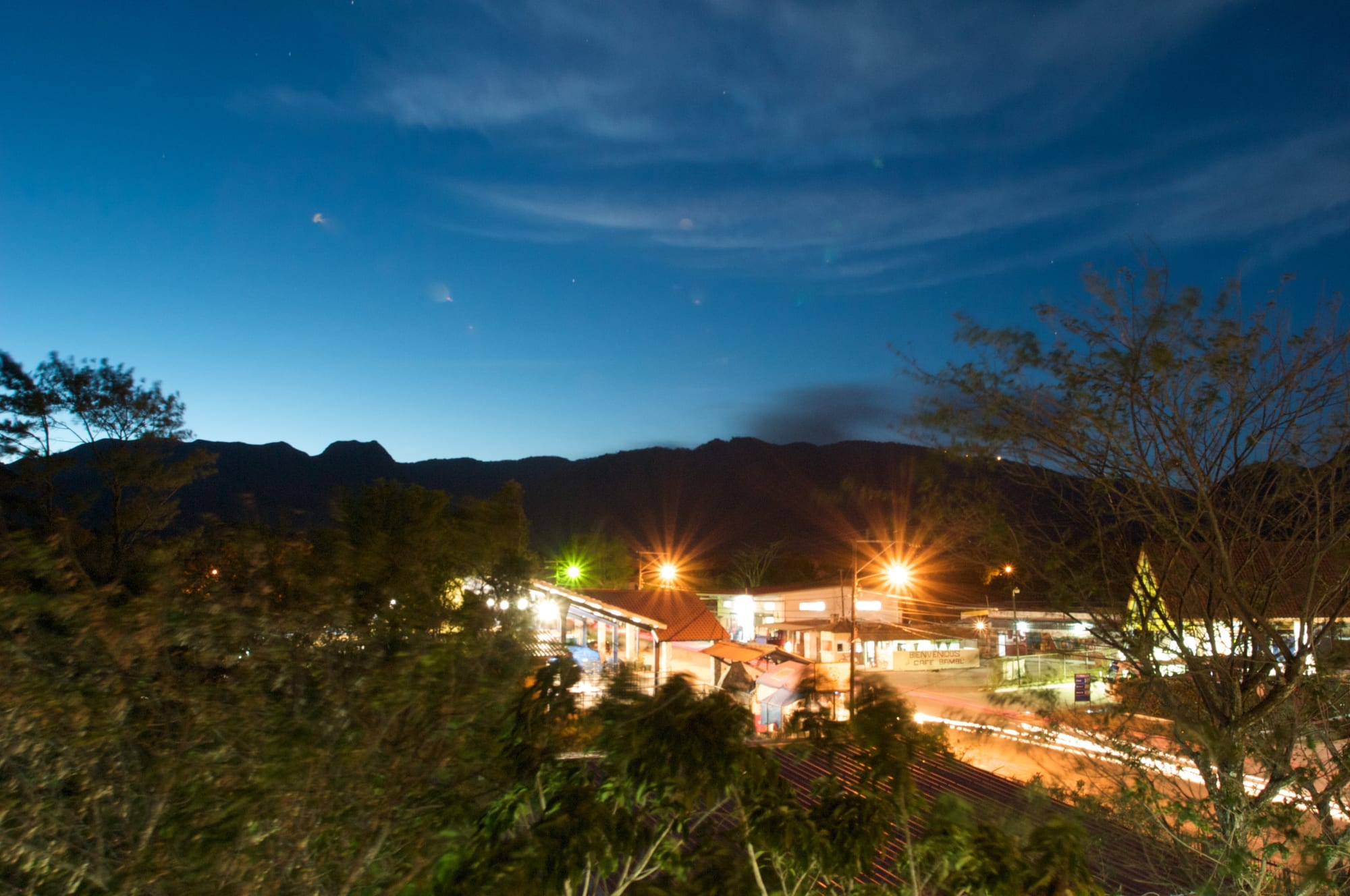
Buildings and street lights of El Valle de Antón at nightfall

The Azuero Peninsula & the Central Highlands, Panama

El Valle de Antón

El Valle de Antón at nightfall. (Garrison Gunter from State College, Pa, USA / Wikimedia Commons · CC BY-SA 2.0)

A small highland town in Coclé province, built on the flat floor of the caldera of the inactive El Valle volcano at about 600 metres. Long a cool weekend retreat for families from Panama City, it is a quiet place of one main street, a daily market, waterfalls, thermal pools and forested ridge trails, and a centre for orchid and frog conservation.

Neighbourhoods

  • Avenida Central and the market
    • First-time visitors
    • Best for food
    • Close to public transport

    The town's one main road, also called Calle Central, runs east to west across the valley floor. The public market, the parish church, small restaurants, bakeries and the bus stops are all along it, and on flat ground most people get about on foot or by bicycle.

    Open in Maps
  • The valley edges and the crater rim
    • Quiet and residential
    • Walks and nature

    Away from the main road, lanes lead out to weekend houses, many owned by families from Panama City, gardens and small farms. Trailheads for the ridges, the waterfalls and the thermal pools sit at the foot of the forested walls of the caldera.

    Open in Maps

Things to do

In the valley

  • El Valle volcanolandmark

    The stratovolcano whose top collapsed in a huge eruption long ago, leaving the wide caldera the town stands in; the lava domes of Cerro Pajita, Cerro Gaital and Cerro Caracoral rose inside it later.

    Open in Maps
  • El Valle public marketmarket

    The town's main landmark on Avenida Central, open every day though often called the Sunday market, selling fruit, vegetables and handicrafts, with the busiest trade at weekends.

    Open in Maps
  • Thermal poolsattraction

    A group of three small cement pools of mineral water whose colour varies with the minerals present at the time.

    Open in Maps
  • La Piedra Pintadalandmark

    A rock carved with pre-Columbian petroglyphs on a trail west of the town.

    Open in Maps
  • El Níspero zooattraction

    A small private zoo named after a kind of tree.

    Open in Maps
  • APROVACA orchid centreattraction

    An orchid conservation centre displaying more than 100 native local orchid species, founded to protect endangered Panamanian orchids.

    Open in Maps
  • El Valle Amphibian Conservation Centerattraction

    A rescue centre set up with the Houston Zoo to keep frogs, toads and salamanders safe from a deadly fungal disease, with displays on the Panamanian golden frog.

    Open in Maps

Waterfalls, walks and viewpoints

  • Chorro El Machoattraction

    A large waterfall near the town.

    Open in Maps
  • Chorro Las Mozasattraction

    A second waterfall near the town.

    Open in Maps
  • La India Dormidatrail

    The western ridge of the crater, named for its outline of a woman lying on her back; a popular trail climbs through woodland past a carved stone to open views across the valley.

    Open in Maps
  • Mirador Cerro Gaitalviewpoint

    A track on the northern ridge of the valley ending at a lookout platform over the caldera, often wrapped in cloud.

    Open in Maps

Seasonal events

  • Feast of San José19 March

    A celebration held in the town in honour of San José.

  • Festival ArtesanalMarch

    A handicrafts festival held in the town each March.

Eat and drink

Long-standing places and food districts in El Valle de Antón. Hours, ratings and directions come from your maps app, always current.

El Valle classics

  • El Valle public marketmarket

    Fresh fruit, vegetables and local produce from the volcanic soil of the valley floor, sold beside crafts.

    Open in Maps
  • Avenida Central restaurantsneighborhood

    Small local restaurants serving grilled and fried chicken and fish with rice, alongside a few Italian and Spanish places and a bakery.

    Open in Maps

Experience El Valle de Antón

History

The valley is the caldera of El Valle, the easternmost volcano of the Central American Volcanic Arc. In a huge eruption long ago its top collapsed into the empty magma chamber below, leaving a crater about 6 km wide; lava domes later rose inside it to form Cerro Pajita, Cerro Gaital and Cerro Caracoral. Until research in the early 1990s, it was thought that no active volcanism existed in Panama. Rain collecting in the crater formed a lake, and when it drained it left the dark, fertile soil, tierra negra, that still covers the valley floor and is sold in bags across the country.

People lived here long before the Spanish: the petroglyphs of La Piedra Pintada are the most visible trace. The town was long relatively isolated, and its first real road was built with money and labour from the community in 1927; it was repaved in 1997. From the early 20th century its cool climate made it a favoured retreat for established Panamanian families, and the town grew from about 4,900 people in 1990 to more than 7,500 by 2010. The forests around it later became known as one of the last habitats of the Panamanian golden frog.

Culture & Customs

El Valle presents itself as a piece of old Panama: one main street, a market, a parish church and a calendar of country festivals. San José is celebrated on 19 March, a handicrafts festival is held in March, and the town also marks Holy Week, patriotic parades, a farmers' week and festivals devoted to the golden frog and to the chayote, a local vegetable.

The Panamanian golden frog is a national symbol of Panama and an emblem of conservation. The forests around El Valle were among its last habitats, and the species may have been extinct in the wild since 2007; the town's amphibian centre, set up with the Houston Zoo, keeps collected frogs, toads and salamanders in clean conditions out of reach of the chytrid fungus. The orchid centre, founded in 2001, works to protect endangered Panamanian orchids, whose numbers in El Valle have been cut by poaching.

The town also draws people for quieter reasons. A number of settlers have come for its reputed spiritual atmosphere, offering yoga, massage and spa treatments. Some writers describe La India Dormida, the western ridge named for its outline of a woman lying on her back, as a sanctuary for meditation.

Daily Life

About 7,600 people lived in El Valle at the 2023 census. Some properties in the heart of the town belong to wealthy families from Panama City who use them as weekend or holiday homes, and the town's economy rests on these visitors, on day-trippers and foreign travellers, and on the produce of the valley's rich soil.

The pace is slow and the day is early. On the flat valley floor bicycles are the everyday transport, and at busy times whole families can be seen riding together down the main street. Life gathers along Avenida Central: small grocery shops, a bakery, a handful of restaurants and bars, the bus stops and the market, which is open every day but liveliest at weekends, when visitors arrive from the capital and the bars along the main street can turn noisy. When the sun goes down most of the town goes to sleep.

The forests and volcanic peaks north of the town form an Important Bird Area of about 10,600 hectares, home to black guans, olive-sided flycatchers and golden-winged warblers, and some of the forests around the town are protected areas. Cycling, hiking, horse riding and birdwatching are the town's everyday draws.

Food

El Valle eats like the rest of rural Coclé: rice, beans, plantains and maize, with chicken and fish served grilled or fried, stews of local beef, and sancocho, the chicken soup flavoured with culantro, as the dish of choice on a cool evening. Bakeries sell bread and sandwiches, and fondas serve set lunches of rice with a stew or meat and a side of salad or beans.

The market is the place to see what the volcanic soil grows: fruit and vegetables, many sold by the farmers themselves, with crafts alongside. The chayote, a mild green squash, is common enough to have a festival of its own. A few Italian and Spanish restaurants and a weekend pizza maker cater to visitors from the city, and there is an ice cream parlour.

Breakfast in the central provinces often means bollos, maize dough wrapped in husks and boiled, or thick fried maize tortillas, eaten with fresh white cheese from the region's dairies. Hojaldras, fried dough, are another morning staple, and carimañolas, yuca fritters stuffed with meat, and empanadas are sold as snacks.

Planning tools

Budget

El Valle is a weekend escape for Panama City families, so prices are higher than in the lowland market towns of Coclé, and rooms fill up on weekends and holidays. Accommodation runs from camping and simple guest houses to comfortable small hotels. Local restaurants are inexpensive, and the trails, waterfalls and private sights charge small entry fees.

Daily Budget Midrange
USD 80–160 (small hotel, restaurant meals, entry fees, a guide or taxi to the trailheads)
Daily Budget Shoestring
USD 35–60 (camping or a simple guest house, local restaurants and market food, minibuses)

Come midweek for quieter trails and easier rooms, and carry small notes for trail booths and market stalls.

Best Time to Visit

The dry season, from mid-December to late April, is sunny and very windy and the easiest time for the ridge walks. The rainy months that follow are greener and quieter; October and November are the wettest. Weekends and holidays bring crowds from the capital, and the town celebrates San José on 19 March.

Suggested Number of Days

One or two days covers the town and its valley floor at an easy pace. Three or four suit walkers, birdwatchers and anyone combining the crater with the beaches and colonial towns of Coclé. Rain and cloud on the ridges can make an extra day useful.

First Visit
1–2 days
With Surroundings
3–4 days

Transportation

The valley floor is flat, and bicycles are the usual local transport; bicycles and horses can be hired. Local taxis and small buses run along the main road, and some trailheads need a ride to reach. Minibuses link the town with the Pan-American Highway and the coast.

Trails on the crater walls can be steep and slippery after rain; set out early, before the clouds settle on the ridges.

Airport & Station Connections

El Valle is about 25 km up a two-lane road from the Pan-American Highway in Coclé, roughly two hours by road from Panama City. Frequent minibuses run to and from the Albrook terminal in the capital, taking two to two and a half hours; for other destinations travellers usually change at San Carlos on the highway. International flights arrive at Tocumen International Airport in Panama City.

Walkability

The town is small and flat, and most of what is in it can be reached on foot along the main road. Waterfalls, the thermal pools and the zoo are walkable or a short bicycle ride away; the ridge trails start farther out and involve real climbs.

Safety

Panama is one of the safer countries in Central America, and the main tourist areas are generally fine with normal precautions. The central region is among the calmest in Panama, with low crime in its market towns and villages. In El Valle the main risks are on the road and the trails: the winding route up from the highway, slippery paths in wet weather and fast-changing conditions on the ridges.

Avoid driving rural roads after dark, walk the ridge trails in company and in dry weather, and keep valuables out of sight. Check current official travel advice before travelling.

Climate

At about 600 metres, El Valle is cooler than the Panamanian lowlands, with fresh, spring-like weather much of the year and temperatures around 19°C. The dry season brings sunshine and strong winds; the rainy season brings afternoon storms and mist on the crater rim.

Summer
the wet season, May to November: 24–32°C in the region's lowlands, milder and misty in El Valle, with October and November the wettest months
Winter
the dry season, mid-December to April: sunny and windy, 18–28°C in El Valle

Local Customs

El Valle is a conservative country town with a slow rhythm: activity starts early and the town goes quiet soon after dark. A greeting of buenos días or buenas tardes is expected before any question. Dress is casual, but swimwear belongs at the pools and waterfalls rather than on the main street.

Ask before photographing people at the market, dress modestly in the church, and leave a tip in sit-down restaurants where no service charge is added.

Common Payment Methods

Panama uses the US dollar as paper currency, with its own balboa coins of the same size and value. Cards are accepted at hotels and some restaurants, but the market, small eateries, buses, taxis and trail booths run on cash, so carry enough small notes.