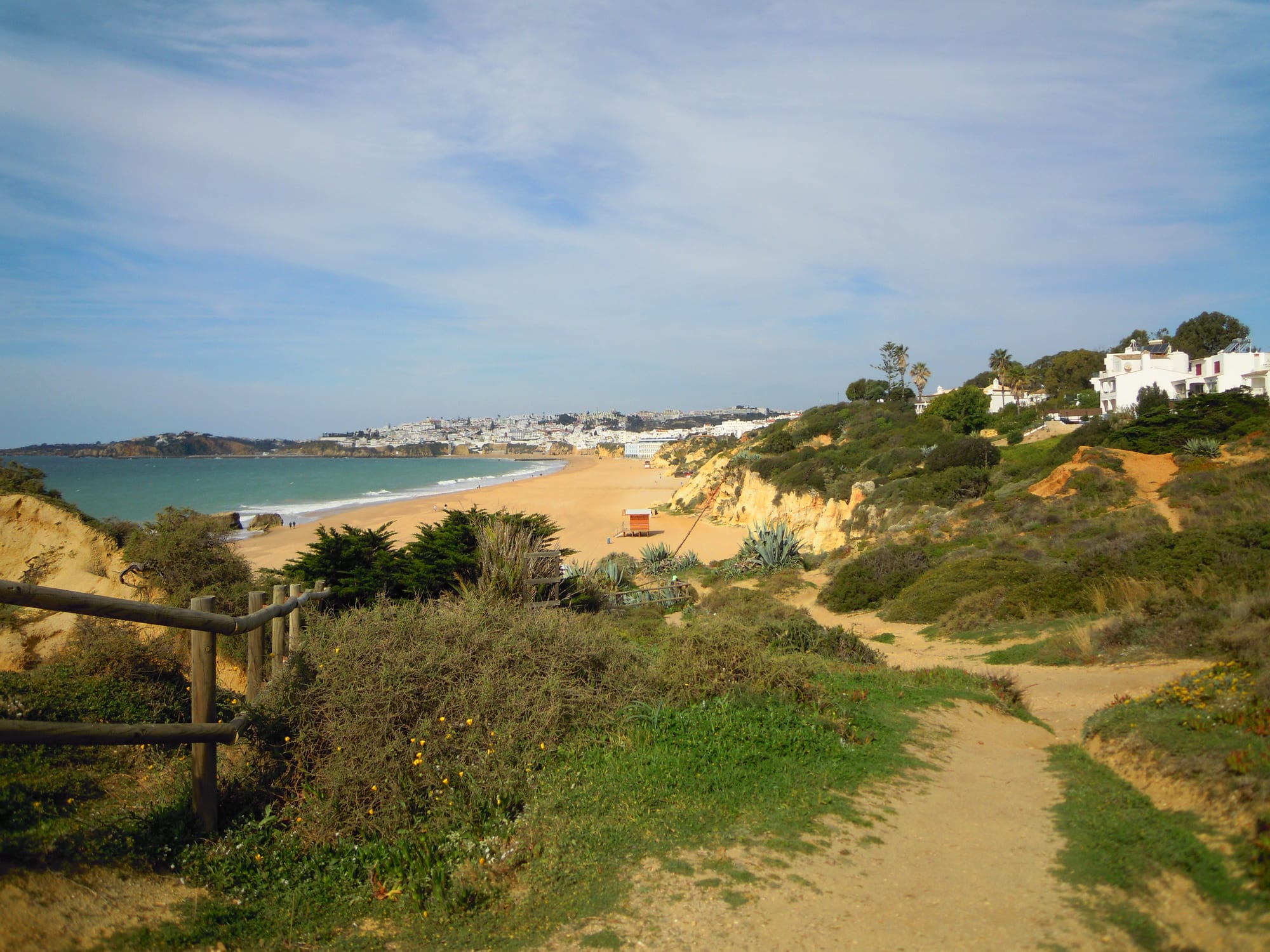
A sandy cliff-top path above a long golden beach curving towards the white houses of Albufeira's old town

The Algarve, Portugal

Albufeira

The cliff path above Praia dos Alemães, looking west along the beaches to Albufeira's old town. (Kolforn / Wikimedia Commons · CC BY 3.0)

The Algarve's busiest resort, on the south coast between Lagoa and Faro. A Moorish stronghold and later a small fishing town wrecked by the 1755 tsunami, it grew from the 1960s into a holiday city of white houses on cliffs above the sea, with an old town, a nightlife strip and a long chain of sandy beaches.

Neighbourhoods

  • Old Town
    • First-time visitors
    • Historic district
    • Beaches

    The white-walled centre on the cliffs above Praia dos Pescadores and Praia do Túnel, with narrow streets, the clock tower, the parish church and the archaeology museum. Its lanes fill with shops, bars and seafood restaurants, and pavement terraces face the fishermen's beach.

    Open in Maps
  • Areias de São João and The Strip
    • Nightlife
    • Beaches

    The eastern district around Praia da Oura, about two kilometres from the old town. Avenida Francisco Sá Carneiro, known as The Strip, is lined with bars, restaurants and open-air clubs that stay busy into the early hours in summer.

    Open in Maps
  • Olhos de Água
    • Quiet and residential
    • Beaches
    • Best for food

    A former fishing village east of the town, named for the freshwater springs that appear on its beach at low tide. Fishing boats are still hauled up the slipway, and it gives access to the long red cliffs of Praia da Falésia.

    Open in Maps
  • The Marina
    • Boat trips
    • Quieter evenings

    On the western edge of the city, an artificial basin opened in 2003 with moorings for nearly 500 boats. The working fishing harbour sits beside it, and many of the boat trips along the coast leave from here.

    Open in Maps

Things to do

Beaches

  • Praia dos Pescadoresbeach

    The fishermen's beach in front of the old town, a Blue Flag beach and the setting for the city's big New Year's Eve celebrations.

    Open in Maps
  • Praia do Túnelbeach

    The western of the two town beaches, also called Praia do Peneco, named after the 20-metre tunnel that cuts through the cliff from the town square to the sand.

    Open in Maps
  • Praia da Ourabeach

    A Blue Flag beach of about 900 metres in the Areias de São João district, at the bottom of The Strip.

    Open in Maps
  • Praia de Santa Euláliabeach

    A Blue Flag beach east of the town, between Praia da Oura and Olhos de Água, with fine golden sand backed by golden cliffs and rock formations.

    Open in Maps
  • Praia da Falésiabeach

    Cliff Beach — a long strand below red and whitish cliffs that run from Barranco das Belharucas east towards Vilamoura.

    Open in Maps
  • Praia de São Rafaelbeach

    A small beach west of the old town below golden limestone cliffs, scattered with eroded rock formations such as the Swallow's Nest.

    Open in Maps

The old town

  • Municipal Archaeology Museummuseum

    A small museum in the former town hall on Praça da República, with finds from prehistory through the Roman, Visigothic and Islamic periods to modern times.

    Open in Maps
  • Torre do Relógiolandmark

    The 19th-century clock tower on Rua Bernardino de Sousa, crowned with an iron belfry, which the city treats as its emblem.

    Open in Maps
  • Igreja Matrizlandmark

    The neoclassical parish church of Nossa Senhora da Conceição, consecrated in 1800 to replace the former mosque that collapsed in the 1755 earthquake.

    Open in Maps

Short trips from the town

  • Castle of Padernelandmark

    The ruined walls of a 12th-century Almohad castle on a bend of the Quarteira river inland, thought to be one of the castles on Portugal's national flag.

    Open in Maps
  • Guianeighborhood

    An inland parish town about five kilometres from the coast, known for its chicken restaurants and its Baroque hermitage of Nossa Senhora da Guia.

    Open in Maps
  • Zoomarineattraction

    A marine park near Guia with dolphin, seal and sea lion presentations, an aquarium and pools, popular with families.

    Open in Maps

Seasonal events

  • Almond Blossom Cross Countryearly March

    An international cross country race first run in 1977, held in Albufeira every year since 2005 and one of the IAAF permit meetings.

  • Festa do Frangofirst weekend of August

    Guia's chicken festival, celebrating the piri-piri chicken the village is known for.

  • Festas de Nossa Senhora da Oradamid-August

    Festivities on 14 and 15 August for Our Lady of Orada, whose hermitage is a Marian shrine that draws pilgrims from across the Algarve.

  • Municipality Day20 August

    The town's holiday, marking the charter granted by King Manuel I on 20 August 1504.

  • New Year's Eve31 December

    A large open-air party on Praia dos Pescadores, which set a Guinness record when 25,000 people raised a toast at the turn of 2009–10.

Eat and drink

Long-standing places and food districts in Albufeira. Hours, ratings and directions come from your maps app, always current.

Albufeira classics

  • Old town seafood restaurantsneighborhood

    The lanes and terraces around Praia dos Pescadores, where many restaurants serve fish and shellfish caught close to the beach — grilled sardines, caldeirada and cataplana.

    Open in Maps
  • Guia chicken housesneighborhood

    Chicken piri-piri is the village's speciality, served in its many chicken restaurants; Guia is known locally and nationally as the capital of chicken.

    Open in Maps

Markets

  • Mercado Municipal de Albufeiramarket

    The town market near the bus station, for fish, fruit and vegetables and dried figs from local growers.

    Open in Maps
  • Olhos de Água fishermen's squareneighborhood

    A small fish market and a cluster of fish and shellfish restaurants by the beach where the village's boats still land their catch.

    Open in Maps

Experience Albufeira

History

The Romans called the settlement Baltum and farmed and traded around it, leaving traces of roads and bridges. After the Visigoths, Muslim forces from North Africa took the area early in the 8th century, and the town's name comes from their word al-Buħayra, "the lagoon", for the lagoon that formed in the lowlands. The Moors fortified it so strongly that it held out longer than most of their possessions in Portugal; Templar and Hospitaller knights failed to take it, and it fell only in 1249, after the capture of Faro, to the forces of Afonso III, who gave it to the Order of Aviz. King Manuel I granted it a charter on 20 August 1504.

Few Algarve towns suffered more from natural disaster. In the 1755 earthquake waves about 10 metres high swept over the lower town, and only 27 houses were left standing, all of them damaged; the parish church, a converted mosque where many people had taken shelter, collapsed and killed 227. In 1833, during the Liberal Wars, the absolutist guerrilla leader Remexido attacked the town and executed many of its inhabitants.

Fishing revived Albufeira in the 19th century, and in the early 20th century when fish and nuts were the main exports, five factories employed 700 to 800 people, mostly fishermen's wives. Between 1930 and 1960 many factories closed, the fleet shrank and the population fell by half. Tourism arrived in the 1960s and transformed the place: the town spread over the surrounding hills, became a city in 1986, and in 2025 was the most visited place in the Algarve by overnight stays and the second in Portugal.

Culture & Customs

Albufeira's culture is shaped by the meeting of an old fishing town with one of Portugal's largest tourist centres. The architecture mixes the Algarve's white, tiled houses on narrow streets with large modern hotels and apartment blocks, and the town has more foreign residents than any other city in Portugal. The fishermen's beach is still the centre of town life, and it hosts the big public celebrations — on New Year's Eve 2009–10 some 25,000 people gathered there for what Guinness recorded as the world's largest toast.

The calendar follows the church and the sea. Festivals honour Our Lady of Orada in mid-August and the Blessed Vicente of Albufeira in September; the city celebrates its charter on 20 August; Olhos de Água holds octopus and sardine festivals; and Guia, inland, has its chicken festival on the first weekend of August. The painter Samora Barros, from Albufeira, is remembered in the parish church, whose altarpiece he painted, and in the municipal gallery named after him in the old power station.

Sport has an international flavour. The local club, Imortal DC, plays football and basketball; many British football clubs have spent pre-season training camps in the town; and the Almond Blossom Cross Country, first run in 1977, brings international runners every March. At night the Strip in Areias de São João, with its bars and open-air clubs, is the best-known nightlife district in the Algarve.

Daily Life

The city proper had about 28,600 people at the 2021 census and the wider municipality about 44,000, spread over four parishes: Albufeira e Olhos de Água, Ferreiras, Guia and Paderne. In summer, and over Christmas and New Year, the number of people in the municipality is estimated to rise to around 300,000, and most of them arrive through Faro Airport.

Tourism and commerce are the economy. Hotels, apartments, restaurants, bars, golf courses and the marina provide much of the work, and the work rises and falls with the season. A small fleet of traditional boats still works from the fishing harbour beside the marina, sharing it with the boats that take visitors along the coast to the sea caves, and at Olhos de Água boats are still pulled up the beach slipway.

Residents live in the hills and suburbs behind the coast, in Ferreiras near the railway station and in the inland villages of Guia and Paderne, while the seafront and the old town are given over largely to visitors. In summer the town keeps late hours, with restaurants and bars busy well into the night; in winter many seasonal businesses close and the town becomes quiet, its streets used mainly by residents and long-stay visitors.

Food

Albufeira eats from the sea. Cataplana, a well-known Algarve dish, takes its name from the hinged copper pan, shaped like two clamshells, in which it is cooked; the sealed pan steams the ingredients, and clams, prawns and pork are the most popular fillings, cooked with onion, peppers, tomato, garlic, olive oil and white wine. Caldeirada is a fishermen's stew of several kinds of fish and potatoes, which varies with the catch, and grilled sardines are a summer staple. Fish is far cheaper than shellfish such as prawns, lobster and crab.

Inland, Guia is known locally and nationally for its chicken piri-piri restaurants, and a chicken festival celebrates it each August. Dishes of salt cod, bacalhau, are common on menus throughout the town.

For produce, the municipal market near the bus station sells fish, fruit and vegetables and dried figs from local growers, and the fishermen's square at Olhos de Água has a small fish market of its own. The Algarve's sweets are made from figs, almonds and honey, and its regional spirit is medronho, a strong brandy distilled from the fruit of the strawberry tree in the hills. Along The Strip and in the newer districts, restaurants serve the food of the visitors' home countries as much as Portuguese cooking.

Planning tools

Budget

Albufeira's prices depend almost entirely on the season. In July and August, and at Christmas and New Year, rooms and apartments cost the most and the town's population multiplies. Out of season, prices fall sharply. Fish is much cheaper than shellfish such as prawns, lobster and crab, and drinks cost more in the clubs than in the bars.

Daily Budget Midrange
USD 140–280 (hotel or apartment, seafood dinners, a boat trip along the coast, a hire car or taxis)
Daily Budget Shoestring
USD 60–100 (hostel or simple guesthouse, market food and grilled fish, local buses)

Visit in May, June, September or October for warm weather and lower prices; the beaches and the cliff paths cost nothing.

Best Time to Visit

May, June, September and October bring warm days and fewer people. July and August are the peak, with crowded beaches, the busiest nights on The Strip and most of the town's festivals. Winter is mild and quiet, and the cross country race comes in early March.

Suggested Number of Days

Two or three days cover the town itself. Most visitors stay a week or more as a beach holiday, and a longer stay also allows time for the inland villages and the rest of the Algarve coast. Without a car, the spread of the resort along the coast adds time.

First Visit
2–3 days
With Surroundings
5–7 days

Transportation

The resort stretches along the coast from Galé in the west to Olhos de Água and Falésia in the east, so most people use local buses, taxis or a hire car between districts. The Giro town buses link the bus terminal, the old town and the beaches. Driving is complicated by a maze of roundabouts, and car hire is not cheap.

Carry cash for the town buses, which do not take bank cards.

Airport & Station Connections

Most visitors fly into Faro Airport, the gateway to the Algarve; Faro lies about 45 kilometres to the south-east, and transfers, taxis and buses run to the resort. Albufeira-Ferreiras railway station, on the Algarve line, is about 6 kilometres from the centre and linked by bus; trains from Faro take about 40 minutes, and some Lisbon–Faro trains stop there. Long-distance coaches use the town's bus terminal. Lisbon is about 250 kilometres away.

Walkability

The old town is compact and best seen on foot, though its streets climb steeply from the beach and there are steps. The cliff-top paths between beaches make good walks. Beyond the centre the resort is spread out along main roads and roundabouts, and The Strip is a bus or taxi ride from the old town rather than a pleasant walk.

Safety

Portugal is one of the safest countries in Europe, with low violent crime. In Albufeira the problems are those of a crowded resort: pickpocketing, bag theft on beaches, break-ins at car parks, and drunken trouble late at night on The Strip. Parts of the coastal cliffs are soft and eroding.

Keep well back from cliff edges and never sit beneath them, swim where lifeguards are on duty, and leave nothing in parked cars. Check current official travel advice before travelling.

Climate

A sunny Mediterranean climate with hot, dry summers and mild, wetter winters. In nearby Faro, most rain falls in winter and it is scarce from June to September, and there are more than 3,000 hours of sunshine a year.

Summer
hot, dry and sunny — in nearby Faro average daytime highs are 27–35°C
Winter
mild by European standards — in nearby Faro the coldest month averages around 8–16°C, with about six hours of sunshine a day

Local Customs

Albufeira is one of the most international places in Portugal. It has more foreign residents than any other Portuguese city, English is widely spoken and many businesses cater to British and Irish holidaymakers. Away from the bars, the town keeps Portuguese customs: a greeting on entering a shop or café, and religious festivals for its patron saints.

Dress modestly and keep quiet inside churches, which are working places of worship.

Common Payment Methods

Portugal uses the euro. Cards and contactless payment are accepted almost everywhere, and Multibanco cash machines are common. Keep some cash for the town buses, market stalls and small cafés.