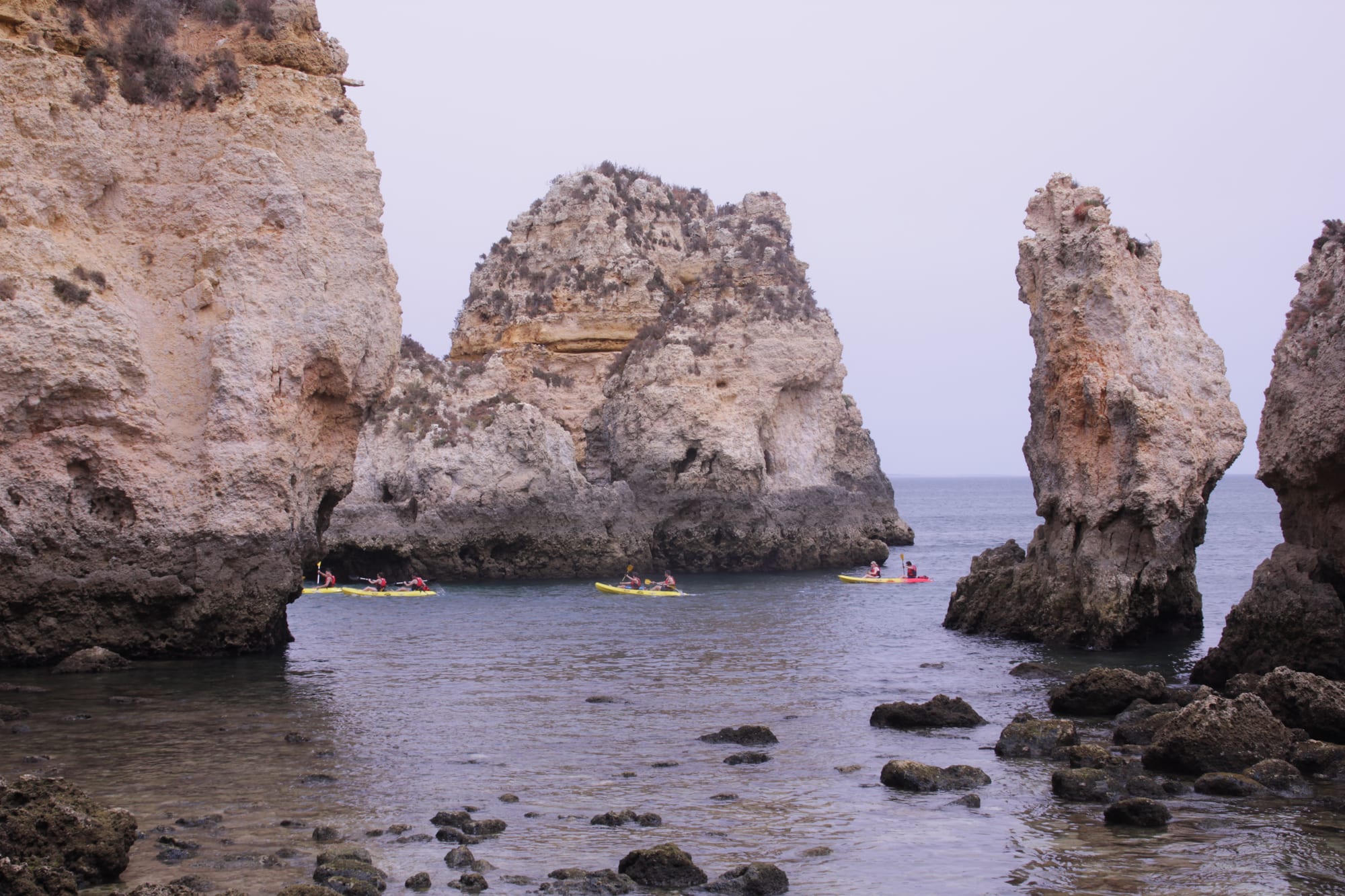
Golden limestone stacks rising from calm sea water, with a line of yellow kayaks passing between the rocks

Portugal

The Algarve

Sea stacks and kayakers at Ponta da Piedade, on the coast just south of Lagos. (Paul Wilkinson / Wikimedia Commons · CC BY 2.0)

Portugal's southernmost region, a strip of coast and low hills between the Atlantic and the Spanish border on the Guadiana — the last land taken from the Moors, the launch pad of the Age of Discovery, and since the 1960s the country's great beach destination, with golden cliffs in the west and lagoon islands in the east.

Explore The Algarve

History

Phoenicians and Carthaginians traded along this coast, and the Romans built towns such as Balsa near Tavira and villas like Milreu, near Faro, with its mosaics. The Moors, who called the region al-Gharb, "the west", ruled it for five centuries. Silves, then Xelb, was its capital, a city of poets and orchards whose governor al-Mu'tamid became one of the great poets of al-Andalus. Afonso III took Faro in 1249, completing Portugal's reconquest, and until 1910 the monarchs styled themselves kings "of Portugal and the Algarves".

In the 15th century the region became the base of Henry the Navigator. Caravels sailed from Lagos down the African coast; Gil Eanes of Lagos rounded Cape Bojador in 1434; and in 1444 Lagos saw the first large sale of enslaved Africans in Europe, recalled today in a small museum. Sagres, on its promontory, is linked with Henry's name and was raided by Francis Drake in 1587, and in 1596 English troops sacked Faro and carried off the bishop's library, which ended up in Oxford.

The 1755 earthquake and tsunami devastated the coast, and Lagos lost its role as regional capital to Faro. The Marquis of Pombal built Vila Real de Santo António as a planned town on the Guadiana. Through the 19th and early 20th centuries the Algarve lived on fishing, tuna traps and canneries, figs, almonds and cork, until Faro airport opened in 1965 and mass tourism transformed the coast.

Culture & Customs

The Algarve has long felt somewhat apart from the rest of Portugal, cut off by the mountains and the Alentejo plain, and its Moorish past shows in its architecture: the lacy white chimneys on older houses, the flat roof terraces of Olhão, and whitewashed walls with coloured trims. Algarvians speak with a distinctive accent, and the older rural culture of the hills survives in villages such as Alte and Querença.

Loulé is the region's cultural centre. Its Carnival is the largest in the Algarve, its municipal market hall is a town landmark, and the Festa da Mãe Soberana is one of the region's main religious events. Olhão holds an annual seafood festival, and Silves stages a medieval fair in its castle each summer.

Traditional crafts include copper cataplanas, palm-leaf baskets and hats, and hand-painted ceramics, with Porches among the best-known pottery centres. Tourism has also made the Algarve the most international part of Portugal. British, Dutch, German, French and Scandinavian residents have settled in large numbers, English is spoken widely along the coast, and golf, marinas and winter residents are part of local life. Beyond the resorts, fishing towns such as Olhão, Portimão and Quarteira keep a working-port character, and inland villages follow a quieter rhythm tied to the church, the café and the harvest.

Daily Life

The Faro district has about 470,000 permanent residents, but its population multiplies in summer. Loulé is the most populous municipality, with around 75,000 people; Faro, the regional capital, has about 65,000, and Portimão, Olhão, Albufeira, Silves, Lagos and Tavira are the other main towns. Much of the growth is along the coast, while the hill villages of the Serra do Caldeirão and Monchique have aged and emptied.

Tourism dominates the economy through hotels, restaurants, golf courses and construction, which makes employment strongly seasonal: jobs multiply in summer and many close in winter. Agriculture remains important, above all oranges from the Silves area, almonds, carob and figs, alongside newer avocado and berry plantations. Fishing and shellfish farming continue in Olhão, Portimão and the Ria Formosa, where clams and oysters are harvested, and salt is gathered in the pans of Castro Marim and Tavira.

The pressing issues are water and housing. Years of drought have left reservoirs low and forced restrictions on farms and golf courses, and local workers struggle to find affordable homes in a market shaped by holiday lets and foreign buyers. Daily life follows the sun: early swims, long lunches, evening strolls along the harbour.

Food

The Algarve eats from the sea. Its best-known dish is cataplana, a seafood, pork or fish stew cooked in a hinged copper pan, named after the pan itself. Portimão is famous for grilled sardines, Santa Luzia near Tavira calls itself the octopus capital, and tuna, once caught in large coastal traps, is served grilled or as steaks at Tavira and Vila Real de Santo António. Arroz de lingueirão is rice with razor clams, xerém a cornmeal porridge cooked with clams or pork, and goose barnacles, percebes, are gathered on the rocks of the west coast near Sagres. Inland, frango da Guia, spit-roasted chicken with piri-piri, comes from the village of Guia near Albufeira.

The region's sweets are made from almonds, figs, carob and eggs. Dom Rodrigos are egg threads with almond wrapped in coloured foil, morgados are almond cakes filled with egg sweets, and doces finos are marzipan shaped into fruit and animals. Figos cheios, stuffed figs, are a speciality of Olhão.

The regional spirit is medronho, a strong brandy distilled from the fruit of the strawberry tree, especially in the Monchique hills. The Algarve has four wine appellations, Lagos, Portimão, Lagoa and Tavira, and its salt flower, flor de sal, from Castro Marim and the Ria Formosa is prized by cooks.

Attractions & Natural Wonders

In the east, Faro's walled old town surrounds the cathedral, and the Carmo church has a chapel lined with bones. The Ria Formosa lagoon stretches along the coast, with ferries to the barrier islands of Culatra, Armona and Deserta. The Roman ruins of Milreu and the Estoi Palace lie inland. Tavira has an old bridge over the Gilão, a castle and many churches, and its island beach at Barril is marked by rows of rusting anchors from the old tuna fishery. Cacela Velha overlooks the lagoon, and Castro Marim's castle faces the salt marshes on the Guadiana border.

The central coast is the resort heartland. Albufeira's old town and Praia dos Pescadores sit next to its busy nightlife strip, and Praia da Falésia runs below red and ochre cliffs. Near Carvoeiro, the Seven Hanging Valleys trail passes Praia da Marinha and reaches the Benagil sea cave, a vast chamber with a round opening in the roof, reached by boat or kayak and now subject to restrictions to manage the crowds. Portimão has Praia da Rocha, and inland Silves is crowned by its red sandstone Moorish castle.

In the west, Lagos has town walls, the slave market museum, and the headland of Ponta da Piedade with arches, stacks and grottoes. Sagres fortress and the lighthouse on Cabo de São Vicente stand on the southwestern tip of mainland Europe. Along the wilder west coast, Aljezur, Arrifana and Odeceixe face the Atlantic surf, and inland Monchique's Fóia peak, at about 900 metres, is the highest point in the Algarve.

Cities in The Algarve

Planning basics

Budget

The Algarve's prices swing with the seasons. In July and August accommodation in Albufeira, Lagos, Vilamoura and Carvoeiro is among the most expensive in Portugal, and golf resorts and villas are costly all year. From October to April prices fall sharply, and inland towns such as Silves, Loulé and Monchique are cheaper than the coast.

Daily Budget Midrange
USD 140–290 (hotel or apartment, seafood dinners, a boat trip to the caves, a hire car)
Daily Budget Shoestring
USD 55–100 (hostel or guesthouse, fish lunches in local tascas, regional trains and buses)

Visit in May, June, September or October for warm sea and lower prices, and eat where fishermen do rather than on the seafront strips.

Safety

The Algarve is safe, with mainly petty crime in the busiest resorts: pickpocketing, bag theft on beaches and break-ins at car parks. Late nights on the Albufeira strip can bring drunken trouble. The real dangers are natural: the limestone cliffs collapse without warning, currents are strong on the west coast, and summer wildfires hit the Monchique hills.

Keep well back from cliff edges and never sit beneath them, swim where lifeguards are on duty, and leave nothing in parked cars. Check current official travel advice before travelling.

Climate

The sunniest and driest part of Portugal. The Serra de Monchique and the hills behind the coast shelter the south-facing shore from northern winds, so winters are mild and summers long and hot. The sea is warmer in the east near Tavira than on the west coast, where the Atlantic is cooler and rougher. Drought has become a serious problem in recent years.

Summer
hot and dry, 28–33°C, sometimes hotter inland; sea around 20–23°C
Winter
mild and sunny between showers, 10–17°C

Transportation

Faro airport serves the whole region. Direct trains run from Lisbon to Faro, and a slow regional line runs along the coast from Lagos to Vila Real de Santo António, though some stations are far from the towns they serve. Buses fill the gaps. The A22 motorway crosses the region, toll-free since January 2025, and the west coast and the hills are best explored by car.

Book cave boat trips from Portimão, Carvoeiro or Benagil early in the day, when the sea is calmest.

Best Time to Visit

May, June, September and October give warm weather, swimmable sea and fewer crowds. July and August are the peak, with packed beaches and traffic, while winter is mild and popular with walkers, golfers and long-stay visitors. Almond blossom colours the hills in late January and February.