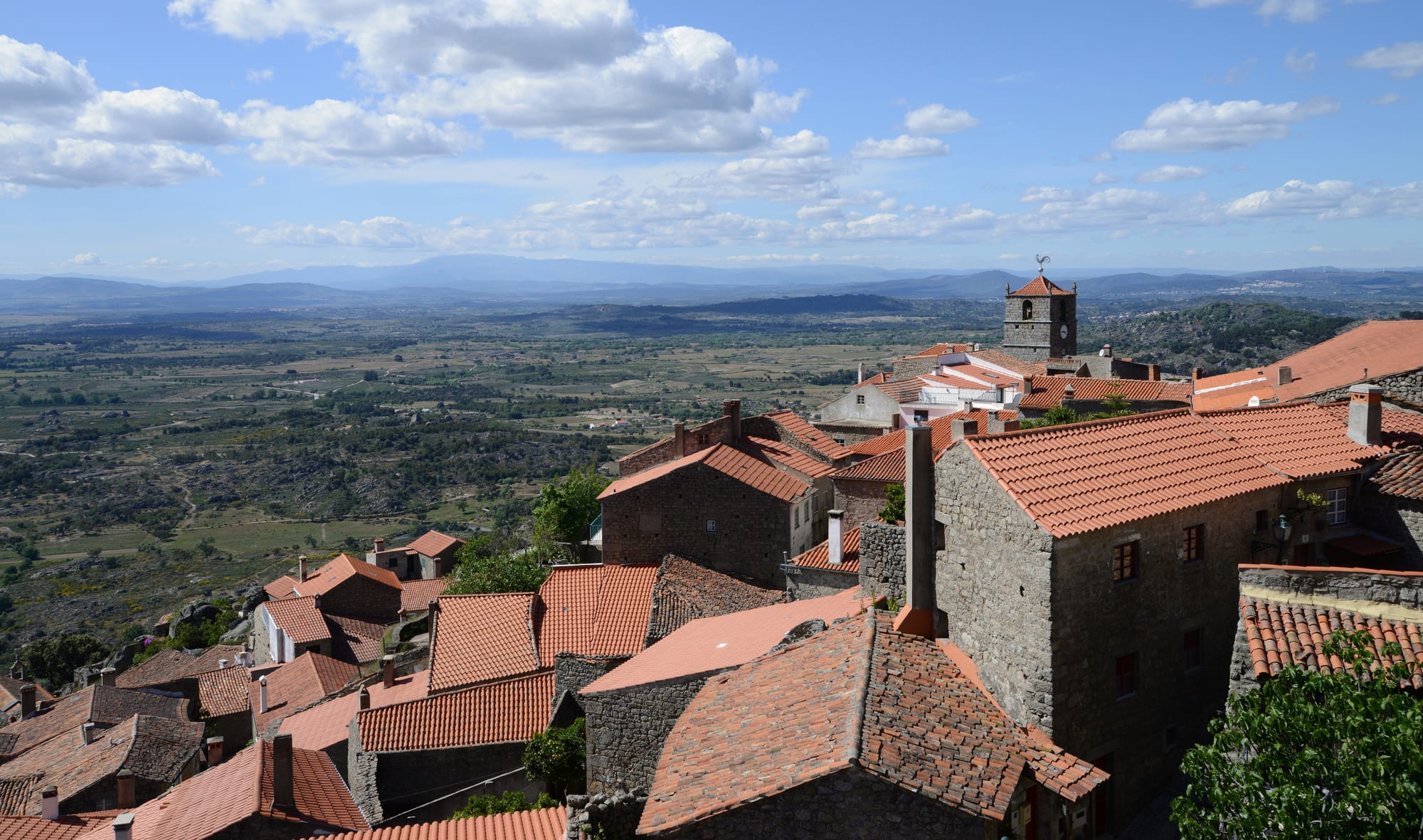
Stone houses with orange tiled roofs and a bell tower, looking over a wide plain of fields and scrub to distant hills

Portugal

Central Portugal

The granite village of Monsanto, looking out over the plains of Beira Baixa. (Alvesgaspar / Wikimedia Commons · CC BY-SA 4.0)

The broad middle of Portugal, from the Atlantic lagoons of Aveiro and the surf of Nazaré across the Ribatejo plains and the university city of Coimbra to the granite uplands of the Serra da Estrela and the Spanish border — a region of great monasteries, pilgrim Fátima, wool towns and fortified hill villages.

Explore Central Portugal

History

The Romans built Conímbriga, whose mosaic floors survive south of Coimbra, and the Lusitanian leader Viriathus, who resisted Rome in the 2nd century BC, is linked by tradition with the mountains of the interior. After centuries of Moorish rule and Christian reconquest, Coimbra became the capital of the young kingdom in 1131, and Afonso Henriques, the first king, lies in its monastery of Santa Cruz. Lisbon took over as capital in the 13th century, but the university, founded in Lisbon in 1290, settled permanently in Coimbra in 1537.

The Knights Templar built their castle at Tomar in 1160 to guard the frontier. When the order was suppressed, King Dinis transferred its lands to the new Order of Christ, which, under Henry the Navigator as its governor, helped finance the voyages of discovery. In 1385 João I defeated Castile at Aljubarrota and gave thanks with the monastery of Batalha, while the Cistercian abbey at Alcobaça holds the tombs of Pedro I and Inês de Castro, whose murder at Coimbra in 1355 became Portugal's great tragic love story.

In 1810 Wellington's army checked the French at the ridge of Buçaco. In 1917 three shepherd children at Fátima reported visions of the Virgin Mary, and the village became one of the Catholic world's leading shrines. The interior has since lost much of its population to the coast and abroad, and in 2017 wildfires around Pedrógão Grande killed dozens of people, the worst in the country's history.

Culture & Customs

The centre is a patchwork rather than a single identity: the Beiras of the hills and the border, the Ribatejo of horses and bulls along the Tagus, and the fishing coast. Coimbra's culture is shaped by its students, who still wear black capes, and by Coimbra fado, sung by men and closer to a serenade than Lisbon's tavern fado. In May the Queima das Fitas marks the end of the academic year with a week of parades and concerts.

Fátima draws huge crowds on 13 May and 13 October, when pilgrims walk from all over the country, some completing the last stretch on their knees. Tomar holds the Festa dos Tabuleiros every four years, when girls carry towering trays of bread and flowers on their heads. In the Ribatejo the campino, the horseman in green stocking cap and red waistcoat, herds bulls, and the town of Golegã holds a national horse fair each November.

Along the coast, Nazaré's fishing families kept distinctive dress, including the women's headscarves and embroidered flannel skirts, and Aveiro's lagoon is worked by moliceiros, high-prowed boats painted with bright, often cheeky scenes. Crafts include Vista Alegre porcelain from Ílhavo and glass from Marinha Grande. The small town of Belmonte kept a community of crypto-Jews who practised their faith in secret for centuries after the Inquisition.

Daily Life

Most of the people of the centre's seven districts live in a belt a few dozen kilometres from the sea. Coimbra has about 140,000 people in its municipality and Leiria a similar number; Viseu, Aveiro, Santarém and Castelo Branco are smaller regional cities, and Guarda, at about 1,000 metres, is the highest city in Portugal.

The economy is more varied than its rural image suggests. Aveiro and Leiria districts have a dense network of small factories making ceramics, moulds, plastics and metal goods, Marinha Grande has made glass since the 18th century, and pulp and paper mills rely on the eucalyptus that covers much of the hills. The Ribatejo grows tomatoes, rice and horses; Covilhã was Portugal's wool town, and its old mills now house the University of Beira Interior. Universities in Coimbra and Aveiro keep those cities young.

The interior tells a harder story. Villages in the Beiras have aged and emptied, schools and services have closed, and land abandoned by farmers has become fuel for summer fires. Days follow the national rhythm — coffee at the café, a long lunch, dinner around eight — but in the mountain villages life is quieter still, coming alive in August when emigrants return.

Food

The centre's most famous dish is leitão à Bairrada, suckling pig roasted whole until the skin crackles. Around Coimbra and the Serra da Lousã the speciality is chanfana, old goat slow-cooked in red wine in clay pots. The Aveiro lagoon supplies eels, stewed in a caldeirada de enguias.

The Serra da Estrela's sheep's cheese, queijo Serra da Estrela, is curdled with thistle and made from raw sheep's milk; it holds protected designation. The Cova da Beira around Fundão is known for its cherries.

Convent sweets are a regional speciality. Aveiro's ovos moles are sweetened egg yolk in thin wafer shells shaped like shells and fish; Tentúgal, near Coimbra, makes paper-thin pastries filled with egg cream; and Ovar is known for its pão de ló sponge cake. In Óbidos, ginjinha, a sour-cherry liqueur, is sold in small chocolate cups.

The wines are serious: Bairrada, built on the tannic Baga grape and known for its sparkling wines; the Dão around Viseu, with elegant reds from Touriga Nacional; and the Tejo vineyards of the Ribatejo.

Attractions & Natural Wonders

Coimbra rises from the Mondego to the university, a UNESCO World Heritage Site, with its bell tower, the Joanina Library and the Sala dos Capelos. Below are the Romanesque Old Cathedral, the monastery of Santa Cruz and, across the river, the gardens of the Quinta das Lágrimas. Conímbriga's Roman ruins lie to the south, and the Buçaco forest, with its neo-Manueline palace hotel, to the north. Aveiro has canals crossed by painted moliceiros and, on the coast nearby, the striped houses of Costa Nova. Viseu has its cathedral and Grão Vasco museum.

In the west, the pilgrimage sanctuary of Fátima stands a short drive from Batalha's Gothic monastery and Alcobaça's Cistercian abbey, both UNESCO sites, and from the caves of Mira de Aire. Tomar's Convent of Christ, also on the UNESCO list, crowns the hill above the town. Nazaré's waves break off the Praia do Norte below the Sítio headland and its lighthouse fort, where Garrett McNamara set a record in 2011. Óbidos, with its castle and complete walls, lies further south, and Peniche is the port for the Berlengas islands. On the Tagus, Almourol castle sits on a small island, and Santarém has Gothic churches above the river.

Inland, the Serra da Estrela rises to Torre at about 1,990 metres, the highest point of mainland Portugal, with the glacial valley of the Zêzere above Manteigas. Monsanto piles its houses among granite boulders under a castle, and the historic villages continue at Piódão, Sortelha and the star-shaped fortress town of Almeida.

Cities in Central Portugal

Planning basics

Budget

Central Portugal is cheaper than Lisbon, Porto or the Algarve. Coimbra, Aveiro and Viseu have good-value hotels and student-priced eating, and rooms in the interior villages and the Serra da Estrela are inexpensive outside the ski and holiday weeks. Prices rise at Fátima during the May and October pilgrimages and at Nazaré and Óbidos in summer.

Daily Budget Midrange
USD 100–210 (mid-range hotel or rural guesthouse, restaurant dinners, a hire car for the interior)
Daily Budget Shoestring
USD 45–80 (hostel or guesthouse, prato do dia lunches, trains and coaches)

Base in Coimbra or Leiria and make day trips; a car is almost essential for the historic villages and the Serra da Estrela.

Safety

The region is very safe. The main dangers are natural: the pine and eucalyptus forests burn in summer, and the fires of 2017 around Pedrógão Grande killed dozens of people. The winter sea at Nazaré is extremely dangerous, and mountain weather on the Serra da Estrela changes fast, with fog and ice on the roads.

Watch the big waves from the Nazaré headland, never from the shoreline rocks, and avoid forest walks on high-fire-risk days. Check current official travel advice before travelling.

Climate

The coast from Aveiro to Nazaré is mild and often breezy, with cool summers and wet winters. Inland the climate becomes more continental: the Ribatejo and Castelo Branco are very hot in summer, and the Serra da Estrela, rising to about 2,000 metres, has abundant snow in winter, with roads over the top sometimes closed in winter.

Summer
mild on the coast, 20–27°C; hot inland, often above 35°C in Santarém and Castelo Branco
Winter
mild and wet on the coast; cold in Guarda and the mountains, with snow on the Serra da Estrela

Transportation

The main Lisbon–Porto line runs through Santarém, Coimbra and Aveiro, with Coimbra under two hours from Lisbon. A branch line reaches Tomar, and the Beira lines serve Castelo Branco, Covilhã and Guarda. Fátima, Batalha, Nazaré and Óbidos are best reached by coach or car. Viseu has no railway, and the historic villages such as Monsanto and Piódão are only practical by car.

Combine Fátima, Batalha, Alcobaça and Nazaré in one driving loop from Leiria; check whether the Serra da Estrela road is open before setting out in winter.

Best Time to Visit

April to June and September to October for the cities, monasteries and villages. The Fátima pilgrimages peak around 13 May and 13 October. Big waves at Nazaré run from roughly October to March, and the Serra da Estrela has snow from about December to March. Summer is the season for the beaches but brings heat and fire risk inland.