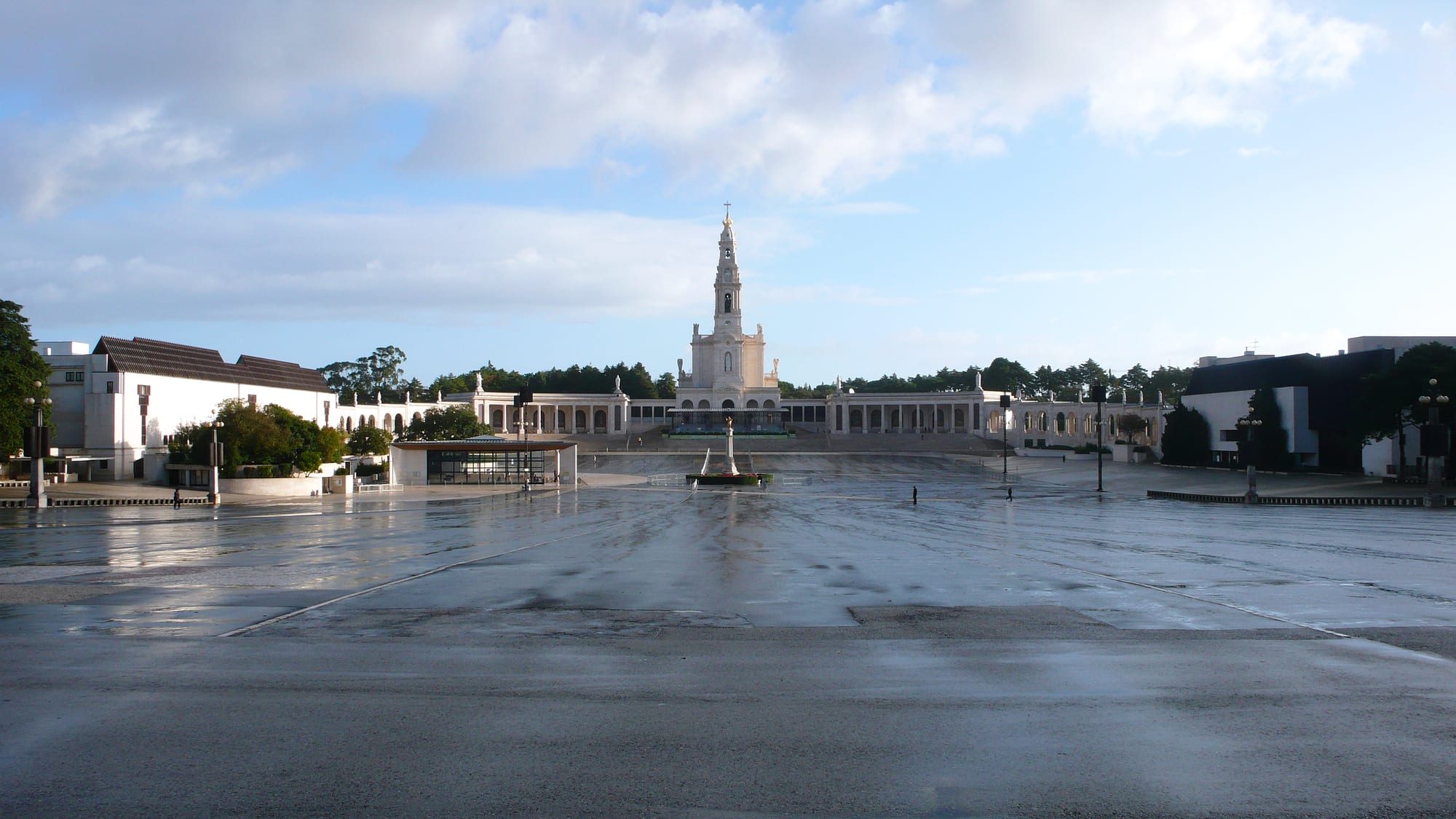
A vast open esplanade, wet after rain, leading to a white basilica with a tall bell tower and curved colonnades

Central Portugal, Portugal

Fátima

The esplanade of the Sanctuary of Fátima, with the Basilica of Our Lady of the Rosary at its far end. (José Luis Filpo Cabana / Wikimedia Commons · CC BY-SA 4.0)

A pilgrimage city on a limestone plateau in central Portugal, in the municipality of Ourém, that grew up around the place where three shepherd children reported visions of the Virgin Mary in 1917. Its vast sanctuary, with two basilicas and the small Chapel of the Apparitions, receives millions of pilgrims a year.

Neighbourhoods

  • Cova da Iria and the sanctuary
    • First-time visitors
    • Pilgrimage
    • Close to public transport

    The hollow where the 1917 apparitions were reported, now covered by the great esplanade of the sanctuary between its two basilicas. The surrounding streets, a few hundred metres from the bus station, are lined with shops selling rosaries and statues, restaurants and pilgrims' lodgings.

    Open in Maps
  • Aljustrel and Valinhos
    • Pilgrimage
    • Quiet and residential
    • Walks

    The small hamlet about a kilometre from Fátima where the three shepherd children were born, with their family houses, and the nearby Valinhos, reached by a Way of the Cross across the plateau.

    Open in Maps
  • The town centre
    • Local life
    • Shopping

    The everyday town beyond the sanctuary, along avenues such as Avenida Dom José Alves Correia da Silva, with cafés, shops and the services of a city of about 10,500 people.

    Open in Maps

Things to do

The sanctuary

  • Chapel of the Apparitionslandmark

    The small chapel first built in 1919 on the exact spot where the children said the Virgin appeared, the spiritual heart of the sanctuary and the scene of daily prayer.

    Open in Maps
  • Basilica of Our Lady of the Rosarylandmark

    The white basilica at the head of the esplanade, consecrated in 1953, with a central bell tower about 65 metres high topped by a bronze crown of 7,000 kg.

    Open in Maps
  • Basilica of the Most Holy Trinitylandmark

    The huge modern church facing the old basilica across the esplanade, dedicated in 2007, with 8,633 seats and a weathered-steel cross about 34 metres high by Robert Schad.

    Open in Maps
  • Berlin Wall segmentlandmark

    A section of the Berlin Wall near the entrance to the sanctuary, placed to express the belief that rosary prayers contributed to its fall.

    Open in Maps

The pilgrims' paths

  • Way of the Cross and Hungarian Calvarytrail

    Stations of the Cross leading to the Hungarian Calvary at Valinhos, traditionally considered an essential walk for pilgrims.

    Open in Maps
  • Houses of the Three Little Shepherdsattraction

    The family homes of Lúcia dos Santos and of Francisco and Jacinta Marto in the hamlet of Aljustrel.

    Open in Maps
  • Life of Christ Museummuseum

    A themed museum of 33 scenes with 210 life-size wax figures portraying the life of Jesus from the Annunciation to the Ascension.

    Open in Maps
  • Wax Museum of Fátimamuseum

    The story of the apparitions told in scenes of wax figures, set in the décor of 1917.

    Open in Maps

Short trips from the town

  • Castle of Ourémlandmark

    The hilltop castle of the municipal seat, a national monument since 1910.

    Open in Maps
  • Aire and Candeeiros Ranges Natural Parkpark

    The limestone ranges near Fátima, the most important limestone deposit in Portugal, with sinkholes and caves.

    Open in Maps
  • Mira de Aireattraction

    A small town in the natural park known for the caves that draw many visitors.

    Open in Maps
  • Monastery of Batalhalandmark

    The great Gothic monastery raised in thanks for the victory at Aljubarrota in 1385, a UNESCO World Heritage Site.

    Open in Maps
  • Convent of Christlandmark

    The Templar stronghold and convent above Tomar, later headquarters of the Order of Christ, which supported the voyages of discovery; also on the UNESCO list.

    Open in Maps

Seasonal events

  • Anniversary pilgrimage of the first apparition13 May

    One of the two largest gatherings of the year, when crowds approaching a million fill the roads to the shrine; May sees the highest numbers of visitors.

  • Anniversary pilgrimage of the last apparition13 October

    The second great pilgrimage, marking the last apparition of 1917 and the 'Miracle of the Sun' reported by many of the crowd that day.

Eat and drink

Long-standing places and food districts in Fátima. Hours, ratings and directions come from your maps app, always current.

Food districts

  • Restaurants of Cova da Irianeighborhood

    Restaurants, cafés and pastelarias serving pilgrims in the streets around the sanctuary.

    Open in Maps
  • Avenida Dom José Alves Correia da Silvaneighborhood

    Restaurants and cafés along one of the town's avenues in Cova da Iria.

    Open in Maps

Experience Fátima

History

The name recalls a Moorish princess, Fátima, who according to tradition was captured by a Christian knight, Gonçalo Hermigues, and later converted. For centuries the parish, founded in 1568, was a rural place on the dry limestone plateau of the Serra de Aire. Marian devotion here predates the famous events: in the 18th century the Virgin was said to have appeared to a mute shepherdess at Ortiga, now part of Fátima, giving rise to a sanctuary there in 1758.

On 13 May 1917, three children — Lúcia dos Santos and her cousins Francisco and Jacinta Marto, from the hamlet of Aljustrel — said they saw a lady dressed in white and shining with light while tending sheep in the Cova da Iria. They reported six apparitions, the last on 13 October, when an estimated 70,000 people gathered and some described the sun moving unusually, the so-called Miracle of the Sun. Francisco died in 1919 and Jacinta in 1920 in the influenza pandemic; Lúcia became a nun and lived until 2005. Local people built a small chapel at the site in 1918 and 1919, and the bishop later declared the apparitions worthy of belief.

Pilgrimage grew rapidly. The Basilica of Our Lady of the Rosary was consecrated in 1953, and during the Second World War Fátima became a focus of prayers for peace. Popes visited from 1967 onwards, John Paul II three times, and Francis canonised Francisco and Jacinta here on 13 May 2017, the centenary of the first apparition. The Basilica of the Most Holy Trinity opened in 2007, and Fátima became a city in 1997.

Culture & Customs

Fátima's culture is its faith. The sanctuary holds several masses a day, and pilgrims arrive on foot from across Portugal, especially for the great anniversaries of 13 May and 13 October. In 2015 the sanctuary recorded about 6.7 million visitors at almost 10,000 celebrations, with May the busiest month.

The message attributed to the apparitions has carried political meaning as well as religious. The prayers linked to Fátima became associated with peace during the Second World War, and a segment of the Berlin Wall stands near the sanctuary entrance to express the belief that rosary prayers influenced its fall. The crown of the statue holds one of the bullets that struck Pope John Paul II in a failed assassination attempt, and popes from Paul VI to Francis have made the journey here; Francis returned in August 2023.

Outside the sanctuary the town is given over to the needs of pilgrims, with streets of shops selling rosaries, statues and candles, and many religious houses and retreat centres. Around it, the walks to Aljustrel and Valinhos keep something of the rural plateau the children knew, with olive trees and oaks.

Daily Life

The city of Fátima had about 10,500 people in 2021 and the wider parish about 13,200. It belongs to the municipality of Ourém in Santarém district; a campaign by local business people to make it a municipality of its own was vetoed by President Jorge Sampaio in 2003.

The economy rests on religious tourism. Shops and stalls selling religious articles and souvenirs line the streets near the sanctuary, and hotels, restaurants and other services depend on the six to eight million visitors who come each year. Beyond tourism the area has marble carving, sawmills, carpentry, construction and commerce.

Life follows the religious calendar. The town is calm on ordinary weekdays, busier at weekends and in summer, and overwhelmed around 13 May and 13 October, when pilgrims arrive on foot from all over the country. The plateau is also water-poor: its porous limestone soil holds little moisture in the dry summer, and the woods of pine and eucalyptus around the city burn in hot, dry spells. In January 2026 Storm Kristin destroyed more than 500 trees at the sanctuary, causing over €2 million of damage.

Food

Fátima's food is that of a pilgrim town. Restaurants, cafés and pastelarias around the sanctuary serve large numbers of visitors quickly, and more line the avenues of Cova da Iria.

Central Portugal's best-known dishes come from elsewhere in the region: leitão à Bairrada, roast suckling pig, is a famous dish of the Bairrada area, and chanfana, old goat marinated in red wine and roasted in a black clay pot, is common across Coimbra district. Many Portuguese desserts began as convent sweets, and Serra da Estrela cheese, made from raw sheep's milk curdled with thistle, is among the country's most famous cheeses.

The wine regions of central Portugal include Bairrada, built on the tannic Baga grape and known for sparkling wine, and the Dão, the origin of the Touriga Nacional vine. The surrounding countryside is olive country, with olive trees among the oaks of the plateau, and an old olive-oil press survives in the parish on the Estrada das Matas.

Planning tools

Budget

Fátima has a very large number of pilgrims' lodgings and simple restaurants, so outside the main pilgrimage dates it is one of the cheaper places to stay in Central Portugal. Prices rise sharply and rooms fill around 13 May and 13 October, and during papal visits.

Daily Budget Midrange
USD 90–180 (mid-range hotel, restaurant dinners, museum tickets, a hire car for the monasteries)
Daily Budget Shoestring
USD 40–75 (pilgrims' guesthouse, set lunches, coaches)

Book months ahead for the May and October pilgrimages; the sanctuary, the basilicas and the walks to Valinhos and Aljustrel are free.

Best Time to Visit

For the experience of the pilgrimages, the days around 13 May and 13 October, when vast crowds gather. For a quieter visit, spring and autumn away from those dates. Summer is warm and dry; late autumn and winter are the wettest seasons on the plateau, with light frosts.

Suggested Number of Days

One day covers the sanctuary and the walk to Aljustrel. Two or three days allow the monasteries, castles and caves around, or time for services and quiet. Pilgrims attending the big anniversary dates often stay longer.

First Visit
1 day
With Surroundings
2–3 days

Transportation

The sanctuary, Valinhos and Aljustrel can all be reached on foot from the town. Buses leave the bus station for other towns, but the monasteries, caves and castles of the surrounding hills are much easier by car.

On the great pilgrimage days, expect heavy traffic and scarce parking near the sanctuary, and allow extra time.

Airport & Station Connections

Coaches run to and from Lisbon in about an hour and a half and Porto in about two and a half hours, at least hourly from dawn to dusk, arriving at the bus station a few hundred metres from the sanctuary. Lisbon's Humberto Delgado Airport is the usual gateway for international visitors.

Walkability

Very good. The sanctuary is a short walk from the bus station along streets of shops and lodgings, and the paths to Valinhos and Aljustrel are pleasant walks across the plateau. The esplanade itself is vast and exposed to sun and rain.

Safety

Portugal is one of the safest countries in Europe, with low violent crime. Fátima is a calm town, but the great pilgrimages bring enormous crowds, with the usual risks of crushes, lost companions and petty theft, and long walks in heat or rain. In dry, hot spells the surrounding woods are at risk of forest fire.

Agree a meeting point with companions on the pilgrimage days, carry water and keep valuables close. Check current official travel advice before travelling.

Climate

A warm-summer Mediterranean climate on a plateau about 356 metres above sea level, higher than the rest of Ourém's parishes, with about 1,150 mm of rain a year, falling mostly in late autumn and winter. Summers are warm, dry and sometimes unpredictable.

Summer
days around 27°C and nights around 15°C, though Atlantic air can hold days to about 22°C and heat from the interior can push them above 35°C
Winter
daytime around 13°C and nights around 4°C in January, with light frosts from late December to mid-February and rare snow

Local Customs

The sanctuary is an active place of worship, with several masses daily in the basilicas and at the Chapel of the Apparitions. Modest dress, quiet behaviour and respect for people praying are expected. Tipping is modest and not obligatory.

Cover shoulders and knees in the basilicas and the chapel, keep phones silent, and avoid photographing people at prayer without permission.

Common Payment Methods

The currency is the euro. Cards and contactless payment are accepted almost everywhere, and Multibanco ATMs are common. Carry some cash for candles, small religious-goods shops and cafés.